Global Market Guide to Mushroom Fruiting Containers 2026
Immediate Guidance for Fruiting Container Planning

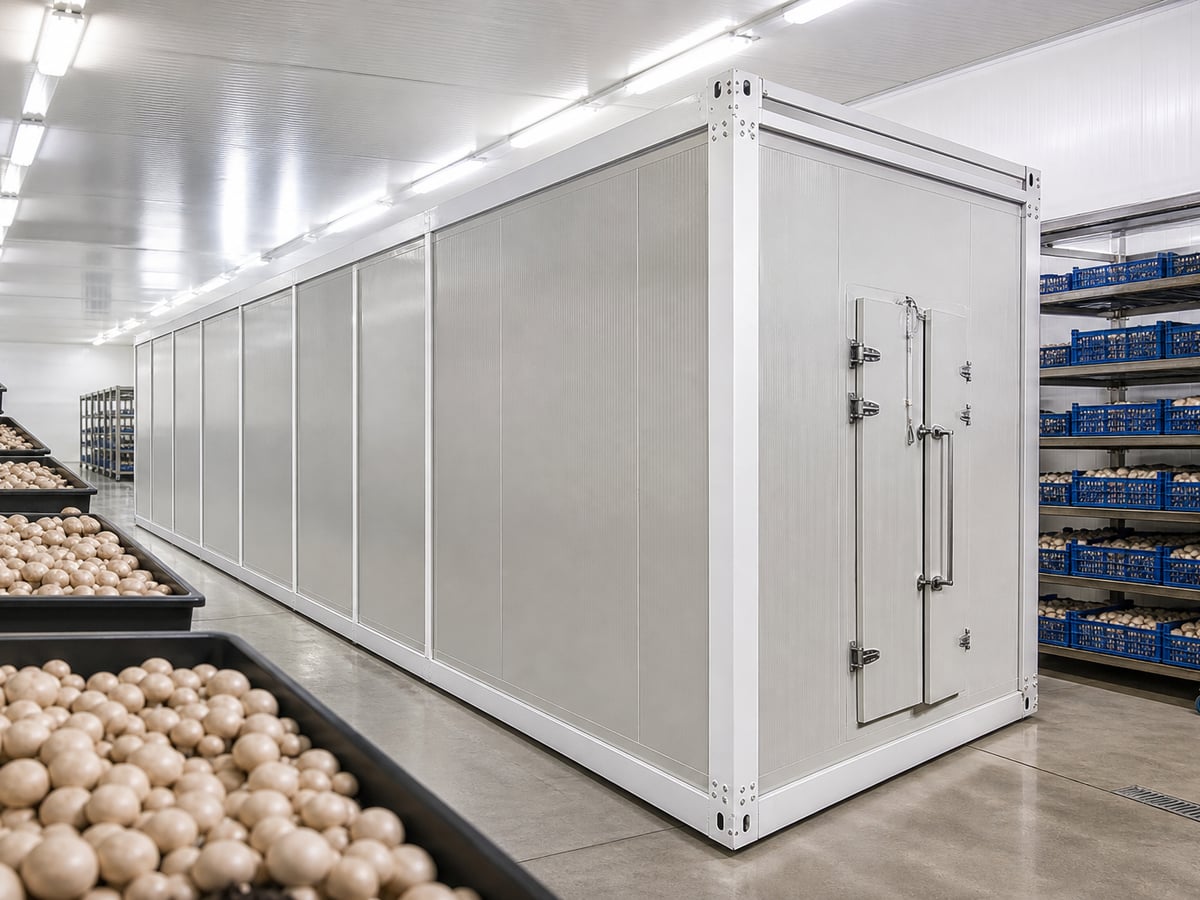
A mushroom fruiting container is a controlled cultivation room designed to take fully colonized substrate blocks from incubation into pinning, mushroom development, harvest, recovery, and the next flush. For growers in the Global Market, the best system is not simply an insulated shipping container with cooling equipment. It is an integrated cultivation environment that controls temperature, fresh air, carbon dioxide, humidity, airflow direction, lighting, drainage, sanitation, and worker access at each stage.
For oyster mushrooms, shiitake, lion’s mane, enoki, king oyster mushrooms, and other commercial varieties, fruiting conditions can change rapidly after blocks are opened or cut. A productive container must respond to biological demand rather than operate at one static temperature and humidity setting. It should remove excess CO2 after pinning begins, maintain high humidity without keeping caps or block surfaces constantly wet, and provide airflow that reaches every production tier without drying the mushrooms.
The most practical buying approach is to select a container based on daily block volume, target species, harvest labor availability, climate at the installation site, power supply, water quality, and cleaning workflow. A grower operating near Rotterdam, Dubai, Singapore, Durban, Los Angeles, São Paulo, or Melbourne may face very different outdoor temperatures, humidity loads, shipping conditions, and utility costs. A properly engineered mushroom fruiting container reduces those local variables through insulation, refrigeration, dehumidification, ventilation, and smart climate controls.
For farms that need an integrated solution, a smart mushroom cultivation container can combine an insulated structure, shelving layout, climate equipment, drainage design, and automated control platform in one modular unit. This approach is especially useful for commercial pilots, distributed farms, restaurants, agricultural projects, and growers expanding without constructing a permanent building.
| Fruiting Requirement | What the Container Should Do | Risk if Poorly Controlled |
|---|---|---|
| Temperature | Maintain species-specific setpoints with stable day-to-night operation. | Slow pinning, malformed mushrooms, reduced yield. |
| Fresh air | Replace stale air while distributing incoming air evenly. | Long stems, small caps, weak mushroom structure. |
| CO2 removal | Use sensors and staged exhaust to manage concentration. | Species-specific morphology defects and inconsistent crops. |
| Humidity | Maintain humid air without continuous water deposition. | Cracking, drying, bacterial blotch, or aborts. |
| Air movement | Prevent stagnant zones without blowing directly onto fruit bodies. | Uneven pinning and dry edges on shelves. |
| Sanitation | Provide washable interiors, drainage, and easy access. | Contamination pressure between production cycles. |
The table shows why fruiting container design is a biological and operational decision. Equipment capacity alone does not guarantee a stable crop. The air must be conditioned, delivered, sensed, and removed in a way that matches the crop density and the physical layout of the growing room.
Core Environmental Factors a Fruiting Container Must Manage

A well-designed fruiting container manages the interaction between the mushroom crop and the room environment. Colonized blocks generate metabolic heat and moisture. As blocks begin to fruit, they also require more oxygen and lower CO2 than during incubation. The container must offset these changing loads while preventing sudden fluctuations caused by door openings, outdoor weather, irrigation cycles, or uneven rack loading.
Temperature is often the first specification buyers discuss, but the most important issue is temperature stability at crop level. A sensor installed close to the evaporator may show an acceptable value while blocks on the upper rear shelves experience warmer, drier conditions. Multiple monitoring points, correctly positioned supply ducts, return-air paths, and calibrated controllers help growers understand what the mushrooms actually experience.
Humidity must be interpreted alongside air temperature and airflow. Warm air can carry more water vapor than cold air, while airflow increases evaporation from exposed mushroom surfaces. A container that produces high humidity readings but directs air too aggressively at blocks may still cause caps to dry. Conversely, a room with fogging equipment but poor extraction can become wet, stagnant, and vulnerable to bacterial problems.
Lanhu’s technological capability is centered on thermodynamic design and integrated environmental control. With more than 12 years of research and development experience in climate systems, the company designs solutions that coordinate cooling, heating, humidification, dehumidification, ventilation, and intelligent sensing. A dedicated mushroom climate controller can help operators manage temperature, humidity, CO2, fan schedules, alarms, and stage-based recipes from one control interface.
| Control Variable | Pinning Priority | Fruiting Priority | Recommended Design Feature |
|---|---|---|---|
| Air temperature | Trigger species-appropriate pin initiation. | Support steady development and cap quality. | Variable-capacity cooling and heating control. |
| Relative humidity | Keep exposed substrate and primordia from drying. | Protect developing mushrooms without condensation. | Fine-mist humidification with sensor feedback. |
| CO2 concentration | Begin reducing concentrations as pins develop. | Maintain morphology appropriate to the species. | CO2 sensor, exhaust fan, and fresh-air damper. |
| Air velocity | Use gentle circulation across loaded racks. | Prevent stagnant zones and surface wetness. | Ducted air distribution and adjustable diffusers. |
| Lighting | Provide consistent exposure where required by species. | Support orientation and harvest visibility. | Moisture-resistant LED lighting. |
| Drainage | Remove condensate and cleaning water promptly. | Keep floors dry and safe for workers. | Sloped floor, drain channels, and sealed connections. |
These variables should not be controlled separately. For example, adding outdoor air lowers CO2 but may introduce hot, cold, humid, or dry air depending on the local climate. The controller should compensate with cooling, heating, or humidification capacity. This is particularly important in coastal regions with high moisture loads, desert regions with dry intake air, and northern climates where winter ventilation can rapidly cool a small container.
How to Prepare Colonized Blocks Before Loading

Fruiting performance begins before blocks enter the container. Colonized substrate should be fully run through, structurally firm, correctly labeled, and inspected for contamination, excess moisture, damaged bags, or incomplete mycelial growth. Loading weak or partially colonized blocks into the fruiting room increases labor, occupies valuable shelf space, and can create avoidable sanitation risks.
Before loading, growers should confirm the species, strain, substrate formula, inoculation date, intended fruiting method, and expected harvest schedule. Different products require different handling. Oyster mushroom bags may be cut with X-shaped slits or side openings. Shiitake blocks may require a rest period, bag removal, soaking, chilling, or a controlled shock depending on the strain and production method. Lion’s mane is often fruited through a carefully sized opening to maintain form and reduce unnecessary drying.
Blocks should be transferred using clean carts, clean gloves, and a defined movement route. Avoid bringing incubation-room debris, damaged packaging, or unwashed tools into the fruiting area. In larger facilities, the loading process should follow a one-way flow from incubation to fruiting to harvest to waste handling. This reduces the chance of moving contaminants backward into cleaner zones.
| Loading Step | Operator Check | Why It Matters |
|---|---|---|
| Block inspection | Confirm complete colonization and no visible contamination. | Prevents weak blocks from occupying productive space. |
| Lot identification | Record species, strain, date, and rack location. | Supports traceability and yield analysis. |
| Bag preparation | Cut, open, remove, or shock according to the crop recipe. | Creates a uniform fruiting trigger. |
| Rack spacing | Leave adequate gaps between blocks and shelves. | Improves air delivery and harvest access. |
| Climate preconditioning | Stabilize the room before blocks arrive. | Reduces stress caused by sudden environmental change. |
| Loading records | Document quantity, time, batch, and expected first harvest. | Helps schedule labor and forecast sales. |
Container loading density should be determined by climate capacity, not only by physical shelf volume. A tightly packed container may hold more bags, but it also increases metabolic heat, moisture release, CO2 generation, and obstruction of airflow. A buyer should ask suppliers for recommended loading densities for the intended species and local design conditions rather than relying on a single nominal block capacity.
Climate Adjustments from Pinning to Full Fruiting
Pinning and fruiting are connected but distinct biological stages. During pinning, the crop needs conditions that encourage primordia formation and retain small developing pins. During full fruiting, mushrooms need stable conditions that support size, cap development, density, color, texture, and shelf life. A container operated with one fixed recipe through both stages may produce acceptable crops, but stage-specific control usually improves consistency.
For many oyster mushroom varieties, the transition toward fruiting involves more fresh air, lower CO2, appropriate light exposure, and carefully maintained humidity. However, exact targets vary by strain, substrate, market preference, and local production experience. King oyster mushrooms are commonly managed differently from blue oyster mushrooms, while shiitake and lion’s mane each have their own temperature and humidity sensitivities. Buyers should request configurable recipes rather than a controller with rigid, generic settings.
Crop load changes over time. A newly loaded room may have high block density but limited mushroom surface area. Later, a heavy fruiting flush can dramatically increase evaporation and fresh-air demand. Smart controls should allow separate schedules for pinning, fruiting, recovery, night operation, and emergency ventilation. Historical trend data can help growers identify why one flush performed differently from another.
In the Global Market, producers increasingly use digital crop recipes to standardize production across cities and sites. A grower in Hamburg can use the same core production logic as a grower in Nairobi or Vancouver while adjusting equipment capacity and intake-air treatment for local climate conditions. This is valuable for franchise farms, regional distributors, and commercial projects supplying restaurants, supermarkets, and food-service customers.
Fresh-Air Exchange and Carbon Dioxide Reduction
Fresh-air management is one of the defining functions of a mushroom fruiting container. Mycelium and fruit bodies respire continuously, releasing CO2. As CO2 builds up, mushroom form changes. Oyster mushrooms may develop longer stems and smaller caps, while other species can show different quality effects. The objective is not simply to run an exhaust fan continuously; it is to maintain an appropriate CO2 range while preserving temperature and humidity stability.
A practical ventilation system includes a CO2 sensor located where it reflects crop-zone conditions, a fresh-air intake path, exhaust capacity, controlled dampers, filtration where needed, and air circulation that distributes fresh air across all racks. Exhaust placement should prevent short-circuiting, where incoming air is immediately removed before it reaches the crop. Likewise, supply air should not create harsh jets directly across fruiting surfaces.
Outdoor air quality should be considered during project planning. Farms near busy roads, industrial zones, ports, or dusty agricultural areas may require improved intake filtration. Projects near the Port of Shanghai, Jebel Ali, Antwerp-Bruges, Long Beach, or major logistics corridors should evaluate dust, salt air, fuel emissions, and seasonal weather conditions. The right intake design protects the crop while reducing cleaning requirements inside the container.
| Ventilation Situation | Recommended Response | Operational Result |
|---|---|---|
| CO2 rises after loading | Increase staged fresh-air exchange and verify sensor accuracy. | Supports the transition from incubation conditions. |
| Upper racks fruit poorly | Check duct balance and return-air circulation. | Improves climate uniformity throughout the room. |
| Caps dry after ventilation | Reduce direct air velocity and coordinate humidification. | Maintains quality while retaining gas control. |
| Outdoor air is very hot | Use adequate cooling capacity and controlled intake cycles. | Prevents heat spikes during ventilation. |
| Outdoor air is very cold | Use heat recovery or staged ventilation where appropriate. | Reduces heating demand and temperature shocks. |
| External air is dusty | Use serviceable intake filtration and scheduled inspection. | Protects crop surfaces and internal equipment. |
CO2 management also affects energy costs. Over-ventilation wastes conditioned air; under-ventilation compromises quality. Automated sensor-based control is usually more efficient than relying only on fixed fan timers, particularly when crop density changes from one flush to the next. Operators should still verify readings with periodic calibration and visual crop assessment.
Maintaining Humidity Without Constant Surface Moisture
High humidity is essential for many fruiting mushrooms, but persistent water on caps, stems, block openings, walls, and floors is not desirable. Wet surfaces can encourage bacterial blotch, promote uneven development, create slippery floors, and increase sanitation work. The goal is humid air with controlled evaporation, not a permanently wet room.
Humidification methods may include ultrasonic systems, high-pressure misting, fogging systems, or other finely atomized approaches. The most suitable method depends on container size, water quality, ambient climate, refrigeration design, airflow pattern, and species. Regardless of the equipment selected, droplets should have time to evaporate into the air rather than settling heavily onto crops.
Water treatment and maintenance are equally important. Mineral-rich water can clog nozzles and leave deposits. Poorly maintained reservoirs or pipes can become microbial reservoirs. Buyers should ask about filtration, cleaning access, drain-down procedures, replacement parts, and water-quality recommendations. In hard-water areas, a treatment strategy can protect humidification equipment and maintain reliable output.
Humidity sensors must be placed away from direct mist discharge and away from locations where condensation produces false readings. Several sensors across the room may be useful in larger or densely loaded containers. The operator should also observe mushroom surfaces, block edges, floor conditions, and wall condensation because visual inspections complement digital data.
Harvest Access Through Repeated Flushes
A fruiting container should support harvesting as efficiently as it supports climate control. Commercial mushrooms are often harvested over multiple flushes, requiring workers to enter the room repeatedly, inspect blocks, remove mature clusters, trim stems, collect waste, and monitor new pins. A poorly planned rack arrangement can make these daily tasks slow, unsafe, and damaging to the crop.
Rack depth, aisle width, shelf height, door position, lighting, and collection-cart access should be considered before production begins. Shelves that are too deep create unreachable blocks and airflow shadows. Narrow aisles can improve nominal capacity but limit worker movement and make it harder to harvest without brushing mushrooms. The optimum layout balances block count with labor productivity, airflow, and cleaning access.
Harvest timing strongly influences yield quality and market value. Mushrooms should be harvested at the stage requested by local buyers, whether that means tighter caps for long-distance transport or more developed caps for nearby restaurants and farmers’ markets. In cities such as London, Toronto, Tokyo, Paris, and Sydney, premium fresh mushroom customers often value visual consistency, firmness, cleanliness, and reliable delivery windows.
Batch records should include first pin date, first harvest date, flush yield, rejected product, labor hours, and observed climate conditions. These records make it possible to compare strains, substrate suppliers, room recipes, and seasonal operating costs. Over time, the container becomes a measurable production system rather than a simple growing space.
Sanitation Procedures Before Loading Another Batch
Cleaning between batches protects future production and extends equipment life. After the final planned flush, spent blocks should be removed promptly and transferred through a controlled waste route. The container should then be emptied of loose debris, washed according to farm sanitation procedures, rinsed where appropriate, dried, inspected, and prepared for the next loading cycle.
Interior wall panels, shelving, floor drains, door seals, humidification lines, fan guards, drain pans, sensors, and air filters all require attention. Organic residues can collect in corners, beneath racks, around drains, and behind equipment panels. A container designed with washable surfaces, sealed joints, corrosion-resistant materials, drainage slope, and accessible service points reduces the time required to complete this work.
Lanhu’s manufacturing capability supports this practical requirement through integrated product design, engineering development, sheet metal fabrication, CNC bending, insulation-panel production, electrical assembly, system integration, testing, and quality inspection. The company operates a modern manufacturing facility exceeding 30,000 square meters in Dezhou, Shandong, allowing key components and finished modular systems to be coordinated through a controlled production process.
Before shipment, functional inspection, electrical verification, performance testing, and operational evaluation help confirm that equipment is ready for installation. This manufacturing discipline is relevant for overseas buyers who need dependable container systems shipped through trade hubs such as Qingdao, Tianjin, Ningbo, Rotterdam, or Dubai. Durable construction and accessible components are particularly valuable when replacement lead times may be longer for international projects.
| Cleaning Area | Between-Batch Action | Reason for the Procedure |
|---|---|---|
| Spent blocks and bags | Remove promptly using a designated waste path. | Reduces pest and contamination pressure. |
| Racks and shelves | Brush, wash, sanitize, rinse if required, and dry. | Eliminates organic residue from crop contact surfaces. | Floor and drains | Clear debris, flush drains, and inspect drainage flow. | Prevents standing water and odor buildup. |
| Humidification system | Clean reservoirs, lines, filters, and nozzles. | Maintains water hygiene and misting performance. |
| Air-handling equipment | Inspect filters, coils, fans, and drain pans. | Protects airflow capacity and energy efficiency. |
| Sensors and controls | Check calibration, wiring, alarms, and stored recipes. | Ensures the next batch starts with reliable data. |
The cleaning table should become part of a written standard operating procedure. Farms with multiple containers benefit from a consistent release checklist confirming that the room is clean, dry, mechanically sound, and climate-stable before new blocks are introduced.
Our Company and Global Project Support
Shandong Lanhu Air Conditioning Equipment Co., Ltd. supplies agricultural climate-control equipment, industrial HVAC solutions, and modular cultivation systems for customers across the Global Market. Its product range includes smart mushroom cultivation containers, climate controllers, hydroponic plant containers, and air source heat pumps. The company’s experience supports projects ranging from small commercial trials to larger cultivation installations for agricultural contractors, equipment distributors, engineering companies, and commercial farms.
Lanhu’s service capability is designed around the practical needs of international buyers. Factory-direct supply can simplify product communication and configuration, while OEM and ODM options allow customers to adapt container dimensions, rack layouts, electrical standards, climate recipes, branding, and auxiliary equipment to project requirements. Learn more about available OEM and ODM cultivation equipment services for specialized commercial applications.
Project support can include engineering assistance, international logistics coordination, spare-parts support, installation guidance, and after-sales service. For buyers preparing sites in Africa, Europe, the Middle East, Southeast Asia, Oceania, or the Americas, early planning should address delivery route, foundation requirements, crane access, electrical connection, water supply, drainage, local permits, and operator training.
Lanhu holds ISO 9001, ISO 14001, ISO 45001, and ISO 12100 certifications, alongside patent certificates and enterprise credibility credentials. With more than 45 registered patents, the company continues to develop integrated climate solutions that improve operating control and modular farm deployment. Prospective customers can review practical deployment examples through the mushroom cultivation project case studies.
For buying decisions, compare suppliers on more than container appearance. Ask for climate design assumptions, insulation specifications, cooling and heating capacity, humidity method, CO2 strategy, control functions, electrical drawings, spare-parts list, warranty terms, remote-support process, cleaning access, and commissioning guidance. Local suppliers may provide fast on-site response, while an experienced manufacturer can offer stronger customization and integrated production capability. The best choice depends on the project’s technical complexity and long-term service plan.
Looking toward 2026, mushroom container design is moving toward connected sensors, remote diagnostics, variable-speed equipment, energy monitoring, automated crop recipes, lower-water humidification methods, and better insulation performance. Sustainability expectations are also increasing. Buyers are evaluating refrigerant choices, renewable-energy compatibility, heat recovery, water reuse where safe and permitted, and efficient logistics. Food-security policies, urban agriculture programs, and controlled-environment agriculture incentives may further support modular mushroom projects in many regions.
Frequently Asked Questions About Fruiting Containers
What size mushroom fruiting container should a new commercial farm choose?
Start with your expected weekly block volume, crop cycle length, number of flushes, labor capacity, and sales channel. A smaller modular container can be a practical first step because it allows recipe development and market validation before expansion. Do not choose capacity only by the maximum number of bags that can physically fit inside.
Can one container fruit several mushroom species?
It is possible when species have compatible environmental requirements, but dedicated rooms usually provide better consistency. Oyster mushrooms, shiitake, lion’s mane, and king oyster mushrooms may need different temperature, CO2, humidity, lighting, or fruiting triggers. Separate recipes and careful scheduling are essential when sharing a container.
How is CO2 controlled in a mushroom fruiting container?
CO2 is managed through sensors, programmable ventilation, exhaust fans, fresh-air intake, and air circulation. The system should increase air exchange when crop respiration raises CO2 while avoiding unnecessary temperature and humidity losses.
Why are mushrooms wet even when the humidity setting seems correct?
The cause may be oversized droplets, poor humidifier placement, weak air circulation, condensation from cold surfaces, excessive misting time, or inadequate drainage. Relative humidity readings alone do not reveal whether water is depositing on mushroom surfaces.
What should buyers ask about after-sales support?
Ask about installation guidance, remote troubleshooting, spare-parts availability, electrical documentation, controller training, warranty coverage, recommended maintenance intervals, and response procedures for refrigeration, ventilation, or sensor issues. These points are especially important for international installations.
What 2026 trends should mushroom growers consider?
Key trends include remote environmental monitoring, predictive maintenance, digital batch records, energy-efficient inverter systems, enhanced insulation, lower-carbon equipment choices, water-management improvements, and modular farms located closer to urban food markets. These developments can help growers improve traceability, reduce waste, and respond more quickly to changing demand.
Share this article

About the Author: Shandong Lanhu Air Conditioning Equipment
Lanhu is a professional climate control equipment manufacturer specializing in smart agricultural systems, commercial HVAC solutions, and customized temperature control technologies. With extensive engineering experience, Lanhu provides reliable solutions for plant factories, controlled environment agriculture, and industrial applications.
Need a Custom Climate Control Solution?
From smart agricultural systems to commercial HVAC solutions, Lanhu provides reliable temperature and humidity control solutions tailored to your project needs.
Contact Us