Global Market Guide to Mushroom Container Automation
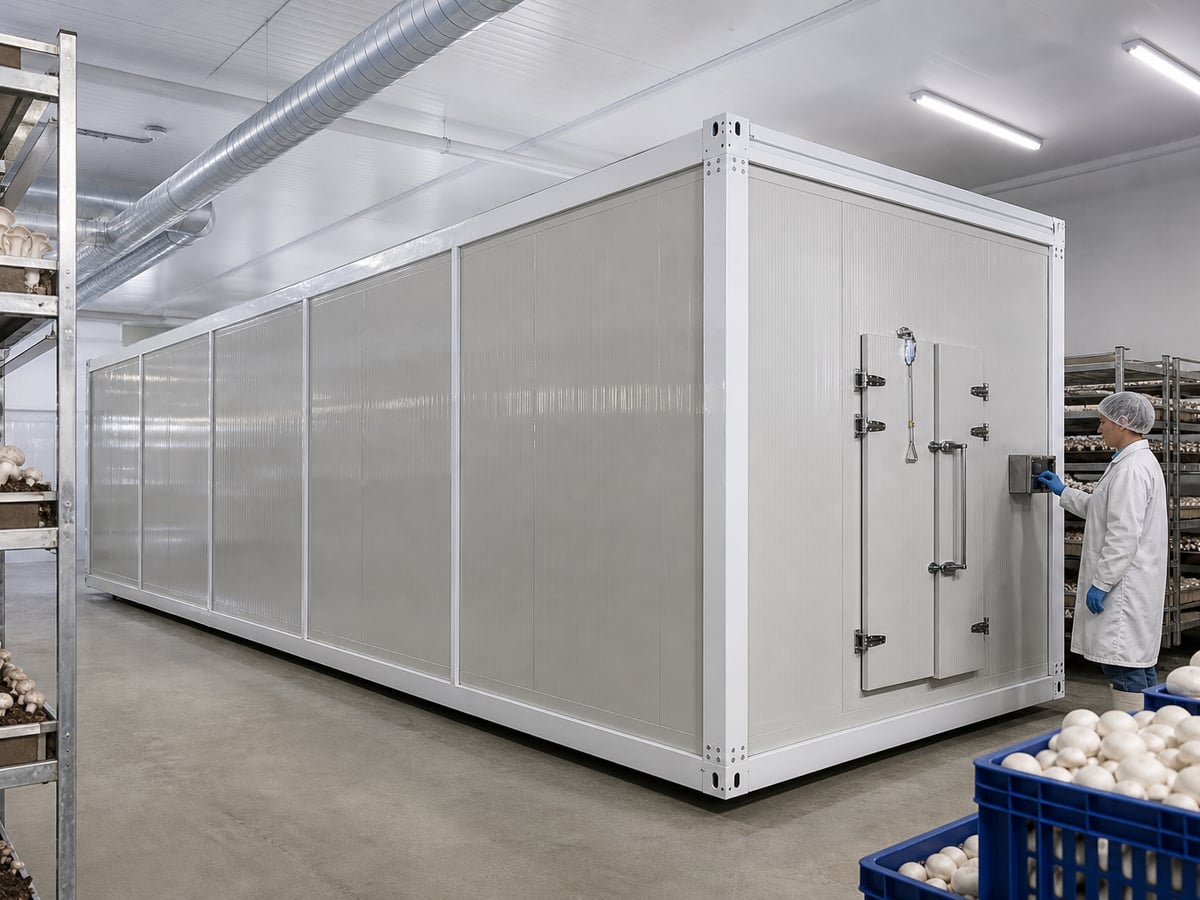
Fast Overview of Automated Climate Control

Smart mushroom cultivation containers can automate many repeatable environmental tasks in the Global Market, including temperature control, humidification, dehumidification, fresh-air exchange, CO2 management, fan operation, damper positioning, lighting schedules, data recording, and fault notifications. These controls can keep a container closer to the environmental targets required by each mushroom species and crop stage.
However, automation does not replace the grower. A reliable system supports the grower by maintaining stable setpoints, reducing response time, recording operating data, and raising alarms when conditions move outside acceptable limits. Crop observation, disease recognition, substrate assessment, harvesting decisions, sanitation, and recovery after severe failures still require trained people.
For commercial farms, contractors, and equipment distributors, the most valuable automation strategy is usually not “fully unattended growing.” It is a practical combination of dependable control loops, clear manual override functions, remote monitoring, preventive maintenance, and operating procedures that local teams can follow. This approach is relevant for container farms shipped through global trade hubs such as Shanghai, Rotterdam, Dubai, Singapore, Los Angeles, and Santos.
Climate Functions That Are Suitable for Automation

Mushroom cultivation containers are controlled growing spaces where outdoor weather can change rapidly while the crop needs a relatively stable indoor environment. Automation is especially useful for climate tasks that are measurable, repetitive, and connected to controllable equipment. Sensors collect environmental data, a climate controller compares actual values with target values, and outputs activate equipment such as compressors, heaters, evaporator fans, humidifiers, fresh-air fans, dampers, and lights.
The strongest automation candidates are temperature, relative humidity, CO2 concentration, air exchange, lighting time, pressure balance, and equipment status monitoring. A well-designed controller can also log trends that help growers identify why a yield, flush uniformity, or quality result changed from one production cycle to another.
Different mushroom species and substrate systems require different control programs. Oyster mushrooms, shiitake, lion’s mane, enoki, button mushrooms, and medicinal mushrooms may use different temperature ranges, CO2 levels, air movement patterns, light requirements, and humidification strategies. Therefore, a container should use configurable recipes rather than one fixed program.
| Climate Task | Typical Automated Equipment | Primary Sensor Input | Why Automation Helps | Grower Verification Needed |
|---|---|---|---|---|
| Cooling and heating | Heat pump, refrigeration unit, heater, circulation fan | Air temperature sensor | Maintains crop-stage temperature targets day and night | Check sensor accuracy and crop response |
| Humidification | Ultrasonic humidifier, high-pressure fogger, solenoid valve | Relative humidity sensor | Reduces drying of primordia and fruiting bodies | Inspect for condensation and wet caps |
| Dehumidification | Cooling coil, heat recovery unit, exhaust fan | Humidity and dew-point data | Controls excessive moisture and condensation risk | Confirm surfaces remain clean and dry enough |
| CO2 management | Fresh-air fan, exhaust fan, modulating damper | NDIR CO2 sensor | Supports morphology and respiration management | Assess stem length, cap shape, and crop density |
| Lighting schedule | LED grow lights, timer, relay panel | Program clock or crop recipe | Provides repeatable photoperiods where required | Verify light intensity and fixture cleanliness |
| Alarm monitoring | Controller, SMS gateway, remote dashboard | All critical sensors and equipment status signals | Speeds up response to out-of-range conditions | Follow recovery procedures and investigate causes |
The table shows that automation is most effective where a sensor can provide reliable feedback and the system has a safe method of correction. It also shows why visual crop inspection remains necessary. Sensors can measure air conditions, but they cannot fully judge cap texture, abnormal mycelium growth, bacterial blotch, insect activity, substrate contamination, or harvesting maturity.
Market Demand and Product Categories
Across the Global Market, automated mushroom containers are used by commercial mushroom farms, agricultural investors, university research facilities, hospitality suppliers, food-security projects, rural development programs, and controlled-environment agriculture contractors. Demand is growing in regions where climate variability, limited farmland, high labor costs, difficult site conditions, or long transport distances make conventional mushroom houses less practical.
Container systems are commonly supplied as fruiting containers, incubation containers, multi-stage modular units, mobile trial units, and integrated farms with several connected containers. A project in a hot coastal city such as Dubai may prioritize heat rejection and insulation performance, while an installation near Rotterdam, Hamburg, Toronto, or Seoul may prioritize winter heating capacity, condensate control, and energy-efficient ventilation. Projects in Nairobi, São Paulo, Jakarta, and Manila may also require designs suited to local voltage, humidity, logistics, and maintenance capabilities.
Temperature and Humidity Feedback Loops

Temperature and humidity are the core climate control loops in a mushroom container. A feedback loop begins with a correctly located sensor. The controller reads the air condition, compares it with the programmed setpoint and deadband, then starts or modulates equipment to move the environment back toward the target. The system repeats this process continuously.
For temperature, the controller may activate cooling when the air rises above the upper limit and activate heating when the air falls below the lower limit. To avoid rapid switching that can shorten equipment life, control logic normally uses deadbands, minimum run times, compressor protection delays, and staged capacity control. Larger systems may use variable-speed fans, electronic expansion valves, inverter compressors, or air source heat pumps for more stable operation.
Humidity control needs more careful design because water vapor, fresh air, cooling coils, crop respiration, and surface condensation all interact. Adding moisture when relative humidity is low may be simple, but removing moisture without causing excessive cooling can be more complex. An integrated system can coordinate cooling, reheat, ventilation, and humidification instead of allowing each device to operate independently.
| Crop Stage | Control Priority | Temperature Control Approach | Humidity Control Approach | Important Observation |
|---|---|---|---|---|
| Container pre-cooling | Stabilize empty room conditions | Run cooling or heating before substrate loading | Confirm humidifier and drain operation | Check for leaks, condensation, and uneven airflow |
| Incubation | Uniform substrate temperature | Control air temperature without overcooling blocks | Maintain conditions appropriate to the substrate system | Watch for overheating within densely packed material |
| Pinning initiation | Trigger consistent fruiting conditions | Apply programmed temperature changes gradually | Maintain high humidity without surface water | Inspect pin distribution across shelves |
| Early fruiting | Prevent pin drying | Maintain stable air temperature and circulation | Use short, controlled humidification cycles | Look for dry edges or water droplets on caps |
| Harvest development | Protect quality and morphology | Limit heat buildup from crop respiration and lights | Balance moisture with disease prevention | Check firmness, color, and cap opening |
| Post-harvest reset | Prepare for the next flush or sanitation | Return to recipe-specific recovery conditions | Dry or humidify according to cleaning procedures | Inspect drains, coils, filters, and internal surfaces |
The table emphasizes that climate targets should not be treated as permanent values. Each crop stage has a different objective. During pinning, for example, growers may prioritize uniform initiation; during later development, they may focus on fruit body quality, controlled evaporation, and prevention of condensation-related disease.
Sensor placement is equally important. A temperature and humidity sensor installed directly in the path of a humidifier nozzle, supply-air outlet, heater discharge, exterior door, or cold wall may not represent the crop zone. Commercial installations often use protected sensors placed at representative shelf height, away from direct water spray and strong supply-air streams. Larger containers may benefit from multiple sensors or zone-based monitoring.
For buyers considering a smart mushroom climate controller, important questions include sensor calibration access, control accuracy, historical data storage, remote communication options, alarm configuration, manual override capability, and compatibility with local electrical systems.
CO2-Controlled Fans and Dampers
CO2 concentration is a key variable in mushroom production because mushrooms respire continuously and can rapidly increase CO2 levels in a tightly sealed container. The acceptable concentration depends on the species and the growth stage. High CO2 may be useful or tolerated in some phases, but excessive CO2 during fruiting can lead to undesirable morphology, elongated stems, reduced cap development, lower air freshness, and inconsistent crops.
Automation usually relies on an NDIR CO2 sensor connected to a controller. When CO2 rises above the upper setpoint, the controller can open a fresh-air damper, start an exhaust fan, increase variable-speed fan capacity, or use a coordinated intake-and-exhaust sequence. Once the CO2 value returns to the desired range, the controller reduces ventilation to avoid unnecessary energy loss and humidity disturbance.
Fresh air should not be treated as an isolated function. Outdoor air can be very hot, cold, dry, humid, dusty, smoky, or contaminated. In regions with high summer heat, such as the Gulf, northern Australia, inland India, or parts of Mexico, frequent ventilation can significantly increase cooling demand. In cold locations such as Northern Europe, Canada, or northern China, uncontrolled fresh-air intake can increase heating demand and create dry air conditions. Proper dampers, filtration, insulation, and control sequencing are therefore important.
| CO2 Condition | Automatic Response | Energy Consideration | Humidity Consideration | Manual Check |
|---|---|---|---|---|
| Below minimum target | Reduce fresh-air rate or close modulating damper | Avoid unnecessary fan energy use | Prevents excessive drying from outside air | Confirm sensor has not drifted low |
| Within target band | Maintain minimum ventilation and circulation | Use low-speed fan operation where possible | Maintain stable moisture balance | Observe even crop development |
| Slightly above target | Increase fresh-air fan speed or damper opening | Use staged ventilation before full capacity | Prepare humidification compensation if needed | Inspect air paths for blockages |
| High CO2 alarm level | Run enhanced exhaust and intake sequence | Accept temporary energy increase for crop protection | Monitor for sudden humidity decline | Check fan operation and crop density |
| Sensor fault signal | Switch to safe backup ventilation strategy | Use time-based temporary mode only when necessary | Avoid prolonged over-ventilation | Calibrate or replace the CO2 sensor |
| Power recovery event | Restart equipment in programmed sequence | Prevent all loads starting simultaneously | Re-establish air exchange before intensive misting | Review alarm log and crop condition |
This control sequence helps buyers understand why CO2 automation should include more than a simple on/off exhaust fan. Modulating dampers, variable-speed fans, alarm thresholds, sensor calibration plans, and backup rules can improve stability and reduce wasted energy. The design should also prevent unfiltered outside air, insects, and rainwater from entering the cultivation area.
Lighting Programs for Each Crop Stage
Lighting automation is generally simpler than temperature or humidity control, but it is still valuable for production consistency. Some mushrooms require light as a developmental signal, while others need limited or no light during particular phases. Programmable LED lighting allows growers to set photoperiods, light intensity, switching times, and crop-specific recipes.
Lighting schedules should account for the mushroom species, room layout, shelf depth, fixture distance, worker access, and heat load. LEDs are commonly preferred because they offer long service life, lower heat output than traditional lamps, and the ability to use timers or controller-based programs. Lights should be sealed or appropriately rated for humid conditions and positioned so they can be cleaned safely.
Automation can also provide work-light modes. During harvesting, inspection, loading, cleaning, or maintenance, staff may require brighter lighting than the crop schedule normally provides. A controlled manual override allows workers to activate task lighting without permanently changing the crop recipe.
Buying Advice for Lighting and Climate Integration
When selecting an automated container, buyers should confirm whether the lighting system is integrated into the climate controller or operates on a separate timer. Integrated systems can record lighting status in the same dashboard as temperature, humidity, CO2, and equipment alarms. This makes troubleshooting easier, particularly for remote farms and multi-container projects.
Ask suppliers whether the electrical panel includes separate protection for lights, humidifiers, fans, refrigeration equipment, and sockets. A fault in one circuit should not unnecessarily stop the entire container. For export projects, verify voltage, frequency, plug standards, breaker ratings, local electrical codes, and the availability of replacement LED drivers.
Fault Alerts and Manual Recovery Procedures
Automated systems should be designed around the expectation that failures can occur. Power interruptions, sensor drift, water shortages, drainage blockage, refrigerant faults, fan failures, communication outages, and door-left-open events can all affect crop conditions. A strong fault strategy combines alarms, backup operating rules, manual control access, clear labeling, and trained staff.
Alarm notifications may be sent through a local buzzer, indicator light, touchscreen display, SMS message, email, cloud dashboard, or mobile application. Not every alarm should have the same priority. A brief temperature deviation may require observation, while a high-temperature alarm during a heatwave or a refrigeration shutdown could require immediate action.
| Fault Event | Suggested Alarm Priority | Automatic Protective Action | Manual Recovery Step | Preventive Measure |
|---|---|---|---|---|
| Main power failure | Critical | Send outage alert and preserve controller settings | Start generator or restore supply safely | Install backup power plan and surge protection |
| High temperature | Critical | Start cooling sequence and high-temperature alarm | Check compressor, doors, condenser, and ambient conditions | Clean condenser and test alarm response |
| Low humidity | High | Activate humidification within safety limits | Check water source, nozzle, pump, and mist output | Clean filters and inspect water quality |
| High CO2 | High | Increase ventilation and open damper | Check exhaust fan, intake path, and sensor reading | Maintain fans and calibrate sensors |
| Drain blockage | High | Limit humidification if water accumulation is detected | Clear drain line and sanitize affected area | Schedule drain cleaning between cycles |
| Sensor communication loss | High | Use programmed safe mode and send fault alert | Inspect wiring, connectors, and sensor module | Keep spare sensors and protect cables from moisture |
The table demonstrates why alarm systems must be paired with recovery procedures. An alert alone does not protect the crop if nobody knows which breaker, valve, fan, drain, or controller setting should be checked first. Each site should maintain a simple operating manual in the local working language, including emergency contacts, equipment diagrams, daily inspection steps, and escalation rules.
Manual mode is not a weakness in an automated container. It is a necessary safety feature. Authorized personnel should be able to operate key fans, humidifiers, lights, and climate equipment during troubleshooting. At the same time, manual controls should be protected from accidental activation and should clearly show whether the system is in automatic, off, or manual operation.
Growing Tasks That Still Require Skilled People
Automation can control air conditions, but mushrooms are biological crops. Skilled growers remain responsible for interpreting what the crop is showing. They determine whether a climate recipe is working, whether a flush is uniform, whether substrate quality is acceptable, and whether a change in morphology comes from climate, genetics, contamination, watering practice, nutrition, or handling.
Human expertise is especially important for receiving substrate or spawn, evaluating bag or block condition, arranging shelves, monitoring mycelial health, identifying contamination, adjusting harvest timing, grading produce, cleaning equipment, and deciding whether a room should be isolated after a disease issue. Workers also manage food safety, traceability, packing, cold-chain transfer, and customer quality requirements.
In high-value markets such as Japan, Singapore, Germany, the United Arab Emirates, the United Kingdom, and major North American cities, buyers may expect uniform packaging, reliable supply, clean appearance, and documented production practices. Automation can support these goals through stable climate records, but it cannot replace trained crop management and quality assurance.
Applications and Industries Served
Automated mushroom containers can support fresh mushroom production near cities, specialty mushroom farms, restaurant supply programs, agricultural demonstration centers, research institutions, food-security projects, remote mining or camp catering, and modular farm developments. They can also help distributors supply packaged cultivation solutions to local entrepreneurs.
For urban applications, containers can be placed near distribution zones around London, Dubai, Johannesburg, Sydney, Vancouver, Lima, or Bangkok, reducing the distance between production and customers. For rural applications, modular units can support decentralized production where land is available but climate-controlled buildings are limited. The right configuration depends on crop volume, utility capacity, labor skills, water quality, local climate, and access to substrate.
Verifying Automation Before Loading Crops
Automation should be tested before substrate, bags, blocks, shelves, or growing materials are loaded into the container. Empty-room commissioning is one of the most effective ways to identify wiring issues, sensor errors, incorrect equipment rotation, airflow imbalance, drain problems, and control logic conflicts without risking a crop.
A complete test should include heating, cooling, humidification, dehumidification, fresh-air intake, exhaust operation, damper movement, lighting control, CO2 sensor response, water supply, drainage, alarms, remote access, and manual override. The system should also be tested during simulated faults, such as disconnecting a sensor, opening the door, stopping a fan, or interrupting a water supply.
| Pre-Loading Test | What to Verify | Acceptance Result | Risk if Ignored | Recommended Record |
|---|---|---|---|---|
| Temperature pull-down test | Cooling capacity and temperature stability | Container reaches target within planned time | Heat stress after crop loading | Time-to-setpoint log |
| Heating test | Heating response and electrical protection | Stable recovery without breaker trips | Cold damage in winter operations | Heating run report |
| Humidity test | Humidifier output and sensor feedback | Humidity rises without pooling water | Dry pins or excessive condensation | Humidity trend graph |
| CO2 response test | Sensor, fan, and damper coordination | Ventilation activates at programmed threshold | Misshapen fruiting bodies | CO2 alarm verification sheet |
| Drainage test | Condensate and wash-water discharge | Water flows freely to designated outlet | Standing water and hygiene problems | Drain inspection checklist |
| Alarm and remote test | Notification delivery and user access | Alarm reaches responsible staff promptly | Delayed response to equipment failure | Contact and escalation test record |
These tests should be documented because they create a baseline for future service. If a container later struggles to maintain temperature or humidity, technicians can compare current performance with the original commissioning results. This is particularly helpful for international installations where equipment may travel from a Chinese manufacturing site through Qingdao or Shanghai ports to customers in Africa, Europe, the Middle East, Oceania, or the Americas.
Before crop loading, operators should also check hygiene. Internal wall panels, shelving, floor drains, humidification components, filters, doors, seals, and condensate trays should be cleaned and inspected. A technically advanced controller cannot compensate for poor sanitation or contaminated substrate.
About Lanhu Climate Equipment
Shandong Lanhu Air Conditioning Equipment Co., Ltd. supports commercial controlled-environment agriculture projects with integrated climate-control and modular cultivation equipment. Its solutions are designed for customers seeking factory-direct equipment for mushroom production, hydroponic growing, agricultural engineering, and climate-managed container applications across the Global Market.
Technological Capabilities
Lanhu develops smart cultivation solutions based on more than 12 years of thermodynamic research and development experience. Its product range includes smart mushroom cultivation containers, mushroom climate controllers, hydroponic plant containers, and air source heat pumps. The company’s technical focus includes coordinated temperature, humidity, ventilation, CO2, and lighting control, helping customers create configurable climate recipes for different crop stages.
For growers planning a modular project, the smart mushroom cultivation container can be specified around crop type, regional climate, available utilities, capacity requirements, and operational preferences. Control functions can be selected to support both daily automation and practical manual recovery when required.
Manufacturing Capabilities
Lanhu operates a manufacturing facility of more than 30,000 square meters in Dezhou, Shandong, China. Its integrated production capabilities include product design, engineering development, sheet metal fabrication, CNC bending, insulation panel production, electrical assembly, system integration, equipment testing, and quality inspection. This integrated workflow helps maintain coordination between the insulated container structure, HVAC equipment, electrical cabinet, drainage arrangement, and control system.
Before shipment, systems undergo functional inspection, electrical verification, performance testing, and operational evaluation. Lanhu holds ISO 9001, ISO 14001, ISO 45001, and ISO 12100 certifications and has accumulated more than 45 registered patents. Buyers can review cultivation project examples to understand how modular climate-control concepts can be applied in different commercial settings.
Service Capabilities
Lanhu provides factory-direct supply, OEM and ODM customization, engineering assistance, international logistics support, spare-parts support, installation guidance, and after-sales service. These services are important for overseas buyers who need clear commissioning plans, wiring documentation, replacement-part planning, remote troubleshooting, and local contractor coordination.
For distributors, engineering companies, and agricultural contractors, OEM and ODM customization services can support private-label projects, project-specific layouts, climate configurations, electrical specifications, and branded equipment requirements. Early communication about local conditions, import requirements, utilities, crop plans, and maintenance teams helps reduce avoidable commissioning delays.
Future Trends for 2026 and Beyond
By 2026, mushroom container automation is expected to move toward more connected, energy-aware, and traceable systems. Remote dashboards will increasingly combine sensor trends, energy use, alarm history, maintenance reminders, and crop recipes in one interface. Predictive maintenance may use fan runtime, compressor current, coil temperature, and sensor behavior to identify faults before they become critical.
Sustainability will also become a stronger purchasing factor. Buyers are increasingly evaluating insulation performance, low-GWP refrigerant options where locally permitted, heat-pump integration, variable-speed equipment, water-saving humidification practices, condensate management, durable materials, and reduced crop losses. In markets with carbon reporting, food-safety controls, energy-efficiency programs, or import requirements, transparent equipment specifications and recorded operating data can support project compliance.
Policy trends may encourage local food production, water efficiency, reduced food miles, worker safety, and energy management. Nevertheless, buyers should assess regulations in their specific country, including electrical certification, refrigerant rules, building permits, food-processing requirements, wastewater handling, fire safety, and import documentation. A modular container can simplify deployment, but it still needs to fit local legal and operational conditions.
Frequently Asked Questions
Can an automated mushroom container operate without workers?
No. It can automate routine environmental control, monitoring, and alarms, but workers are still needed for crop inspection, cleaning, substrate handling, harvesting, packing, maintenance, and fault recovery.
Which functions provide the greatest automation value?
Temperature, humidity, CO2-based ventilation, fan and damper control, lighting schedules, data logging, and alarms usually provide the most immediate value because they are repetitive and measurable.
Should CO2 fans run continuously?
Not necessarily. Continuous full-speed ventilation can waste energy and disturb humidity. A CO2-based control strategy with minimum ventilation, staged fan operation, and damper modulation is usually more efficient.
How often should sensors be checked?
Sensor inspection and calibration frequency depends on the equipment, crop risk, and operating environment. As a practical rule, growers should regularly compare readings, inspect sensor condition, review trends, and follow the manufacturer’s calibration recommendations.
What should be tested before loading a new crop?
Test cooling, heating, humidification, drainage, CO2 response, ventilation, lighting, alarms, remote access, and manual override functions. Empty-room testing is safer and less costly than discovering faults after crop loading.
Can container automation be customized for different countries?
Yes. Projects can be adapted for local voltage, frequency, ambient climate, insulation needs, water conditions, logistics, crop types, available service personnel, and relevant regulations. Clear technical specifications should be agreed before manufacturing and shipment.
Share this article

About the Author: Shandong Lanhu Air Conditioning Equipment
Lanhu is a professional climate control equipment manufacturer specializing in smart agricultural systems, commercial HVAC solutions, and customized temperature control technologies. With extensive engineering experience, Lanhu provides reliable solutions for plant factories, controlled environment agriculture, and industrial applications.
Previous Post
Next Post
Need a Custom Climate Control Solution?
From smart agricultural systems to commercial HVAC solutions, Lanhu provides reliable temperature and humidity control solutions tailored to your project needs.
Contact Us