Shiitake Growing Containers for the Global Market
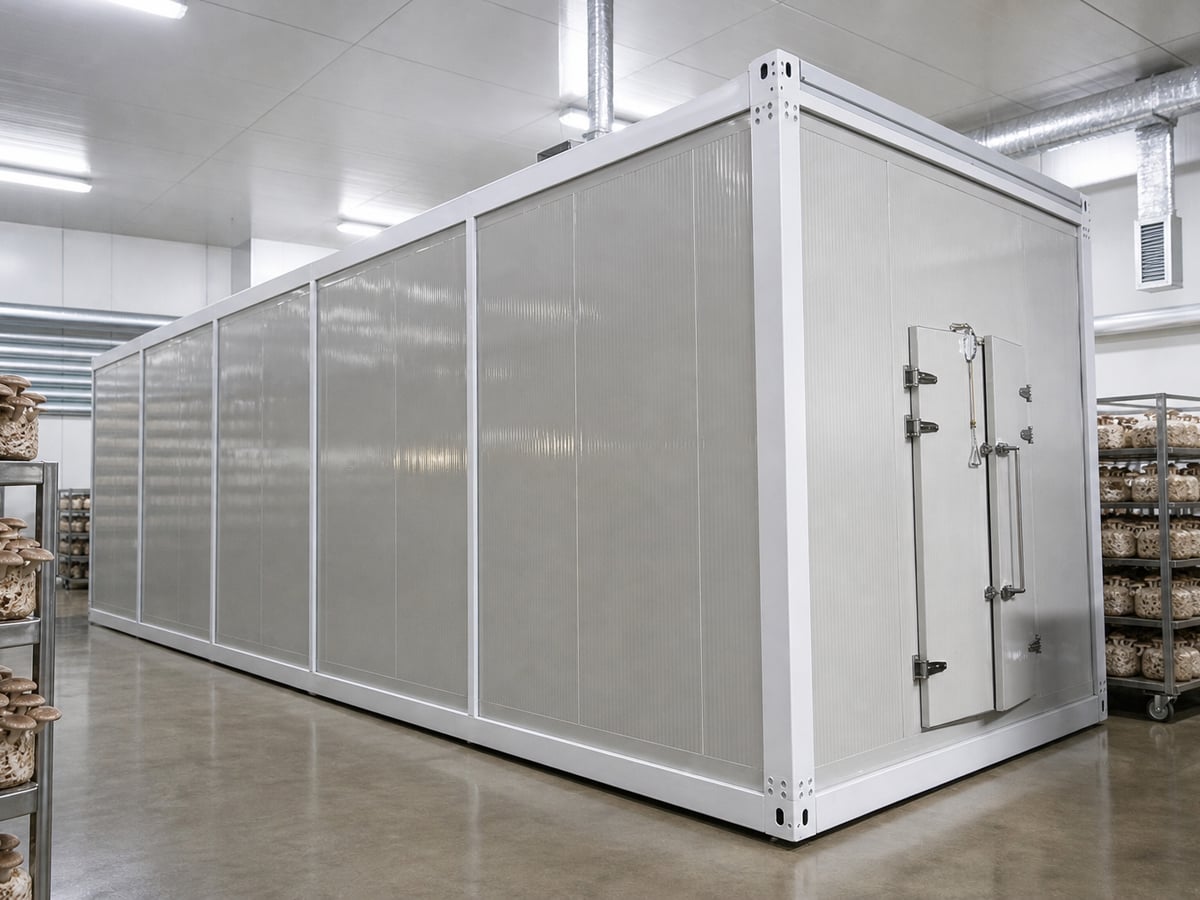
Quick Answer: Choosing a Shiitake Container for the Global Market

A shiitake mushroom container is a controlled cultivation room designed to receive colonized blocks, condition them, trigger fruiting, and manage repeated harvest cycles. For commercial growers, the best system is not simply a refrigerated box. It must coordinate temperature, relative humidity, fresh-air exchange, air movement, surface drying, lighting, sanitation, drainage, and production scheduling.
When purchasing a container for the Global Market, first determine whether you will receive mature shiitake blocks from an external supplier or incubate your own blocks. A fruiting-only unit can be smaller and less expensive, while a complete operation needs separate incubation capacity, fruiting space, loading access, cold-chain planning, and room for cleaning and packing. The container should also be matched to the local climate, electricity standard, water quality, logistics route, and service availability.
For most commercial projects, prioritize five points:
- Stable temperature control during conditioning, pinning, fruiting, and rest periods.
- Independent humidity and ventilation control rather than relying on a single air-conditioning function.
- Enough aisle and shelf clearance for handling dense blocks without damaging mushrooms.
- Uniform fresh air around every shelf level, including corners and the center of the room.
- A controller that records conditions, alarms, and supports repeatable recipes for each flush.
A modular cultivation container can be installed near farms, warehouses, distribution centers, restaurants, research sites, or urban food projects. It may be used as a standalone fruiting room, a multi-container farm, or one module within a larger mushroom production line. The most reliable design is based on the block supplier’s biological specifications and the grower’s target harvest calendar, not on container size alone.
Receiving Mature Shiitake Blocks: What Happens Before Fruiting

Mature shiitake blocks are commonly delivered after the substrate has been fully colonized and has developed the biological strength needed for fruiting. Their exact condition varies. Some blocks arrive ready for browning and conditioning, while others have already completed part of the maturation process. Before accepting a shipment, confirm the block age, substrate formulation, inoculation date, recommended fruiting temperature, moisture range, expected flush count, and transport requirements.
Receiving mature blocks is both a biological and logistical operation. A truck arriving from a supplier in Qingdao, Shanghai, Rotterdam, Hamburg, Dubai, or Los Angeles may contain blocks that have experienced temperature changes during loading and transit. Do not move them immediately into a strong fruiting cycle without inspection. Check packaging integrity, visible contamination, unusual odors, overheating, surface damage, and condensation inside protective film.
Allowing blocks to stabilize in a designated receiving area helps prevent sudden environmental stress. The receiving area should be clean, shaded, and protected from direct sunlight. It should not be used as a general warehouse for chemicals, cardboard, soil, or waste. If the blocks are transported internationally, import documentation, phytosanitary requirements, customs clearance, and port delays should be included in the project plan.
| Receiving Check | What to Inspect | Why It Matters |
|---|---|---|
| Block temperature | Core and surface temperature after delivery | Identifies transport heating or chilling stress |
| Packaging | Tears, punctures, leaks, and excessive condensation | Damaged packaging can increase contamination risk |
| Surface condition | Color, browning, bruising, and abnormal growth | Shows whether blocks are ready for conditioning |
| Odor | Clean mushroom or substrate odor versus sour or chemical odor | Unusual odors may indicate contamination |
| Batch records | Supplier, inoculation date, strain, and expected flush schedule | Supports traceability and production planning |
| Transport history | Transit duration, delays, and temperature exposure | Explains variation between blocks in the same shipment |
The table above should become part of a receiving checklist. Commercial farms should photograph each batch, assign a lot number, and record the number of accepted, quarantined, or rejected blocks. If a shipment contains a suspicious block, isolate it instead of placing it directly among healthy production stock.
For projects importing into the United States, Canada, the European Union, Australia, or the Gulf states, buyers should confirm local rules before shipment. A supplier may provide documentation, but the importer remains responsible for local clearance and regulatory compliance. Planning a route through major trade hubs such as Rotterdam, Hamburg, Singapore, Busan, or Dubai can improve access to freight services, but it does not remove the need for temperature protection and inspection.
Space for Conditioning and Handling: Designing a Workable Layout

Space planning directly affects yield, labor cost, and contamination control. A container filled beyond its practical shelf capacity may appear efficient on paper but become difficult to clean, inspect, harvest, and ventilate. Workers need enough room to turn, lift blocks, remove mature mushrooms, and transport trays without brushing against neighboring shelves.
Separate the container or production building into functional zones whenever possible:
- Receiving and inspection area.
- Conditioning or browning area.
- Fruiting area.
- Harvest transfer and short-term holding area.
- Cleaning, waste, and equipment service area.
When a single container must perform several functions, use timed batches and physical procedures to avoid cross-contamination. Do not move dirty carts from waste handling directly into the fruiting room. Provide washable floors, coved corners, corrosion-resistant shelving, and floor drainage where permitted by local building codes. A hand-wash station and dedicated footwear policy are inexpensive compared with the cost of a contaminated production cycle.
Shelf arrangement should support vertical production while allowing air to move between blocks. Dense shelves can create a humid microclimate in which mushroom caps remain wet, stems elongate, and bacterial problems become more likely. Conversely, excessive spacing may waste valuable cubic capacity. The best arrangement is determined through airflow testing, not by calculating only the number of blocks that physically fit.
| Layout Element | Recommended Planning Focus | Operational Benefit |
|---|---|---|
| Loading access | Door width, cart turning radius, and threshold design | Reduces block damage and handling time |
| Vertical clearance | Space between shelf levels and ceiling-mounted equipment | Improves inspection and air distribution |
| Service clearance | Access around evaporators, fans, sensors, and control panels | Makes maintenance safer and faster |
| Harvest aisle | Clear route from shelves to packing or holding space | Prevents unnecessary movement through production zones |
| Drainage | Sloped washable floor and protected drain location | Controls wash water and supports sanitation |
| Quarantine space | Small isolated area for questionable blocks | Limits the spread of contamination |
For a compact farm in London, Toronto, Melbourne, or Seoul, a modular container may be installed in an industrial yard or converted warehouse. In hot climates such as Riyadh, Bangkok, Lagos, or coastal Brazil, the external placement of the refrigeration and heat-rejection equipment becomes especially important. Shade, service access, and protection from dust can have a major effect on energy consumption and equipment life.
Stage Changes and Temperature Control: Building a Repeatable Recipe
Shiitake production is not managed with one temperature setting from delivery to harvest. The desired conditions change according to block maturity, surface development, pin initiation, fruiting, and rest. A controller should allow separate recipes or setpoints rather than forcing the grower to operate the entire cycle manually.
During conditioning, the objective is to help the block reach the appropriate physiological state while avoiding rapid drying or overheating. The correct temperature depends on strain, substrate, maturity, and supplier instructions. During fruiting, a controlled reduction or change in temperature may help initiate pins, but abrupt changes can produce uneven development. After harvest, the block usually needs a rest period with carefully managed moisture and fresh air before the next flush.
Temperature sensors should measure representative room conditions rather than only the air near the cooling coil. A sensor mounted too close to a supply outlet may report a false low temperature, while a sensor near a warm door may report a false high temperature. For dense shelves, use multiple sensors or movable verification instruments to identify differences between the front, center, top, and bottom levels.
| Production Stage | Primary Objective | Control Considerations |
|---|---|---|
| Receiving | Stabilize the delivered blocks | Avoid sudden heat, cold, and direct airflow |
| Conditioning | Prepare the block for productive fruiting | Follow strain-specific temperature and moisture guidance |
| Pin initiation | Encourage uniform primordia development | Coordinate temperature, humidity, light, and fresh air |
| Fruiting | Produce firm, attractive mushrooms | Balance humidity with surface drying and ventilation |
| Harvest recovery | Protect the block after picking | Remove damaged tissue and avoid prolonged surface wetness |
| Rest period | Allow biological recovery before another flush | Use a lower-intensity climate recipe and monitor block weight |
Temperature control also includes heat generated by fans, lighting, people, compressors, and neighboring equipment. In warm regions, the cooling load can rise sharply when doors are opened frequently. In cold regions, heating and humidity preservation may become more important than refrigeration. A properly sized system should be evaluated using local summer and winter design conditions, not only average annual weather.
Smart controls can record temperature trends and alert operators to door openings, sensor failures, compressor faults, high humidity, or abnormal deviations. A remote dashboard is helpful for farms with multiple units in different locations, although remote monitoring should support—not replace—local inspections.
Humidity and Surface Drying Balance: Avoiding Wet Caps and Dry Blocks
Relative humidity is one of the most misunderstood variables in shiitake cultivation. A high room reading does not guarantee that the block surface is in the correct condition. Local airflow, surface temperature, mushroom density, condensation, and evaporation all influence the actual microclimate around the crop.
Excessive humidity without enough air movement can leave caps and stems wet for too long. This may reduce quality, encourage bacterial issues, and produce weak or poorly formed mushrooms. Excessive drying can crack caps, reduce mushroom weight, slow development, and force the block to use moisture too quickly. The target is a controlled balance in which the crop remains hydrated while surfaces periodically lose excess water.
Humidity should be managed through several coordinated tools:
- High-quality humidity sensors positioned away from direct mist or condensate.
- Humidification equipment sized for the actual room volume and air exchange rate.
- Cooling coils and condensate drains that remove moisture predictably.
- Air circulation that prevents stagnant pockets without blasting the crop.
- Door discipline and insulated panels that reduce uncontrolled moisture changes.
- Observation of cap texture, surface sheen, cracking, and block weight.
Fogging or misting systems should be selected carefully. Very fine droplets may remain suspended and travel into electrical components, while large droplets can wet mushroom surfaces directly. Water quality also matters. Mineral-rich water can clog nozzles, leave deposits, and increase maintenance. In some locations, filtration or water treatment is necessary.
| Observed Condition | Likely Environmental Cause | Practical Response |
|---|---|---|
| Wet mushroom surfaces | High humidity combined with weak air exchange | Increase controlled fresh air and verify circulation |
| Cracked caps | Low humidity or excessive surface drying | Reduce drying intensity and inspect humidification |
| Long thin stems | Insufficient fresh air or poor air distribution | Review carbon dioxide removal and shelf airflow |
| Uneven pinning | Temperature or humidity variation across shelves | Map the room with additional sensors |
| Condensation on panels | Cold surfaces, infiltration, or excessive moisture | Check insulation, door seals, and drain performance |
| Rapid block weight loss | Over-ventilation, high air speed, or low humidity | Reduce drying load and review the recipe |
Operators should use visual inspection together with measured data. A room may show an acceptable average humidity while a corner remains stagnant and wet. Likewise, a short period of low humidity may not be harmful if the block surface recovers quickly. Consistent records help distinguish a biological issue from a control-system issue.
Fresh Air Around Dense Shelves: Ventilation Without Crop Stress
Fresh air is necessary to remove carbon dioxide, excess heat, odors, and moisture. However, simply installing a large exhaust fan does not guarantee uniform ventilation. Air may short-circuit from the inlet to the outlet, leaving the center of the shelving with inadequate exchange. A good design considers air paths, shelf orientation, fan location, ducting, filtration, and the relationship between fresh-air volume and room humidity.
Dense shelving requires gentle circulation in addition to fresh-air exchange. Circulation fans should distribute air across the room rather than point continuously at one row of blocks. Adjustable-speed fans are valuable because the appropriate airflow can change between pinning, fruiting, harvest, and rest. Operators should look for consistent mushroom quality at the top, middle, and bottom of the racks.
In dusty outdoor environments, intake filtration protects both the crop and the equipment. In coastal areas such as Miami, Manila, or Durban, salt-laden air may accelerate corrosion. In dry inland regions, excessive outside-air intake can make humidity control expensive. In cold climates, incoming air may need tempering before entering the room to avoid chilling the crop.
Airflow testing can be performed with smoke visualization, anemometers, or temporary sensor arrays. The goal is not to maximize air speed everywhere. It is to eliminate stagnant zones while maintaining a stable crop surface. Any test should be performed with shelves loaded because empty-room measurements may not represent production conditions.
Managing Flushes and Rest Periods: Scheduling Reliable Output
Commercial shiitake production becomes more predictable when blocks are divided into batches rather than fruited all at once. Batch scheduling spreads labor, energy demand, packing activity, and sales volume across the week. It also reduces the risk that one environmental mistake affects the entire inventory.
After a flush, remove mature mushrooms carefully and inspect the block. Avoid leaving damaged tissue or over-mature mushrooms that can become a sanitation concern. The block then enters a recovery or rest period. The length and conditions depend on strain, substrate, block weight, previous yield, and supplier guidance. Operators should not force the next flush before the block has recovered enough moisture and biological strength.
A production calendar should record the following:
- Block batch and supplier lot.
- Date of entry into the container.
- Conditioning start and end dates.
- Pinning date and harvest date.
- Weight harvested by flush.
- Rejected or downgraded product.
- Rest-period start and next expected fruiting date.
- Cleaning, inspection, and maintenance actions.
| Scheduling Method | Best Use | Main Advantage |
|---|---|---|
| Single large batch | Small trials or limited labor operations | Simple to organize but creates harvest peaks |
| Weekly staggered batches | Restaurants, markets, and direct sales | Creates a steadier supply of fresh mushrooms |
| Container rotation | Multi-module commercial farms | Allows different recipes to run simultaneously |
| Strain separation | Operations using several shiitake varieties | Prevents conflicting temperature requirements |
| Flush-based planning | Buyers with defined delivery windows | Links climate recipes to sales commitments |
| Reserve capacity | Projects exposed to shipping delays or demand changes | Improves resilience and reduces emergency decisions |
Harvest planning must include the market. Premium fresh shiitake may be sold to supermarkets, specialty distributors, hotels, restaurants, meal-kit companies, and farmers’ markets. Lower-grade mushrooms may be directed to drying, processing, or sauces. Understanding these outlets before construction helps determine packing space, cold storage, labeling, and delivery routes.
Planning Separate Incubation Capacity: Fruiting Is Only One Part of the Farm
A fruiting container is appropriate when mature blocks are purchased from a specialist supplier. An integrated farm that produces its own blocks needs additional areas for substrate preparation, sterilization or pasteurization, inoculation, incubation, browning, and waste management. These stages have different environmental requirements and should not be forced into the same room.
Incubation commonly requires stable conditions for mycelial development, while fruiting requires active air exchange, humidity variation, light management, and frequent worker access. Combining the two can increase energy use and raise contamination risk. Separate incubation capacity also makes production more scalable because blocks can be prepared in advance and transferred into fruiting rooms according to demand.
For a new project, calculate capacity in blocks per week rather than only container volume. Consider the number of blocks entering incubation, the average incubation duration, the percentage of rejected blocks, the number of flushes, and the target weekly harvest. A farm near Warsaw may need different insulation and heating provisions from one near Jakarta, but both require a clear capacity model.
| Capacity Question | Planning Calculation | Decision Supported |
|---|---|---|
| Weekly block intake | Number of blocks inoculated or purchased each week | Determines receiving and incubation size |
| Incubation duration | Average days from inoculation to mature block | Defines total incubation inventory |
| Fruiting duration | Conditioning, harvest, and rest time per cycle | Defines required fruiting capacity |
| Expected yield | Harvest weight per block and per flush | Connects capacity to revenue forecasts |
| Rejection rate | Percentage lost to contamination or damage | Prevents optimistic production estimates |
| Expansion allowance | Additional shelves, utility load, and floor area | Supports future growth without redesign |
Modular systems offer an alternative to building one large room immediately. A project may begin with one fruiting unit and add incubation or additional fruiting modules after validating local demand. This approach is useful for growers in emerging markets, agricultural universities, hotel farms, and distributors that want to test a regional business model before making a larger investment.
Products, Applications, and Buying Advice for Commercial Growers
Available mushroom climate solutions generally fall into four categories. The first is a fruiting container for mature blocks. The second is an incubation container or controlled room. The third is a complete modular cultivation unit with climate control, shelving, lighting, drainage, and monitoring. The fourth is a separate climate controller that can operate equipment in a purpose-built room.
Buyers should compare systems based on usable growing volume, not external dimensions alone. Ask for the number of practical shelf levels, recommended block density, cooling capacity under local design conditions, ventilation range, humidity-control method, electrical requirements, insulation performance, and cleaning procedure. A lower purchase price may become expensive if the unit has poor access, undersized refrigeration, difficult-to-replace sensors, or limited after-sales support.
Key industries and applications include:
- Commercial mushroom farms supplying retail and food-service customers.
- Agricultural contractors building controlled-environment projects.
- Equipment distributors serving regional growers.
- Hotels, restaurants, and urban farms producing premium local mushrooms.
- Universities and research centers testing strains and cultivation recipes.
- Container farms in remote areas where conventional buildings are difficult to construct.
- Food processors using fresh or partially processed shiitake for packaged products.
For buyers comparing a complete unit, the smart mushroom cultivation container provides a useful reference for modular room design. Projects that already have a room but need coordinated monitoring can review the mushroom climate control system and assess compatibility with existing refrigeration, humidification, and ventilation equipment.
| Buying Criterion | Questions to Ask the Supplier | Commercial Importance |
|---|---|---|
| Climate capacity | What outdoor design temperature and humidity were used? | Confirms performance in the actual destination |
| Control functions | Can temperature, humidity, fresh air, light, and alarms be programmed? | Improves consistency and labor efficiency |
| Electrical design | Can voltage, frequency, protection, and plugs match local standards? | Reduces installation and safety problems |
| Construction quality | What panels, floor materials, seals, and corrosion protection are used? | Influences sanitation, energy use, and service life |
| Maintenance | Are filters, sensors, fans, valves, and spare parts available? | Limits downtime during production |
| Project support | Does the supplier provide layout, installation, commissioning, and training? | Helps local teams achieve stable operation |
Buyers should request factory test records, electrical documentation, operating manuals, and a clear warranty scope. For international projects, clarify who handles inland transport, export packing, port delivery, customs documents, installation, and commissioning. A professional supplier should identify which tasks belong to the manufacturer and which belong to the local contractor.
Case Examples and Local Supplier Considerations
Consider a distributor in Rotterdam supplying small commercial farms across the Netherlands and Belgium. The distributor may prefer standardized containers with European electrical components, corrosion-resistant construction, remote alarms, and documentation in several languages. Because the region has cool winters and humid weather, insulation, heating control, condensation management, and drainage are important.
A grower in São Paulo may prioritize cooling performance, water treatment, local service access, and protection against seasonal heat. A farm near Nairobi may need robust voltage protection, simplified maintenance, and staff training. A project in Dubai may require strong insulation, shaded equipment placement, high-capacity cooling, and careful filtration against dust. These examples show why a global product should still be configured for local conditions.
Local suppliers can contribute civil works, foundations, electrical connection, water treatment, forklift services, refrigeration support, and routine maintenance. The container manufacturer may provide the integrated climate system, but local partners are often essential for permits and on-site execution. Select suppliers with experience in cold rooms, agricultural HVAC, food production, or controlled environments rather than relying only on general construction experience.
Relevant logistics and service hubs may include Qingdao and Shanghai for Chinese export routes, Rotterdam and Hamburg for European distribution, Dubai for Gulf projects, Singapore for Southeast Asia, and Los Angeles or Vancouver for North American supply chains. The best route depends on container dimensions, shipping schedules, customs requirements, and the availability of local installation support.
More project examples and deployment references can be reviewed through the mushroom cultivation project case studies. When evaluating a case, focus on the climate zone, production scale, block type, installed equipment, harvest target, and operating team. A case in a cool warehouse may not be directly comparable to an outdoor container in a tropical region.
Future Trends for Shiitake Container Farming in 2026
In 2026, commercial mushroom systems are moving toward more measurable and resource-efficient operation. Smart controllers are increasingly expected to store historical data, provide alarm notifications, identify abnormal trends, and support recipe-based control. The value is not automation for its own sake; it is the ability to connect environmental conditions with yield, quality, labor, and energy records.
Artificial intelligence and predictive analytics may help identify early signs of uneven pinning, excessive drying, equipment deterioration, or abnormal power consumption. These tools should be treated as decision support. Human inspection remains necessary because a sensor cannot fully assess cap quality, contamination, handling damage, or the biological condition of a block.
Sustainability will also shape purchasing decisions. High-performance insulation, variable-speed fans, heat recovery, efficient compressors, water-saving humidification, LED lighting, recyclable packaging, and responsible substrate disposal can reduce operating costs and environmental impact. In suitable climates, heat pumps may provide efficient heating and cooling integration. Solar power and battery storage may reduce peak electrical demand, although the system must be engineered for the refrigeration load.
Policy trends are likely to increase attention to energy reporting, food traceability, worker safety, water use, refrigerant selection, and waste management. Exporters and project owners should monitor regulations in the destination market rather than designing only for current minimum requirements. Modular equipment that can be upgraded with new sensors, software, or energy systems may offer better long-term value than a closed system.
The chart is an illustrative planning tool rather than a market survey. It emphasizes that stable environmental control remains the foundation, while efficiency, traceability, remote access, and modular growth increasingly influence investment decisions.
Our Company: Technology, Manufacturing, and Project Support
Technological capabilities
Shandong Lanhu Air Conditioning Equipment Co., Ltd. develops agricultural climate-control equipment, industrial HVAC systems, and modular cultivation solutions from Dezhou, Shandong, China. The company has more than 12 years of thermodynamic research and development experience and has registered more than 45 patents. Its engineering work focuses on coordinating temperature, humidity, ventilation, air circulation, and control logic for demanding agricultural environments.
Lanhu’s product range includes smart mushroom cultivation containers, mushroom climate controllers, smart hydroponic plant containers, and air-source heat pumps. For shiitake projects, this technological capability supports different operating recipes for conditioning, fruiting, harvest recovery, and rest periods. The engineering team can also evaluate the destination climate, utility conditions, installation layout, and desired production workflow before recommending a system configuration.
Manufacturing capabilities
The company operates a modern manufacturing facility covering more than 30,000 square meters. Its integrated production process includes product design, engineering development, sheet-metal fabrication, CNC bending, insulation-panel production, electrical assembly, system integration, equipment testing, and quality inspection. This internal coordination helps reduce the gap between the mechanical enclosure, refrigeration system, electrical cabinet, sensors, and control software.
Before shipment, systems undergo functional inspection, electrical verification, performance testing, and operational evaluation. Lanhu holds ISO 9001, ISO 14001, ISO 45001, and ISO 12100 certifications, along with patent certificates and enterprise credibility credentials. For an international buyer, these processes provide a useful basis for reviewing manufacturing consistency, workplace safety, environmental management, and equipment documentation.
Service capabilities
Lanhu provides factory-direct supply, OEM and ODM customization, engineering assistance, international logistics support, spare-parts support, installation guidance, and after-sales service. Its customers include agricultural contractors, equipment distributors, engineering companies, and commercial farming projects worldwide. Customization may include dimensions, shelving arrangements, electrical standards, control functions, branding, insulation specifications, and climate-system configuration.
Projects requiring a tailored enclosure or integrated farm design can learn more about the OEM and ODM cultivation equipment service. Early communication is recommended because international projects may require drawings, utility schedules, packing details, local compliance documents, and coordination with contractors in the destination country.
FAQ: Shiitake Mushroom Containers and Commercial Operation
Can a shiitake container be used only for fruiting?
Yes. A fruiting-only container is suitable when the grower purchases mature, colonized blocks from a reliable supplier. It should still provide space for receiving, conditioning, harvest handling, cleaning, and temporary isolation of questionable blocks. If the farm makes its own blocks, separate incubation and substrate-processing capacity will normally be required.
How many blocks can one container hold?
Capacity depends on container dimensions, shelf design, block size, aisle clearance, airflow requirements, and the desired working density. A supplier should provide practical loading capacity rather than a maximum physical count. Overloading shelves may reduce uniformity, increase labor difficulty, and create stagnant air zones.
Is a standard shipping container sufficient for mushroom production?
A standard shipping container can provide the basic enclosure, but commercial production requires appropriate insulation, washable surfaces, controlled ventilation, refrigeration or heating, humidity management, drainage, lighting, sensors, electrical protection, and safe access. A purpose-designed cultivation container is generally easier to clean, control, and service.
What is more important: temperature or humidity control?
Both are essential, and they interact. Temperature affects crop development and the ability of air to hold moisture, while humidity affects surface drying and block moisture loss. A stable system should control both variables together and verify conditions at several locations around the shelves.
Why can mushrooms near the door look different from those in the center?
Doors introduce temperature changes, outside air, drafts, and humidity fluctuations. The center of a dense shelf may receive less fresh air, while the area near a supply outlet may dry faster. Better air distribution, sensor placement, operating discipline, and shelf spacing can reduce these differences.
Should the container use fresh outdoor air continuously?
Not necessarily. Fresh-air demand changes with crop stage, room load, outdoor conditions, and humidity requirements. Continuous maximum ventilation can waste energy and dry the blocks. A modulating system with filtration and adjustable control is usually more effective than a fan that runs at one fixed speed.
How should growers plan multiple flushes?
Record the harvest date, yield, block weight, surface condition, and recovery period for each batch. Use staggered block entries so all blocks do not fruit at once. The climate recipe for a rest period should reflect the supplier’s instructions and the biological condition of the block rather than following an unchanging calendar.
What should be included in an international quotation?
Request the equipment scope, usable capacity, layout drawings, electrical requirements, cooling and heating performance, control functions, spare-parts list, testing documents, packaging details, delivery terms, warranty, installation responsibilities, and commissioning support. Also confirm whether the quotation includes shelving, humidification, lighting, drainage components, sensors, and remote monitoring.
How can a buyer compare suppliers from different countries?
Compare verified performance, manufacturing quality, service response, documentation, customization ability, local installation support, and total operating cost. Consider freight from ports such as Qingdao, Shanghai, Rotterdam, Hamburg, Dubai, or Singapore, but also evaluate who will support the equipment after delivery. A lower initial price may not be economical if replacement parts and technical assistance are difficult to obtain.
Is a modular system suitable for a small farm?
Yes. Modular systems allow a small farm to begin with one controlled unit and add capacity as sales develop. This can reduce initial construction risk and make it easier to test strains, recipes, labor requirements, and local demand. The first module should still be planned with future utility capacity and workflow expansion in mind.
Share this article

About the Author: Shandong Lanhu Air Conditioning Equipment
Lanhu is a professional climate control equipment manufacturer specializing in smart agricultural systems, commercial HVAC solutions, and customized temperature control technologies. With extensive engineering experience, Lanhu provides reliable solutions for plant factories, controlled environment agriculture, and industrial applications.
Need a Custom Climate Control Solution?
From smart agricultural systems to commercial HVAC solutions, Lanhu provides reliable temperature and humidity control solutions tailored to your project needs.
Contact Us