Lion’s Mane Fruiting Containers for the Global Market
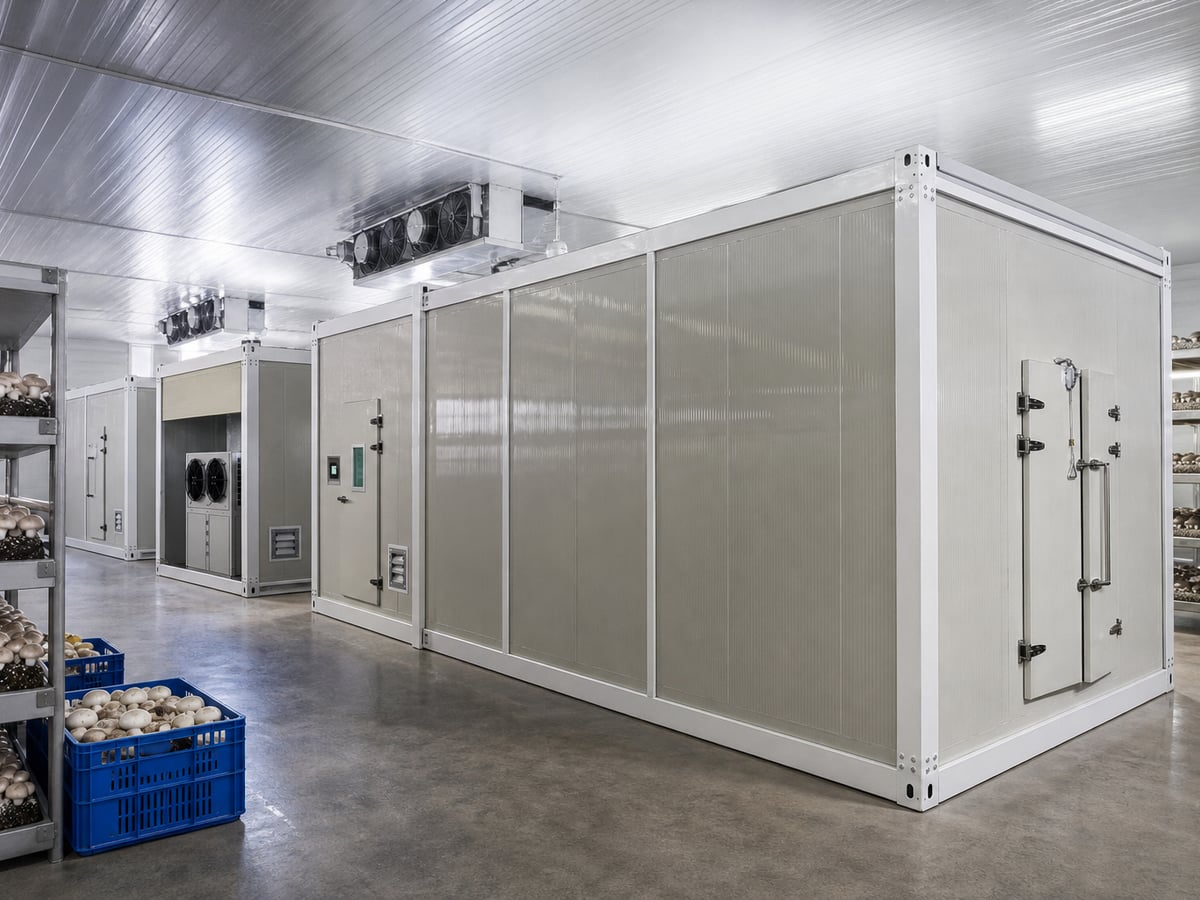
Quick Answer: How to Improve Lion’s Mane Crop Quality

Lion’s mane mushroom quality depends on more than a suitable substrate and a productive strain. The fruiting environment must keep fresh air, relative humidity, temperature, light, cleanliness, and handling practices within a stable operating range. A well-designed lion’s mane cultivation container helps growers control these variables repeatedly, especially when production takes place in warm regions, cold climates, urban facilities, or buildings with uneven rack conditions.
For most commercial trials, place fully colonized blocks with the fruiting opening facing the aisle or controlled air path. Maintain high humidity without allowing water to remain on the developing fruit bodies, provide gentle but regular air exchange, and avoid strong drafts across young growth. Keep temperature differences between upper, middle, and lower rack levels as small as possible. Schedule inspection and harvest so workers can reach every block without squeezing, dropping, or compressing the mushrooms.
During a trial production cycle, record block position, flush date, temperature, humidity, carbon dioxide, fresh-air periods, browning, fruit-body density, harvest weight, and rejected product. These records reveal whether quality problems come from the mushroom strain, substrate, rack location, or climate-control settings. For commercial buyers, the most useful equipment is not simply a sealed box. It is an integrated cultivation platform that supports repeatable climate control, safe access, sanitation, energy efficiency, and service after installation.
| Quality target | Practical control | What to monitor | Common warning sign |
|---|---|---|---|
| White, dense fruit bodies | Stable humidity and moderate air exchange | Surface color and texture | Yellowing, browning, or dry tips |
| Compact shape | Correct fresh-air timing and gentle circulation | Spine length and density | Long, thin, or sparse teeth |
| Uniform crop timing | Even temperature across rack levels | First pin and harvest dates | Top racks fruiting early |
| Low contamination risk | Cleanable surfaces and controlled access | Inspection and sanitation logs | Repeated mold at one location |
| Good saleable yield | Accessible rack design and careful harvest | Weight by block and flush | Damage during handling |
| Repeatable production | Digital records and alarm limits | Daily climate history | Unexplained batch variation |
The best setting is always confirmed through a small controlled trial because strains, block formulation, opening size, room insulation, and local climate affect results. A container should make those trials easier to measure, not hide variation behind a single average reading.
Block Placement for Lion’s Mane Fruiting

Block placement influences light exposure, air velocity, temperature, worker access, and the direction in which fruit bodies develop. Lion’s mane blocks are commonly placed on racks with one or more openings exposed to the fruiting environment. If an opening faces a wall, another block, or a strong supply-air outlet, the mushroom may receive uneven humidity and oxygen conditions. This can produce irregular growth even when the room sensor reports an acceptable average.
Place blocks so that the fruiting surface has clear space around it. A practical arrangement allows the mushroom to expand without touching adjacent blocks, rack frames, curtains, or packaging materials. Keep the opening visible from the aisle so staff can inspect pin formation, color, surface moisture, and contamination without repeatedly moving the block. When several rack levels are used, stagger openings where possible rather than creating a continuous vertical wall that restricts circulation.
For first trials, divide the rack into zones. Use a top, middle, and lower zone, then place a similar number of blocks in each area. Record the block code and position. This simple method can show whether the upper level is warmer, whether the bottom level receives less air movement, or whether one corner has a humidity problem. After two or three cycles, the data can support a better rack layout.
Matching placement to the crop stage
Newly opened blocks may need more protection from direct air movement than blocks approaching harvest. Young pins can dehydrate quickly if a fan or supply outlet points directly at them. Mature fruit bodies, however, may benefit from adequate air exchange to reduce excessive softness and support a clean shape. Some growers therefore use adjustable rack curtains, directional diffusers, or separate climate phases rather than treating every stage identically.
| Rack position | Potential condition | Placement recommendation | Record for comparison |
|---|---|---|---|
| Upper level | Warmer air and stronger supply influence | Leave clearance above blocks and check for drying | Temperature, tip color, harvest date |
| Middle level | Often closest to average room conditions | Use as a reference zone | Climate and yield baseline |
| Lower level | Cooler air or reduced circulation | Prevent blocked return-air paths | Condensation and contamination |
| Near door | Frequent temperature and humidity changes | Protect from drafts and traffic | Door opening frequency |
| Near supply outlet | Higher air speed and rapid evaporation | Use a diffuser or change orientation | Surface moisture and browning |
| Far corner | Possible stagnant air | Confirm circulation with periodic mapping | CO₂ and shape variation |
In a containerized system, block placement should be considered together with the fan, evaporator, humidification device, fresh-air inlet, and return-air route. A strong equipment layout can reduce dead zones, but it cannot compensate for racks packed too tightly. Buyers should request a rack plan, service clearance, drainage arrangement, and loading procedure before approving a commercial configuration.
Fresh Air and Fruit-Body Shape

Fresh air is one of the main factors affecting lion’s mane fruit-body shape. During fruiting, the crop consumes oxygen and releases carbon dioxide. If carbon dioxide accumulates, fruit bodies may become elongated, loose, or less dense. If fresh air is introduced too aggressively, the surface may dry, pins may stall, and the mushroom may develop brown edges. The goal is controlled renewal rather than maximum fan speed.
Fresh-air management should consider the actual condition of the crop, not only a fixed timer. A digital climate controller can coordinate ventilation with temperature, humidity, and carbon dioxide readings. When the room is warm or the crop load is high, the required air exchange may differ from a lightly loaded room. In a sealed or semi-sealed cultivation container, sensor placement is important because a single sensor near the return air may not represent the conditions around the fruiting openings.
Observe the shape together with the climate record. Long, narrow teeth can indicate insufficient fresh air, although strain genetics and substrate nutrition may also contribute. Very dry, rough, or browned tips may indicate excessive air velocity or low humidity. A balanced crop normally develops a full, compact appearance with clean color and a surface that is moist but not visibly wet.
Fresh-air controls for different production situations
Small farms often use timed ventilation because it is easy to operate. Commercial operations may obtain better consistency by combining a minimum ventilation rate with sensor-based adjustment. In tropical locations such as Singapore, Manila, or Bangkok, incoming outdoor air may carry substantial heat and moisture. In dry continental areas such as Almaty, Ulaanbaatar, or inland Mexico, fresh air may reduce room humidity quickly. Coastal sites near Rotterdam, Hamburg, or Qingdao may need attention to corrosion, filtration, and seasonal moisture loads.
| Observed shape or surface | Possible environmental cause | First adjustment to test | Additional check |
|---|---|---|---|
| Long, open teeth | Insufficient fresh-air renewal | Increase air exchange gradually | Verify strain and block maturity |
| Dry or brown tips | High air speed or low humidity | Reduce direct draft and review humidification | Inspect upper rack levels |
| Soft, wet surface | Condensation or inadequate drying period | Improve gentle circulation | Check dew point and drain function |
| Uneven growth direction | One-sided airflow or light | Rebalance diffuser and rack spacing | Map air velocity by zone |
| Small stalled pins | Rapid environmental change | Stabilize temperature and humidity | Review opening and block condition |
| Dense but discolored crop | Heat stress, age, or delayed harvest | Confirm temperature and harvest timing | Check sanitation and cultivar behavior |
A smart mushroom cultivation container can be useful where the grower needs a repeatable air-exchange program within a limited footprint. The smart mushroom climate controller can be specified to coordinate temperature, humidity, ventilation, alarms, and operating records according to the project design.
Humidity and Browning Prevention
High humidity is usually needed for lion’s mane fruiting, but humidity alone does not guarantee white, high-quality mushrooms. Browning can be associated with drying, excessive maturity, physical damage, heat, condensation, microbial pressure, or unsuitable airflow. The growing surface should remain adequately hydrated while the fruit body is protected from persistent free water.
Use a calibrated humidity sensor and place it near the crop zone rather than directly beside a humidifier outlet. If the sensor is too close to the mist source, it may report an artificially high value while distant blocks dry out. Multiple sensors are valuable in longer containers or rooms with several rack levels. Periodic hand inspection remains important because electronic readings cannot describe every fruit-body surface.
Humidification should be distributed evenly. Fine mist, steam, or other systems may be selected according to room size, water quality, sanitation policy, and energy costs. Water droplets should not be directed at developing mushrooms. Wet surfaces, standing water, and poor drainage can raise contamination risk and create slippery working conditions. A well-insulated enclosure with proper condensate management reduces unnecessary climate swings.
Reducing browning during production and harvest
Set clear quality rules for color. For example, define acceptable cream or white color, the point at which tips are considered browned, and the maximum time between harvest and cooling. Handle fruit bodies with clean gloves or sanitized tools when required by the operation. Avoid stacking warm mushrooms in deep containers because trapped heat and moisture can accelerate quality loss.
| Risk factor | Effect on lion’s mane | Prevention measure | Verification method |
|---|---|---|---|
| Direct mist on crop | Wet surface, discoloration, contamination risk | Redirect humidification and improve distribution | Inspect during humidifier cycles |
| Low humidity near supply air | Dry tips and browning | Use diffusers and adjust air speed | Compare sensor zones |
| Condensation on panels | Drips, sanitation problems, corrosion | Improve insulation and dew-point control | Daily panel inspection |
| Delayed harvest | Older color and reduced firmness | Set maturity standards and harvest windows | Record age at harvest |
| Rough handling | Bruising and broken teeth | Design clear access and use suitable crates | Grade damage percentage |
| Unclean water system | Odor and microbial risk | Use a documented cleaning schedule | Review sanitation records |
Humidity control also affects energy consumption. Excessive humidification followed by strong cooling wastes electricity and can increase condensation. A climate-control strategy that coordinates temperature, fresh air, and humidity is generally more efficient than operating each device independently. This is particularly relevant for growers facing high power prices in Europe, Australia, Japan, and major North American cities.
Temperature Consistency Across Rack Levels
Temperature variation across rack levels is a frequent cause of inconsistent lion’s mane production. Warm air rises, refrigeration equipment may cool one side of a container more strongly, and frequent door opening can affect the front racks. Even a small difference can change pin initiation, harvest timing, surface moisture, and contamination behavior over several days.
Measure temperature at representative crop positions rather than relying on a controller sensor mounted near the equipment. During commissioning, place temporary data loggers on upper, middle, and lower racks, near the door, and near the return-air opening. Take readings during cooling, humidification, ventilation, and door-opening events. The purpose is to identify patterns, not to chase every short-term fluctuation.
Insulated panels, correct refrigeration capacity, balanced air distribution, and suitable rack spacing all contribute to consistency. The enclosure should be designed for the local ambient climate and expected block load. A container located in Dubai, Lagos, or southern Spain may face high external heat, while a site in northern Europe or Canada may need frost protection and stable heating during winter.
| Measurement location | Why it matters | Recommended action if different | Business impact |
|---|---|---|---|
| Top rack | Shows heat accumulation | Review return-air path and ceiling clearance | Earlier or uneven fruiting |
| Middle rack | Provides a central reference | Use as the comparison baseline | More reliable trial data |
| Bottom rack | Shows cold-air pooling | Check floor insulation and circulation | Delayed pinning or condensation |
| Door-side rack | Reveals traffic and infiltration effects | Reduce door-open time and use staging space | Variable quality near access point |
| Supply-air zone | May be colder or drier | Adjust diffuser direction and fan speed | Surface damage or stalled growth |
| Return-air zone | May represent mixed room air only | Compare with crop-level sensors | False confidence in uniformity |
When purchasing equipment, ask the supplier for expected temperature uniformity under a defined load, not simply the nominal cooling capacity. Request information about insulation thickness, door construction, evaporator placement, control accuracy, defrost strategy, drainage, and alarm functions. These details have a direct relationship with crop quality and operating cost.
Airflow Without Drying Delicate Growth
Airflow should move air through the cultivation space without creating a damaging jet across the fruit bodies. Delicate lion’s mane growth can lose moisture quickly when exposed to high velocity, particularly during the pinning stage. At the same time, completely stagnant air can increase carbon dioxide and create a humid microclimate that encourages surface problems.
Use gentle circulation fans, properly sized diffusers, and a return-air route that avoids short-circuiting. A short circuit occurs when supply air returns directly to the inlet without passing through the crop zone. Racks should not block the main circulation path. If curtains are used, leave planned openings so air can pass consistently rather than fluttering unpredictably around the blocks.
Airflow commissioning can include smoke visualization where permitted, anemometer readings at crop openings, and comparison of sensor results by rack level. The objective is not to achieve the highest possible air speed. It is to create a stable, repeatable pattern that supports gas exchange and keeps surfaces from drying.
Designing for sanitation and maintenance
Fans, filters, coils, humidifiers, and drains need inspection access. Dust and organic particles can collect around poorly protected fans or blocked filters. Equipment should be easy to clean without placing tools or service workers over exposed mushrooms. Condensate lines need a slope and drain trap appropriate to the design. Smooth interior panels and protected wiring simplify washdown and reduce hidden contamination points.
For facilities with limited technical staff, a modular mushroom cultivation container can reduce the complexity of building an insulated room from separate components. The final specification should still be adapted to local voltage, climate, access conditions, water quality, loading method, and production scale.
Harvest Access and Product Handling
Harvest access affects crop quality, labor cost, and worker safety. A block that looks excellent in the room can lose value if it is damaged while being removed from a crowded rack. Plan aisle width, door clearance, rack height, lighting, drainage, and a clean staging area before production begins. Workers should be able to see the whole fruit body and cut or remove it without pulling against neighboring blocks.
Harvest timing depends on the intended market. Fresh retail mushrooms may require a clean appearance, firm texture, and minimal browning. Food-service buyers may prioritize consistent size and delivery reliability. Processing customers may accept a wider appearance range but require stable moisture and documented traceability. Define specifications with the buyer before the first commercial cycle.
Use food-contact containers that protect the fruit bodies from compression. Avoid deep piles of warm product. Move harvested mushrooms promptly to the designated cooling or packing process, subject to the operation’s validated food-safety procedures. Record rejected product by reason, such as browning, contamination, mechanical damage, undersize, or late harvest. This information helps distinguish a growing problem from a handling problem.
| Handling stage | Quality objective | Recommended practice | Record |
|---|---|---|---|
| Pre-harvest inspection | Confirm maturity and cleanliness | Inspect all faces before opening the rack | Block code and maturity grade |
| Removal from rack | Avoid compression and breakage | Use clear access and support the block | Damage incidents |
| Cutting or separation | Create a clean product base | Use a consistent method and sanitized tools | Operator and time |
| Temporary holding | Prevent heat and moisture accumulation | Use shallow, ventilated food-safe containers | Holding duration |
| Cooling or packing | Preserve appearance and firmness | Follow the approved post-harvest process | Batch and destination |
| Dispatch | Maintain traceability | Label harvest date, lot, and customer order | Shipment record |
Good access also improves inspection frequency. Workers are more likely to identify contamination, broken blocks, blocked drains, and sensor faults when they do not need to climb, reach dangerously, or move multiple racks. Ergonomic design is therefore both a safety investment and a crop-quality control.
Recording Quality During Trial Production
Trial production should be treated as a structured experiment rather than an informal first crop. Begin with a production objective, such as improving whiteness, reducing harvest variation, testing a new block formulation, or comparing two air-exchange programs. Keep the number of variables manageable. If strain, block size, rack design, humidity, temperature, and harvest age all change at once, the results will be difficult to interpret.
Assign every block a code that connects the substrate batch, inoculation date, opening date, rack position, and harvest records. A simple digital form or spreadsheet is sufficient for many operations. Larger facilities may connect sensors and controller data to a production-management platform. Photos taken from the same angle and distance can provide useful evidence of color, density, and shape.
Review results by rack zone and by flush. Average yield alone may hide quality problems. A batch with a high total weight may still have an unacceptable percentage of browned, damaged, or undersized product. Track saleable yield, rejected weight, labor time, energy use, water use, and customer feedback. These metrics help compare a container with a conventional room on a realistic commercial basis.
| Record category | Minimum information | Why it supports decisions | Useful review frequency |
|---|---|---|---|
| Block identity | Batch, strain, date, and position | Links crop results to materials and location | At every inspection |
| Climate | Temperature, humidity, CO₂, and alarms | Explains shape and timing differences | Continuous or daily |
| Crop development | Pin date, size, color, and abnormalities | Shows response to environmental changes | Daily during active growth |
| Harvest | Date, weight, grade, and flush number | Calculates saleable productivity | Every harvest |
| Rejections | Reason and quantity | Separates environmental and handling losses | Every batch |
| Operating resources | Electricity, water, labor, and service events | Supports total-cost comparison | Weekly or per cycle |
Using data to improve the next cycle
At the end of each cycle, compare top, middle, and lower rack results. Look for repeated relationships rather than isolated events. If the top rack browns in three consecutive trials, investigate air speed and heat before changing the substrate. If all zones show long teeth, review fresh-air programming, carbon dioxide readings, and strain suitability. If only one batch performs poorly, inspect block preparation and contamination history.
Modern controllers can issue alerts when temperature, humidity, or carbon dioxide leaves a defined range. Alerts should be practical and prioritized. Too many warnings may cause staff to ignore them. Include a response procedure for power failure, sensor error, refrigeration fault, water interruption, and high-temperature events. Remote monitoring can be valuable for unattended sites, but it should supplement—not replace—physical crop inspection.
Buying Advice, Markets, and Product Types
Buyers in the global market usually choose among insulated grow rooms, retrofitted buildings, modular cultivation containers, and larger integrated mushroom facilities. The right option depends on production volume, available land, climate, transport access, labor, utilities, and expansion plans. A container can shorten installation time and provide a repeatable enclosure, while a permanent room may offer greater capacity and lower cost per unit at a large scale.
| Product type | Best fit | Advantages | Points to verify |
|---|---|---|---|
| Smart cultivation container | Trial farms, urban sites, modular expansion | Integrated enclosure and climate control | Capacity, service access, shipping dimensions |
| Climate-control cabinet | Existing insulated rooms | Can upgrade an established facility | Compatibility, sensor quantity, installation scope |
| Retrofit grow room | Warehouses and agricultural buildings | Uses available floor area | Insulation, drainage, vapor control, utilities |
| Multi-room project | Commercial continuous production | Separates stages and improves scheduling | Air balance, hygiene zoning, commissioning |
| Hybrid modular farm | Phased investment and distributed production | Can add capacity in steps | Standardized controls and spare parts |
| Research or pilot unit | Universities, breeders, and product trials | Supports controlled comparisons | Data logging, calibration, cleaning access |
When comparing suppliers, request a complete specification rather than a product photograph. Confirm cooling and heating performance, humidity method, ventilation filtration, control interface, rack arrangement, panel materials, floor load, drain design, electrical standards, packaging, warranty, spare parts, and installation support. Clarify whether the quoted price includes commissioning and operator training.
Regional logistics also influence the purchase decision. Equipment shipped through Qingdao, Shanghai, Ningbo, Rotterdam, Hamburg, Dubai, or Los Angeles may require different documentation, inland transport planning, and electrical adaptations. Buyers should provide the destination country, port, voltage, frequency, ambient design temperature, and site access details early in the quotation process. This reduces the risk of unexpected modifications after arrival.
Industries and Applications
Lion’s mane cultivation systems serve more than one type of customer. Specialty mushroom farms use them for fresh produce, while food manufacturers may use controlled rooms to supply processing lines. Restaurants, retailers, educational institutions, research centers, and agricultural contractors may require different capacities and operating features.
Urban farms in London, Toronto, Seoul, Singapore, and New York often value a compact footprint and low disturbance to neighboring premises. Rural farms may prioritize loading access, expansion, and simple maintenance. Distributors and engineering companies may seek standardized units that can be deployed across several countries. Universities and research facilities usually need flexible programming, sensor access, and detailed data export.
Applications include fresh lion’s mane production, strain comparison, substrate trials, seasonal production, demonstration farms, contract growing, and controlled post-harvest preparation. The same equipment can sometimes support other gourmet mushrooms, but the environmental program must be validated for each species and strain. Buyers should avoid assuming that a setting proven for oyster or shiitake mushrooms will automatically produce premium lion’s mane.
Case Studies and Local Supplier Considerations
A useful case study begins with the original problem, the operating conditions, the intervention, and the measured result. For example, a grower may find that upper racks harvest two days earlier than lower racks. After improving air distribution and insulation, the grower can compare temperature maps, harvest timing, and saleable yield across multiple cycles. The result is more valuable than a claim based on one successful crop.
Another example involves a warm coastal facility where outdoor fresh air raises the cooling load. The project may use filtered air, a dehumidification strategy, insulated panels, and a staged ventilation schedule. The evaluation should include electricity use, crop color, fruit-body shape, and the frequency of high-temperature alarms. In a dry inland facility, the case may instead focus on humidification efficiency, water quality, and reduced tip browning.
Local suppliers can assist with building permits, electrical connection, refrigeration service, water treatment, transport, and labor training. However, a local installer may not manufacture the cultivation enclosure or climate-control package. Buyers should define responsibilities between the equipment manufacturer, local contractor, freight provider, and farm operator. A clear responsibility matrix reduces delays when a component needs replacement.
Lanhu supports international projects through factory-direct supply and can coordinate with agricultural contractors, distributors, engineering companies, and commercial growers. Buyers may review project examples through the cultivation equipment case studies and discuss a configuration suited to local production goals.
Our Company: Technology, Manufacturing, and Service
Technological capabilities
Shandong Lanhu Air Conditioning Equipment Co., Ltd. develops agricultural climate-control equipment, industrial HVAC systems, and modular cultivation solutions from Dezhou, Shandong, China. Its work combines thermodynamic research with practical cultivation requirements, including temperature stability, humidity management, air exchange, insulation, sensor placement, and energy use. More than 12 years of thermodynamic research and development experience and over 45 registered patents support the company’s engineering activities.
For mushroom projects, technology selection is based on the crop, block load, enclosure size, local weather, and operating schedule. The control architecture can be configured for temperature, relative humidity, carbon dioxide, ventilation, alarms, and data recording. This approach helps growers move from manual adjustment toward repeatable production. It also allows OEM and ODM customers to request different interfaces, rack layouts, capacities, and regional electrical specifications.
Manufacturing capabilities
Lanhu operates a manufacturing facility of more than 30,000 square meters. Integrated capabilities include product design, engineering development, sheet-metal fabrication, CNC bending, insulation-panel production, electrical assembly, system integration, equipment testing, and quality inspection. Bringing these processes together can improve communication between mechanical, refrigeration, electrical, and enclosure teams.
Before shipment, systems undergo functional inspection, electrical verification, performance testing, and operational evaluation. Quality systems include ISO 9001, ISO 14001, ISO 45001, and ISO 12100 certifications, together with patent and enterprise credibility credentials. Buyers should still complete site-specific commissioning and validate the finished crop because actual results depend on local installation and operating practices.
Service capabilities
Lanhu provides factory-direct supply, OEM and ODM customization, engineering assistance, international logistics support, spare-parts support, installation guidance, and after-sales service. This is important for customers shipping equipment to different trade hubs and climates. Project discussions can cover loading access, container transport, utility requirements, local service coordination, operator training, and maintenance schedules.
For customized projects, customers can use the OEM and ODM cultivation equipment service to communicate project requirements. A complete inquiry should include target production, block dimensions, number of rack levels, location, climate, power supply, desired automation, and expected expansion. Clear information at the design stage improves the accuracy of performance and cost estimates.
Future Trends for 2026 and Beyond
By 2026, commercial mushroom growers are expected to place greater emphasis on measurable efficiency rather than equipment features alone. Climate controllers will increasingly combine sensor data, alarm history, production records, and energy information. Predictive maintenance may identify a blocked filter, abnormal fan load, refrigeration drift, or humidifier issue before crop quality declines.
Artificial intelligence and advanced analytics may help detect changes in fruit-body shape or color through camera systems. These tools should be used as decision support because lighting, cultivar, camera position, and condensation can affect image interpretation. The most useful systems will connect visual information with verified climate and harvest records.
Sustainability will also influence equipment selection. Buyers may request high-efficiency compressors, variable-speed fans, heat recovery, low-global-warming-potential refrigerants where appropriate, recyclable panels, water-saving humidification, and better insulation. Solar power, thermal storage, and demand-response operation may become more practical for farms with suitable local infrastructure. The goal is to reduce energy and water per kilogram of saleable mushrooms, not simply to install more sensors.
Policy and market requirements are likely to increase attention to traceability, worker safety, refrigerant management, food hygiene, electrical compliance, and packaging waste. Exporters serving the European Union, United Kingdom, North America, the Gulf region, and East Asia should monitor destination-country requirements and involve qualified local professionals. A modular container designed for one market may need changes for another market’s electrical, fire, transport, or building rules.
Future cultivation systems will likely be more modular, serviceable, and data-enabled. However, good fundamentals will remain essential: clean blocks, suitable genetics, balanced fresh air, stable humidity, uniform temperature, careful harvest, and disciplined records.
FAQ: Lion’s Mane Fruiting Container Quality Control
What is the most important environmental factor for lion’s mane?
There is no single factor that guarantees quality. Stable coordination between fresh air, humidity, temperature, and airflow is more important than maximizing one setting. Crop observations and production records should guide adjustments.
Can a cultivation container prevent all browning?
No. A container can reduce environmental variation, but browning may also result from strain characteristics, delayed harvest, physical damage, contamination, heat stress, or block quality. The equipment should support investigation and repeatability rather than promise perfect results.
How many sensors are needed?
The requirement depends on container size, rack count, and climate variation. At minimum, measure the representative crop zone. Larger systems benefit from sensors at different rack levels and locations near supply and return air. Sensors should be calibrated and positioned away from direct mist.
Should air exchange run continuously?
Not necessarily. Continuous high-rate ventilation can dry delicate growth and increase energy use. A minimum circulation program combined with controlled fresh-air periods or sensor-based adjustment is often more practical. The final schedule should be validated through crop shape and climate records.
How should blocks be arranged on racks?
Keep fruiting openings visible and provide enough space for expansion, inspection, and harvest. Avoid placing openings directly against walls or strong supply-air outlets. Divide the rack into zones and record block positions so results can be compared.
What should be included in a supplier quotation?
Request enclosure dimensions, rack capacity, insulation details, refrigeration and heating performance, humidity method, ventilation, controls, sensors, electrical requirements, drainage, access clearances, testing, packaging, warranty, spare parts, installation guidance, and after-sales support.
Is a modular container suitable for a commercial farm?
It can be suitable for pilot production, urban farms, distributed operations, and phased expansion. Large farms may combine several modules or use a permanent multi-room facility. The decision should compare capacity, labor, utilities, logistics, maintenance, and expansion plans.
How long should a trial production cycle be?
One cycle may reveal obvious problems, but several cycles are usually needed to identify repeatable rack and seasonal effects. Keep the strain, block formulation, and harvest standard consistent while testing one major environmental change at a time.
What local information should global buyers provide?
Provide destination country and city, port or inland delivery point, ambient temperature range, humidity conditions, electrical voltage and frequency, water quality, floor and access limitations, production target, block dimensions, and any local compliance requirements.
How can Lanhu support an international project?
Lanhu can support equipment design, OEM and ODM customization, factory-direct production, engineering coordination, international logistics, spare parts, installation guidance, system testing, and after-sales communication. Project requirements should be shared early so the configuration can be adapted to the destination site.
Share this article

About the Author: Shandong Lanhu Air Conditioning Equipment
Lanhu is a professional climate control equipment manufacturer specializing in smart agricultural systems, commercial HVAC solutions, and customized temperature control technologies. With extensive engineering experience, Lanhu provides reliable solutions for plant factories, controlled environment agriculture, and industrial applications.
Previous Post
Need a Custom Climate Control Solution?
From smart agricultural systems to commercial HVAC solutions, Lanhu provides reliable temperature and humidity control solutions tailored to your project needs.
Contact Us