Oyster Mushroom Container Design for the Global Market
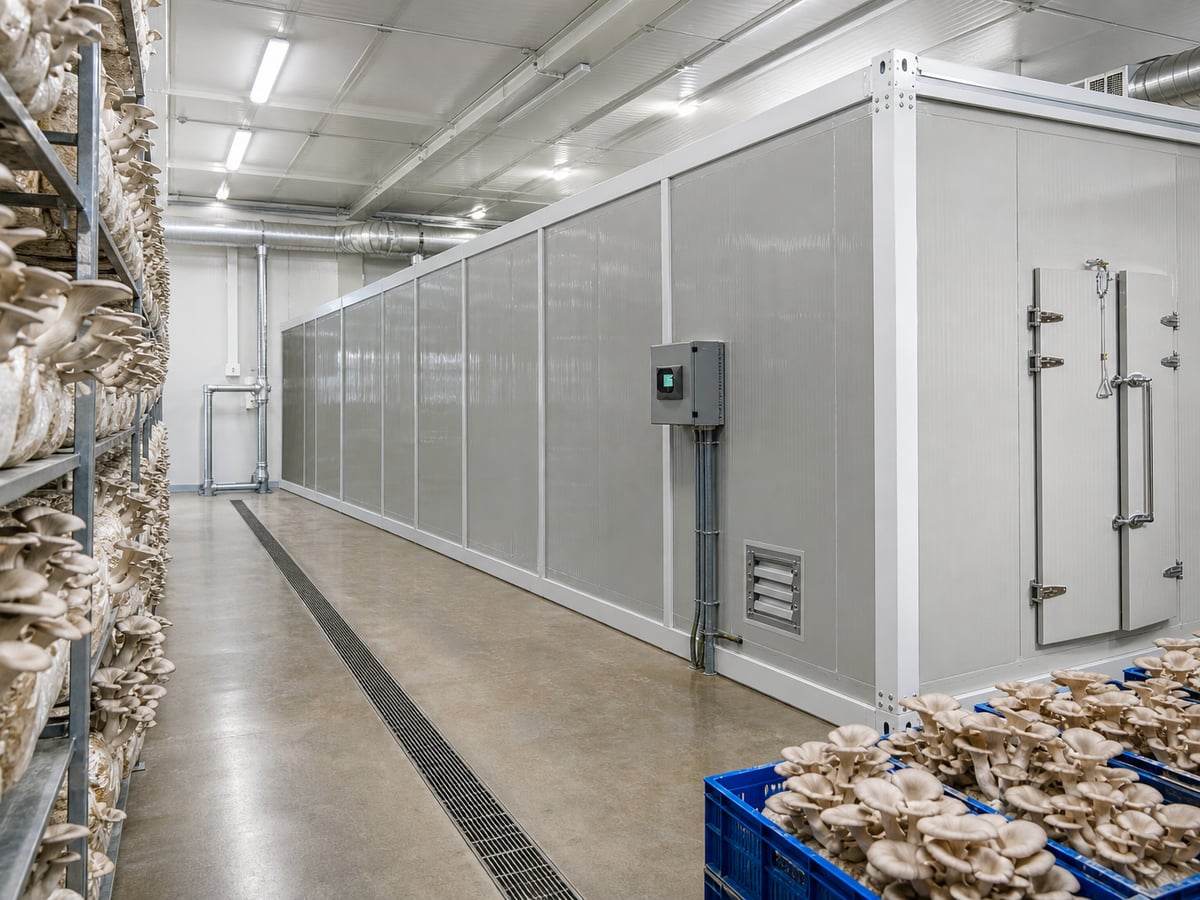
Fast Answer: What Makes an Oyster Mushroom Container Work?

A productive oyster mushroom container is not simply an insulated box filled with growing bags. It is a controlled cultivation environment in which strain selection, rack geometry, fresh-air exchange, humidity, lighting, sanitation, and harvest access work together. For growers in the Global Market, the best design is one that can be adapted to local climate, electricity conditions, labor costs, crop schedules, and logistics.
Start by matching the oyster strain to the surrounding climate and the container’s refrigeration or heating capacity. Arrange bags so that air can move around every fruiting surface, create openings that support predictable pin formation, and install fresh-air equipment capable of removing carbon dioxide during fruiting. Maintain high relative humidity without continuously wetting mushroom caps. Use gentle, evenly distributed light, leave enough space for inspection and harvesting, and validate the planned capacity through small trial batches before filling every rack.
A well-designed modular unit can support farms, restaurants, supermarkets, agricultural cooperatives, food processors, education projects, and urban farms. It can also reduce the risk associated with building a large permanent mushroom house before the operator understands local demand and operating costs. Container cultivation is especially useful where land is expensive, weather is unstable, or a farm needs a movable and repeatable production room.
| Design priority | Practical target | Why it matters | Common error |
|---|---|---|---|
| Temperature | Match the strain’s fruiting range | Supports consistent pinning and crop speed | Choosing a strain before reviewing seasonal temperatures |
| Fresh air | Adjust ventilation to crop stage and density | Controls stem length, cap shape, and carbon dioxide | Using one fixed fan setting all day |
| Humidity | Maintain moisture around the crop without soaking caps | Prevents drying while reducing bacterial and mold risk | Spraying directly onto developing clusters |
| Rack spacing | Leave access for airflow, inspection, and harvest | Improves uniformity and labor efficiency | Maximizing bag count until air cannot circulate |
| Lighting | Provide even, low-heat illumination | Encourages balanced development and easier inspection | Installing bright hot lamps in only one zone |
| Validation | Run staged trial batches before full loading | Reveals real capacity and operating cost | Relying only on supplier capacity claims |
The table shows why capacity should be viewed as a biological and operational result, not just a number of bags per container. A room that holds more bags but produces uneven flushes, long stems, contamination, or difficult harvesting may deliver less saleable mushroom than a slightly less dense arrangement.
Choosing Oyster Strains for Your Climate

Oyster mushrooms include several groups with different temperature preferences, growth rates, colors, textures, and market characteristics. A strain that performs well in a cool warehouse in Rotterdam may require substantial cooling in Bangkok, while a warm-weather strain may fruit poorly in a naturally cool mountain location. Selecting the correct strain is therefore the first climate-control decision.
Common commercial groups include grey or pearl oyster, white oyster, pink oyster, yellow oyster, blue oyster, and king oyster. Pink and yellow varieties can attract premium retail interest but often have shorter shelf life and more specific temperature requirements. Grey and pearl oysters are widely used because they can provide vigorous production across a relatively broad range when the fruiting environment is managed correctly. King oyster generally requires a different crop strategy, with more emphasis on individual stems, lower humidity at selected stages, and precise air movement.
Review the following before importing spawn or planning a production cycle:
- The strain’s colonization temperature and fruiting temperature.
- The expected time from opening to pinning and from pinning to harvest.
- Whether the strain is sensitive to high carbon dioxide.
- Cluster size, cap color, stem length, and shelf-life expectations.
- Availability of reliable commercial spawn in the target region.
- Buyer preferences in local markets, restaurants, hotels, and food-service channels.
| Climate or market condition | Potential strain direction | Container design response | Commercial consideration | Trial question | Useful location example |
|---|---|---|---|---|---|
| Cool, temperate seasons | Grey, pearl, or blue oyster | Prioritize heating control during winter | Good fit for regular fresh-market supply | Can the room prevent cold shock? | Warsaw or Vancouver |
| Hot, humid summers | Warm-tolerant oyster lines | Increase cooling reserve and dehumidification control | Energy cost must be modeled carefully | Does the unit recover quickly after door opening? | Manila or Ho Chi Minh City |
| Dry inland climate | Strains suited to controlled humidity | Use efficient humidification and good insulation | Water treatment may be important | Can humidity recover without wetting caps? | Almaty or Johannesburg |
| Warm premium market | Pink or yellow oyster for niche sales | Provide careful airflow and short-cycle scheduling | Sell quickly because shelf life may be shorter | Will buyers accept seasonal color variation? | Dubai or Singapore |
| Cool highland location | Cool-fruiting grey or blue lines | Size heating and circulation for night conditions | Lower cooling demand can improve margins | Is condensation controlled during warm afternoons? | Nairobi highlands or Quito |
| Restaurant-focused production | Strain selected for flavor and appearance | Use flexible room settings for smaller batches | Harvest timing can be coordinated with orders | Can the room deliver several harvest sizes? | London or Toronto |
This comparison is a starting point rather than a universal prescription. Spawn suppliers may use different names for related strains, and the same strain can behave differently depending on substrate formula, moisture content, bag size, inoculation rate, and incubation history. Ask for production records under conditions close to the intended farm environment.
For farms near coastal ports such as Qingdao, Rotterdam, Los Angeles, or Durban, imported spawn and equipment may be accessible, but shipping time and customs requirements still matter. Operators far from major trade hubs should prioritize strains with dependable local spawn supply and maintain a buffer stock only when storage conditions are validated.
Bag Placement and Fruiting Openings

Bag placement determines whether the crop receives usable air, humidity, and light. The objective is not to pack the maximum number of substrate blocks into the smallest volume. The objective is to create enough fruiting surface per rack while preserving a stable microclimate around each opening.
Many commercial bags are placed on shelves, hung from rails, or supported in vertical rack systems. Shelves are easy to load and inspect, while hanging systems can expose more of the bag surface and improve floor utilization. Whichever method is selected, the rack should be designed around the bag dimensions, expected cluster direction, cleaning route, and worker reach.
Fruiting openings should be consistent. Slits, round holes, or larger cut sections can each work, but the opening size and location influence the number of clusters, moisture loss, and harvest timing. Too many openings can dry the substrate and create a scattered crop. Too few openings can concentrate fruiting in large clusters that are difficult to harvest or that compete for air.
Keep bags away from direct contact with cooling coils, supply ducts, wet walls, and floors. Cold surfaces may cause condensation, while restricted areas can become stagnant. Lower shelves often experience different humidity and airflow from upper shelves, so a full-height test is essential.
| Rack element | Recommended design question | Risk if undersized | Risk if oversized | Inspection method | Labor benefit |
|---|---|---|---|---|---|
| Shelf depth | Can bags remain stable without blocking the rear wall? | Falling bags and poor support | Hidden stagnant zones | Inspect rear corners with a light | Safer loading and unloading |
| Vertical clearance | Can clusters expand without touching the shelf above? | Deformed caps and difficult harvest | Lower bags per room | Measure mature cluster height | Faster cutting and sorting |
| Side aisle | Can a worker reach every opening? | Unharvested or damaged crop | Reduced production density | Perform a loaded-room walk-through | Lower picking time |
| Rear clearance | Can supply air reach the back row? | High carbon dioxide pockets | Unused floor area | Compare front and rear crop shape | More even quality |
| Opening direction | Does the cluster grow toward an accessible aisle? | Broken caps during harvest | Fewer usable opening options | Mark growth direction on trial bags | Cleaner harvesting |
| Rack material | Can it withstand repeated washing and sanitizing? | Rust, contamination, and repairs | Higher initial cost | Check welds, corners, and drainage | Longer service life |
For a new operation, use a pilot rack loaded with representative bags rather than testing an empty room. Measure the distance between bags, observe how clusters expand, and record whether workers can turn, lift, and carry harvested product without touching neighboring bags. This practical test often identifies design problems that drawings do not reveal.
Container dimensions should also reflect transport and installation conditions. A unit shipped through Ningbo, Hamburg, or Santos may need different lifting points, electrical arrangements, and site clearances than one delivered locally. Confirm road access, crane or forklift requirements, drainage, service space, and the position of condensers before finalizing the rack layout.
Fresh-Air Demand During Fruiting
Fresh air is one of the most important controls during fruiting. Oyster mushrooms consume oxygen and release carbon dioxide. When carbon dioxide accumulates, stems may become excessively long, caps may remain small, and clusters may lose the shape expected by buyers. However, excessive ventilation can remove moisture, increase energy consumption, and create uneven conditions between supply and exhaust zones.
Fresh-air demand changes with crop density, substrate temperature, fruiting stage, room temperature, and the number of bags actively producing. A room that performs well during pinning may need a different ventilation pattern when hundreds of clusters mature simultaneously. Control should therefore be staged rather than based on a single permanent fan speed.
Use a calibrated carbon dioxide sensor positioned near the crop, not only beside the door or exhaust duct. Multiple sensors may be justified in long containers or high-density rooms. Compare readings with visual crop signs and record them alongside temperature, humidity, fan status, and harvest results. Sensor placement should avoid direct supply-air streams, which can produce misleadingly low readings.
| Crop stage | Air-management goal | Control emphasis | Visual warning sign | Energy caution | Record to keep |
|---|---|---|---|---|---|
| Post-incubation opening | Refresh the room gradually | Avoid sudden drying or temperature shock | Openings dry before pinning | Do not over-ventilate an inactive crop | Opening time and first pin date |
| Pin initiation | Supply enough oxygen for uniform pins | Use sensor feedback and gentle circulation | Long stems or uneven pin sets | Balance fan time with humidification | CO₂ trend and pin distribution |
| Early fruiting | Remove increasing metabolic load | Increase fresh-air exchange in steps | Small caps with elongated stems | Review cooling load in hot weather | Fan setting and crop response |
| Peak fruiting | Maintain stable air across all racks | Check front, center, and rear zones | Different shapes by rack position | Prevent unnecessary door opening | Zone readings and harvest weight |
| After first flush | Support recovery without excessive drying | Adjust according to remaining moisture | Cracked substrate surface | Reduce ventilation when biological load falls | Flush interval and bag condition |
| Room sanitation | Dry and refresh surfaces safely | Use a separate cleaning procedure | Persistent condensation or odor | Do not confuse sanitation ventilation with crop control | Cleaning date and verification |
Air distribution is as important as total air volume. A powerful fan can still leave dead spots behind racks. Supply air should be distributed so that it does not blast directly onto exposed caps. Return or exhaust points should remove air from areas where carbon dioxide tends to accumulate. Adjustable dampers, variable-speed fans, and a programmable controller make it easier to tune the room after loading.
In hot regions, outdoor air may carry a large cooling and moisture load. In cold regions, excessive fresh-air exchange can lower room temperature and dry the crop. A climate controller should coordinate ventilation with heating, cooling, and humidification instead of operating each device independently. The smart mushroom climate controller from Lanhu is designed as part of an integrated environmental management approach for commercial cultivation projects.
Humidity Without Direct Cap Wetting
Oyster mushrooms require adequate moisture during pinning and fruiting, but high humidity does not mean that mushroom caps should remain wet. Direct water droplets can damage delicate tissue, encourage bacterial problems, reduce appearance quality, and create inconsistent drying between clusters. The aim is to manage the air and substrate moisture so that the crop receives water without continuous surface soaking.
Use clean water, suitable filtration, and a humidification method that produces fine moisture or controlled vapor. The system should be sized for the container volume, insulation quality, fresh-air rate, and local weather. Humidification may be more demanding in a dry climate such as inland Australia or northern Mexico, while dehumidification may be necessary after frequent door opening in a tropical environment.
Humidity sensors should be shielded from direct mist and positioned near the crop canopy. One sensor beside the humidifier is not enough to represent the whole room. Check high and low rack levels, especially during the first production cycles. Hygrometers should be calibrated or compared with a trusted reference before operators make expensive changes.
Moisture management also depends on the substrate. A bag that is too dry may produce weak clusters even when room humidity appears correct. A bag that is too wet can develop anaerobic areas or contamination. Review substrate moisture, sterilization, cooling, inoculation, and incubation practices together with room humidity.
| Humidity tool | Best use | Installation point | Control risk | Maintenance task | Suitable project type |
|---|---|---|---|---|---|
| Ultrasonic humidifier | Fast response in controlled rooms | In a protected service zone | Mineral deposits or excess mist | Clean tank and inspect transducer | Small and medium containers |
| High-pressure fogging | Fine distribution across larger crop areas | Above or along the air path | Wet surfaces if poorly tuned | Check nozzles and filtration | Commercial multi-rack rooms |
| Steam humidification | Precise moisture addition | Connected to safe distribution piping | Energy cost and hot surfaces | Descale and test safety controls | High-control facilities |
| Evaporative media | Lower-cost moisture support | In a dedicated air-handling section | Microbial buildup in wet media | Replace and sanitize media | Dry climates with moderate demand |
| Dehumidification | Remove excess moisture after ventilation or harvest | Where condensate can drain safely | Over-drying the crop | Clean coil, filter, and drain | Humid coastal and tropical sites |
| Manual misting | Small trials or corrective action | Only with trained operators | Direct cap wetting and unevenness | Sanitize tools and monitor results | Very small pilot batches |
Condensation is a warning rather than a target. If water collects on walls, ceilings, racks, or bags, investigate air temperature differences, insulation bridges, excessive humidification, and insufficient air movement. Drainage should be designed into the container so that cleaning water and condensate do not remain near the crop.
Lighting and Even Crop Development
Oyster mushrooms do not need intense sunlight for commercial fruiting, but they benefit from a consistent light-dark schedule and enough illumination for normal development, inspection, and harvesting. Light helps many oyster strains orient their caps and can support more uniform crop presentation. A dark room may still produce mushrooms, but growth can become less predictable and workers may miss contamination or maturity changes.
Use low-heat LED fixtures protected against the moisture level of the room. Position them so that the upper, center, and lower racks receive comparable illumination. Long linear fixtures are often easier to distribute than a few bright point sources. Avoid placing lamps where condensation can enter electrical housings, and follow local electrical safety requirements for wet agricultural environments.
Lighting should not be used to compensate for poor airflow or unsuitable temperature. Excessively bright fixtures can add heat and raise electricity use without improving the crop. Establish a repeatable photoperiod, then compare cap orientation, color, cluster density, and harvest uniformity across rack levels.
Even crop development also depends on consistent bag opening size, equal rack spacing, and air distribution. If the front row receives light and fresh air while the rear row remains shaded and stagnant, lighting alone will not correct the difference.
For commercial projects, include service access to lights, sensors, filters, fans, and control panels. A fixture that requires unloading an entire rack for replacement increases downtime and creates avoidable labor costs. Modular electrical design is particularly useful for container farms that may be relocated or expanded in stages.
Harvest Access and Flush Scheduling
Harvest design should be considered before the first bag enters the container. Oyster clusters can mature quickly, and a delayed harvest may reduce appearance, texture, shelf life, and saleable weight. Workers need a clear route, adequate light, clean tools, and enough room to remove clusters without damaging neighboring fruiting bodies.
Set the harvest point according to the target market. A restaurant may prefer young, compact clusters with a particular texture, while a wholesale buyer may require a larger uniform pack size. Record the time between pinning and harvest for each strain and season. Do not rely only on calendar dates, because temperature and airflow can alter development speed.
Flush scheduling is a balance between biological recovery and market demand. Some operators prefer a concentrated first flush to reduce labor and simplify delivery. Others use staggered openings or separate rooms to maintain a steady weekly supply. A container can support both approaches when bags are loaded in batches and environmental records are linked to each batch.
| Scheduling model | Loading approach | Main advantage | Main limitation | Best fit | Control requirement |
|---|---|---|---|---|---|
| Single batch | Load most bags together | Simple room management | Large harvest peak | Contract orders and processing | Strong harvest labor planning |
| Weekly stagger | Load a fixed portion each week | More even supply | More complex records | Retail and restaurant accounts | Batch identification and cleaning plan |
| Two-zone rotation | Use separate rack or room areas | Allows different crop stages | Higher equipment investment | Growing businesses | Independent monitoring by zone |
| Premium variety cycle | Reserve space for specialty strains | Supports higher-value sales | Shorter shelf life or variable demand | Urban markets and chefs | Pre-orders and rapid delivery |
| Flush-focused cycle | Optimize for first flush weight | Fast return from each batch | Later flushes may be less consistent | Short-term production targets | Substrate and moisture tracking |
| Continuous mixed cycle | Combine several ages in one facility | Uses labor and equipment steadily | Harder sanitation separation | Large commercial operations | Strict zoning and traceability |
Leave space for harvest carts, crates, scales, packaging materials, and rejected product. A container that is technically full of racks may have no practical room for the harvest team. Consider door width, threshold height, ramp angle, washable surfaces, and the shortest route to a cool packing area.
Where possible, separate clean substrate handling, fruiting, harvest handling, and waste movement. This reduces cross-contamination and makes staff training easier. In a modular farm near a city such as Jakarta, Madrid, or Chicago, the container may be located close to consumers, but traffic, noise, drainage, and local planning rules still require attention.
Validating Capacity with Trial Batches
Manufacturers and growers may describe a container by bag capacity, growing area, or expected yield. These figures are useful for comparison, but they should not be treated as guaranteed production. Actual output depends on bag weight, substrate formula, biological efficiency, contamination rate, flush count, harvest timing, labor, and the saleable percentage of the crop.
Validate the design with trial batches. Begin with a small number of bags distributed across all rack levels and positions. Include bags from the intended supplier and substrate recipe. Run the same environmental program planned for commercial production, then record the result from each zone.
| Trial measurement | How to collect it | Why it matters | Decision supported | Minimum comparison | Warning result |
|---|---|---|---|---|---|
| Pinning time | Record opening date and first visible pins | Shows whether the crop schedule is realistic | Set loading and delivery dates | Compare top, middle, and bottom racks | Large unexplained delay |
| First-flush weight | Weigh saleable clusters by bag | Measures early commercial return | Estimate harvest labor and revenue | Compare several bag positions | High variation between zones |
| Saleable percentage | Separate acceptable and rejected product | Prevents overestimating income | Review strain and handling method | Use the same buyer specification | Many damaged or undersized caps |
| CO₂ profile | Log readings during active fruiting | Links air quality to crop form | Adjust fan capacity and placement | Measure multiple room points | Persistent rear-zone elevation |
| Humidity recovery | Observe response after door opening | Tests control stability under work conditions | Size humidification and ventilation | Repeat during different weather | Slow recovery or surface wetting |
| Harvest minutes | Time loading, cutting, sorting, and removal | Reveals labor cost and access problems | Modify aisles and rack spacing | Use trained and new workers | Workers cannot reach rear bags |
Trial batches should cover at least one warm period and one cooler period when the project operates in a seasonal climate. For export projects, test the control system at the destination site rather than relying only on factory testing. Voltage fluctuation, water quality, ambient temperature, and installation workmanship can all affect performance.
Use a simple production dashboard with batch number, strain, substrate weight, inoculation date, opening date, environmental settings, harvest weight, contamination, and buyer feedback. The data can be stored in spreadsheets or integrated into a farm-management system. Over time, this record becomes more valuable than a single projected yield figure because it shows how the specific farm behaves.
Lanhu’s smart mushroom cultivation containers can be evaluated through staged commissioning and project-specific configuration. Buyers should ask for a clear definition of rated capacity, included controls, installation requirements, test procedures, warranty scope, and expected operating conditions.
Market, Product Types, and Buying Advice
The Global Market for controlled mushroom cultivation includes several product categories. A buyer may need a complete smart container, an insulated fruiting room, a climate controller, a modular rack system, a humidification package, or an air-source heat pump. The correct purchase depends on whether the project is a farm expansion, a mobile unit, a demonstration site, or a fully integrated commercial facility.
| Product type | Typical user | Primary purpose | Key specification | Buying question | Expansion path |
|---|---|---|---|---|---|
| Smart cultivation container | Commercial grower or contractor | Integrated fruiting production | Insulation, capacity, controls, airflow | What is included and factory tested? | Add parallel modules |
| Climate controller | Existing mushroom house | Automate temperature, humidity, and air | Sensor inputs and output compatibility | Can it communicate with existing equipment? | Connect additional rooms |
| Modular rack package | Farm builder or distributor | Increase usable crop area | Load rating and washable construction | Does it fit actual bag dimensions? | Reconfigure production zones |
| Air-source heat pump | Energy-conscious facility | Heating or cooling support | Performance at local ambient conditions | What is seasonal efficiency? | Serve packing or incubation areas |
| Hydroponic plant container | Urban farm or institution | Controlled plant production | Light, nutrient, and climate integration | Can the supplier support multiple crops? | Build a mixed modular farm |
| OEM or ODM system | Distributor and engineering company | Private-label or project-specific supply | Documentation and customization range | Who owns drawings and service responsibility? | Develop regional product lines |
When comparing suppliers in China, Europe, North America, Southeast Asia, Africa, or the Middle East, examine the complete cost rather than only the factory price. Include freight, port handling, import duties, local electrical adaptation, foundation work, lifting, installation, commissioning, spare parts, filters, water treatment, and operator training.
Supplier location can influence lead time and after-sales support. A manufacturer in Shandong may ship through Qingdao or another suitable logistics route, while international distributors may stock equipment closer to customers in Dubai, Rotterdam, Sydney, or Lagos. Ask whether replacement sensors, control boards, fans, and filters can be delivered quickly to your region.
Review technical documentation before placing an order. It should identify electrical voltage and frequency, refrigerant or heat-pump details where relevant, insulation construction, drainage, sensor positions, safety protections, maintenance access, and commissioning requirements. For a project financed by a bank or development program, clear specifications also support approval, tendering, and compliance reviews.
Industries and Applications
Oyster mushroom containers are used in more than conventional farms. Their controlled environment makes them suitable for businesses and institutions that need predictable production in limited space.
- Commercial mushroom farms: Add modular fruiting capacity without constructing a large permanent building.
- Agricultural contractors: Deliver standardized cultivation systems for clients in different climates.
- Food distributors: Produce close to retail centers to shorten the time from harvest to shelf.
- Restaurants and hotels: Grow specialty varieties for menus and chef-led marketing.
- Supermarkets: Support local-produce programs and improve supply visibility.
- Universities and vocational schools: Demonstrate controlled agriculture, thermodynamics, automation, and circular food systems.
- Community farms: Operate production in urban or peri-urban locations where land is limited.
- Food processors: Coordinate mushroom production with drying, seasoning, or ready-meal operations.
Applications vary by climate. In tropical regions, the container may reduce heat and humidity risk compared with an open-sided structure. In dry regions, it can conserve water by focusing humidity around the crop. In cold regions, insulation and heat recovery can reduce the energy needed to maintain fruiting conditions.
Containers can also support phased investment. A business may begin with one unit, learn local demand, and add a second unit once sales, labor, and biological performance are proven. This approach is often safer than constructing a large room that cannot be efficiently filled.
Field Examples and Local Supplier Considerations
Consider a small urban farm near Singapore. The operator may have strong restaurant demand but face high outdoor temperature, frequent rainfall, limited floor area, and expensive labor. A compact container with automated humidity, efficient cooling, short harvest routes, and precise batch scheduling may be more practical than a conventional farm building.
In a dry inland location near Johannesburg or Monterrey, water management and humidity recovery may be the main issues. The operator should evaluate filtration, humidification efficiency, condensate handling, and the cost of bringing treated water to the site. A well-insulated container can reduce the effect of large daily temperature swings.
In a cool city such as Warsaw or Vancouver, heating, condensation, and winter fresh-air control may dominate the design. The unit should prevent cold air from drying the crop and should recover efficiently after doors are opened. The supplier should provide performance information for the expected winter conditions rather than only a mild factory climate.
For a distributor serving East Africa, the project may require robust packaging, spare-parts planning, voltage protection, remote technical support, and clear installation documents. Ports such as Mombasa and Dar es Salaam can affect freight planning, while inland delivery may require careful route and lifting assessment.
Local suppliers are valuable for electrical work, foundations, drainage, water treatment, refrigeration service, and routine maintenance. The equipment manufacturer should define which tasks must be performed by trained technicians and which can be handled by the farm team. A successful project usually combines factory expertise with qualified local contractors.
Our Company: Technology, Manufacturing, and Service
Technological capabilities
Shandong Lanhu Air Conditioning Equipment Co., Ltd. develops agricultural climate-control and modular cultivation systems from Dezhou, Shandong, China. Its work combines thermodynamic research, environmental control, automation, and practical agricultural engineering. The company has more than 12 years of thermodynamic research and development experience and has registered more than 45 patents.
Its product range includes smart mushroom cultivation containers, mushroom climate controllers, smart hydroponic plant containers, and air-source heat pumps. These technologies can be configured for projects that require temperature regulation, humidity management, fresh-air control, sensor feedback, and repeatable crop programs. Buyers can review the project case studies to understand how modular cultivation solutions are applied in different environments.
Manufacturing capabilities
Lanhu operates a modern manufacturing facility covering more than 30,000 square meters. Its integrated production resources include product design, engineering development, sheet-metal fabrication, CNC bending, insulation-panel production, electrical assembly, system integration, equipment testing, and quality inspection.
This integrated structure can help reduce coordination gaps between the enclosure, insulation, electrical cabinet, airflow components, and control system. Every system is subjected to functional inspection, electrical verification, performance testing, and operational evaluation before shipment. The company maintains ISO 9001, ISO 14001, ISO 45001, and ISO 12100 certifications, together with patent certificates and enterprise credibility credentials.
Service capabilities
Lanhu supplies equipment directly from the factory and supports OEM and ODM projects for agricultural contractors, equipment distributors, engineering companies, and commercial farming projects. Service capabilities include engineering assistance, international logistics support, spare-parts support, installation guidance, commissioning coordination, and after-sales service.
For buyers planning a project in the Global Market, the most useful first step is to provide the target country, local ambient conditions, electricity standard, available water, desired strain, substrate bag dimensions, production target, site measurements, and expected delivery route. This information allows the supplier to discuss a practical configuration rather than a generic container.
Organizations seeking private-label equipment can also use Lanhu’s OEM and ODM service to discuss branding, control interfaces, enclosure details, documentation, and project-specific engineering. A strong supplier relationship should continue beyond shipment through commissioning, operator training, spare-parts planning, and performance review.
Frequently Asked Questions
How many oyster mushroom bags fit in one container?
There is no universal number. Capacity depends on container dimensions, bag size, rack configuration, opening method, aisle width, ventilation, and the intended harvest process. Ask whether the quoted capacity refers to tightly packed bags, recommended operating capacity, or a tested commercial configuration. A trial batch should confirm the practical number.
Can one container grow different oyster strains?
It may be possible when strains have compatible temperature, humidity, airflow, and lighting requirements. However, strains with significantly different fruiting conditions are easier to manage in separate zones or separate batches. Mixed production also requires clear labeling and harvest records to prevent product confusion.
Should mushroom caps be sprayed with water?
Direct cap spraying is generally not the preferred humidity strategy. Use controlled room humidity, clean water, suitable airflow, and correct substrate moisture. If a corrective mist is necessary during a trial, apply it carefully and observe whether it creates surface wetness, bacterial damage, or uneven crop development.
What causes long stems and small caps?
High carbon dioxide is a common cause, but it is not the only one. Insufficient light, poor air distribution, excessive crop density, unsuitable strain selection, and temperature problems can create similar symptoms. Check sensor position, front-to-back readings, rack density, and crop history before increasing fan speed dramatically.
How often should fresh air be exchanged?
The correct schedule depends on crop load, room volume, strain, temperature, humidity, and equipment. Instead of copying a fixed interval, monitor carbon dioxide and crop shape while adjusting ventilation in stages. A variable-speed system with sensor feedback is usually more adaptable than a single-speed fan running continuously.
What type of light is suitable for an oyster mushroom container?
Low-heat, moisture-protected LED lighting is generally suitable. Use even distribution across all racks and a repeatable photoperiod. Lights should support crop orientation and worker inspection without creating excessive heat or glare. Electrical components must be selected and installed for the room’s moisture conditions.
How can a grower reduce condensation?
Review insulation, thermal bridges, surface temperature, humidification level, air circulation, fresh-air temperature, and drainage. Condensation often occurs when warm moist air meets a cold wall, ceiling, coil, or bag surface. Do not solve the problem only by lowering humidity if the underlying temperature difference remains.
Is a mushroom container suitable for a new farmer?
Yes, provided the operator begins with realistic scale and receives training in substrate handling, sanitation, environmental control, harvesting, and sales. A small trial can reveal whether local buyers accept the chosen strain and whether electricity, labor, water, and logistics fit the business plan.
What should be included in a supplier quotation?
Request container dimensions, rack layout, rated and recommended bag capacity, electrical requirements, climate-control range, fresh-air equipment, humidity system, sensors, controller functions, lighting, drainage, installation scope, testing procedure, warranty, spare parts, packaging, shipping terms, and after-sales support. Also ask which site works are excluded.
Can Lanhu customize a cultivation container?
Lanhu supports OEM and ODM cooperation and can discuss project-specific requirements such as dimensions, rack arrangements, control functions, branding, electrical standards, and integration with other equipment. Final feasibility depends on the crop, site, target climate, safety requirements, and production plan.
What trends will influence oyster mushroom containers through 2026?
Future development is likely to focus on sensor-based control, predictive maintenance, energy-efficient heat pumps, variable-speed ventilation, remote monitoring, and data-linked production records. Sustainability priorities will encourage lower refrigerant impact, improved insulation, water reuse where safe, recyclable materials, and reduced food miles. Policy and food-safety requirements may also increase demand for traceable batches, hygienic surfaces, documented cleaning, and verified energy performance.
As climate variability increases, growers will place greater value on equipment that can respond to heat waves, cold snaps, water restrictions, and fluctuating electricity prices. Modular containers can support this transition by allowing farms to expand in stages, isolate crop cycles, and standardize production across different regions. The strongest long-term design will combine biological understanding with efficient engineering, trained operators, reliable local support, and honest capacity validation.
Share this article

About the Author: Shandong Lanhu Air Conditioning Equipment
Lanhu is a professional climate control equipment manufacturer specializing in smart agricultural systems, commercial HVAC solutions, and customized temperature control technologies. With extensive engineering experience, Lanhu provides reliable solutions for plant factories, controlled environment agriculture, and industrial applications.
Need a Custom Climate Control Solution?
From smart agricultural systems to commercial HVAC solutions, Lanhu provides reliable temperature and humidity control solutions tailored to your project needs.
Contact Us