High-Performance Mushroom Climate Systems | Global Market
Quick Answer: Why Mushroom Crop Loads Define Cooling Capacity

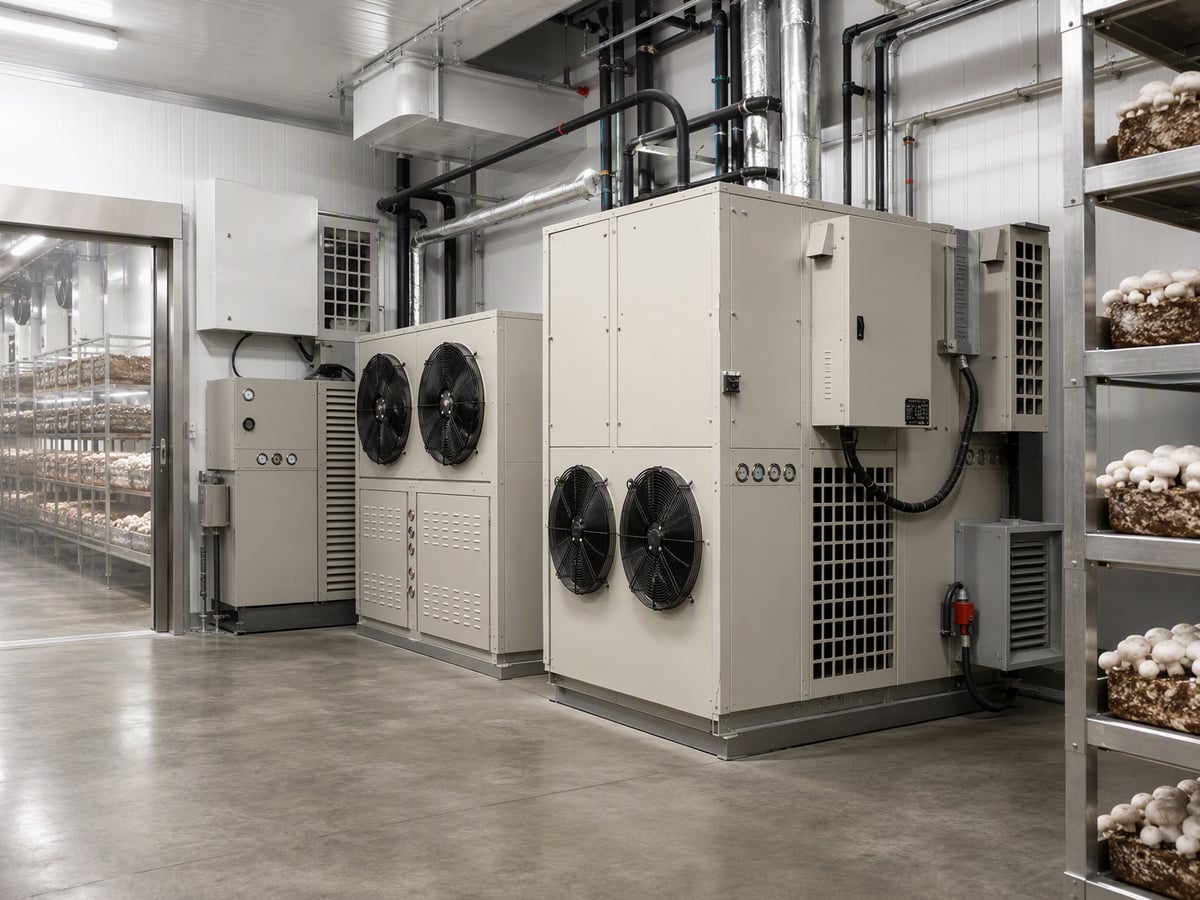
Mushroom air conditioners are not ordinary comfort-cooling units. A production room contains a living crop, wet substrate, humidification equipment, workers, lighting, fresh-air requirements and sometimes warm outdoor air entering through ventilation. These sources create a changing thermal and moisture load that can be much higher than the load suggested by room size alone.
The correct system must therefore be selected from design conditions rather than from floor area or a simple “watts per square metre” rule. A reliable calculation considers outdoor temperature, substrate temperature, compost or block mass, crop stage, target relative humidity, fresh-air volume, carbon dioxide removal, fan heat, lighting, door openings and the required pull-down time after loading.
For growers in the Global Market, the best mushroom climate system normally combines precise temperature control, strong dehumidification performance, controlled fresh-air treatment, corrosion-resistant construction and stable operation at partial load. A system that only delivers nominal cooling capacity in a laboratory condition may struggle during a hot loading day or when a room is filled with warm substrate.
- Sensible load changes room temperature and comes from weather, substrate, equipment, lighting, fans and people.
- Latent load adds moisture that must be condensed or removed through managed ventilation.
- Fresh-air load can be substantial because incoming outdoor air must be cooled and often dehumidified.
- Biological load varies with species, substrate activity and crop development.
- Control load increases when the system must maintain a narrow temperature range without over-drying the crop.
In practical terms, the right mushroom air conditioner is a climate-control platform, not simply a compressor and evaporator. The system should be evaluated for its performance at the actual design temperature, humidity and airflow required by the farm.
Cooling a Living Production Environment

A mushroom room is a controlled biological environment. The crop continues to respire, the substrate exchanges heat and moisture with the air, and ventilation must balance oxygen supply with carbon dioxide removal. This makes the room more dynamic than a warehouse, cold store or office.
Temperature stability is especially important during colonisation, pinning, fruiting and harvest. Depending on the species and production method, a small temperature deviation can influence pin formation, flush timing, stem quality, cap development, contamination risk and total yield. Fast temperature recovery after door opening or loading may also be important in commercial facilities operating several rooms on different schedules.
Why room volume alone gives a poor estimate
Two rooms with the same volume may require very different cooling capacities. One may contain empty racks and dry packaging, while the other contains several tonnes of wet substrate, active compost, humidification equipment and a high fresh-air rate. A calculation based only on room volume can understate the initial pull-down load or overstate the required capacity for a later low-load crop stage.
The load also changes during the day. A farm near Bangkok, Lagos, Dubai or São Paulo may receive warm, humid air whenever ventilation increases. A farm in Rotterdam, Vancouver or Qingdao may experience a much lower outdoor moisture load but still require heating, cooling and precise humidity control during seasonal transitions. Climate data and operating schedules must therefore be included in the design.
Production-room conditions to define first
| Design item | Why it matters | Typical information to provide |
|---|---|---|
| Room dimensions | Establishes air volume, surface area and equipment layout. | Length, width, height and insulated panel thickness. |
| Crop type | Species and substrate influence respiration and moisture release. | Oyster, shiitake, button, lion’s mane or another commercial crop. |
| Substrate mass | Warm blocks or compost can create a large initial sensible load. | Mass per room, loading temperature and loading time. |
| Target conditions | Determines coil temperature, airflow and control accuracy. | Temperature, relative humidity and CO2 set points. |
| Fresh-air rate | Outdoor air may add heat and moisture while removing CO2. | Air changes per hour, fan flow or CO2 control strategy. |
| Operating schedule | Shows whether the system needs rapid pull-down or mainly steady maintenance. | Loading days, harvest periods, door openings and shift pattern. |
| Local climate | Outdoor design conditions determine peak cooling and dehumidification demand. | Summer dry-bulb, wet-bulb, humidity and winter conditions. |
The table shows why a supplier should request more than room dimensions. A professional quotation should state the assumptions used for outdoor air, internal heat, substrate condition, humidity and design set points. This makes competing offers easier to compare and reduces the risk of selecting a unit based on an attractive but irrelevant nominal rating.
Cooling approaches for different farm sizes
Small farms may use packaged air-cooled systems serving one insulated room. Medium facilities often use separate systems for incubation, fruiting, storage and processing areas. Large projects may use multiple packaged units, modular plant rooms, chilled-water systems or containerised climate modules. The most suitable arrangement depends on redundancy, service access, energy prices, room segregation and the availability of qualified technicians.
In all cases, air distribution is as important as refrigeration capacity. Poorly placed supply air can create cold spots, dry areas or excessive air velocity across mushrooms. Ducts, perforated textile systems, fan speed and return-air position should be designed with the crop layout and rack arrangement in mind.
Sensible Heat from Weather, Substrate and Equipment

Sensible heat is the portion of the load that raises air or material temperature. In mushroom cultivation, it comes from several sources that may occur simultaneously. Outdoor heat enters through walls, ceilings, doors and fresh-air ducts. Warm substrate brings stored heat into the room. Fans, pumps, lights, controllers and motors convert electrical energy into heat. Workers and handling equipment add smaller but still measurable contributions.
Outdoor transmission and solar exposure
Insulated panels reduce heat transfer but do not eliminate it. The load depends on panel U-value, surface area, outdoor temperature, indoor temperature, thermal bridges and solar exposure. A south-facing roof in a hot climate may experience a significantly higher surface temperature than the surrounding air. Door frames, service penetrations and poorly sealed joints can also become local heat bridges.
Facilities near Riyadh, Perth, Mexico City, Johannesburg or inland areas of China should be assessed for high summer design temperatures. Coastal locations such as Singapore, Manila, Jakarta, Rotterdam and Busan may have lower dry-bulb extremes but higher humidity, increasing the total enthalpy of incoming air.
Substrate and compost heat
Substrate is often the most overlooked source of peak sensible heat. Blocks or compost may arrive warmer than the target room condition, particularly after sterilisation, pasteurisation, transport or outdoor staging. The cooling system must remove this stored heat while also maintaining the desired room temperature for the crop already present.
The calculation should include the quantity loaded per hour, the specific heat of the substrate, the difference between loading temperature and room set point, and the required pull-down duration. If a grower wants the room to recover within two hours rather than twelve hours, the required capacity may increase substantially.
Internal equipment and people
Fan motors release nearly all of their electrical input as heat into the air stream. Humidifiers may add latent moisture and sensible heat, while pumps, lighting and control panels contribute additional heat. Forklifts, pallet trucks and workers become relevant during loading and harvesting peaks.
| Heat source | Load behaviour | Design question | Risk if ignored |
|---|---|---|---|
| Warm substrate | High during loading, then decreases. | How many tonnes enter per hour? | Slow pull-down and temperature overshoot. |
| Outdoor walls and roof | Continuous and weather-dependent. | What are the local summer design conditions? | Insufficient capacity during hot weather. |
| Fresh-air fans | Continuous or demand-controlled. | What airflow is required for CO2 removal? | Unexpected peak load and poor air quality. |
| Circulation fans | Continuous while operating. | What is the motor power and location? | Room temperature rises despite cooling. |
| Humidifiers | Intermittent, often high during fruiting. | How much water is evaporated? | Higher latent load and unstable humidity. |
| Lighting | Scheduled or continuous. | Are lights inside the conditioned envelope? | Capacity shortfall during working periods. |
| People and vehicles | Short-duration peaks. | How many workers enter and for how long? | Temporary temperature and CO2 changes. |
For a first estimate, the sensible load can be expressed as the sum of transmission, substrate pull-down, equipment, lighting, people, fan and solar loads. A final selection should also consider safety factors without applying an excessive margin. Oversizing can cause short cycling, poor dehumidification and unstable room conditions, especially during later crop stages.
Case example: a warm-loading fruiting room
Consider a fruiting room outside Izmir with insulated panels, several rows of oyster mushroom blocks and a loading schedule concentrated in the morning. If blocks arrive at 28°C while the room target is 18°C, the refrigeration plant must first remove the stored sensible heat. At the same time, outdoor air enters to control CO2, workers open doors and humidification maintains the crop environment.
A unit selected only from the room’s cubic volume may maintain 18°C after the room is stable but fail during loading. A design that separates pull-down capacity from steady-state capacity provides a more realistic result. Multiple staged units can also offer redundancy and allow the farm to operate efficiently when only one room is at high load.
Moisture Loads and Coil Performance
Humidity is not a secondary consideration in mushroom production. The crop, wet substrate, humidifiers, sanitation procedures, fresh air and door openings all affect the moisture balance. A cooling coil removes moisture only when its surface temperature is below the dew point of the air passing across it. Therefore, nominal cooling capacity alone does not prove that the system can control relative humidity.
Where moisture enters the room
- Water evaporates from substrate, casing layers and mushroom surfaces.
- Humidifiers add water intentionally to protect crop quality.
- Fresh air brings outdoor humidity into the room.
- Cleaning and sanitation can create temporary high moisture loads.
- Open doors allow humid air to enter and cool surfaces to reach dew point.
- Respiration produces water as the crop develops.
In a warm and humid climate, a fresh-air system may need to remove both sensible heat and a large amount of latent heat before air reaches the cultivation room. In a dry climate, the same room may require humidification for much of the crop cycle. The control strategy should avoid fighting between humidifiers and a cold coil wherever possible.
Coil selection and condensate management
Coil rows, face velocity, entering-air condition, leaving-air temperature and refrigerant or chilled-water temperature all affect moisture removal. A coil designed for comfort cooling at a relatively high leaving-air temperature may not provide enough latent performance for a mushroom room. Conversely, an excessively cold coil may over-dry the crop, increase energy use and create excessive condensate.
Drain pans, traps, slopes and condensate piping need careful attention. High humidity can expose weak installation details quickly. Standing water in a pan can support microbial growth, while poorly trapped drains can pull humid air into the unit or leak water into an insulated room. Access for cleaning and inspection should be included at the design stage.
| Moisture-control feature | Purpose | Selection or inspection point | Operational benefit |
|---|---|---|---|
| Low-temperature coil option | Improves condensation when latent load is high. | Confirm leaving-air temperature and crop tolerance. | More reliable humidity control. |
| Variable-speed fan | Adjusts airflow across the coil. | Check minimum and maximum airflow limits. | Better part-load stability. |
| Condensate drain system | Removes water safely from the air handler. | Review slope, trap, material and clean-out access. | Fewer leaks and hygiene problems. |
| Fresh-air pre-treatment | Reduces outdoor moisture before room entry. | Confirm design wet-bulb and airflow. | Lower latent burden on the room coil. |
| Humidity sensor placement | Measures representative crop-room conditions. | Avoid direct supply air and wet surfaces. | More accurate control. |
| Dehumidification mode | Maintains humidity when temperature load is low. | Check reheat or sensible-heat management. | Stable humidity without overcooling. |
| Washable filters | Protect coils from dust and biological particles. | Verify filtration class and service access. | Maintains airflow and sanitation. |
Relative humidity versus absolute moisture
Relative humidity changes with temperature. Air at 90% relative humidity can hold very different quantities of water at 12°C and 24°C. For engineering decisions, humidity ratio, dew point and enthalpy are often more useful than relative humidity alone. Growers should ask suppliers to state entering and leaving air conditions, not just a percentage humidity target.
A high-quality mushroom climate controller can coordinate temperature, humidity, fan speed and ventilation. The [smart mushroom climate controller] (https://smartmushroomcabin.com/smart-mushroom-climate-controller/) can be reviewed as an example of how a dedicated control platform supports more precise agricultural operation than a basic thermostat.
Fresh-Air Treatment and CO2 Removal
Fresh air is essential because mushrooms and microorganisms consume oxygen and release carbon dioxide. CO2 concentration influences crop morphology and must be managed according to species and stage. Ventilation, however, introduces outdoor heat and moisture. The engineering challenge is to remove CO2 without creating temperature swings, excessive drying or unnecessary energy consumption.
Ventilation strategies
Some facilities use a constant fresh-air rate, while others use CO2 sensors and demand-controlled ventilation. Constant ventilation is simple and predictable but may waste energy when the crop load is low. Demand control can reduce fan energy and conditioning load, provided sensors are calibrated and minimum ventilation is maintained.
Fresh-air fans should be selected for the resistance of filters, ducts, dampers, coils and distribution devices. The fan curve must be checked at the actual operating point. A nominal fan flow without static-pressure information can result in inadequate air exchange after filters become dirty.
Outdoor air treatment
In humid cities such as Kuala Lumpur, Ho Chi Minh City, Miami and Lagos, fresh air may require substantial dehumidification. In hot, dry locations such as Phoenix, Riyadh and inland Australia, the main challenge may be sensible cooling plus humidification. In cold regions, outdoor air may need heating before it reaches the crop room.
A dedicated outdoor-air unit or a pre-conditioning section can reduce the burden on the main room air conditioner. Heat recovery may also be useful where exhaust air and fresh air volumes are significant. The design must consider hygiene, filter maintenance and whether the recovery device is suitable for a biological production environment.
| CO2 and fresh-air method | Best suited to | Advantages | Limitations |
|---|---|---|---|
| Constant ventilation | Small rooms with stable crop schedules. | Simple operation and predictable airflow. | Higher energy use at low biological load. |
| CO2 demand control | Multiple crop stages and variable respiration. | Reduces unnecessary outdoor-air conditioning. | Requires accurate sensors and commissioning. |
| Dedicated outdoor-air unit | Humid climates or high ventilation rates. | Separates latent load from room control. | Higher initial cost and added maintenance. |
| Heat-recovery ventilation | Facilities with long operating hours. | Can reduce heating and cooling energy. | Needs careful hygiene and frost protection. |
| Intermittent purge cycles | Rooms with predictable CO2 accumulation. | Lower fan runtime in selected conditions. | May cause temperature and humidity swings. |
| Independent exhaust fans | Simple agricultural buildings. | Low equipment complexity. | Limited control of incoming air condition. |
| Central air-handling system | Large commercial mushroom projects. | Integrated filtration, cooling and control. | Requires stronger engineering coordination. |
CO2 sensors should be positioned where they represent the crop zone rather than the supply-air jet or exhaust outlet. Calibration, alarm limits and sensor replacement intervals should be documented. A controller that can record temperature, humidity, CO2 and alarms helps growers compare room performance across batches.
Energy and sustainability considerations
By 2026, more growers are evaluating energy intensity per kilogram of mushrooms, not only installed refrigeration capacity. Variable-speed compressors, EC fans, heat recovery, demand-controlled ventilation and low-global-warming-potential refrigerants are becoming more important in project specifications. Buyers should ask for seasonal efficiency information and service requirements, not just peak capacity.
Materials for High-Humidity Operation
High humidity, frequent washing, disinfectants and organic particles can be demanding for equipment. The casing, fasteners, drain pan, coil treatment, insulation, control enclosure and ductwork should all be selected for the application. A unit that performs well in a dry warehouse may deteriorate quickly in a mushroom room if its materials are not suitable.
Construction details to review
- Use corrosion-resistant sheet metal or appropriate protective coatings for exposed surfaces.
- Specify stainless steel or treated materials for drain pans and wet areas where practical.
- Seal panel joints and penetrations to prevent moisture migration into insulation.
- Provide smooth, cleanable internal surfaces with minimal dirt traps.
- Protect electrical cabinets against condensation and wash-down exposure.
- Use insulation with suitable vapour resistance for the room temperature and humidity.
- Ensure filters, coils, fans and drain systems can be accessed without damaging crop-room hygiene.
Electrical protection deserves special attention. Condensation can occur when a warm, humid room contacts a cold cabinet or cable gland. Proper enclosure ratings, cable routing, anti-condensation measures and grounding should be verified by qualified personnel. Local electrical codes vary between countries, so the final installation must comply with the requirements of the project location.
| Component | Preferred design consideration | Inspection question | Maintenance implication |
|---|---|---|---|
| Outer casing | Coated steel, stainless steel or another corrosion-resistant finish. | Is the coating suitable for humid agricultural use? | Inspect scratches, rust and coating damage. |
| Drain pan | Sloped, cleanable and resistant to corrosion. | Does water flow fully to the drain outlet? | Clean and disinfect at scheduled intervals. |
| Coil fins | Coating or material selected for moist environments. | Is the coil compatible with cleaning chemicals? | Remove dust and biological deposits carefully. |
| Insulation panels | Low air leakage and strong vapour resistance. | Are joints, corners and penetrations sealed? | Check for wet insulation or damaged seals. |
| Electrical enclosure | Suitable ingress protection and cable entry. | Can condensation be prevented during shutdown? | Test terminals, fans, sensors and alarms. |
| Fasteners | Corrosion-resistant hardware in exposed areas. | Are screws and brackets suitable for wash-down zones? | Replace corroded hardware before failure. |
| Air filters | Washable or replaceable media with secure frames. | Can filters be removed without contaminating the room? | Set cleaning and replacement intervals. |
Modular and containerised cultivation
Modular cultivation rooms and smart mushroom containers can help growers create repeatable production conditions where conventional buildings are unavailable or expansion must be phased. A containerised solution may combine insulated panels, refrigeration, fresh-air treatment, controls, lighting and monitoring in a compact footprint.
These systems are useful for pilot farms, urban agriculture, contract production, remote sites and markets where rapid deployment is important. However, the same load calculations still apply. A small container can contain a high crop density, and limited service space makes equipment access and condensate management especially important. The [smart mushroom cultivation container] (https://smartmushroomcabin.com/smart-mushroom-cultivation-container/) provides a reference point for evaluating an integrated modular approach.
Part-Load Control and Crop Stages
Mushroom production rarely operates at one constant load. A room may be empty during sanitation, heavily loaded during substrate placement, biologically active during fruiting and lightly loaded after harvest. The air conditioner must respond to these changes without excessive cycling or unstable humidity.
Matching capacity to crop development
During early substrate stages, the sensible and respiratory load may increase as biological activity develops. During pinning and fruiting, humidity and fresh-air requirements may become more significant. After harvest, the room may need cleaning, drying or a different temperature profile. A fixed-speed unit that is correctly sized for peak load may be too large during maintenance or low-load operation.
Part-load control can be achieved through inverter compressors, multiple compressor circuits, staged units, variable-speed indoor fans, electronic expansion valves and intelligent control logic. The right combination depends on room size, budget, climate and required redundancy.
| Control technology | How it works | Useful application | Potential concern |
|---|---|---|---|
| Inverter compressor | Modulates compressor speed to match demand. | Rooms with large variation between crop stages. | Requires compatible electrical and control design. |
| Multiple compressor circuits | Starts or stops separate capacity steps. | Medium and large rooms needing redundancy. | More components and control coordination. |
| Variable-speed indoor fan | Adjusts airflow while maintaining distribution. | Humidity control and low-load operation. | Minimum airflow must protect the coil. |
| Electronic expansion valve | Controls refrigerant flow accurately. | Changing load and wide operating ranges. | Needs correct commissioning and sensors. |
| Demand-controlled ventilation | Changes fresh-air flow according to CO2. | Rooms with varying respiration rates. | Sensor drift can affect crop conditions. |
| Hot-gas or electric reheat | Controls humidity without excessive cooling. | Humid climates and low sensible loads. | Adds energy use and installation complexity. |
| Room scheduling software | Coordinates set points and production stages. | Facilities with many rooms and recipes. | Requires training and reliable communications. |
Control sequences that protect the crop
A useful control sequence may reduce compressor capacity before reaching the temperature set point, maintain a minimum airflow across the coil, adjust fresh-air dampers according to CO2 and limit humidification when the coil is actively dehumidifying. Alarm functions should identify high temperature, low temperature, high humidity, low airflow, blocked filters, sensor failure and communication loss.
Remote monitoring is increasingly valuable for farms operating multiple locations or long shifts. A dashboard can show trends and compare rooms, but remote access should not replace local safety controls. The system should continue to protect the crop if the internet connection fails.
Future trends through 2026 and beyond
Climate-control technology is moving toward predictive operation. Controllers can use historical room data, weather forecasts, crop recipes and energy prices to pre-cool rooms before a high-load event or reduce ventilation when CO2 demand is low. Digital records can support traceability, food-safety audits and production planning.
Sustainability requirements are also becoming more influential. Farms are evaluating refrigerants with lower environmental impact, heat recovery for hot water or adjacent spaces, photovoltaic integration, low-leakage insulated envelopes and equipment that can be repaired rather than discarded. Policy developments in refrigerant management, energy efficiency and food production emissions may affect equipment selection and ownership costs in different regions.
For global projects, buyers should request a clear statement of refrigerant type, efficiency test conditions, expected maintenance, replacement parts and compliance documentation. A sustainable design is not only about a refrigerant number; it also includes long service life, low leakage, efficient control and correct sizing.
Requesting Capacity at Design Conditions
A professional request for quotation should allow suppliers to calculate both peak and operating capacity. Instead of asking only for a “10-ton mushroom air conditioner,” provide a design schedule. This helps suppliers in China, Europe, the Middle East, Southeast Asia, Africa and the Americas quote comparable equipment.
Information to include in an enquiry
| Quotation input | Example description | Why the supplier needs it |
|---|---|---|
| Project location | For example, Muscat, Nairobi, Hamburg or Guangzhou. | Defines outdoor design temperature and humidity. |
| Room size | Internal dimensions and insulated construction details. | Supports transmission and airflow calculations. |
| Crop and substrate | Species, block or compost type and total mass. | Estimates biological and pull-down loads. |
| Target conditions | Temperature, relative humidity and CO2 range by stage. | Determines coil, controls and ventilation requirements. |
| Loading schedule | Quantity and temperature of material entering per hour. | Calculates peak sensible load and recovery time. |
| Fresh-air requirement | Air changes, litres per second or CO2 control limits. | Calculates outdoor-air conditioning load. |
| Electrical supply | Voltage, phase, frequency and available capacity. | Ensures equipment compatibility. |
| Installation conditions | Indoor, outdoor, rooftop or containerised placement. | Influences casing, weather protection and service access. |
Ask for the following performance information:
- Total and sensible cooling capacity at the stated entering and leaving conditions.
- Moisture removal rate or condensate capacity at the design humidity.
- Airflow, external static pressure and fan power.
- Compressor operating range and minimum stable capacity.
- Noise level and vibration-control provisions.
- Power input, efficiency and expected operating range.
- Refrigerant type, safety classification and service requirements.
- Control functions, sensor inputs, alarms and data-logging capability.
- Recommended spare parts and response arrangements.
- Factory inspection, testing and documentation included before shipment.
Comparing suppliers in different regions
Local suppliers may provide rapid service and familiarity with local codes. International manufacturers may offer specialised agricultural designs, modular systems or factory-direct pricing. The best decision depends on total ownership cost, not only equipment purchase price. Freight from Shanghai, Qingdao, Ningbo, Hamburg, Rotterdam, Dubai or Los Angeles can affect the landed cost, while local labour rates and spare-parts availability influence long-term operation.
For an imported system, confirm Incoterms, packaging, customs documentation, voltage, plug and control standards, warranty scope, commissioning support and delivery of replacement sensors or boards. For a local system, confirm whether the supplier has experience with high-humidity mushroom rooms rather than only offices, shops or general cold storage.
Installation and commissioning checklist
- Verify that the insulated envelope is complete and air leakage is controlled.
- Check that the unit is level, accessible and supported according to the installation drawings.
- Confirm refrigerant piping, drainage, electrical protection and airflow direction.
- Calibrate temperature, humidity, CO2 and pressure sensors.
- Measure actual supply and return airflow at operating static pressure.
- Test cooling, dehumidification, ventilation, alarms and failure recovery.
- Record entering and leaving air conditions under representative load.
- Train operators on crop recipes, filter cleaning and emergency procedures.
Systems intended for international shipment should undergo documented functional inspection, electrical verification, performance testing and operational evaluation before dispatch. Factory acceptance records make installation troubleshooting easier and provide evidence that the equipment was tested against an agreed specification.
Our Company: Agricultural HVAC Engineering from China
Shandong Lanhu Air Conditioning Equipment Co., Ltd. develops agricultural climate-control equipment, industrial HVAC systems and modular cultivation solutions from Dezhou, Shandong, China. Its location provides access to established manufacturing, engineering and logistics networks serving projects in East Asia, Southeast Asia, Central Asia, the Middle East, Africa, Europe and the Americas.
Technological capabilities
Lanhu combines more than twelve years of thermodynamic research and development experience with agricultural climate-control applications. Its product range includes mushroom climate controllers, smart mushroom cultivation containers, hydroponic plant containers and air-source heat pumps. The engineering approach focuses on integrating cooling, heating, humidity, fresh-air and monitoring functions rather than treating each requirement as a separate device.
The company has more than forty-five registered patents and develops control solutions for changing crop stages. Its systems can be configured for different room sizes, climate zones, electrical supplies and operating recipes. Buyers can review the [mushroom climate control solution] (https://smartmushroomcabin.com/smart-mushroom-climate-controller/) when comparing control functions, sensor integration and remote-management requirements.
Manufacturing capabilities
The company operates a manufacturing facility of more than 30,000 square metres. Its integrated production activities include product design, engineering development, sheet-metal fabrication, CNC bending, insulation-panel production, electrical assembly, system integration, equipment testing and quality inspection.
This integrated structure can help reduce coordination problems between the enclosure, refrigeration system, controls and installation package. It is especially useful for modular cultivation projects where mechanical, electrical and insulated-panel interfaces must be completed accurately. Factory testing can include functional checks, electrical verification, performance evaluation and operational review before shipment.
Service capabilities
Lanhu supplies equipment directly from the factory and supports OEM and ODM projects for agricultural contractors, distributors, engineering companies and commercial farms. Service support can include engineering assistance, international logistics coordination, spare-parts planning, installation guidance, commissioning communication and after-sales support.
Its management systems include ISO 9001 quality management, ISO 14001 environmental management, ISO 45001 occupational health and safety and ISO 12100 machinery-safety certification. These credentials should be reviewed alongside the project specification, testing records and local compliance requirements rather than treated as a substitute for technical verification.
For examples of completed agricultural equipment projects, buyers can explore the [global cultivation project examples] (https://smartmushroomcabin.com/case/). For customised room layouts, branding, controls or production configurations, the [OEM and ODM engineering service] (https://smartmushroomcabin.com/oem-odm-service/) can be considered during the early design stage.
Who can benefit from a factory-direct partner?
Factory-direct cooperation may suit mushroom distributors, agricultural contractors, project developers, equipment integrators and growers building several rooms. It can simplify communication for standard and customised equipment, but buyers should still appoint qualified local professionals for installation, electrical work, refrigerant handling and compliance approval.
FAQ: Mushroom Air Conditioner Selection
Is a mushroom air conditioner the same as a cold-room unit?
No. A cold-room unit is generally designed to hold a stored product at a specified temperature. A mushroom room must manage a living crop, humidity, CO2, fresh air, substrate heat and changing biological loads. Some refrigeration components may be similar, but the controls, airflow, coil performance and ventilation strategy are different.
How do I calculate the required cooling capacity?
Begin with transmission, substrate pull-down, fresh-air, equipment, fan, lighting, people and biological loads. Add the latent load from crop respiration, substrate, humidification, sanitation and outdoor air. State the design outdoor conditions and the required recovery time. A qualified HVAC engineer should then verify the total, sensible and latent capacity at the actual operating conditions.
Can I select a unit by room volume?
Room volume is useful for estimating air quantity, but it is not enough to select cooling capacity. Two rooms of equal volume may have different substrate mass, ventilation rates, outdoor conditions, insulation, equipment heat and crop schedules. Volume-only selection can result in poor temperature recovery or unstable humidity.
Why does the room become too dry when cooling is active?
Cold coils condense moisture. If the coil is too cold, airflow is too low or the system operates for long periods at low sensible load, it may remove more moisture than the crop requires. Control logic, variable-speed capacity, humidification coordination and suitable coil selection can reduce this problem.
Do I need a dedicated fresh-air treatment unit?
Not always. Small rooms with modest ventilation may condition fresh air through the main unit. A dedicated outdoor-air system becomes more attractive when ventilation rates are high, outdoor humidity is severe, CO2 control is demanding or several rooms share a central system. The decision should be based on enthalpy, airflow, hygiene and lifecycle cost.
What materials are suitable for a high-humidity room?
Use corrosion-resistant finishes, sealed insulated panels, cleanable surfaces, properly sloped drain pans, suitable fasteners and electrical enclosures designed for the installation environment. The exact material depends on wash-down practice, disinfectants, temperature, humidity and local safety requirements.
Are inverter systems useful for mushroom cultivation?
Yes, when properly selected and commissioned. Inverter compressors and variable-speed fans can match capacity to changing crop stages, reduce short cycling and improve energy performance. The system must still maintain minimum airflow, humidity control, oil return and reliable operation at the required low-load condition.
How should CO2 sensors be installed?
Place sensors in representative crop-zone locations, away from direct supply air, exhaust outlets, wet surfaces and areas with unusual worker activity. Sensors require calibration and periodic verification. Use alarms and trend data to identify drift or ventilation problems.
What should an international buyer ask a manufacturer?
Request capacity at design conditions, sensible and latent performance, airflow and static pressure, electrical data, refrigerant information, control functions, testing records, installation requirements, warranty terms, spare-parts availability and service arrangements. Also confirm packaging, shipping documents, Incoterms and local compliance responsibilities.
Can modular mushroom containers work in different climates?
Yes, if the container is designed for the local outdoor condition and crop recipe. Hot-humid, hot-dry, cool and cold climates impose different requirements for cooling, heating, dehumidification, humidification, insulation and fresh-air treatment. A modular unit should be customised or selected according to the project design data.
What is the most important buying mistake to avoid?
Do not compare systems using only horsepower, compressor size or nominal cooling tons. Ask whether the stated capacity applies at your entering-air temperature, humidity, airflow and outdoor condition. Confirm how the system performs during warm substrate loading and low-load crop stages.
How often should mushroom HVAC equipment be maintained?
Inspect filters, coils, drain pans, sensors, fans, electrical connections and condensate lines according to operating hours and hygiene conditions. High-humidity rooms may require more frequent cleaning than general commercial spaces. Maintenance intervals should be adjusted after reviewing pressure drop, airflow, coil cleanliness and crop-room records.
Conclusion: Specify the Crop Load, Not Just the Room
Mushroom air conditioning succeeds when the equipment is designed around the complete production process. Weather, substrate, crop respiration, humidity, CO2, fresh air, equipment heat and operating schedules all influence the required capacity. A technically correct system should maintain the crop environment during peak loading while remaining stable and efficient during low-load stages.
Growers should request performance at design conditions, review sensible and latent capacity separately, confirm materials for high-humidity operation and evaluate controls for changing crop stages. They should also consider service access, spare parts, local installation support, energy use and future regulatory requirements.
Whether the project is a small farm near Nairobi, a commercial facility near Rotterdam, a modular container installation in Dubai or a multi-room operation in Qingdao, the same principle applies: calculate the living production load first, then select the air-conditioning system. This approach produces more reliable temperatures, better humidity control, stronger crop consistency and a clearer basis for comparing suppliers across the Global Market.
Indicative Crop-Load Visualization
The following illustrative chart shows how different load categories may contribute to a mushroom production room. Actual values must be calculated from project-specific conditions and should not be used as a final equipment selection.
Share this article

About the Author: Shandong Lanhu Air Conditioning Equipment
Lanhu is a professional climate control equipment manufacturer specializing in smart agricultural systems, commercial HVAC solutions, and customized temperature control technologies. With extensive engineering experience, Lanhu provides reliable solutions for plant factories, controlled environment agriculture, and industrial applications.
Need a Custom Climate Control Solution?
From smart agricultural systems to commercial HVAC solutions, Lanhu provides reliable temperature and humidity control solutions tailored to your project needs.
Contact Us