Global Market Guide to Smart Mushroom Climate Controls
Quick Answer: Choosing a Smart Mushroom Climate Controller

A smart mushroom climate controller is the operating center of a commercial growing room, cultivation container, tunnel, or modular farm. It receives information from temperature, humidity, carbon dioxide, pressure, airflow, and equipment sensors, then adjusts fans, dampers, humidifiers, heating systems, cooling equipment, fresh-air valves, lighting, and alarms according to the programmed growing recipe.
For most professional mushroom farms, the best solution is not simply the controller with the largest touchscreen or the lowest purchase price. The correct system must match the crop, room volume, local climate, equipment capacity, electrical standards, production workflow, and service expectations. A controller for oyster mushrooms may require rapid air exchange and humidity recovery, while a system for button mushrooms may require tighter control of carbon dioxide, temperature stages, and ventilation transitions.
Buyers in the Global Market should normally compare five elements:
- Control architecture: an integrated climate unit, a standalone control panel, or a PLC-based system with a human-machine interface.
- Sensor coverage: temperature, relative humidity, carbon dioxide, pressure, water level, airflow, door status, and equipment feedback where needed.
- Output capacity: variable-speed fan control, damper actuators, valves, pumps, compressors, heaters, humidifiers, alarms, and communication interfaces.
- Operational flexibility: automatic recipes, manual override, local touchscreen access, remote monitoring, data recording, and user permissions.
- Protection and recovery: overload protection, high and low limit alarms, emergency stops, phase-loss protection, backup parameters, and automatic restart after power failure.
A well-designed controller should provide stable environmental conditions rather than constantly switching equipment on and off. It should maintain the target range with appropriate hysteresis, proportional control, staged operation, or PID regulation. It should also identify a failed sensor or actuator before a crop-threatening condition continues unnoticed.
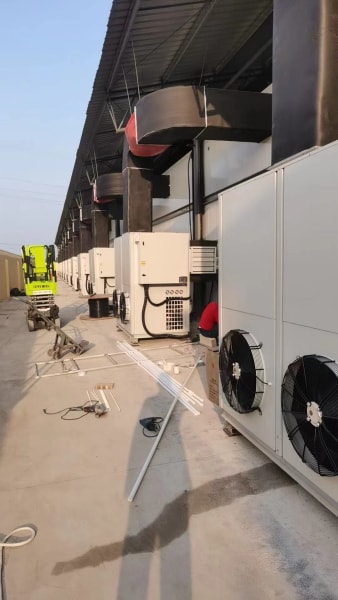
For growing projects that need compact integration, a smart mushroom climate control system can combine control hardware, software, electrical protection, and equipment interfaces in one coordinated package. For larger developments, the controller may be installed in a dedicated panel and linked to air-handling units, refrigeration systems, steam or ultrasonic humidification, and building management systems.
Integrated Climate Unit or Control Panel?

The first purchasing decision is whether to select an integrated climate unit or a separate control panel. Both approaches can be technically effective, but they serve different project requirements. An integrated unit typically combines the air-treatment equipment and control functions in a compact enclosure. A separate panel provides more freedom to connect equipment from different manufacturers and to expand the system as the farm grows.
Integrated climate units
Integrated units are suitable for modular cultivation rooms, container farms, demonstration facilities, small commercial farms, and projects where installation speed is important. The air-handling, humidification, cooling, heating, filtration, and control functions are engineered as a package. This can reduce commissioning time and make responsibility clearer because the equipment supplier can test the complete system before shipment.
A packaged design is also useful when floor space is limited. A cultivation container installed near a production building in Rotterdam, Vancouver, Dubai, or Singapore may need a compact solution that can be connected with limited site modification. Integrated equipment can reduce the number of field connections and simplify transportation, installation, and operator training.
Separate PLC control panels
A standalone control panel is often preferred for large farms, multi-room facilities, engineering projects, and installations using existing mechanical equipment. The panel can control several rooms with different recipes and connect to central refrigeration, boiler, heat pump, water-treatment, fire-alarm, or building-management systems.
This approach is particularly valuable when a project is being delivered by an agricultural contractor or mechanical engineering company. The contractor can specify motor starters, variable-frequency drives, contactors, actuators, safety relays, circuit protection, and communications according to the local electrical code. The controller software can then be adapted to the selected fans, dampers, humidifiers, and HVAC equipment.
| Selection factor | Integrated climate unit | Separate control panel | Best fit |
|---|---|---|---|
| Installation speed | Usually faster because major functions are preassembled | Requires more field wiring and commissioning | Rapid deployment and modular projects |
| Equipment compatibility | Optimized for the supplied mechanical package | Can connect to equipment from multiple brands | Large engineering projects |
| Space requirements | Compact and coordinated | Requires separate panel and mechanical equipment areas | Depends on room layout |
| Expansion capacity | May require an upgraded model or additional module | Typically easier to expand with extra I/O and software | Growing farms and multi-room sites |
| Commissioning responsibility | Often handled by one package supplier | Shared between panel builder, HVAC contractor, and farm operator | Projects with experienced integrators |
| Maintenance approach | Package-based replacement and service | Component-level troubleshooting and replacement | Depends on local technical capability |
The table shows why the cheapest initial quotation is not always the lowest total-cost option. A separate panel may have a lower equipment price but higher engineering and commissioning costs. An integrated unit may cost more at purchase but reduce design work, site wiring, and startup risks. Buyers should request a complete scope that identifies included sensors, outputs, software functions, electrical components, documentation, testing, and after-sales support.
Required Sensors and Equipment Outputs

Sensor selection determines how accurately a mushroom climate controller can understand the growing environment. Too few sensors create blind spots. Poorly positioned sensors may produce misleading readings. Excessive sensors without a clear control strategy can increase cost and maintenance without improving crop performance.
Core environmental sensors
- Air temperature sensors: Measure room temperature and, where useful, supply-air and return-air temperature. Multiple sensors can reveal uneven distribution.
- Relative humidity sensors: Provide feedback for humidifiers, cooling coils, dehumidification, and ventilation. They should be protected from direct water droplets and installed where air is representative.
- Carbon dioxide sensors: Support fresh-air control and exhaust management. CO₂ sensor range and calibration stability should match the crop and expected concentration.
- Differential pressure sensors: Monitor filter loading, room pressure, duct pressure, or the pressure difference between clean and production areas.
- Airflow or fan feedback sensors: Confirm that an airflow command produces the expected result. A running motor does not always mean that air is moving correctly.
- Water-level sensors: Protect pumps, humidifiers, and water-treatment systems from dry running or overflow.
Equipment feedback and safety inputs
Equipment feedback is essential for fault diagnosis. A controller should be able to distinguish between a command sent to a fan and confirmation that the fan is operating. Digital inputs can receive motor fault, overload, high-pressure, low-pressure, flow switch, door switch, emergency-stop, and fire-alarm signals.
In cold climates, outdoor temperature and frost protection sensors help prevent coil freezing. In hot climates, condenser temperature, chilled-water temperature, and high-pressure feedback may be required. Projects in coastal regions such as Qingdao, Busan, Rotterdam, or Santos should also consider corrosion-resistant sensor housings and careful placement in humid, salty air.
Typical equipment outputs
Outputs should be specified according to the equipment’s electrical and control requirements. A controller may provide relay outputs, analog outputs, pulse signals, communication ports, or network commands. The specification should state whether each output directly powers a device or only sends a control signal to an external relay, drive, or contactor.
| Function | Typical input or output | Control purpose | Specification point |
|---|---|---|---|
| Room temperature | Digital or analog temperature input | Heating, cooling, and recipe control | Accuracy, range, and sensor location |
| Relative humidity | Humidity transmitter | Humidification and ventilation balance | Condensation protection and calibration |
| Carbon dioxide | CO₂ transmitter | Fresh-air damper and exhaust control | Measurement range and calibration interval |
| Supply fan | Analog speed signal or drive communication | Air circulation and pressure management | Minimum speed, ramp time, and feedback |
| Fresh-air damper | Modulating actuator output | Ventilation and CO₂ regulation | Fail position, torque, and operating time |
| Exhaust fan | Relay, starter, or variable-speed command | Air exchange and moisture removal | Interlock with supply fan and alarm logic |
| Humidifier | Relay or modulating output | Humidity recovery after ventilation | Water quality, capacity, and low-level protection |
| Heating equipment | Relay, analog signal, or valve actuator | Temperature maintenance and dehumidification | Heat source, staging, and safety limits |
| Cooling equipment | Enable signal, valve signal, or compressor command | Temperature reduction and moisture control | Anti-short-cycle protection |
| Alarm beacon and notification | Relay output and network message | Local and remote fault notification | Alarm priority and escalation process |
The table should be used as a starting point rather than a fixed bill of materials. A project engineer should determine the final I/O list after confirming the room size, crop type, air volume, refrigeration method, humidification technology, fan characteristics, local voltage, and emergency requirements.
PLC Programs and Touchscreen Operation
A PLC-based control system provides a reliable platform for continuous operation. The PLC executes the control sequence, reads sensors, checks interlocks, records alarms, and sends commands to equipment. The touchscreen provides the operator interface for viewing conditions, changing setpoints, selecting recipes, acknowledging alarms, and switching between automatic and manual modes.
What the PLC program should include
A practical mushroom climate program normally includes startup and shutdown sequences, automatic mode, manual mode, recipe management, sensor validation, equipment interlocks, alarm handling, communication monitoring, and power-recovery logic. It should also prevent unsafe commands. For example, a humidifier should not operate when its water-level input indicates an empty tank, and a compressor should not restart immediately after a power interruption.
Recipe control is especially important in commercial production. The operator may define different stages for filling, spawn running, pinning, fruiting, flushing, harvesting, and room sanitation. Each stage can include temperature, humidity, CO₂, minimum ventilation, maximum fan speed, time duration, and alarm limits. The program should show which recipe and stage are active so that operators can quickly verify the room’s operating status.
Touchscreen features
- Live display of temperature, humidity, CO₂, pressure, fan speed, damper position, and equipment status.
- Trend graphs covering recent hours, days, or production stages.
- Recipe selection with password-protected editing.
- Manual commands for authorized technicians during commissioning and maintenance.
- Alarm history showing time, description, acknowledgment, and return-to-normal status.
- Separate screens for room overview, detailed equipment status, sensor calibration, and system settings.
- Language options and unit selection for international projects.
Touchscreen simplicity matters. Operators may work in several rooms and need to identify abnormal conditions quickly. A useful interface uses clear color states, plain alarm descriptions, consistent symbols, and a limited number of high-priority actions. Technical information can remain available on diagnostic screens without making the main overview difficult to understand.
For projects in Europe, North America, the Middle East, Southeast Asia, Africa, and Latin America, the controller should support locally familiar units, time zones, electrical conventions, and user training requirements. Documentation should include wiring diagrams, I/O lists, alarm descriptions, operating instructions, and recommended maintenance intervals.
Fan Speed and Damper Control
Air movement is one of the most important functions in mushroom cultivation. The controller must manage air exchange, circulation, mixing, pressure, temperature uniformity, humidity distribution, and carbon dioxide removal without creating excessive drying or damaging the crop.
Variable-speed fan regulation
Variable-frequency drives allow the controller to adjust fan speed rather than simply turning fans on or off. Lower speed can maintain circulation with reduced energy use, while higher speed can support cooling, CO₂ reduction, or moisture removal. The program should define minimum and maximum safe speeds, acceleration and deceleration times, motor protection, and feedback behavior.
Fan speed should not be treated as an isolated variable. Increasing outdoor air may lower humidity and temperature, while reducing fan speed may allow CO₂ to rise. A balanced strategy uses room conditions, supply-air conditions, damper position, and equipment capacity together.
Damper sequencing
Fresh-air and exhaust dampers can be controlled in stages or continuously. A modulating damper provides finer adjustment, but it requires correct actuator sizing, position feedback, and a suitable control signal. A two-position damper may be adequate for smaller rooms or systems with simple ventilation requirements.
Supply and exhaust dampers should be interlocked where necessary. A system should avoid creating excessive negative pressure when an exhaust fan runs without sufficient make-up air. In clean-room style cultivation facilities, pressure relationships may be intentional, but they still need to be measured and maintained within the design range.
| Operating condition | Primary objective | Typical control response | Risk to manage |
|---|---|---|---|
| Temperature above target | Remove heat and increase cooling capacity | Increase fan speed or cooling output | Over-drying and uneven airflow |
| Humidity below target | Recover moisture without excessive air exchange | Reduce unnecessary ventilation and enable humidifier | Condensation or wet surfaces |
| CO₂ above target | Increase fresh-air exchange | Open fresh-air damper and increase exhaust gradually | Temperature and humidity swings |
| Filter pressure high | Maintain airflow and identify maintenance need | Adjust fan within safe limit and generate alarm | Motor overload or insufficient air delivery |
| Outdoor air very hot | Protect room conditions and refrigeration capacity | Limit fresh-air demand and use cooling strategy | High energy consumption |
| Outdoor air very cold | Prevent freezing and crop stress | Limit damper opening and enable preheating | Coil frost and low room temperature |
| Power returns after outage | Restore safe operation in sequence | Delay fans, dampers, compressors, and humidifiers | Simultaneous startup and electrical overload |
Energy efficiency should be considered during design. A variable-speed fan can consume substantially less power at reduced speed, while appropriate damper sequencing can reduce unnecessary heating and cooling. Heat recovery, efficient motors, high-quality filters, and air-tight ductwork can further reduce operating costs. Sustainability targets in many markets are making energy monitoring and equipment efficiency increasingly important parts of a cultivation-control specification.
Remote Access and Local Operation
Local operation remains essential even when remote access is available. The touchscreen should continue to provide basic control during network interruptions, and the plant should not depend entirely on a cloud platform for safe operation. Remote access is most valuable for supervision, alarm notification, trend review, recipe verification, and technical assistance.
Local control functions
On-site operators should be able to view current conditions, adjust approved setpoints, select a production recipe, acknowledge alarms, switch to manual mode when authorized, and inspect equipment status. Critical safety functions such as emergency stops and electrical isolation should remain independent of the touchscreen and network.
Remote monitoring
Remote access may use an industrial Ethernet connection, secure VPN, cellular gateway, or approved cloud service. The buyer should ask how user authentication, encryption, software updates, data ownership, and backup are handled. A low-cost remote application is not automatically a secure or reliable industrial solution.
Remote monitoring is useful for farms operating across multiple sites. A technical team in London may supervise a project in Manchester, while a distributor in Dubai may support a customer in Riyadh. A manufacturer in China can assist a contractor during commissioning in Jakarta, Warsaw, or Mexico City when authorized remote diagnostics are available.
| Function | Local touchscreen | Remote access | Recommended protection |
|---|---|---|---|
| View live conditions | Yes | Yes | User authentication |
| Change crop setpoints | Authorized users | Authorized users with audit trail | Password levels and change logging |
| Acknowledge alarms | Yes | Yes | Record acknowledgment time and user |
| Emergency stop | Dedicated physical device | No remote substitute | Independent safety circuit |
| Review historical trends | Configured storage capacity | Export or dashboard access | Data backup and retention policy |
| Software maintenance | Service mode | Secure controlled access | Backup before changes |
| Manual equipment override | Technician permission | Restricted and supervised | Automatic timeout and event logging |
Fault Protection and Power Recovery
Fault protection protects both the crop and the equipment. A climate controller should not only report a fault; it should place the affected system in a safe state and provide enough information for a technician to identify the cause.
Important fault categories
- Sensor failure: Open circuit, short circuit, implausible value, frozen reading, or communication loss.
- Fan failure: Motor overload, drive fault, low airflow, loss of feedback, or abnormal current.
- Cooling failure: High pressure, low pressure, compressor overload, insufficient water flow, or low refrigerant protection.
- Humidification failure: Low water level, high water level, pump failure, blocked nozzle, or excessive humidity.
- Electrical fault: Phase loss, incorrect phase sequence, overvoltage, undervoltage, earth leakage, and short circuit.
- Environmental limit: High temperature, low temperature, high CO₂, high pressure difference, or abnormal humidity.
- Communication fault: Loss of connection between PLC, touchscreen, drive, remote gateway, or expansion module.
Alarm priorities should be clearly defined. A critical alarm may require immediate local action and telephone notification. A warning may indicate a dirty filter or calibration requirement. An information message may simply record a mode change. Too many alarms with the same priority can cause alarm fatigue and delay the response to serious conditions.
Power failure and automatic restart
Power recovery should follow a controlled sequence. The PLC should retain approved recipes and setpoints in non-volatile memory. After power returns, the controller can check sensor validity, confirm emergency-stop status, verify drive readiness, open or close dampers to their safe position, and restart equipment with time delays.
Compressors, heaters, pumps, fans, and humidifiers should not all restart at once. Staged startup reduces inrush current and protects electrical infrastructure. Anti-short-cycle timers are essential for compressors. If a power failure lasts long enough to threaten the crop, the system should record the duration and issue an alarm when operation resumes.
For facilities in regions with unstable grids, including parts of Southeast Asia, Africa, Latin America, and remote agricultural areas, the specification may include UPS support for the PLC and communication equipment, generator interface signals, surge protection, voltage monitoring, and a defined restart strategy. The UPS does not necessarily need to power every motor; it may only keep controls, alarms, and data recording active until the main supply returns.
Questions to Include in Your Specification
A detailed specification prevents misunderstandings between the farm owner, equipment supplier, electrical contractor, and installation team. The following questions can be included in a request for quotation or technical tender.
Application and capacity
- What mushroom species and production stages will the system control?
- What are the room dimensions, usable volume, rack arrangement, and expected crop load?
- What temperature, humidity, CO₂, and pressure ranges are required?
- How many rooms or containers must be controlled now and in the future?
- What are the local outdoor design temperatures and humidity conditions?
Hardware and I/O
- Which sensors are included, and how many are installed per room?
- Are temperature and humidity sensors protected against condensation and washdown?
- Does the panel include circuit breakers, overload protection, contactors, drives, relays, and surge protection?
- Which equipment outputs are relay, analog, pulse, or network based?
- Are spare I/O points included for future expansion?
Software and operation
- How many recipes and production stages can be stored?
- Can users adjust setpoints without changing the PLC program?
- Is manual control available for commissioning and maintenance?
- Does the system record trends, alarms, setpoint changes, and user activity?
- Can the interface support local languages, metric units, and multiple time zones?
Installation and service
- Who is responsible for field wiring, startup, calibration, and final commissioning?
- What electrical voltage, frequency, grounding, and communication standards are supported?
- Are wiring diagrams, software backups, manuals, spare parts, and training included?
- What remote support is available during installation?
- What is the response time for replacement parts and technical assistance?
| Category | Minimum information to request | Why it matters | Evidence to review |
|---|---|---|---|
| Environmental performance | Control ranges, accuracy, response, and stability | Confirms suitability for the crop | Technical datasheet and test records |
| Electrical design | Voltage, frequency, protection, enclosure, and certifications | Reduces installation and safety risks | Panel drawings and inspection report |
| Automation software | Recipes, alarms, trends, permissions, and backups | Supports consistent daily operation | Screen demonstration and program description |
| Mechanical interfaces | Fan, damper, humidifier, heating, and cooling signals | Prevents incompatible equipment connections | I/O schedule and interface list |
| Commissioning | Factory testing, site startup, calibration, and training | Improves actual performance after installation | Commissioning plan and acceptance criteria |
| After-sales service | Remote help, spare parts, warranty, and response time | Limits production interruptions | Service terms and support contacts |
| Expansion | Extra I/O, software capacity, and network options | Allows future rooms or equipment additions | Expansion schedule and license terms |
Suppliers should also be asked for references that resemble the proposed project. A small demonstration container is not equivalent to a thirty-room commercial facility. Relevant experience should include similar room volume, climate conditions, crop type, equipment arrangement, and operating schedule.
Our Company: Technology, Manufacturing, and Service
Technological capabilities
Shandong Lanhu Air Conditioning Equipment Co., Ltd. develops climate-control equipment for agricultural and industrial applications. Its technical work combines thermodynamic research, air treatment, refrigeration, electrical control, and modular cultivation engineering. With more than twelve years of thermodynamic research and development experience and over forty-five registered patents, the company can support projects that require more than a standard off-the-shelf controller.
Lanhu’s product range includes smart mushroom cultivation containers, mushroom climate controllers, smart hydroponic plant containers, and air source heat pumps. This combination allows the engineering team to consider the relationship between the controller and the complete thermal system. A controller can be designed around the actual fan, cooling, heating, humidification, and ventilation functions instead of being treated as an isolated electrical box.
For customers evaluating a modular growing solution, the smart mushroom cultivation container provides an example of how climate control, enclosure design, air treatment, and production workflow can be integrated. The company can also discuss OEM and ODM development for distributors, agricultural contractors, and engineering companies that need customized branding, dimensions, functions, or control logic.
Manufacturing capabilities
Lanhu operates a modern manufacturing facility in Dezhou, Shandong, China, covering more than 30,000 square meters. The production process includes product design, engineering development, sheet metal fabrication, CNC bending, insulation panel production, electrical assembly, system integration, equipment testing, and quality inspection.
This integrated structure can improve coordination between mechanical and electrical teams. Panel dimensions, duct connections, insulation details, cable routing, sensor mounting, and equipment access can be considered together before shipment. Factory integration is particularly valuable for international projects where site labor costs are high or installation time is limited.
Every system undergoes functional inspection, electrical verification, performance testing, and operational evaluation before dispatch. The company maintains ISO 9001, ISO 14001, ISO 45001, and ISO 12100 certifications, along with patent certificates and enterprise credibility credentials. Buyers should still confirm the exact certification and documentation requirements for their destination market, but these systems indicate a structured approach to quality, environmental management, occupational safety, and machinery risk assessment.
Service capabilities
Lanhu provides factory-direct supply, OEM and ODM customization, engineering assistance, international logistics support, spare-parts support, installation guidance, and after-sales service. This model is suitable for distributors in Europe, North America, the Middle East, Africa, Southeast Asia, and Latin America, as well as commercial farms that need direct technical communication with the manufacturer.
Service planning should begin before shipment. The supplier can help review room drawings, equipment lists, utility conditions, control points, shipping arrangements, installation sequences, and commissioning requirements. For projects routed through Qingdao, Shanghai, Ningbo, or Shenzhen, logistics planning may include export packaging, container loading, documentation, and spare-parts recommendations. On the receiving side, local installation support may be coordinated with contractors in ports and trade hubs such as Rotterdam, Hamburg, Dubai, Singapore, Los Angeles, and Santos.
Customers can review completed installations and project information through the company’s mushroom climate-control project cases. When comparing a supplier, ask whether the case is technically similar to the proposed application and whether the company can provide a complete technical package rather than only individual components.
FAQ: Smart Mushroom Climate Control Systems
What is the difference between a mushroom climate controller and a general HVAC controller?
A mushroom climate controller is configured for biological production requirements. It typically manages humidity, carbon dioxide, staged recipes, ventilation transitions, air circulation, and crop-specific alarm limits. A general HVAC controller may control temperature and humidity effectively but may not include production-stage logic, crop recipes, harvest schedules, or the required balance between fresh air and moisture retention.
How many sensors does one mushroom room need?
The number depends on room size, airflow pattern, rack layout, crop sensitivity, and control objectives. A small room may use one or two temperature and humidity sensors plus a CO₂ sensor. Larger rooms may require multiple environmental sensors, supply and return-air measurements, pressure sensors, fan feedback, water-level switches, and equipment fault contacts. Sensor placement is as important as sensor quantity.
Can one PLC control several cultivation rooms?
Yes. A properly sized PLC can control multiple rooms using expansion modules, distributed I/O, networked drives, or separate room controllers. Each room should retain independent recipes, alarms, sensor validation, and safe operating logic. The specification should identify the number of rooms, required I/O points, communication method, and future expansion capacity.
Should fans run at constant speed?
Not necessarily. Constant-speed fans may be appropriate for basic circulation or systems designed around fixed airflow. Variable-speed fans generally provide better control and can reduce energy use, but they require correct motor sizing, drive configuration, minimum-speed settings, feedback, and ramp control. The final approach should be based on the room’s airflow and crop requirements.
Is remote access necessary?
Remote access is not mandatory for every farm, but it is valuable for multi-site operations, technical support, alarm notification, and trend analysis. Local operation must remain available, and safety functions should not rely on the internet. Remote connections should use controlled user permissions, secure communication, and documented data practices.
What happens if a sensor fails?
The controller should identify an implausible or missing signal, issue an alarm, and apply a defined fallback strategy. Depending on the sensor and process, the system may hold the last valid value briefly, use a backup sensor, switch to a safe fixed output, or stop a specific piece of equipment. The strategy should be tested during commissioning rather than assumed.
Can the controller work with equipment from different brands?
Often, yes. Compatibility depends on the available relay, analog, pulse, Ethernet, or fieldbus interfaces and on the equipment manufacturer’s communication protocol. Before ordering, provide a complete list of fans, drives, dampers, humidifiers, heat pumps, refrigeration units, heaters, pumps, and alarm devices. The supplier can then prepare an interface and I/O schedule.
What should be included in factory testing?
Factory testing should include visual inspection, wiring verification, electrical safety checks, sensor simulation, output testing, alarm testing, touchscreen operation, recipe review, communication checks, and power-recovery simulation where applicable. A test record should identify the equipment serial number, tested functions, results, and any corrective actions.
How can energy consumption be reduced?
Use variable-speed fans, efficient motors, correctly sized refrigeration and humidification equipment, insulated cultivation rooms, clean filters, airtight ducts, optimized damper sequences, heat recovery where practical, and well-tuned recipes. Energy meters connected to the controller can help identify high-consumption stages and compare room performance.
What trends will shape mushroom climate control through 2026 and beyond?
Future systems are likely to combine more detailed environmental data, edge-based analytics, predictive maintenance, energy monitoring, and adaptive recipes. Artificial intelligence may assist with anomaly detection and production forecasting, but it should complement verified sensor data and operator judgment. Industrial cybersecurity, secure remote access, and software backup practices will become increasingly important as farms connect more equipment to networks.
Policy and sustainability requirements are also influencing design. Many markets are encouraging lower energy consumption, refrigerant management, water efficiency, waste reduction, and traceable production data. Heat pumps, heat recovery, efficient humidification, renewable-energy integration, and recyclable construction materials may become more common in modular farms. Buyers should ask suppliers whether the controller can record energy, water, alarm, and production-stage data needed for future reporting.
Finally, local service capability will remain a decisive factor. A technically advanced system is only valuable when operators can use it, technicians can maintain it, and replacement parts can be delivered. For a global project, the strongest supplier is usually the one that combines sound control engineering, tested manufacturing, complete documentation, responsive support, and a clear understanding of the local installation environment.
Share this article

About the Author: Shandong Lanhu Air Conditioning Equipment
Lanhu is a professional climate control equipment manufacturer specializing in smart agricultural systems, commercial HVAC solutions, and customized temperature control technologies. With extensive engineering experience, Lanhu provides reliable solutions for plant factories, controlled environment agriculture, and industrial applications.
Need a Custom Climate Control Solution?
From smart agricultural systems to commercial HVAC solutions, Lanhu provides reliable temperature and humidity control solutions tailored to your project needs.
Contact Us