Advanced Mushroom HVAC Design Guide for the Global Market
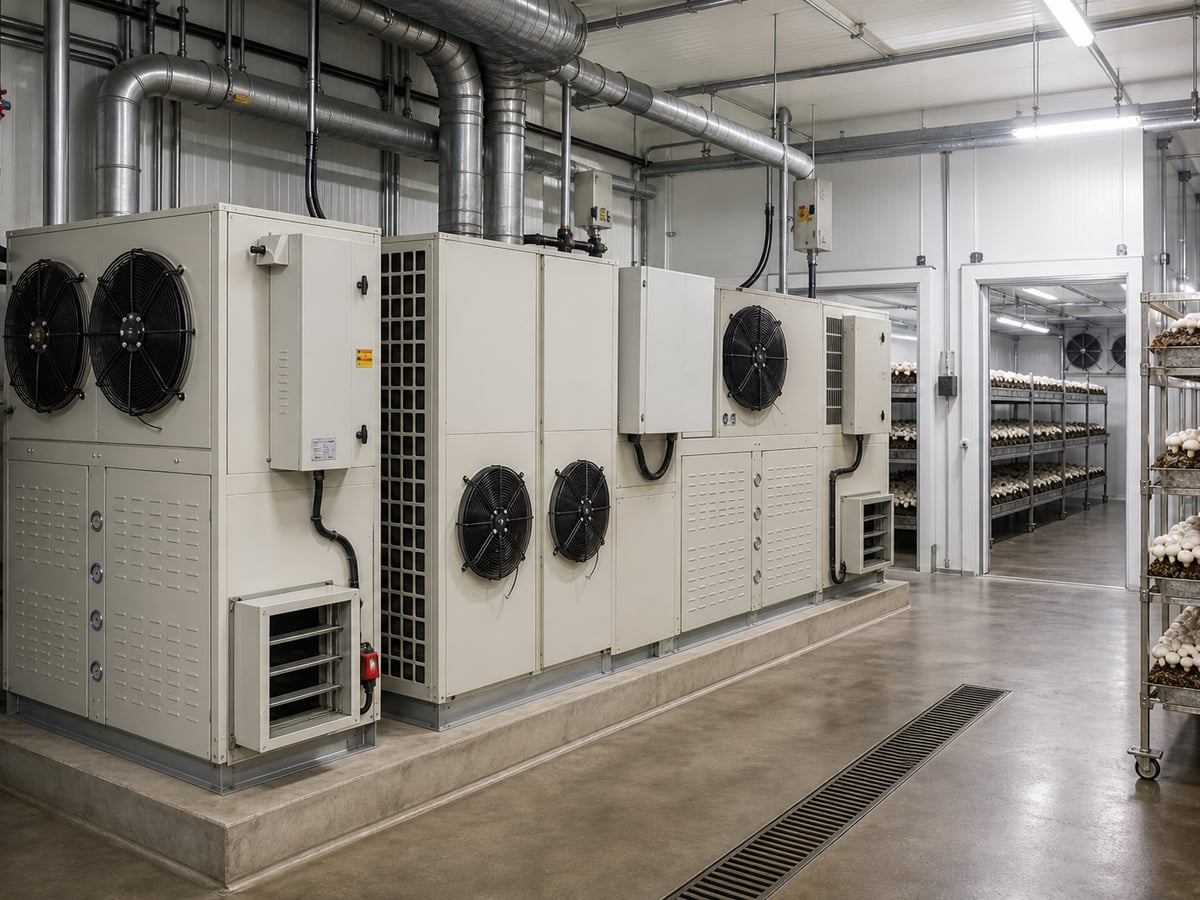
Quick Answer: Size Mushroom HVAC by Load, Not Floor Area

A commercial mushroom room cannot be sized reliably by multiplying floor area by a simple cooling factor. The correct design begins with the crop stage, rack arrangement, substrate mass, room loading schedule, fresh-air requirement, moisture removal, envelope performance, and the outdoor climate at the project location. A room in Qingdao, Rotterdam, Toronto, Dubai, or São Paulo may have the same dimensions but require very different equipment.
The practical sequence is straightforward:
- Define the mushroom species, crop stage, substrate quantity, rack density, and room loading pattern.
- Calculate transmission, infiltration, lighting, fan, pump, people, and respiration heat.
- Add the latent load from substrate evaporation, humidification, fresh air, door openings, and sanitation.
- Select cooling, heating, dehumidification, ventilation, and control equipment for local design extremes rather than average weather.
- Design ducts and air-distribution devices so that every shelf receives similar temperature, humidity, oxygen, and carbon dioxide conditions.
- Test operation at full production, partial loading, empty-room sanitation, start-up, and low outdoor temperatures.
For many farms, the main mistake is selecting a large air-conditioning unit that can reduce temperature quickly but cannot control moisture or distribute air evenly. A mushroom HVAC system is a process-control system. It must protect biological performance while maintaining stable conditions, removing metabolic heat, controlling carbon dioxide, and preventing condensation on panels, coils, doors, and growing media.
A useful first estimate can be made with the following concept:
Total design load = envelope load + respiration load + ventilation load + infiltration load + moisture load + equipment and people load − useful heat recovery.
This is only a starting point. Final selection should use a room-by-room heat and moisture balance, manufacturer performance data, psychrometric analysis, and a commissioning plan. For modular projects, a dedicated mushroom climate controller can coordinate temperature, relative humidity, carbon dioxide, fresh air, fan speed, alarms, and crop recipes.
Define Crop Stages, Room Loading, and Production Objectives

The first design decision is not the equipment brand. It is the biological operating profile. Different mushrooms release different amounts of heat and moisture, and the peak load may occur after the room appears fully occupied. A room used for incubation has a different load from a fruiting room, while a room used for composting or pasteurization may require high-temperature heating and powerful exhaust.
Before requesting a quotation, prepare a design brief containing the species, production cycle, shelf count, substrate weight, bag or tray format, target temperature, relative humidity, carbon dioxide limits, air-change rate, sanitation procedure, and expected harvest schedule.
| Crop stage | Typical operating objective | Main heat source | Main moisture concern | Important control point | Design implication |
|---|---|---|---|---|---|
| Spawn run or incubation | Stable temperature with limited disturbance | Biological respiration and fans | Condensation and excessive drying | Uniform shelf temperature | Moderate air movement and accurate sensors |
| Pinning | Controlled temperature reduction and fresh air | Respiration and ventilation fans | Surface moisture balance | Carbon dioxide transition | Responsive outdoor-air and humidity control |
| Fruiting | Stable temperature, humidity, and gas exchange | Respiration, lights, pumps, and fans | Evaporation and latent cooling load | Air velocity and canopy uniformity | High latent capacity and balanced distribution |
| Flush or harvest peak | Maintain quality during maximum metabolic activity | Peak biological heat | Rapid moisture release | Fast load response | Capacity reserve and staged compressors |
| Room reset and sanitation | Drying, washing, and hygiene recovery | Hot water, steam, heaters, and fans | Very high temporary humidity | Condensation prevention | Dedicated purge and dehumidification mode |
| Empty or standby room | Protect structure and prepare for the next cycle | Small standby equipment load | Residual moisture and mold risk | Low-energy temperature protection | Variable-speed operation and low-load stability |
Explanation: The table shows why one fixed design condition is inadequate. Fruiting may determine cooling and dehumidification capacity, while sanitation may determine exhaust, heating, drainage, and corrosion protection. The equipment should therefore be selected for the complete operating envelope, not only the normal production point.
Room loading means more than the number of bags or trays. Record the total substrate mass, water content, average spacing, rack height, aisle width, plastic packaging, tray material, harvest labor, and expected loading sequence. A room loaded over three days may have a different heat curve from a room loaded in a single shift.
For mushroom farms in the Global Market, planning should also account for local logistics and climate. A farm near Rotterdam or Hamburg may have cool outdoor air but high humidity. A project near Jeddah or Dubai may have extreme sensible and latent ventilation loads. A facility near Vancouver may face mild summers but cold winter heating conditions. A site close to the Port of Shanghai, Ningbo-Zhoushan, Busan, Santos, or Rotterdam may have convenient equipment logistics, but local electrical standards, refrigerants, service skills, and spare-parts access still need to be confirmed.
Calculate Envelope, Respiration, and Internal Heat

A complete load calculation separates sensible heat, which raises air temperature, from latent heat, which adds or removes water vapor. Mushroom facilities are often dominated by latent processes, especially during fruiting and after washing. Ignoring this distinction can result in a system that reaches the temperature setpoint but leaves the room too wet, causes condensation, or creates unstable humidity.
Envelope heat transfer comes through insulated panels, floors, ceilings, doors, windows, thermal bridges, pipe penetrations, and service openings. The basic transmission relationship is:
Q = U × A × ΔT
Here, Q is heat transfer, U is the overall heat-transfer coefficient, A is surface area, and ΔT is the temperature difference between the room and surrounding conditions. Use the actual panel construction and door details rather than a generic wall value. Wet insulation, compressed joints, exposed fasteners, and unsealed penetrations can increase real heat transfer.
Solar gain may affect rooms with external walls, skylights, or lightweight structures. Although many mushroom rooms are enclosed inside larger buildings, roof exposure and sun-facing metal surfaces can become significant in tropical and arid regions. Doors are another major source of load. Every opening introduces warm, humid air and may disturb pressure balance.
Respiration heat is generated by the crop and substrate. The value changes with species, strain, substrate formulation, temperature, age, oxygen supply, carbon dioxide concentration, and biological activity. A practical design should use measured or supplier-provided respiration data at each stage. If exact data are unavailable, use conservative assumptions and verify them with commissioning measurements.
| Load category | Calculation basis | Typical timing | What can be underestimated | Recommended verification | Design response |
|---|---|---|---|---|---|
| Wall and ceiling transmission | Area, panel U-value, temperature difference | Continuous | Thermal bridges and damaged insulation | Panel inspection and infrared survey | Improve joints and insulation continuity |
| Floor transmission | Floor construction and adjacent temperature | Continuous | Cold slabs or heated neighboring spaces | Floor temperature measurement | Add insulation or controlled floor heating |
| Door infiltration | Door area, opening frequency, pressure difference | Intermittent and often severe | Harvest traffic and loading operations | Door log and smoke testing | Use vestibules, strip curtains, and interlocks |
| Crop respiration | Substrate mass and stage-specific metabolic rate | Rises and falls by crop cycle | Peak activity after loading | Temperature trend and oxygen or carbon dioxide data | Provide staged capacity and reserve |
| Fans and pumps | Motor input power and operating hours | Continuous or scheduled | Heat released inside the room | Electrical measurement | Use efficient variable-speed motors |
| Lighting and controls | Installed wattage and operating schedule | Scheduled | Drivers and transformers inside room | Equipment inventory | Move heat-producing components outside where practical |
Explanation: Internal equipment heat is often treated as a minor item, but fan motors, pumps, lighting, humidifiers, and control panels can become meaningful in a tightly insulated room. When the room is small, even a few kilowatts can alter the cooling balance.
Respiration heat can be estimated from oxygen consumption or carbon dioxide generation when appropriate biological data are available. The conversion should be checked by a qualified engineer because the relationship depends on the substrate and metabolic process. For a commercial design, do not simply multiply room volume by a generic watt-per-cubic-metre value.
Use design weather data for the actual location. The cooling design point should reflect the local summer dry-bulb and wet-bulb conditions, while the heating design point should represent the cold outdoor condition. For a project in Nairobi, Mexico City, Warsaw, Melbourne, or Osaka, the outdoor design profile may differ substantially from a standard catalogue condition. If equipment will be shipped from China to another market, request performance data at the destination climate, voltage, frequency, and refrigerant requirements.
Add Ventilation, Infiltration, and Moisture Loads
Fresh air is essential for carbon dioxide management, oxygen supply, odor control, and crop quality. However, outdoor air can impose a large cooling and dehumidification penalty. In a humid coastal climate, ventilation air may bring in more moisture than the crop itself releases during part of the cycle. In a hot, dry climate, ventilation may add a large sensible load while creating a strong humidification demand.
Ventilation load should be calculated from the required mass flow of dry air and the difference in enthalpy between outdoor and indoor air. The total air-side relationship is commonly expressed as:
Q = air mass flow × enthalpy difference.
Separate sensible and latent components should be evaluated. The system may need cooling below the room setpoint to condense water from the air, followed by reheating to avoid overcooling the crop. A dedicated dehumidifier, heat-pump reheat arrangement, desiccant system, or energy-recovery ventilator may be appropriate depending on the climate and crop schedule.
Carbon dioxide control should not be based on a single fixed air-change rate. Use sensors and a control sequence that increases outdoor air when carbon dioxide exceeds the crop limit, subject to temperature and humidity protection. A high-quality controller can coordinate outside-air dampers, return-air mixing, fan speed, cooling capacity, humidification, and alarms.
| Moisture source | How it enters the room | Risk if ignored | Measurement approach | Control method | Maintenance need |
|---|---|---|---|---|---|
| Substrate evaporation | Water released from bags, trays, or blocks | High latent load and surface condensation | Mass balance and humidity trend | Cooling coil, dehumidifier, and air movement | Drain and coil hygiene |
| Crop transpiration | Water vapor released by fruiting bodies | Wet caps, quality loss, and microbial risk | Humidity sensors at multiple heights | Staged ventilation and dehumidification | Sensor calibration |
| Fresh outdoor air | Ventilation and pressure control | Humidity shock and oversized cooling demand | Outdoor temperature and humidity sensors | Enthalpy-based air control | Filter replacement and damper inspection |
| Door openings | Warm air infiltration during traffic | Condensation on doors and panels | Door counter and trend logging | Vestibule, interlock, and air curtain | Seal and closer adjustment |
| Washing and sanitation | Water spray, hot cleaning, and wet surfaces | Temporary humidity surge | Cleaning schedule and drainage records | Purge fan, heating, and drying mode | Drain cleaning and corrosion checks |
| Humidifier or fogger | Deliberate water atomization | Over-humidification and wet equipment | Water-flow measurement | Modulating valves and humidity limits | Water treatment and nozzle cleaning |
Explanation: Moisture control is a process issue, not merely a comfort issue. The correct system must remove water at the required room temperature while avoiding excessive air velocity, cold surfaces, or rapid humidity swings.
Use multiple humidity sensors because one sensor near an air outlet can report a very different condition from a sensor inside the rack. Sensor locations should represent the crop zone, return air, supply air, and room entrance where useful. Protect sensors from direct spray and condensation, but do not place them in stagnant corners.
Pressure control also matters. Slightly positive pressure can reduce unfiltered infiltration, but excessive positive pressure wastes energy and pushes moist air into building cavities. Negative pressure may be needed for odor or hygiene control in selected areas, but it can draw untreated air through cracks. The pressure strategy should be defined for each room and coordinated with doors, airlocks, exhaust fans, and adjacent spaces.
Select Equipment for Local Climate Extremes and Service Conditions
Equipment selection should begin with the calculated peak sensible and latent loads, then be checked against the expected minimum load. A unit that performs well at catalogue conditions may lose capacity in extreme heat, low outdoor temperature, high humidity, or low indoor setpoints. Ask suppliers for capacity tables at the actual evaporating and condensing conditions rather than relying on nominal model names.
A complete mushroom HVAC package may include air-cooled or water-cooled refrigeration, evaporators, condensers, heat pumps, electric or hot-water heating, humidifiers, dehumidification coils, fresh-air modules, exhaust fans, filters, dampers, sensors, variable-frequency drives, drains, and a central controller.
| Equipment type | Best application | Selection check | Climate concern | Energy consideration | Backup recommendation |
|---|---|---|---|---|---|
| Packaged air-cooled unit | Independent rooms and modular farms | Capacity at design outdoor temperature | High ambient derating | Variable-speed compressors and fans | Critical spare controls and fan motor |
| Remote condensing system | Multiple rooms with central plant | Pipe length, oil return, and diversity | Low ambient control and frost | Staged compressors and heat recovery | Parallel refrigeration circuit |
| Air-source heat pump | Heating, cooling, and transitional seasons | Heating capacity at cold outdoor conditions | Defrost performance | Seasonal efficiency | Electric or hot-water backup |
| Dedicated dehumidifier | High latent load and drying cycles | Water removal at room temperature | Reduced output in cold rooms | Heat reclaim for reheat | Drain and condensate protection |
| Fresh-air treatment unit | Carbon dioxide and hygiene control | Outdoor-air flow and filtration | Humidity extremes and dust | Heat and moisture recovery | Manual bypass and spare filters |
| Hot-water or electric heater | Cold-weather protection and reheat | Required leaving-air temperature | Freeze protection | Modulating control | High-limit safety and alarm |
Explanation: Each equipment type solves a different part of the process. In many facilities, the best result comes from combining refrigeration, heating, fresh-air treatment, and controls rather than asking one oversized unit to perform every task.
Local extremes include more than weather. Consider power quality, voltage, frequency, water hardness, dust, salt air, altitude, refrigerant regulations, fire codes, hygiene rules, and technician availability. A farm near Casablanca may experience dust and high solar gain. A coastal site near Alexandria, Miami, or Cape Town may need enhanced corrosion protection. A high-altitude location may require fan and compressor corrections.
For international projects, confirm whether the equipment can be supplied with the required electrical configuration and documentation. Projects may require CE, UKCA, UL, SASO, EAC, or other local compliance documentation depending on the destination. A factory-direct supplier should also clarify packaging, container loading, commissioning responsibility, spare parts, warranty terms, and remote support.
Modular cultivation rooms and smart containers can reduce construction time and simplify replication. Lanhu supplies smart mushroom cultivation containers and integrated climate equipment for commercial projects that need compact, repeatable production modules. A modular mushroom cultivation container can be evaluated as a complete thermal and process envelope rather than as a basic shipping box with an added air conditioner.
Design Ducts and Air Distribution for Uniform Growing Conditions
Correct capacity cannot compensate for poor air distribution. If one rack receives cold, dry supply air while another rack receives stagnant return air, the average room reading may look acceptable while the crop develops unevenly. The design goal is not maximum air velocity. It is uniform temperature, relative humidity, carbon dioxide, and gas exchange throughout the crop zone.
Start with the room geometry, rack layout, ceiling height, shelf depth, aisle width, door location, return-air path, evaporator position, and sanitation requirements. Select supply outlets and return grilles after the rack arrangement is fixed. Do not place the return directly beside the supply if this creates short-circuiting.
| Distribution element | Design objective | Common mistake | Recommended practice | Field test | Maintenance point |
|---|---|---|---|---|---|
| Main supply duct | Deliver balanced airflow to zones | Long run with uncontrolled pressure loss | Use calculated sizing and balancing dampers | Measure static pressure and flow | Inspect insulation and leakage |
| Perforated duct | Gentle, broad air distribution | Uneven hole spacing or blocked sections | Match opening pattern to pressure profile | Smoke visualization and anemometer survey | Clean openings and fabric surfaces |
| Ceiling diffuser | Mix air before reaching crop | Direct jet onto mushrooms | Select throw and induction for room height | Temperature mapping | Clean diffuser face and damper |
| Rack-level outlet | Improve shelf-to-shelf uniformity | Excessive local velocity | Use low-velocity and adjustable outlets | Air-speed measurement in crop zone | Check alignment after rack changes |
| Return-air grille | Collect mixed room air without dead zones | Return placed behind an obstruction | Use several returns where geometry requires | Room pressure and temperature survey | Filter and grille cleaning |
| Fresh-air inlet | Introduce outdoor air without shocks | Unconditioned air discharged onto crop | Mix, filter, cool, heat, or humidify first | Carbon dioxide and humidity trend | Filter, damper, and louver inspection |
Explanation: The distribution system should be validated after racks, bags, trays, lights, and sensors are installed. A design that is balanced in an empty room may become unbalanced when shelves and crop materials obstruct the air path.
Duct velocity, pressure drop, noise, sanitation, and condensation must be considered together. Insulate cold ducts and protect vapor barriers. Avoid exposed porous materials that can absorb moisture or harbor contamination. Provide access panels where cleaning and inspection are required. In wet environments, use corrosion-resistant components and suitable drain pans with adequate slope.
Commissioning should include a grid survey at several heights and rack positions. Record temperature, relative humidity, air velocity, carbon dioxide, supply-air condition, return-air condition, and pressure. Repeat the survey at low, normal, and high fan speeds. If conditions vary significantly, rebalance dampers, revise outlet positions, or adjust control logic before increasing equipment capacity.
Coordinate Heating, Cooling, Dehumidification, and Humidity
Temperature and humidity are linked by psychrometrics. Cooling air below its dew point removes moisture, but it also lowers sensible temperature. If the crop requires a warmer room, the system may need reheat. Humidification adds moisture but may also alter sensible conditions depending on the method. These processes should be sequenced rather than operated independently.
A typical control sequence may start with temperature control as the primary loop, humidity control as a coordinated loop, and carbon dioxide control as a demand signal for ventilation. When room temperature is high and humidity is high, cooling and dehumidification operate together. When humidity is low, humidification is enabled only if temperature and ventilation conditions are acceptable. When outdoor air is favorable, free cooling or economizer operation may be used with strict humidity limits.
Heating is important even in warm climates. Cold nighttime conditions, winter ventilation, defrost, sanitation drying, and reheat after dehumidification may all require heat. Air-source heat pumps can provide efficient heating in moderate climates, but their capacity and efficiency decline as outdoor temperature falls. A backup heater may be justified for sensitive crops or locations with unreliable winter electricity.
Humidity equipment must be hygienic. Steam humidifiers can provide clean, controllable moisture when water quality and electrical capacity are suitable. Ultrasonic systems use less heat but require careful water treatment and sanitation. High-pressure fogging can deliver fine droplets but needs filtration, nozzle maintenance, and suitable separation from electrical equipment. The selected method should reflect the crop, water quality, room temperature, hygiene plan, and maintenance capability.
Control sensors should be calibrated on a defined schedule. Relative humidity sensors can drift when exposed to condensation, dust, disinfectants, or high humidity for long periods. Use alarm limits for high temperature, low temperature, high carbon dioxide, low airflow, high pressure, water failure, condensate overflow, compressor fault, fan fault, and communication loss.
Review Performance at Partial Loading and During Transitions
Many systems operate most of the year at less than peak load. A unit designed only for maximum production may cycle excessively when the room is partially loaded, empty, or in a transition between crop stages. Short cycling reduces efficiency, causes temperature swings, and may create poor humidity control.
Review at least five conditions: full crop load, half load, empty room, sanitation recovery, and extreme outdoor weather. Also examine the moment after a door opening, after a fresh-air purge, during compressor staging, and during defrost. The control system should maintain stable conditions without relying on manual intervention.
| Operating condition | Expected challenge | Performance indicator | Control strategy | Potential failure | Corrective action |
|---|---|---|---|---|---|
| Full fruiting load | Peak respiration and moisture | Stable crop-zone temperature and humidity | Staged cooling and dehumidification | High humidity or compressor overload | Increase latent capacity or airflow |
| Partial crop load | Low biological heat | Long stable run time without cycling | Variable-speed capacity and deadband control | Rapid on-off operation | Reduce minimum capacity or add buffer logic |
| Empty room | Very small internal load | Safe standby temperature and low energy use | Standby recipe and minimum ventilation | Overcooling and excess drying | Set minimum run times and wider deadbands |
| Sanitation recovery | Sudden high humidity | Drying time and condensation control | Purge, heat, and dehumidification sequence | Wet panels and microbial growth | Improve drainage and drying capacity |
| Hot outdoor extreme | Reduced refrigeration capacity | Room setpoint maintained at design peak | Condenser fan modulation and load shedding | High condensing pressure | Use larger condenser or staged backup |
| Cold outdoor extreme | Heating and defrost demand | Stable room temperature during ventilation | Heat-pump staging and auxiliary heat | Frozen coil or low discharge temperature | Add low-ambient controls and preheat |
Explanation: Partial-load review protects both crop performance and operating cost. It also reveals whether the equipment is oversized, whether sensors are poorly located, and whether the control sequence can manage competing heating, cooling, and humidity demands.
Trend logging is one of the most valuable commissioning tools. Record setpoints, actual temperatures, humidity, carbon dioxide, fan speed, compressor stages, valve positions, outdoor conditions, door events, alarms, and energy use. A one-week trend can reveal issues that are invisible during a short site visit.
Energy performance should be judged by production output as well as electricity use. Useful indicators include kilowatt-hours per kilogram of saleable mushrooms, water removed per kilowatt-hour, cooling capacity delivered per compressor input, and percentage of time within crop limits. A system with slightly higher installed cost may produce lower operating cost through better staging, heat recovery, and fewer crop losses.
Market Options, Product Types, and Buying Advice
The Global Market includes several equipment categories. Stand-alone room units are suitable for smaller farms and independent chambers. Central plants can serve multiple rooms and provide diversity between crop schedules. Modular containers are attractive where construction time, mobility, or standardized expansion is important. Custom engineered rooms are appropriate for large farms with complex crop recipes, central utilities, and automated logistics.
When comparing quotations, request a clear schedule of performance. It should state indoor and outdoor design conditions, sensible and total cooling capacity, heating capacity, airflow, external static pressure, dehumidification rate, fresh-air volume, electrical input, sound level, refrigerant, filtration, controls, and operating limits.
Do not compare prices without comparing scope. One quotation may include ductwork, sensors, drains, controls, commissioning, and spare parts, while another may include only the refrigeration unit. Ask whether installation drawings, wiring diagrams, software access, training, remote support, and replacement components are included.
Local suppliers can provide rapid service, local code familiarity, and easier emergency response. International manufacturers may provide more integrated engineering, factory testing, and competitive modular pricing. The strongest procurement model often combines factory production with a qualified local installer and a clear remote commissioning plan.
For large agricultural contractors, distributors, engineering companies, and commercial growers, OEM and ODM capability can be important. Custom panel sizes, electrical arrangements, control languages, branding, refrigerant choices, and container layouts may be required. Lanhu provides OEM and ODM engineering support for projects that need customized cultivation equipment and coordinated production.
Applications, Industries, and Practical Case Examples
Mushroom HVAC systems serve more than one type of grower. Small urban farms may need compact rooms with low noise and simple controls. Regional farms may use several fruiting rooms with staggered production. Food-processing groups may integrate mushroom rooms with cold storage, packaging, logistics, and heat-recovery systems. Agricultural developers may require containerized units that can be deployed near markets or in areas with limited construction infrastructure.
Case example 1: Coastal European farm. A farm near Rotterdam has moderate summer temperatures but high outdoor humidity. The main design risk is not only sensible cooling; it is the latent penalty of ventilation and door opening. The recommended approach is demand-controlled fresh air, energy recovery where hygiene rules permit, accurate crop-zone sensors, corrosion-resistant components, and strong condensate management. A staged dehumidification system can maintain quality without excessive room cooling.
Case example 2: Hot inland project. A facility near Riyadh or Phoenix faces high outdoor temperatures and low humidity. Cooling capacity must be checked at the actual peak ambient condition, while humidification may be needed during ventilation. Condenser placement, dust filtration, shading, coil cleaning, and auxiliary capacity are important. The system should avoid introducing untreated hot air directly into the crop zone.
Case example 3: Cold-climate modular farm. A containerized project near Helsinki, Harbin, or Montreal requires reliable heating, defrost management, freeze protection, and low-temperature ventilation control. An air-source heat pump may reduce seasonal energy use, but electric backup or another heat source should be evaluated. The container envelope, door seals, floor insulation, and condensate drainage require special attention.
Case example 4: Multi-room Asian production site. A large operation near Bangkok, Ho Chi Minh City, or Jakarta may operate incubation and fruiting rooms on different schedules. A central control platform can use room-level sensors and variable-speed equipment to allocate capacity according to production demand. Local high humidity makes drainage, coil hygiene, filtration, and dehumidification essential.
These examples illustrate why a standard room-area rule is unreliable. The same equipment may be appropriate in one site and inadequate in another because of crop stage, weather, ventilation, or operating schedule.
Our Company: Technology, Manufacturing, and Service Capability
Shandong Lanhu Air Conditioning Equipment Co., Ltd. develops agricultural climate-control equipment, industrial HVAC systems, modular cultivation solutions, smart mushroom containers, climate controllers, hydroponic plant containers, and air-source heat pumps. Its engineering work is built around temperature, humidity, airflow, energy efficiency, and repeatable crop management rather than a simple comfort-air-conditioning approach.
Technological capabilities: Lanhu combines thermodynamic research and development with control-system integration. The company has more than 12 years of thermodynamic experience and more than 45 registered patents. Its systems can be configured for room-level temperature control, relative humidity management, ventilation, carbon dioxide response, heating, cooling, alarms, and recipe-based crop operation. The smart mushroom climate controller can support centralized monitoring and practical operating adjustments for different production stages.
Manufacturing capabilities: The company operates a manufacturing facility of more than 30,000 square metres in Dezhou, Shandong, China. Its production scope includes product design, engineering development, sheet-metal fabrication, CNC bending, insulation-panel production, electrical assembly, system integration, equipment testing, and quality inspection. This integrated structure helps coordinate the enclosure, refrigeration, controls, duct connections, electrical system, and modular layout instead of treating each part as an unrelated purchase.
Service capabilities: Lanhu supports factory-direct supply, OEM and ODM customization, engineering assistance, international logistics, spare-parts support, installation guidance, remote coordination, and after-sales service. Before shipment, systems undergo functional inspection, electrical verification, performance testing, and operational evaluation. The company maintains ISO 9001, ISO 14001, ISO 45001, and ISO 12100 certifications, together with patent and enterprise-credibility credentials. For international buyers, the project discussion should still confirm local compliance, installer responsibility, commissioning scope, and required destination documentation.
Potential customers can review completed projects and application information through the company’s mushroom climate-control case studies. A technically suitable supplier should be willing to discuss the crop profile, weather data, room layout, utility conditions, installation environment, and performance verification method before finalizing equipment.
Future Trends for Mushroom HVAC in 2026 and Beyond
By 2026, mushroom climate systems are expected to move further toward connected, data-driven, and energy-aware operation. The most useful trend is not automation for its own sake. It is the ability to convert crop and equipment data into stable biological conditions with less energy and fewer manual corrections.
- Predictive control: Controllers will increasingly use weather forecasts, crop age, respiration trends, door activity, and historical room behavior to anticipate loads rather than reacting only after a setpoint is exceeded.
- Digital commissioning: Digital room models and sensor maps can help engineers compare calculated airflow and heat loads with measured field performance.
- Heat recovery: Refrigeration heat can support hot-water production, sanitation, reheat, or nearby agricultural processes when the temperatures and hygiene requirements are suitable.
- Low-global-warming refrigerants: Refrigerant selection will be influenced by international climate policy, safety classifications, equipment efficiency, and local availability of service technicians.
- Renewable integration: Solar electricity, thermal storage, battery systems, and demand management can reduce peak electricity costs, especially for daytime cooling and ventilation.
- Water efficiency: Condensate recovery, treated process water, efficient humidification, and improved drainage can reduce the water footprint of controlled cultivation.
- Modular expansion: Standardized cultivation containers and repeatable room modules can help growers expand capacity in phases rather than constructing a single oversized facility.
- Cybersecurity and data ownership: Connected controllers should provide secure access, clear user permissions, local fallback operation, and exportable trend data.
Policy will also influence design. Energy-performance rules, refrigerant restrictions, electrical standards, hygiene regulations, building permits, and carbon-reporting requirements differ by country. Buyers should evaluate lifecycle cost, serviceability, and compliance risk alongside purchase price. A system that cannot be maintained locally may become more expensive than a slightly less efficient system with reliable parts and trained support.
Sustainability should be measured across the complete production cycle. High efficiency is valuable, but so are long equipment life, repairable components, recyclable panels, low water consumption, reduced crop waste, and stable quality. The best HVAC design is one that protects the crop while using only the energy, water, and ventilation required by the process.
FAQ: Mushroom HVAC Sizing and Selection
1. Can mushroom HVAC capacity be calculated from room area alone?
No. Room area is only one input. The calculation must include room volume, insulation, crop stage, substrate mass, respiration heat, ventilation, moisture generation, door openings, internal equipment, local weather, and operating schedule.
2. What is the most important load in a fruiting room?
There is no universal answer. Respiration and moisture may dominate during peak fruiting, while ventilation and infiltration may dominate in humid climates. A room-by-room sensible and latent load calculation is required.
3. Should cooling and dehumidification be separate?
They can be integrated or separate. A cooling coil may provide sufficient dehumidification in some conditions, but a dedicated dehumidifier, heat-pump reheat arrangement, or desiccant system may be better when the crop requires moisture removal without excessive temperature reduction.
4. How many humidity sensors should a room have?
The number depends on room size and rack arrangement. At minimum, consider crop-zone sensors, return-air measurement, supply-air measurement, and an outdoor sensor. Large or tall rooms should use multiple crop-zone locations to identify vertical and horizontal variation.
5. Is fresh air always beneficial?
Fresh air is necessary for gas exchange and carbon dioxide control, but untreated outdoor air can add heat, moisture, dust, and contaminants. It should be filtered and conditioned according to outdoor conditions and crop requirements.
6. Are mushroom containers suitable for commercial production?
They can be suitable when the insulation, structural design, drainage, ventilation, equipment capacity, electrical system, and controls are engineered for the crop. A container should be evaluated as a complete cultivation environment, not simply as a modified transport container.
7. What should be requested in an international equipment quotation?
Request capacity at design conditions, airflow, static pressure, heating and cooling performance, dehumidification rate, electrical data, refrigerant information, control functions, dimensions, certifications, installation scope, spare-parts list, warranty, commissioning plan, and destination-market compliance documents.
8. How can uneven shelf conditions be corrected?
Map temperature, humidity, carbon dioxide, and air velocity at multiple shelf positions. Then rebalance ducts, adjust dampers, revise supply or return locations, change fan control, or modify rack spacing. Increasing total capacity alone may not solve a distribution problem.
9. Why does an oversized unit cause problems?
An oversized unit may cool the room quickly but cycle frequently, remove moisture inconsistently, create cold spots, and fail to maintain stable humidity at partial loads. Staging, variable-speed operation, and correct minimum capacity are often more important than maximum capacity alone.
10. What is the best next step before purchasing equipment?
Prepare a design data sheet with crop stages, substrate quantity, room dimensions, rack plan, target conditions, local weather, ventilation requirements, electrical supply, water quality, sanitation method, and production schedule. Use this information to obtain a documented load calculation and equipment selection.
Share this article

About the Author: Shandong Lanhu Air Conditioning Equipment
Lanhu is a professional climate control equipment manufacturer specializing in smart agricultural systems, commercial HVAC solutions, and customized temperature control technologies. With extensive engineering experience, Lanhu provides reliable solutions for plant factories, controlled environment agriculture, and industrial applications.
Need a Custom Climate Control Solution?
From smart agricultural systems to commercial HVAC solutions, Lanhu provides reliable temperature and humidity control solutions tailored to your project needs.
Contact Us