Global Market Guide to Scalable Modular Mushroom Farm Planning
Quick Answer: How to Build a Modular Mushroom Farm That Can Grow

A modular mushroom farm should be planned as a repeatable production system rather than a collection of individual growing rooms. For Global Market growers, the most practical approach is to begin with one fully controlled production module, reserve space and utility capacity for future units, and add rooms only after sales, operating data, and labor capacity demonstrate that expansion is justified.
The first module usually combines reliable climate control, insulated construction, washable interior surfaces, shelving or hanging systems, humidification, fresh-air exchange, drainage, electrical protection, and remote alarms. As output grows, new fruiting modules can be added beside a central support zone for substrate handling, cold storage, packing, sanitation, water treatment, and technical service.
Modular mushroom cultivation is especially suitable for oyster mushrooms, shiitake, lion’s mane, enoki, king oyster mushrooms, reishi, and specialty medicinal varieties. It supports commercial farms, urban agriculture projects, food distributors, hospitality suppliers, research facilities, agricultural contractors, and climate-controlled farming investors. A well-planned site can provide reliable production from a small pilot unit to a multi-room facility serving wholesale buyers in Dubai, Singapore, Rotterdam, Hamburg, Los Angeles, São Paulo, Johannesburg, and other major trade hubs.
The central rule is simple: standardize the first room, measure its performance, and duplicate what works. A grower who understands the real yield, energy use, contamination rate, harvest labor, and weekly sales of one module can make much safer decisions when adding the second, third, or tenth unit.
| Planning Element | Start-Up Recommendation | Reason for the Decision | Expansion Benefit |
|---|---|---|---|
| First production room | Use one independently controlled fruiting module | Provides clear operating data before large capital commitments | Creates a proven model for future rooms |
| Site layout | Reserve adjacent space for additional modules | Avoids later relocation of roads, pipes, or drainage | Supports phased construction |
| Power connection | Install a main panel sized above initial demand | Climate systems may require substantial peak capacity | Reduces electrical upgrade interruptions |
| Water supply | Build a shared filtered water line and drainage route | Humidity and cleaning require stable water quality | Allows multiple rooms to connect efficiently |
| Batch planning | Start with weekly or biweekly inoculation cycles | Balances harvest consistency with manageable labor | Enables staggered harvests across modules |
| Sales strategy | Secure recurring local buyers before rapid expansion | Fresh mushrooms have limited shelf life | Links room additions to dependable demand |
The table shows why modular expansion is not only a construction decision. It is an operating strategy that combines farm design, market access, food safety, utility engineering, and cash-flow management. The most successful projects treat every new production module as a controlled copy of an established and profitable workflow.
Choosing the First Production Module

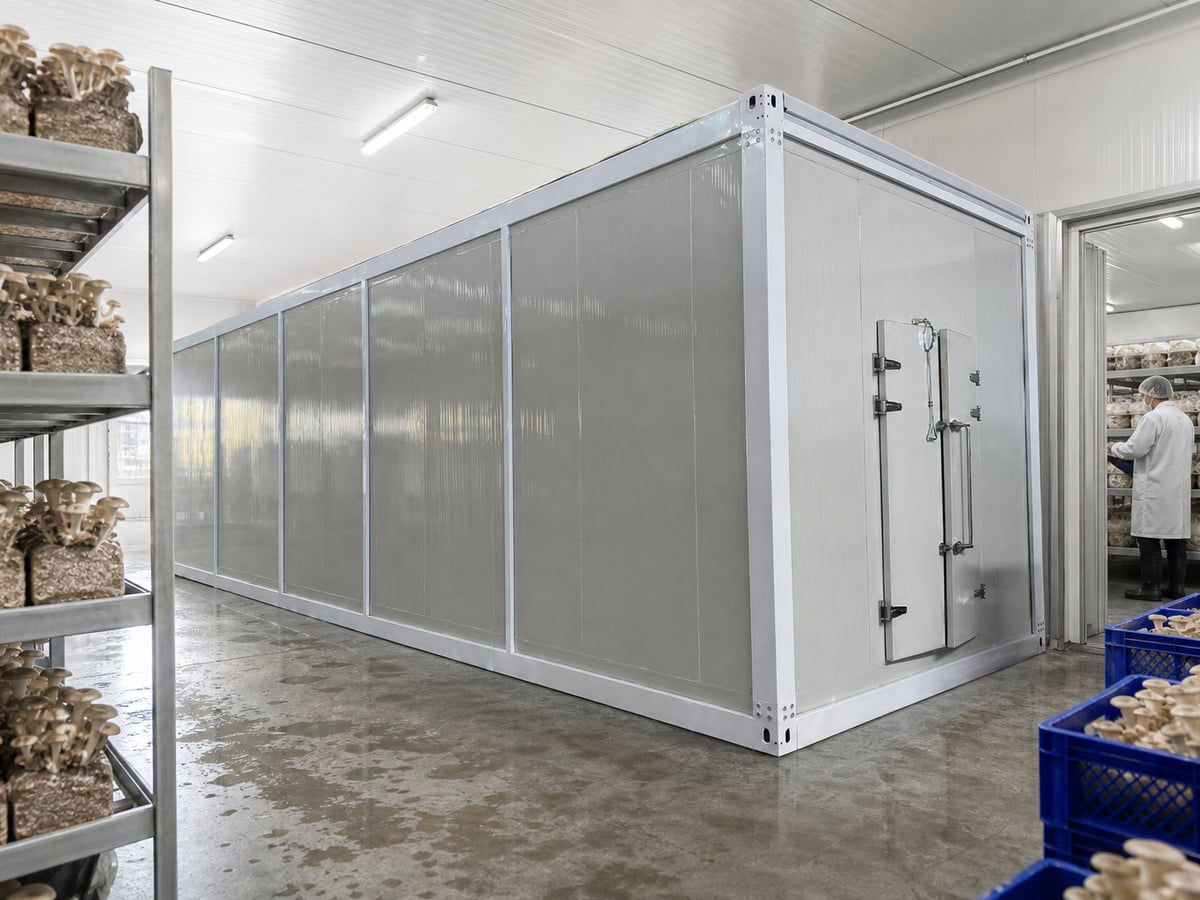
The first production module determines the farm’s future operating standard. It should be large enough to generate meaningful production data and consistent sales, but not so large that a new operator cannot manage sanitation, harvesting, climate adjustments, and customer delivery schedules. For many commercial projects, a smart mushroom cultivation container or insulated modular room is an effective starting point because it provides a predictable envelope and a fast route to commissioning.
Before selecting dimensions, define the mushroom species, substrate source, production stage, target weekly harvest, local climate, available utilities, and buyer profile. Oyster mushrooms often suit a fast-turnover model, while shiitake and lion’s mane may justify higher prices but require more precise crop timing and market education. A restaurant-focused farm near London, Paris, Tokyo, or New York may prioritize premium varieties and frequent delivery. A wholesaler serving supermarkets near Rotterdam, Jebel Ali, or Sydney may prioritize uniform packs, dependable volume, and cold-chain handling.
Production modules should be assessed by usable growing volume, not only external floor area. Rack layout, aisle width, airflow pattern, bag spacing, ceiling height, access doors, and drain location all affect actual capacity. Crowding may increase the number of bags in a room but can restrict air movement, complicate harvesting, and create humidity pockets that raise disease risk.
A high-quality first module should include an insulated enclosure, corrosion-resistant surfaces, LED lighting appropriate for the species, a humidity system, cooling and heating capacity, fresh-air intake, exhaust control, circulation fans, temperature and humidity sensors, carbon dioxide monitoring where required, electrical safeguards, and a floor arrangement that can be washed and drained. Explore a smart mushroom cultivation container solution when a project needs an integrated and relocatable production room.
| First Module Factor | What to Evaluate | Good Practice | Common Risk to Avoid |
|---|---|---|---|
| Species selection | Climate tolerance, crop cycle, local selling price | Start with one or two market-tested species | Launching many varieties without stable buyers |
| Room size | Production volume, labor availability, site space | Choose a size that can be fully managed every day | Building too large before mastering operations |
| Insulation | Wall, roof, floor, and door thermal performance | Use continuous insulated panels and sealed joints | Ignoring heat gain in tropical or desert locations |
| Airflow | Fan location, fresh-air distribution, exhaust path | Design for even circulation through all rack levels | Creating stagnant zones behind dense shelving |
| Drainage | Floor slope, drain size, wastewater route | Plan drainage before equipment installation | Allowing wash water to collect under racks |
| Automation | Sensor accuracy, controller functions, alarm access | Use adjustable recipes and historical data records | Relying only on manual visual checks |
This comparison explains why the lowest purchase price is rarely the best buying criterion. A mushroom production unit with poor insulation, insufficient airflow, or inaccessible drainage can create recurring energy, labor, and crop-quality costs for years. Buyers should request a clear equipment list, utility requirements, wiring documentation, climate-control scope, panel specifications, maintenance recommendations, and commissioning support before confirming an order.
For projects exposed to hot summers, freezing winters, high humidity, salt air, or unreliable grids, the first module should also include local risk planning. Coastal farms near Manila, Mombasa, Santos, or Durban may need enhanced corrosion protection. Facilities in desert markets such as Riyadh or inland Australia may need greater cooling efficiency. Farms in cold regions such as Canada, Northern Europe, or Central Asia should evaluate low-temperature heating performance and door sealing.
Separating Fruiting and Support Areas

A scalable mushroom farm needs a clear separation between crop rooms and support functions. Fruiting modules should remain clean, controlled, and dedicated to growing conditions. Support areas handle activities that create traffic, moisture, dust, packaging waste, or contamination risk, including receiving substrate, storing supplies, packing mushrooms, washing tools, managing waste, and maintaining equipment.
Even a compact site benefits from a logical one-way flow: receiving, storage, crop preparation, fruiting, harvest, packing, cold storage, dispatch, and waste removal. Workers should not carry dirty crates, waste bags, or outdoor footwear through active fruiting rooms. Separating these areas makes sanitation easier and protects the environmental stability required for consistent mushroom quality.
For farms purchasing fully colonized blocks, the support area may be modest: a receiving bay, clean storage zone, packing bench, washing point, refrigeration, and technical cabinet. Farms producing their own substrate require more separation, including raw-material storage, mixing, pasteurization or sterilization, inoculation, incubation, and waste handling. In those larger facilities, fruiting rooms should be physically isolated from high-dust substrate work.
| Area | Main Function | Environmental Requirement | Biosecurity Priority |
|---|---|---|---|
| Receiving zone | Accept substrate blocks, packaging, and supplies | Covered, ventilated, easy to clean | Keep external dirt away from crop rooms |
| Fruiting module | Produce mushrooms under controlled conditions | Stable temperature, humidity, airflow, and CO2 | Restrict entry and sanitize tools |
| Packing room | Sort, weigh, label, and pack harvested mushrooms | Clean, cool, bright, food-safe surfaces | Separate raw blocks from finished product |
| Cold storage | Hold mushrooms before delivery | Consistent refrigeration and monitored temperatures | Prevent product spoilage and cross-contamination |
| Wash and sanitation area | Clean trays, equipment, footwear, and tools | Drainage, washable finishes, controlled chemical storage | Prevent dirty water from entering crop areas |
| Waste zone | Store spent substrate and packaging waste | External or isolated covered area | Keep pests and spores away from production |
The table demonstrates that room separation is a productivity measure as well as a hygiene measure. When packing, repairs, harvesting, and waste handling occur in the same space, workers lose time and the crop environment is disturbed. A defined support zone also makes it easier to comply with customer audits, local food-handling expectations, and export documentation requirements.
Support areas can be modular too. A farm may begin with a small packing and sanitation building, then add a refrigerated dispatch module once supermarket contracts increase. This incremental design is useful for agricultural projects in growing cities such as Nairobi, Bangkok, Mexico City, Istanbul, and Jakarta, where land, labor, traffic congestion, and delivery timing must all be carefully managed.
Sizing Shared Water and Power
Water and electrical infrastructure should be designed for the farm’s planned final capacity, not only for the first fruiting room. Installing undersized cables, water pipes, drainage lines, or electrical panels can make later expansion expensive and disruptive. A practical method is to calculate the initial load, forecast the load of future modules, and include a realistic reserve for peak demand, cleaning, refrigeration, lighting, pumps, and control systems.
Electrical demand varies according to climate, insulation quality, room size, crop recipe, and equipment selection. Cooling and dehumidification can dominate energy use in hot, humid regions, while heating may be the largest load in cold locations. Humidifiers, circulation fans, fresh-air fans, lighting, refrigeration, pumps, and automation should be included in the calculation. The main panel should have labeled circuits, surge protection, grounding, emergency isolation, and sufficient spare capacity for future rooms.
Water planning should include crop humidification, cleaning, handwashing, water treatment, possible evaporative cooling, and emergency reserves where municipal supply is unreliable. Water quality matters because mineral content, sediment, and microbial contamination can affect humidifier performance and maintenance frequency. Filtration, softening, ultraviolet treatment, or reverse osmosis may be considered according to local water analysis and equipment needs.
| Shared Utility | Initial Calculation | Expansion Allowance | Operational Recommendation |
|---|---|---|---|
| Main electrical panel | Total connected load of first module and support spaces | Reserve circuits and capacity for future units | Use documented load schedules and qualified installation |
| Cooling and heating | Based on room envelope, outdoor climate, and crop setpoints | Allow for added modules and seasonal peaks | Prioritize insulation before oversizing equipment |
| Water supply pipe | Humidification, cleaning, and staff use | Size trunk lines for planned farm capacity | Install isolation valves for each module |
| Drainage system | Washdown volume and humidifier discharge | Provide routes for future room connections | Use floor slopes and accessible cleanouts |
| Internet connection | Controller access, alarms, cameras, and records | Support multiple sensors and remote users | Use backup connectivity where possible |
| Backup power | Critical fans, controllers, alarms, and refrigeration | Consider higher loads as rooms are added | Define which systems require uninterrupted operation |
This utility framework highlights an important buying principle: a modular room may be delivered as a finished structure, but the project still needs site-level engineering. Farms should confirm local voltage, phase, frequency, water pressure, drainage regulations, access roads, and permitting requirements before production equipment is shipped. This is particularly important for cross-border projects where electrical standards and site conditions vary between countries.
Smart controllers can reduce waste by regulating temperature, humidity, fresh air, and fan operation according to actual sensor feedback. A mushroom climate controller can help operators establish crop recipes, monitor deviations, and respond faster to changes in room conditions. However, automation should support—not replace—daily crop inspection, sanitation routines, and preventive maintenance.
Staggering Batches Across Modules
Staggered production is one of the strongest advantages of a multi-module mushroom farm. Instead of filling every room at the same time and harvesting one large seasonal peak, growers can schedule blocks across several rooms at different crop stages. This creates a more even weekly harvest, smoother labor demand, steadier buyer supply, and lower risk if one room experiences a crop issue.
A common expansion pattern is to dedicate each module to a crop stage, a species, or a weekly batch group. For example, one module may hold recently introduced blocks, another may produce peak harvest volume, and a third may carry a later batch. The best arrangement depends on the production cycle, product mix, labor team, and customer requirements. Restaurants often value frequent small deliveries, while wholesalers may require predictable pallet-level volumes on fixed delivery days.
Staggering also improves cash flow. Regular harvests create recurring invoices and make it easier to forecast packaging purchases, delivery routes, labor shifts, and substrate orders. The grower can compare expected yield with actual yield by batch, identify weak lots early, and avoid having all inventory ready on a single day.
| Week | Module A | Module B | Module C | Commercial Objective |
|---|---|---|---|---|
| Week 1 | New blocks introduced | Pinning management | Harvest and cleaning | Maintain a continuous crop pipeline |
| Week 2 | Vegetative development | First harvest | New blocks introduced | Supply fresh product to recurring buyers |
| Week 3 | Pinning management | Second harvest | Vegetative development | Balance labor across rooms |
| Week 4 | First harvest | Cleaning and reset | Pinning management | Prepare room turnover without supply gaps |
| Week 5 | Second harvest | New blocks introduced | First harvest | Maintain consistent sales volume |
| Week 6 | Cleaning and reset | Vegetative development | Second harvest | Review yield, quality, and customer demand |
The example schedule is illustrative rather than universal. Crop timing changes with species, substrate quality, climate setpoints, and harvest standards. The key lesson is that each room should have a written batch identity, arrival date, target fruiting window, expected yield, harvest history, sanitation date, and disposal or recycling date. Digital records make this process easier as the number of modules grows.
Future-ready farms increasingly combine batch scheduling with sales forecasting. A distributor can estimate demand by customer, product size, and delivery day; the farm can then adjust upcoming block orders and room loading. By 2026, more farms are expected to use connected sensors, production dashboards, automated alerts, and simple forecasting tools to coordinate crop availability with buyer commitments. This trend supports lower food waste and more reliable local food supply chains.
Central Monitoring and Room Isolation
As more mushroom modules are added, centralized monitoring becomes essential. The farm manager should be able to view room temperature, relative humidity, carbon dioxide level where applicable, ventilation status, alarms, power status, and operating history from one control point. This reduces unnecessary walking between rooms and makes it easier to identify abnormal conditions before crop quality is affected.
Central monitoring should not mean that every room shares the same climate setting. Each module needs independent control because crop stage, mushroom species, loading density, and outside conditions can differ. A lion’s mane room may need a different fresh-air strategy than an oyster mushroom room. A newly loaded room may require a different recipe than a room approaching final harvest. Individual room isolation also helps protect the rest of the farm if one module has a pest issue, equipment failure, contamination concern, or unusual crop response.
Isolation begins with physical details: sealed doors, separate air paths where possible, cleaning tools assigned to each room, footbaths or footwear protocols, labeled harvesting containers, and a policy for visiting rooms from cleanest to highest-risk areas. It also includes operational discipline. Workers should know who can change controller settings, how alarms are acknowledged, and when a maintenance issue requires escalation.
For Global Market projects, remote visibility can be particularly valuable where owners, installers, distributors, or technical teams are located in different cities or countries. A project owner in Amsterdam, a farm manager in Accra, and an equipment support team in China can review key system data without waiting for an on-site visit. Data access should still follow secure account permissions and clear responsibility rules.
Planning Service and Delivery Access
Good site access is often underestimated during early farm planning. Mushroom production requires regular deliveries of substrate blocks, packaging, cleaning supplies, spare parts, and sometimes fuel or water-treatment materials. It also requires rapid dispatch of fresh harvested mushrooms. The site should provide a safe route for vans, refrigerated vehicles, forklifts where needed, waste collection, and maintenance teams.
Position production modules so that service doors, electrical panels, condensers, ventilation equipment, drains, and control cabinets remain accessible. Do not trap technical components behind pallets, racks, or future buildings. Leave space for cleaning equipment, replacement parts, filter service, and safe inspection. If modules are installed in dense urban districts, consider vehicle turning radius, loading-hour restrictions, noise requirements, and the availability of nearby cold-chain logistics.
Delivery planning is closely linked to product quality. Fresh mushrooms should move quickly from harvest to packing and refrigeration. Farms near airports, wholesale markets, ports, and distribution corridors may have an advantage, but local last-mile logistics still determine customer satisfaction. Examples include proximity to the Port of Rotterdam for European distribution, Jebel Ali for Gulf trade, Singapore’s logistics network for Southeast Asia, or regional produce markets in Toronto, Johannesburg, and São Paulo.
Case experience from modular agriculture projects shows that reliable delivery schedules often matter more to commercial customers than the farm’s maximum theoretical output. A chef, retailer, or food-service distributor needs confidence that products will arrive clean, chilled, correctly labeled, and on time. Farms should test delivery routes before adding major production capacity. Review practical examples and project applications through these modular cultivation project cases.
Expansion Triggers Based on Sales
A new module should be added because the business has demonstrated repeatable demand, not simply because the first room appears full. Strong expansion triggers include stable weekly sales, recurring customer contracts, consistently high room utilization, documented production performance, adequate working capital, trained labor, and sufficient utility capacity. The decision should consider contribution margin after substrate, electricity, labor, packaging, distribution, rent, maintenance, and product losses.
One useful rule is to expand when the farm has turned away profitable orders or has operated near practical capacity for several consecutive crop cycles without reducing quality. Another is to secure enough committed demand to absorb a conservative share of the next module’s expected output. This is safer than relying only on optimistic projections or one-time inquiries.
| Expansion Trigger | Evidence to Collect | Recommended Response | Warning Sign |
|---|---|---|---|
| High room utilization | Modules remain productively loaded across multiple cycles | Evaluate a duplicate fruiting module | Loading rooms before sanitation is complete |
| Recurring demand | Regular orders from retailers, restaurants, or distributors | Use contracts or forecast agreements where possible | Expanding based on occasional enquiries |
| Reliable yield | Batch records show consistent harvest and quality | Standardize the proven recipe and operating procedure | Ignoring variable substrate performance |
| Positive operating margin | Real cost records show profitable production | Allocate funds for the next module and working capital | Confusing revenue growth with profitability |
| Labor readiness | Staff can manage harvest, cleaning, and deliveries on time | Train supervisors before adding rooms | Adding capacity without reliable daily labor | Utility readiness | Power, water, drainage, and network capacity are verified | Connect the next room through planned infrastructure | Using temporary connections as permanent solutions |
The table explains why sales-led expansion is more resilient than construction-led expansion. A farm can have excellent equipment but still struggle if it lacks working capital, customer relationships, route planning, or production discipline. Conversely, a small farm with strong buyers and accurate records can scale confidently by adding standardized modules in stages.
By 2026, sustainability and policy considerations will increasingly influence expansion decisions. Buyers are asking for traceability, reduced food miles, recyclable packaging, lower energy use, and responsible management of spent mushroom substrate. Some cities and governments are also encouraging controlled-environment agriculture, renewable electricity, water efficiency, and local food production. Farms can prepare by tracking energy per kilogram, water use, waste recycling, reusable crate programs, and the potential use of spent substrate for compost, soil improvement, animal-feed research, or bio-based material applications where regulations permit.
Our Company: Modular Climate Control and Cultivation Support
Shandong Lanhu Air Conditioning Equipment Co., Ltd. supports commercial mushroom projects with modular cultivation solutions, agricultural climate-control equipment, industrial HVAC capability, smart cultivation containers, mushroom climate controllers, hydroponic plant containers, and air source heat pump systems. The company serves agricultural contractors, equipment distributors, engineering companies, and commercial farming projects across the Global Market.
Technological capability is centered on more than 12 years of thermodynamic research and development experience. Lanhu develops controlled-environment systems that help growers manage the critical relationship between temperature, humidity, fresh air, circulation, and operational stability. Smart controls can support recipe-based adjustment, system visibility, alarm management, and repeatable environmental performance across multiple fruiting modules. This approach is valuable for farms that want to standardize room conditions while maintaining independent control for every module.
Manufacturing capability is supported by a modern facility in Dezhou, Shandong, China, covering more than 30,000 square meters. Integrated processes include product design, engineering development, sheet metal fabrication, CNC bending, insulation panel production, electrical assembly, system integration, equipment testing, and quality inspection. With more than 45 registered patents and management certifications including ISO 9001, ISO 14001, ISO 45001, and ISO 12100, Lanhu applies structured quality controls to functional inspection, electrical verification, performance testing, and operational evaluation before shipment.
Service capability includes factory-direct supply, OEM and ODM customization, engineering assistance, international logistics support, spare parts planning, installation guidance, and after-sales service. For investors and contractors developing phased facilities, the team can help align modular room specifications with target species, site climate, utility conditions, operational goals, and future expansion plans. Learn more about OEM and ODM modular farming services for customized project requirements.
FAQ
- How many mushroom modules should a new commercial farm start with?
- Most new operators benefit from starting with one properly equipped production module and a support area designed for expansion. A second room becomes appropriate when crop performance, weekly sales, labor capacity, and utility readiness are proven over several cycles.
- Can one modular room grow several mushroom species?
- It can, but only when the species have compatible environmental requirements and harvest practices. Separate rooms are usually better for premium species or crops needing different temperatures, humidity levels, fresh-air rates, or sanitation procedures.
- Why should fruiting rooms be separated from packing and storage?
- Separation protects crop hygiene, prevents unnecessary environmental disturbance, improves worker flow, and makes cleaning easier. Packing and dispatch activities create traffic that should not pass through active growing rooms.
- What utility capacity should be planned for future expansion?
- Plan electrical panels, main cables, water trunk lines, drainage routes, internet connectivity, and service access for the intended final number of modules. A qualified local engineer should verify site-specific electrical and building requirements.
- How can a farm maintain consistent weekly mushroom supply?
- Use staggered batches across modules. Introduce substrate blocks on a planned schedule, record each batch, and align expected harvest windows with regular customer delivery days.
- What should trigger the purchase of another mushroom container or room?
- Expansion should be supported by repeat orders, sustained room utilization, reliable yields, positive operating margins, trained staff, working capital, and confirmed utility capacity. Avoid expanding solely because the first room is occasionally busy.
- Are modular mushroom farms suitable for urban areas?
- Yes. They can suit urban and peri-urban projects where access to restaurants, retailers, hotels, and consumers is strong. The site must still meet local rules for power, drainage, food handling, vehicle access, noise, and waste management.
- How does remote monitoring improve mushroom cultivation?
- Remote monitoring gives operators earlier warning of temperature, humidity, ventilation, or power problems. It supports faster corrective action, better production records, and coordinated oversight when management teams are in different locations.
Share this article

About the Author: Shandong Lanhu Air Conditioning Equipment
Lanhu is a professional climate control equipment manufacturer specializing in smart agricultural systems, commercial HVAC solutions, and customized temperature control technologies. With extensive engineering experience, Lanhu provides reliable solutions for plant factories, controlled environment agriculture, and industrial applications.
Need a Custom Climate Control Solution?
From smart agricultural systems to commercial HVAC solutions, Lanhu provides reliable temperature and humidity control solutions tailored to your project needs.
Contact Us