Mushroom Growing Equipment for the Global Market: Buyer Guide
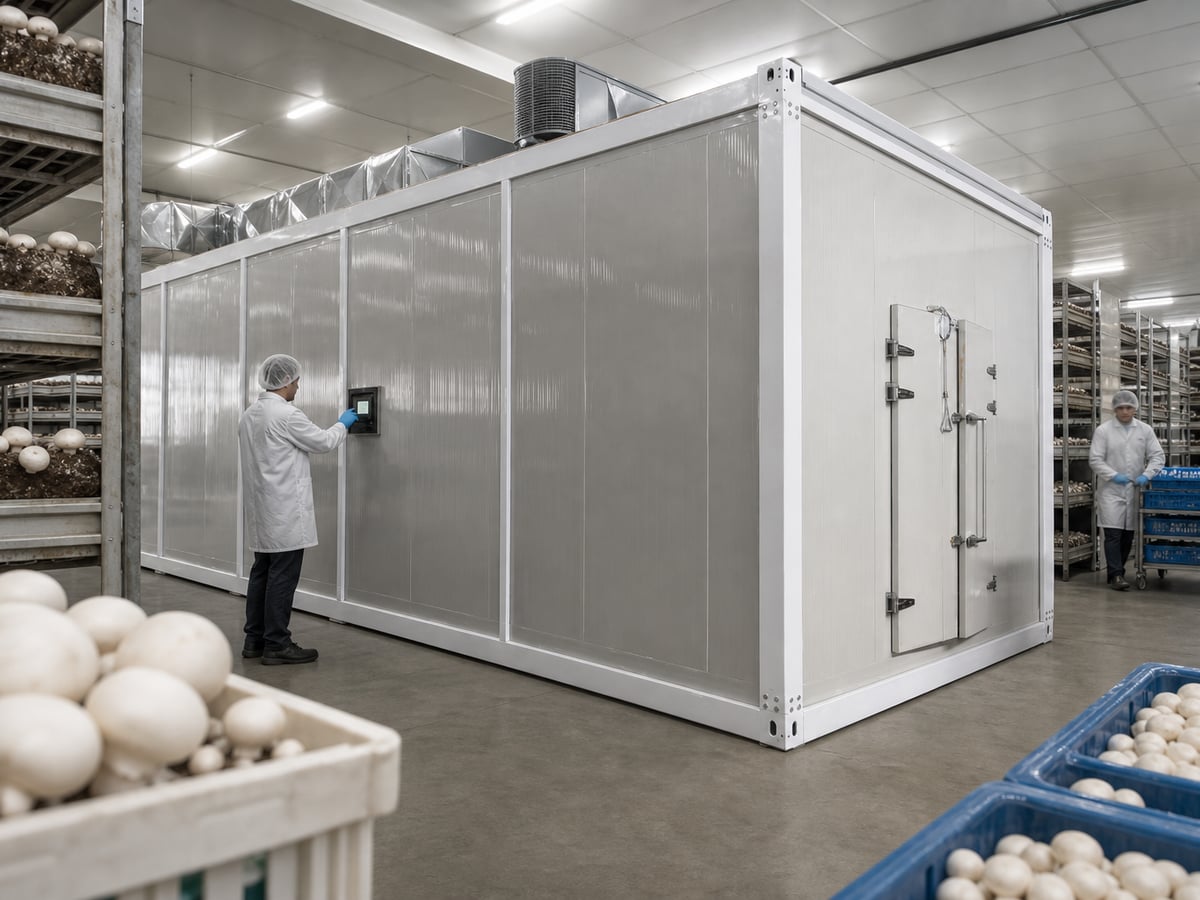
Quick Answer

Mushroom growing equipment is a controlled-environment system designed to create stable fruiting conditions for commercial mushroom production. Depending on the farm scale, it may include insulated grow rooms, cultivation containers, shelving, humidifiers, fresh-air systems, cooling and heating equipment, CO2 sensors, circulation fans, climate controllers, lighting, drainage, and remote monitoring platforms.
For the Global Market, the right mushroom cultivation equipment is not simply a refrigerated room or a humidification unit. It is an integrated system that balances temperature, relative humidity, CO2 concentration, air movement, hygiene, and operational costs for a specific mushroom species. Oyster mushrooms, shiitake, button mushrooms, enoki, lion’s mane, king oyster, and medicinal mushrooms each require different environmental recipes during incubation, pinning, fruiting, harvesting, and room sanitation.
Commercial buyers should evaluate equipment based on usable growing area, expected substrate capacity, local ambient climate, electrical standards, water quality, labor availability, site access, service requirements, and expansion plans. A modular mushroom growing container can be a practical option for rapid deployment, while larger farms may require purpose-built insulated growing rooms with centralized HVAC and automation.
Lanhu supplies integrated climate-controlled cultivation solutions for agricultural contractors, distributors, engineering companies, and mushroom farms. Buyers can review its smart mushroom cultivation containers when comparing compact, modular production systems for export projects and commercial farms.
What Is Mushroom Growing Equipment and Where Is It Used
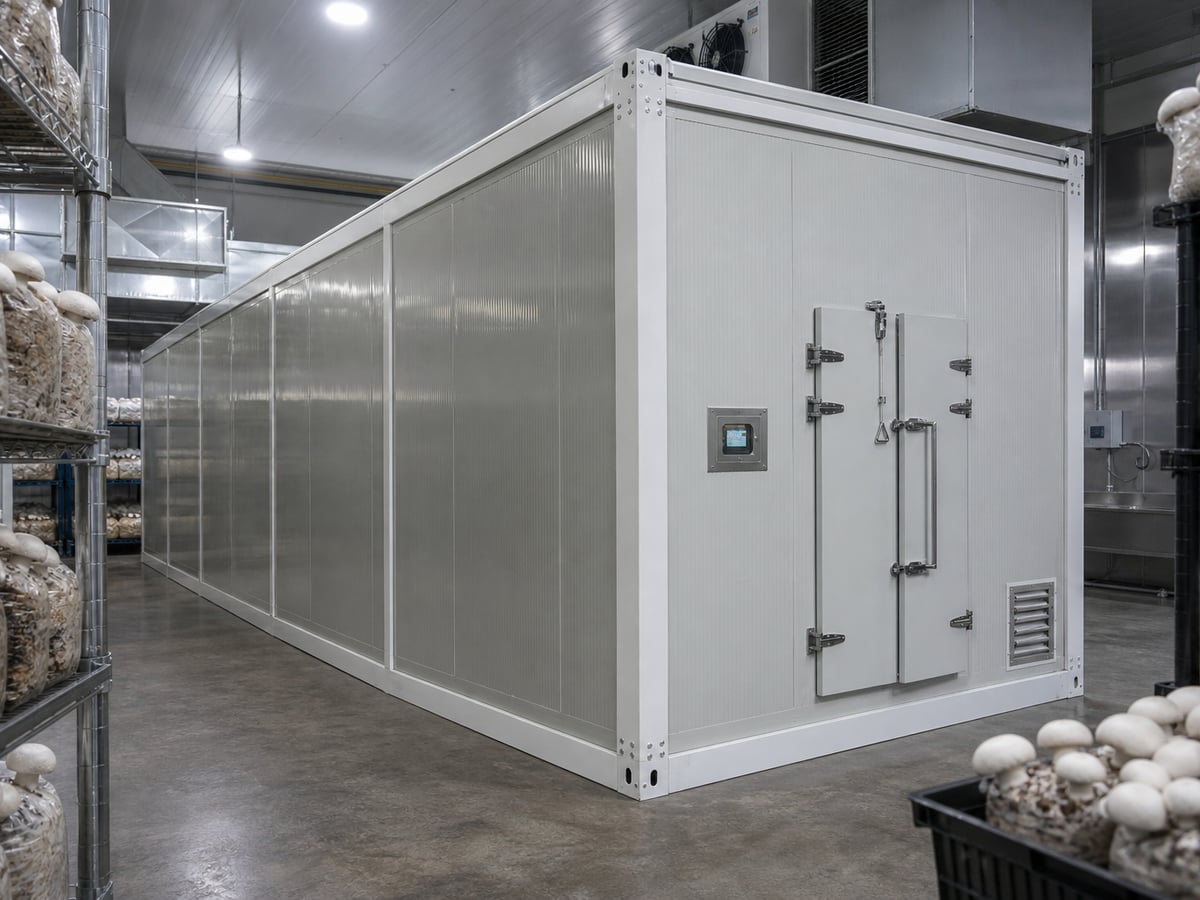
Mushroom growing equipment refers to machinery, structures, environmental controls, and support systems used to cultivate fungi under managed conditions. The equipment creates a repeatable microclimate that supports mycelium development and mushroom fruiting while reducing contamination risks and minimizing dependence on outdoor weather.
It is used in commercial mushroom farms, agricultural cooperatives, urban farming projects, food-security programs, research centers, hotel and restaurant supply farms, specialty mushroom businesses, pharmaceutical raw-material cultivation facilities, and containerized farms serving remote locations. In major trade and logistics hubs such as Rotterdam, Dubai, Singapore, Los Angeles, São Paulo, Johannesburg, and Melbourne, modular cultivation systems are often considered because they can be shipped, installed, and expanded with fewer civil works than conventional agricultural buildings.
In colder regions, mushroom farm equipment may require higher heating capacity, frost protection, insulated wall panels, and heat recovery. In tropical regions such as Southeast Asia, East Africa, Central America, and coastal South America, the priorities are usually high-efficiency cooling, moisture management, corrosion protection, and adequate fresh-air exchange. In dry inland climates, water-saving humidification and accurate humidity control can be especially important.
The commercial market generally includes the following product categories:
| Equipment Type | Primary Function | Typical User | Common Application |
|---|---|---|---|
| Smart cultivation container | Integrated mobile growing environment | Start-up farms and distributed growers | Oyster, shiitake, lion’s mane |
| Insulated mushroom grow room | Large-scale controlled fruiting space | Commercial farms | Multiple production rooms |
| Climate controller | Coordinates temperature, humidity, CO2, and ventilation | Existing farm upgrades | Automation retrofit |
| Humidification system | Maintains target moisture levels | Grow rooms and container farms | Pinning and fruiting stages |
| Air handling and ventilation unit | Supplies fresh air and manages air circulation | Medium and large facilities | CO2 reduction and uniformity |
| Rack and shelving system | Organizes substrate bags or blocks vertically | All production scales | Space-efficient cultivation |
This classification helps buyers distinguish between standalone equipment and complete systems. A single humidifier may improve a room temporarily, but commercial consistency normally requires coordinated refrigeration, heating, ventilation, sensing, airflow distribution, and control logic.
Standard Product Configuration and System Boundaries
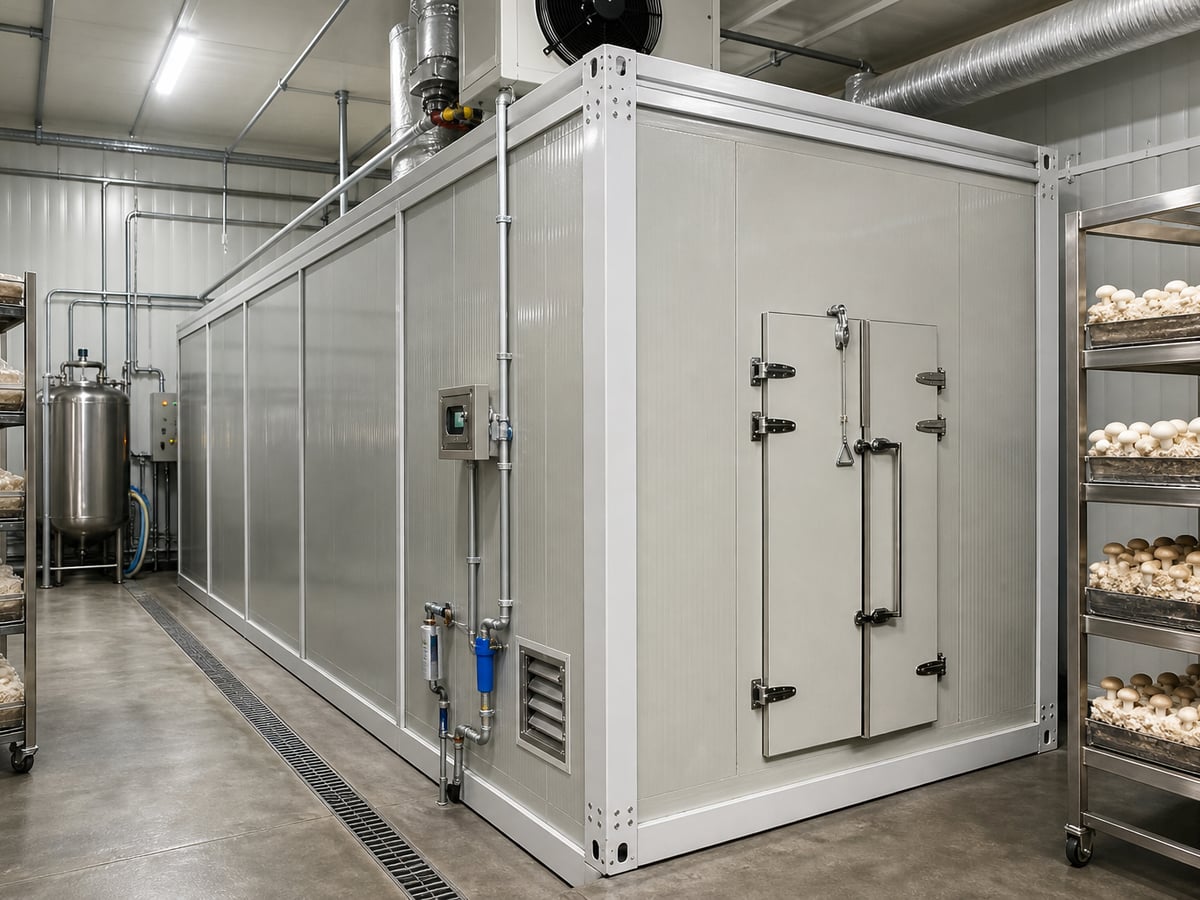
A standard mushroom growing equipment package should be defined clearly before quotation. This avoids confusion between what is included in the supply scope and what remains the responsibility of the buyer, local contractor, or installation team.
For a containerized mushroom farm, the standard configuration commonly includes an insulated container body, internal wall and ceiling panels, access doors, refrigeration or heat-pump equipment, humidification, air circulation fans, fresh-air intake and exhaust components, electrical control cabinet, environmental sensors, lighting, drainage provisions, cultivation racks, and a programmable controller. Optional features may include remote monitoring, automatic misting zones, ultraviolet or ozone sanitation modules, backup power interfaces, water filtration, and custom rack spacing.
For a fixed grow room, the boundaries are broader. The supplier may provide the HVAC system, panels, climate controller, sensors, ductwork, racks, and installation guidance. Civil foundations, main electrical supply, building permits, water connection, wastewater discharge, local fire approvals, and external drainage are often handled by the project owner unless specifically included in the contract.
| System Element | Usually Included | Often Optional | Buyer Responsibility to Confirm |
|---|---|---|---|
| Insulated enclosure | Panels, doors, internal finish | Custom exterior cladding | Foundation and site leveling |
| Climate control | Cooling, heating, fans, sensors | Heat recovery or redundant units | Electrical supply capacity |
| Humidity control | Fogging or humidification equipment | Water treatment module | Water pressure and water quality |
| Ventilation | Fresh-air inlet and exhaust fans | Filtration upgrades | External discharge location |
| Automation | Local control panel and operating modes | Cloud platform and alarm notifications | Internet or SIM connectivity |
| Cultivation hardware | Basic racks or hanging provisions | Custom tray or bag systems | Substrate format and loading method |
A detailed scope sheet should state equipment quantities, brands where required, design conditions, control tolerances, electrical specifications, piping interfaces, shipping method, commissioning support, spare parts, training, and warranty limits. This is particularly important for international shipments through ports such as Qingdao, Shanghai, Jebel Ali, Hamburg, Felixstowe, Mombasa, and Santos.
Lanhu can support OEM and ODM development for customers who need branded control panels, different external finishes, custom layouts, regional electrical configurations, or project-specific operating logic. Its OEM and ODM service is relevant for distributors and engineering partners building localized mushroom farm product lines.
Capacity, Dimensions, and Utility Requirements
Capacity should not be selected only by container length or room floor area. The practical output depends on the mushroom species, substrate block size, shelf spacing, rack levels, crop cycle length, harvest target, loading pattern, labor process, and environmental stability. A room with more racks is not necessarily more profitable if airflow becomes uneven or harvesting access is restricted.
Typical modular mushroom cultivation containers may be based on 20-foot or 40-foot shipping-container dimensions, while custom projects can use expanded modules, connected containers, or insulated room panels. The usable internal area is lower than the external container dimension because wall insulation, equipment space, doors, service channels, and rack clearances must be considered.
| Project Scale | Typical Layout | Approximate Use | Electrical Requirement | Water Requirement |
|---|---|---|---|---|
| Pilot production | Small insulated room | Trial crops and training | Single-phase or light three-phase | Basic potable or filtered water |
| Container farm | 20-foot cultivation module | Specialty mushroom production | Three-phase preferred | Humidification and cleaning supply |
| Expanded container farm | 40-foot module | Regular local distribution | Three-phase commercial supply | Stable pressure and drainage |
| Medium farm | Several grow rooms | Wholesale production | Dedicated distribution board | Water storage and treatment recommended |
| Large production site | Centralized rooms and corridors | Retail, export, and processing supply | Industrial three-phase service | Central water and wastewater design |
| Multi-site network | Multiple modular units | Regional distributed farming | Site-specific electrical design | Standardized local utility connection |
Electrical supply must be checked early. Global projects commonly require 220V, 380V, 400V, 415V, 50Hz, or 60Hz configurations depending on destination. Buyers should provide voltage, frequency, phase, available power, grounding arrangement, and any local electrical-code requirements. Incorrect utility assumptions can delay installation or require expensive changes after arrival.
Water quality affects humidifier performance, nozzles, fogging pipes, and hygiene. High mineral content can cause scaling, while untreated water may introduce microbial risks. Where necessary, sediment filtration, softening, reverse osmosis, ultraviolet treatment, or periodic flushing procedures should be evaluated. Drainage is equally important because washdown water, condensate, and excess humidity must leave the cultivation area safely.
For large mushroom farms, energy consumption should be estimated using local summer and winter design temperatures rather than generic assumptions. A project in Riyadh, Nairobi, Vancouver, Warsaw, or Jakarta will have very different cooling and heating loads. Requesting capacity calculations based on the actual site climate improves equipment selection and operating-cost planning.
Temperature, Humidity, CO2, Airflow, and Control Performance
The value of mushroom cultivation equipment comes from its ability to maintain stable growing conditions. Temperature affects crop metabolism and fruiting speed; humidity affects pin formation, cap development, and weight; CO2 affects stem length and cap shape; airflow influences evaporation and fresh-air distribution. These parameters must work together rather than independently.
Exact setpoints depend on species and strain. Oyster mushrooms may fruit successfully across several temperature ranges depending on variety, while shiitake generally requires a different fruiting profile and button mushrooms follow another production process. A supplier should therefore avoid presenting one universal recipe as suitable for every crop.
| Control Parameter | Why It Matters | Typical Equipment Used | Buyer Evaluation Point |
|---|---|---|---|
| Temperature | Supports stage-specific crop development | Heat pump, refrigeration, heater | Cooling and heating capacity at site conditions |
| Relative humidity | Prevents drying and supports fruit body quality | Fogger, ultrasonic humidifier, nozzles | Uniformity without surface water buildup |
| CO2 concentration | Influences morphology and fresh-air demand | CO2 sensor, intake fan, exhaust fan | Sensor location and ventilation response |
| Air velocity | Controls evaporation and room uniformity | Circulation fans and ductwork | No direct drafts on mushroom clusters |
| Fresh-air volume | Removes excess CO2 and odors | Dampers, fans, air handling unit | Adjustable exchange rate and filtration |
| Alarm performance | Protects crops during equipment faults | Controller, sensors, communication module | High/low alarm limits and notification method |
Good control performance is more than a controller display showing target numbers. Sensors must be positioned properly, calibrated periodically, protected from direct mist, and connected to practical control logic. For example, a CO2 sensor placed directly beside an air inlet may show a lower reading than the crop zone. Similarly, a humidity sensor mounted in the path of a fogger may overstate actual room humidity.
Airflow design should deliver fresh air evenly across all rack levels. Poor airflow can create warm upper shelves, wet lower shelves, high-CO2 corners, uneven pinning, and inconsistent harvest quality. Duct placement, fan direction, return-air routing, and rack arrangement should therefore be reviewed as part of the equipment design.
For critical commercial operations, buyers may request independent temperature and humidity data logging, backup alarm contacts, spare sensors, and remote notification. These features can reduce crop-loss exposure when production rooms are unattended overnight or located far from the farm office.
Lanhu’s smart mushroom climate controller is designed to coordinate environmental inputs in one control platform, helping growers manage different cultivation stages with programmed settings and operational visibility.
Core Components, Materials, and Protection Features
Commercial mushroom growing environments are continuously exposed to high humidity, condensation, organic debris, cleaning chemicals, and temperature changes. Materials and protection features should therefore be considered as seriously as cooling capacity. Low-quality finishes may corrode, trap contaminants, lose insulation performance, or become difficult to clean.
Typical enclosure materials include color-coated steel, galvanized steel, stainless steel in high-hygiene zones, polyurethane insulated panels, and sealed aluminum or stainless trim. The appropriate material selection depends on the farm’s sanitation program, humidity level, budget, location, and expected service life.
| Component | Recommended Feature | Commercial Benefit | Inspection Question |
|---|---|---|---|
| Wall panels | Insulated, sealed, washable surface | Lower heat transfer and easier sanitation | What is the insulation thickness and core material? |
| Doors | Insulated, corrosion-resistant, gasketed | Reduces air leakage and condensation | How is the door seal maintained? |
| Racks | Galvanized or stainless construction | Supports repeated loading and cleaning | What is the load rating per shelf? |
| Electrical cabinet | Protected enclosure and labeled wiring | Improves safety and service access | What ingress-protection level is provided? |
| Fans and motors | Moisture-resistant construction | Improves reliability in humid rooms | Can motors be serviced locally? |
| Drainage system | Sloped floor and accessible drain points | Reduces standing water and hygiene risks | How are condensate and washdown water managed? |
Protection features may include overload protection, phase-loss protection, high-pressure and low-pressure refrigeration protection, automatic defrosting, emergency stop functions, leakage protection, water-level alarms, compressor delay functions, and high-temperature alerts. Projects shipped to coastal locations should consider additional anti-corrosion treatments because salt-laden air can shorten equipment life.
Lanhu operates an integrated manufacturing process in Dezhou, Shandong, covering product design, engineering development, sheet-metal fabrication, CNC bending, insulation-panel production, electrical assembly, system integration, testing, and quality inspection. This production structure supports more consistent interfaces between enclosure, mechanical, and control components than a project assembled from unrelated suppliers.
Before shipment, functional inspection, electrical verification, performance testing, and operating evaluation are important quality-control steps. Buyers should request a pre-shipment checklist, photographs or videos of testing where appropriate, packing details, and clear identification of replacement parts.
Automation, Remote Monitoring, and Customization Options
Automation helps growers standardize environmental conditions, reduce manual adjustment, improve response speed, and create production records. A basic automated system may control fans, humidification, cooling, heating, and alarms. Advanced systems may provide multi-stage recipes, remote access, historical charts, user permissions, energy tracking, maintenance reminders, and mobile notifications.
Remote monitoring is especially valuable for container farms located near distribution centers, remote agricultural sites, universities, hotels, or regional food hubs. A farm operator in Dubai may need to monitor a modular unit in a desert-edge agricultural zone, while a distributor in Europe may need to support several customer installations across different countries.
Customization options should be selected according to operational need rather than added simply because they are available. Common options include:
- Custom container length, connected modules, or insulated room dimensions.
- Rack spacing based on substrate bags, bottles, trays, blocks, or hanging systems.
- Voltage, frequency, plug type, and electrical certification adaptation.
- Different cooling and heating solutions for hot, cold, humid, or dry climates.
- Remote monitoring through Wi-Fi, Ethernet, cellular connection, or local network integration.
- Private-label control panels and branding for distributors.
- Water filtration, automatic flushing, ultraviolet treatment, or enhanced sanitation features.
- Additional access doors, loading areas, service corridors, windows, or observation panels.
Future trends for 2026 include AI-assisted climate optimization, predictive maintenance alerts, cloud-based multi-farm dashboards, energy-use benchmarking, sensor redundancy, and more precise vapor-pressure-deficit management. Sustainability expectations are also increasing. Buyers are seeking heat-pump-based systems, improved insulation, lower-water humidification methods, recyclable packaging, solar-ready electrical design, and better recovery of condensate where local regulations allow.
Policy and food-security programs in many regions are likely to encourage localized fresh-food production, reduced transport distances, water efficiency, and controlled-environment agriculture. However, buyers should verify local building, electrical, sanitation, refrigerant, food-processing, and import requirements before ordering. A technically advanced system still needs to comply with local rules in the destination market.
Installation, Commissioning, Maintenance, and Warranty
Successful installation begins before equipment arrives. The site should be level, accessible to delivery vehicles, protected from flooding, close to electrical and water connections, and designed with safe drainage. Container systems also require adequate clearance for doors, condenser airflow, maintenance access, and loading operations.
For international projects, installation planning should account for customs clearance, inland transport, crane or forklift availability, port-to-site distance, local contractor coordination, and seasonal weather. A container delivered through Rotterdam or Jebel Ali may require a different inland handling plan than one delivered to a rural site from Mombasa, Durban, or Callao.
Commissioning normally includes inspection of electrical connections, pressure testing where applicable, drainage verification, sensor checks, controller setup, fan direction checks, humidification tests, alarm testing, and trial operation under target conditions. The grower should receive operating guidance covering daily inspections, setpoint changes, sanitation, water management, filter cleaning, defrost observation, and fault reporting.
Preventive maintenance protects both crop quality and equipment life. A practical maintenance schedule includes cleaning humidifier nozzles, checking filters, inspecting drain lines, tightening electrical connections, cleaning condenser coils, reviewing door gaskets, checking fan noise and vibration, calibrating sensors, and recording compressor operating conditions.
Warranty terms should identify covered components, duration, excluded conditions, labor responsibility, shipping responsibility for parts, response process, and documentation required for a claim. Buyers should also ask whether spare parts can be shipped internationally and whether local technicians can be trained to perform routine service.
Lanhu provides factory-direct supply, engineering assistance, international logistics support, spare-parts support, installation guidance, and after-sales service. Its technical background includes more than 12 years of thermodynamic research and development experience, while its certifications include ISO 9001, ISO 14001, ISO 45001, and ISO 12100. These capabilities are relevant when buyers need one supplier to coordinate equipment design, manufacturing, testing, and export support.
For examples of system deployment and project concepts, buyers can review Lanhu’s mushroom cultivation project cases and compare layouts suited to different farm scales.
Commercial Specification and RFQ Checklist
A complete request for quotation should give suppliers enough information to design the right equipment, not merely provide a generic price. The clearer the RFQ, the easier it is to compare offers based on real technical value rather than headline cost.
| RFQ Item | Information to Provide | Why It Is Important |
|---|---|---|
| Mushroom species | Oyster, shiitake, button, enoki, or specialty type | Determines environmental control design |
| Production target | Substrate quantity, harvest volume, or room capacity | Defines room size and rack layout |
| Installation location | Country, city, ambient climate, altitude | Supports cooling and heating calculations |
| Utility data | Voltage, frequency, phase, water source, drainage | Prevents compatibility problems |
| Preferred system type | Container, grow room, controller retrofit, or turnkey farm | Clarifies scope and budget direction |
| Automation level | Manual, programmable, remote monitoring, multi-site control | Defines controller and communication requirements |
| Delivery requirement | Destination port, delivery address, Incoterm preference | Supports logistics planning and cost estimation |
Buyers should request a commercial quotation that separates equipment price, optional equipment, packing, shipping terms, installation scope, commissioning support, spare parts, warranty, and lead time. If comparing multiple suppliers, use the same RFQ document for each one. This reduces the risk of comparing a complete system with a partial offer.
Important buying questions include:
- What mushroom species and climate recipe has the system been designed for?
- What is the usable growing capacity after accounting for equipment and service space?
- What temperature, humidity, CO2, and airflow control range can be expected?
- What electrical and water requirements apply at the installation site?
- Which items are included, optional, or excluded from the supply boundary?
- How are sensors protected, calibrated, and replaced?
- What testing is completed before shipment?
- What commissioning, training, technical support, and spare-parts service are available?
- Can the system be upgraded or expanded after the first production phase?
For a project-specific quotation, technical discussion, or export inquiry, buyers can contact Lanhu’s mushroom cultivation equipment team with their target species, location, capacity, utility details, and preferred delivery terms.
FAQ
What is the best mushroom growing equipment for a new commercial farm?
The best option depends on production scale, crop type, climate, budget, and site conditions. A smart mushroom cultivation container is often suitable for pilot projects, specialty production, remote farms, and fast deployment. Larger farms may benefit from insulated multi-room facilities with centralized climate control and separate incubation, fruiting, packing, and sanitation areas.
Can one growing room produce different mushroom species?
It can, but it is not always efficient. Different species and strains may require different temperature, humidity, CO2, fresh-air, and lighting conditions. Growing multiple species in the same room can reduce consistency unless their environmental requirements are closely matched. Separate rooms or separate production schedules are usually better for commercial quality control.
How much electricity does mushroom growing equipment use?
Electricity use depends on room size, insulation, outdoor climate, crop setpoints, cooling demand, heating demand, ventilation volume, humidification method, and operating hours. Hot climates generally require more cooling energy, while cold climates may require more heating. Request a site-specific load estimate rather than relying on a generic consumption figure.
Does mushroom equipment need a water-treatment system?
Not every project needs advanced treatment, but water quality should always be tested or reviewed. High mineral content can block humidification nozzles and create scale. Water with biological contamination concerns may require filtration or disinfection. The required solution depends on the local water source and humidification technology.
Can mushroom cultivation equipment be shipped internationally?
Yes. Modular containers, climate controllers, grow-room components, racks, and packaged HVAC systems can be prepared for international shipment. Buyers should confirm destination port, import regulations, electrical requirements, local unloading capability, and whether they need sea freight, inland delivery, insurance, customs support, or installation guidance.
What maintenance is required for a mushroom climate-control system?
Routine maintenance includes cleaning filters, inspecting fans, cleaning heat-exchanger surfaces, checking drain lines, servicing humidification components, reviewing electrical connections, checking door seals, and calibrating sensors. A written maintenance schedule helps prevent sudden failures and supports stable crop conditions.
What should be included in a mushroom equipment warranty?
A commercial warranty should identify the warranty period, covered components, exclusions, fault-reporting process, replacement-parts procedure, shipping responsibilities, and available remote support. Buyers should also ask about recommended spare parts for their location, especially when the project is far from major service centers.
Share this article

About the Author: Shandong Lanhu Air Conditioning Equipment
Lanhu is a professional climate control equipment manufacturer specializing in smart agricultural systems, commercial HVAC solutions, and customized temperature control technologies. With extensive engineering experience, Lanhu provides reliable solutions for plant factories, controlled environment agriculture, and industrial applications.
Need a Custom Climate Control Solution?
From smart agricultural systems to commercial HVAC solutions, Lanhu provides reliable temperature and humidity control solutions tailored to your project needs.
Contact Us