Mushroom Farm Automation for Global Market Buyers
Quick Answer

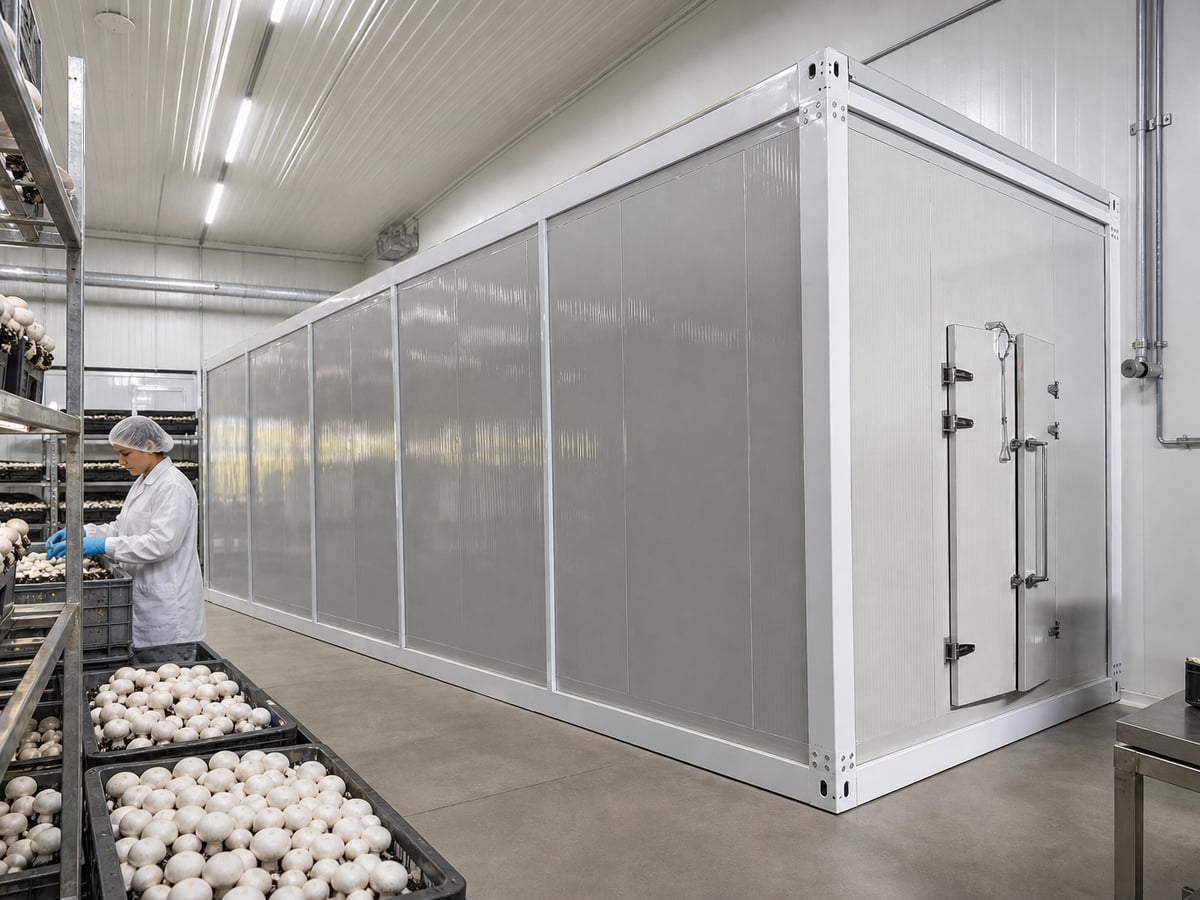
Mushroom farm automation is an integrated environmental-control system designed to maintain stable growing conditions inside mushroom rooms, containers, tunnels, or modular cultivation facilities. It combines temperature control, humidification, fresh-air exchange, CO2 management, airflow circulation, sensors, programmable controllers, alarms, and remote monitoring into one operational platform.
For Global Market growers, automation helps reduce dependence on manual climate adjustments while improving crop consistency, labor efficiency, traceability, and operating visibility. It is widely used for oyster mushrooms, shiitake, button mushrooms, enoki, king oyster mushrooms, lion’s mane, medicinal fungi, spawn production, composting support areas, and controlled-environment research projects.
A commercial mushroom automation system is not simply a humidifier and fan. It is a coordinated cultivation climate solution. The controller receives live information from temperature, humidity, CO2, pressure, and equipment-status sensors, then activates refrigeration, heating, fresh-air fans, circulation fans, fogging equipment, dehumidification devices, dampers, and alarms according to selected cultivation recipes.
For a buyer comparing mushroom farm automation options, the most important questions are:
- What mushroom species and growth stages will be controlled?
- What is the room volume, rack layout, substrate quantity, and daily production target?
- What outdoor climate conditions apply at the installation location?
- Which utilities are available, including electrical supply, drainage, water quality, and ventilation routes?
- Does the supplier provide control logic, commissioning support, spare parts, and after-sales service?
Lanhu supplies integrated systems for agricultural contractors, cultivation equipment distributors, commercial farms, and engineering companies. Buyers can review its smart mushroom cultivation container solutions when a compact, factory-integrated production unit is preferred.
What Is Mushroom Farm Automation and Where Is It Used
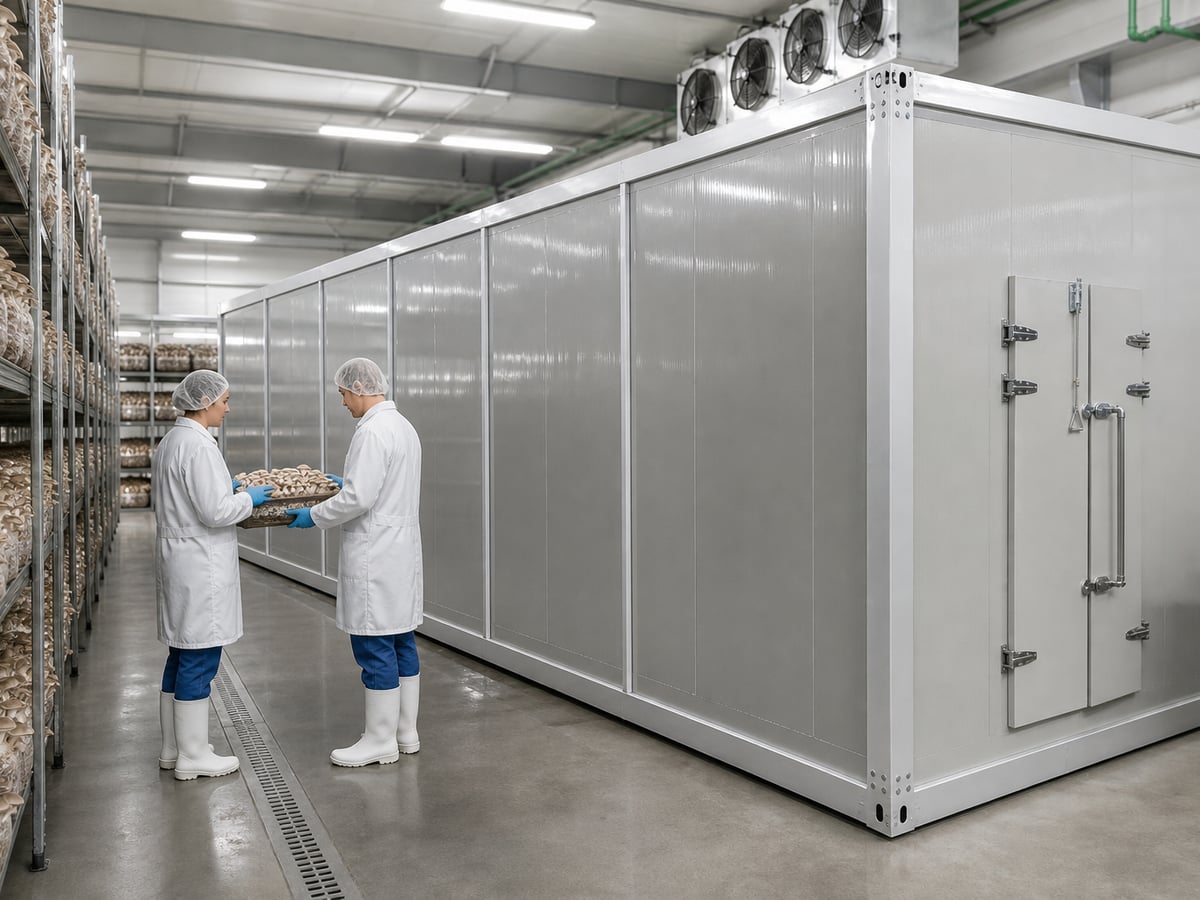
Mushroom cultivation is highly sensitive to microclimate variation. Substrate temperature, room temperature, relative humidity, fresh-air volume, CO2 concentration, airflow speed, and hygiene conditions can influence pinning, stem length, cap development, yield, crop cycle duration, and disease risk. Mushroom farm automation provides a practical way to control these variables with repeatable setpoints and programmed schedules.
Automation systems are commonly installed in growing rooms, insulated mushroom houses, converted agricultural buildings, shipping-container farms, vertical cultivation modules, incubation rooms, fruiting rooms, packing-area pre-cooling zones, and laboratory-scale production facilities. They are used across the Global Market, from humid tropical regions in Southeast Asia to dry climates in the Middle East, temperate farms in Europe, and high-temperature regions of Africa and Latin America.
In trade and logistics hubs such as Rotterdam, Dubai, Singapore, Los Angeles, Hamburg, Mombasa, Santos, and Melbourne, controlled-environment mushroom projects can support local fresh-food supply chains by reducing reliance on long-distance refrigerated transport. Near urban markets, compact automated farms can produce premium fresh mushrooms with shorter delivery times and more predictable quality.
Typical applications include:
- Fresh mushroom farms supplying supermarkets, hotels, restaurants, wholesalers, and food processors.
- Specialty mushroom projects producing lion’s mane, reishi, cordyceps, maitake, and other high-value fungi.
- Containerized farms for urban agriculture, remote communities, research campuses, resorts, and food-security projects.
- Training farms and agricultural demonstration centers.
- Spawn and substrate operations requiring controlled incubation environments.
- Multi-room commercial farms that need separate recipes for incubation, pinning, fruiting, and recovery periods.
The correct automation design depends on whether the project needs a stand-alone controller retrofit, a full climate-control package for an existing building, or a complete modular growing facility. For buyers needing a focused controller upgrade, Lanhu’s smart mushroom climate controller can be configured around the room’s equipment and cultivation process.
| Application Environment | Typical Automation Need | Main Controlled Variables | Common Mushroom Types |
|---|---|---|---|
| Small farm grow room | Basic climate control and alarms | Temperature, humidity, CO2 | Oyster, shiitake |
| Commercial multi-room farm | Zone control and recipe management | Temperature, RH, CO2, airflow | Button, king oyster, enoki |
| Container cultivation unit | Integrated compact HVAC and remote access | Temperature, RH, fresh air, lighting | Oyster, lion’s mane |
| Warm-climate production site | High-capacity cooling and moisture control | Cooling load, RH, CO2 | Oyster, medicinal mushrooms |
| Dry-climate indoor farm | Reliable humidification and insulation | RH, temperature, airflow | Shiitake, oyster |
| Research or training facility | Data logging and adjustable recipes | All environmental parameters | Multiple trial varieties |
This table shows why a single standard machine cannot fit every project. A container beside the Port of Dubai may require stronger cooling and corrosion-resistant equipment, while an inland European grow room may need greater heating capacity and winter fresh-air management.
Standard Product Configuration and System Boundaries
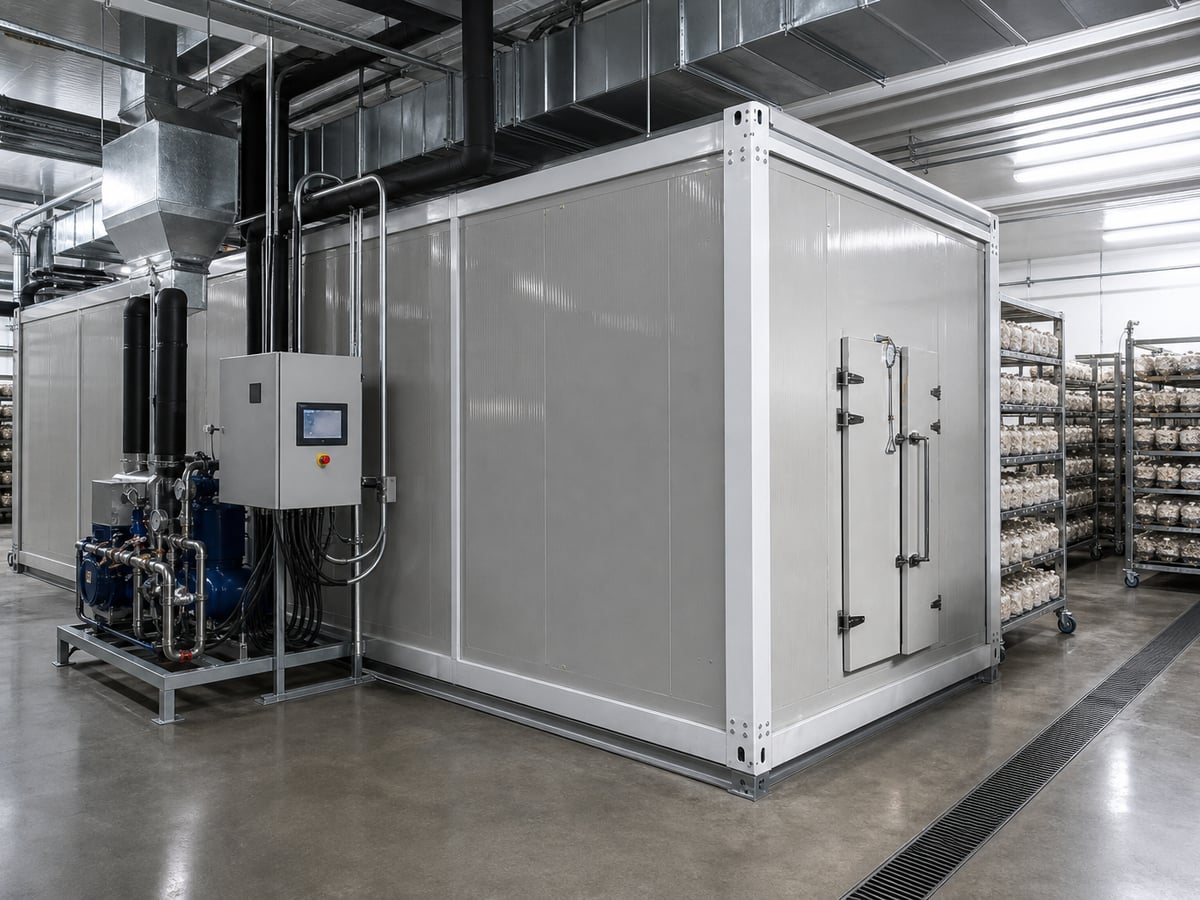
A standard mushroom farm automation package normally includes a climate controller, sensors, electrical control cabinet, ventilation control outputs, humidification control outputs, refrigeration or heat-pump interfaces, alarm functions, and a user interface. Depending on project scope, the system can also include air handling equipment, ductwork, fans, dampers, heat pumps, cooling coils, electric heaters, ultraviolet treatment, water treatment, insulation panels, and remote communication modules.
System boundaries should be confirmed in writing before purchase. In commercial projects, misunderstandings often arise when the buyer assumes that racks, civil works, drainage, electrical cabling, water filtration, refrigeration piping, substrate handling, and installation labor are included. A professional quotation should identify supplied equipment, excluded items, site responsibilities, and commissioning requirements.
Standard configurations may include:
- PLC or microprocessor-based climate controller with touchscreen interface.
- Temperature and humidity sensors positioned for representative room readings.
- CO2 sensor for fresh-air control and crop-stage management.
- Variable-speed or fixed-speed circulation and exhaust fans.
- High-pressure fogging, ultrasonic humidification, or other moisture-generation systems.
- Cooling and heating interfaces for air source heat pumps, condensing units, or HVAC equipment.
- Electrical protection components, emergency stop functions, and fault alarms.
- Optional Wi-Fi, Ethernet, cloud access, mobile notifications, and historical data logging.
For a full turnkey deployment, the supplier can design a modular container, insulated cultivation room, or retrofit package. For a lower initial investment, growers may purchase only the controller and integrate local HVAC components through qualified contractors. This approach can be useful when local service partners are available in markets such as Johannesburg, Warsaw, Jakarta, Mexico City, or Istanbul.
| System Item | Usually Included | Optional Scope | Buyer Responsibility to Confirm |
|---|---|---|---|
| Climate controller | Yes | Multi-zone expansion | Number of rooms and recipes |
| Temperature and RH sensors | Yes | Redundant sensors | Sensor placement and calibration access |
| CO2 monitoring | Usually | Additional monitoring points | Target range by mushroom species |
| Humidification equipment | Project dependent | Water filtration and UV treatment | Water pressure, quality, and drainage |
| Cooling and heating unit | Project dependent | Heat recovery or backup heating | Outdoor design temperature and power supply |
| Racks and cultivation trays | Usually excluded | Custom rack layout | Load capacity and aisle dimensions |
| Installation works | Often excluded | On-site technical guidance | Local contractor and lifting access |
The table clarifies procurement boundaries. Buyers should request a technical scope sheet before comparing prices. A lower quotation may exclude critical equipment that is necessary for successful operation.
Capacity, Dimensions, and Utility Requirements
Mushroom farm capacity can be measured in several ways: room volume, cultivation area, number of shelves, substrate bag quantity, compost tonnage, fresh mushroom yield, or annual production. The most useful capacity measure depends on the crop type. For bag-grown oyster mushrooms, growers often calculate capacity by the number and weight of substrate bags. For button mushroom farms, bed area and compost throughput may be more relevant.
Containerized units often use 20-foot or 40-foot formats, although custom modular dimensions are available. A 40-foot insulated cultivation container can be designed with racks, an equipment section, access corridor, lighting, drainage, and integrated climate controls. Larger farms may use multiple containers or purpose-built insulated rooms connected to a central control platform.
Utility planning is essential. Electrical voltage and frequency differ across the Global Market. Buyers should specify whether the local grid uses 220V, 380V, 400V, 415V, 50Hz, or 60Hz power. The required electrical load depends on cooling capacity, fan motors, humidification pumps, heating method, lighting, and any backup systems. Water supply should be clean and suitable for the selected humidification technology. Drainage must remove condensate, wash-down water, and excess moisture safely.
| Project Scale | Typical Layout | Indicative Production Use | Key Utility Considerations |
|---|---|---|---|
| Trial or pilot unit | One small room or 20-foot module | Training, testing, local sales | Single-phase or small three-phase supply |
| Compact commercial unit | 40-foot container | Specialty fresh mushroom production | Three-phase power, water, drainage |
| Small farm | 2–6 grow rooms | Local wholesale and retail supply | Separate room controls and ventilation routes |
| Medium commercial farm | 6–20 controlled rooms | Regional distribution | Centralized electrical and HVAC planning |
| Large industrial project | Multiple zones and processing areas | National or export supply | Redundancy, energy management, backup power |
| Remote-site farm | Modular container cluster | Mining camps, islands, resorts | Generator, solar integration, water storage |
These examples are planning references rather than fixed production guarantees. Final capacity depends on mushroom variety, substrate formulation, crop cycle, biological efficiency, shelf arrangement, labor practices, harvest schedule, and local environmental conditions.
Before ordering, buyers should provide room drawings, rack dimensions, insulation thickness, location, maximum summer temperature, minimum winter temperature, electrical data, water source details, and target mushroom species. This allows the climate system to be sized more accurately.
Temperature, Humidity, CO2, Airflow, and Control Performance
Environmental control performance should be evaluated as a complete system. A powerful cooling unit cannot compensate for inadequate insulation, poor airflow distribution, incorrect sensor placement, excessive door opening, insufficient drainage, or poor rack design. Likewise, a humidifier alone cannot maintain stable humidity if the room has uncontrolled air leakage or excessive heat load.
Temperature requirements vary by mushroom species and growth stage. Incubation often requires different conditions from pinning and fruiting. Relative humidity is especially important during fruiting, but excessively wet surfaces can increase disease risk. CO2 levels influence morphology and must be managed with balanced fresh-air exchange. Airflow must be gentle and evenly distributed, avoiding stagnant zones as well as direct drafts that dry mushroom surfaces.
A professional controller can use deadbands, delays, staged equipment operation, timer programs, and alarm limits to reduce unnecessary cycling. For example, a system may activate circulation fans continuously at low speed, open fresh-air dampers when CO2 exceeds a target threshold, increase humidification when humidity falls below the recipe range, and start cooling or heating according to temperature setpoints.
| Control Factor | Purpose in Mushroom Production | Risk When Too Low | Risk When Too High |
|---|---|---|---|
| Temperature | Supports stable crop development | Slow growth or delayed fruiting | Heat stress and lower quality |
| Relative humidity | Protects fruit body moisture | Dry caps, cracking, reduced yield | Condensation and disease pressure |
| CO2 concentration | Guides fresh-air management | Excess ventilation energy use | Long stems and poor morphology |
| Airflow | Balances room microclimate | Stagnant zones and uneven growth | Drying and physical crop stress |
| Fresh-air volume | Removes metabolic gases and heat | CO2 accumulation and heat buildup | Humidity loss and energy waste | Substrate temperature | Indicates biological activity | Slow colonization in some stages | Overheating and contamination risk |
The table explains why growers should not select equipment solely by nominal cooling capacity. A successful system must manage the interaction between moisture, temperature, respiration, ventilation, and airflow.
This example trend chart illustrates the objective of automated control: keeping environmental conditions within narrow, crop-appropriate ranges rather than allowing major daily fluctuations.
Core Components, Materials, and Protection Features
Commercial mushroom automation systems require components that tolerate continuous operation in humid environments. The control cabinet should use suitable electrical protection, organized wiring, labeled terminals, overload protection, contactors, breakers, relays, and maintenance access. Sensor selection is important because inaccurate readings can lead to incorrect control actions.
Depending on the project, structural materials may include color-coated steel, galvanized steel, stainless steel, aluminum profiles, insulated sandwich panels, anti-corrosion coatings, food-oriented interior finishes, and sealed flooring systems. For coastal or high-humidity regions near ports such as Manila, Lagos, Chennai, or Cartagena, corrosion protection deserves particular attention.
Core equipment may include air source heat pumps, evaporators, condensers, air handling units, axial fans, centrifugal fans, EC fans, dampers, fogging pumps, nozzles, water filters, UV sterilizers, drainage fittings, insulated ducts, and LED lighting. The best configuration depends on room size, crop stage, climate zone, hygiene standard, and budget.
Lanhu’s technological capabilities are supported by more than 12 years of thermodynamic research and development experience and more than 45 registered patents. The company develops agricultural climate-control equipment with attention to heat transfer, airflow organization, moisture management, control integration, and practical cultivation operation.
Automation, Remote Monitoring, and Customization Options
Modern mushroom farm automation can provide more than automatic on-off control. Advanced functions may include crop recipes, scheduled day and night settings, multi-stage temperature control, CO2-based ventilation, fan speed management, humidification intervals, equipment interlocks, historical records, fault logs, remote alarms, user permissions, and multi-room dashboards.
Remote monitoring is especially useful for farms with several locations or limited technical staff. A farm manager in Nairobi, Kuala Lumpur, Toronto, or Madrid can review room conditions, compare operating trends, receive alarm notifications, and communicate with local staff. Remote access should support operational decisions, but it does not eliminate the need for physical inspections, hygiene management, crop observation, and preventive maintenance.
Customization options can include:
- Single-room, multi-room, or centralized control architecture.
- Customized voltage, frequency, plug standards, and electrical cabinet layout.
- Language settings, branding, OEM labels, and distributor-specific interfaces.
- Different humidification technologies based on water quality and climate.
- Cooling, heating, heat-pump, or hybrid energy configurations.
- Additional sensors for substrate temperature, pressure, door status, water level, and energy use.
- Cloud monitoring, mobile access, alarm messaging, and exportable operating data.
- Container dimensions, rack arrangements, doors, windows, lighting, and hygiene-zone layouts.
Lanhu provides OEM and ODM support for customers seeking branded mushroom automation products or tailored engineering packages. Buyers can explore the company’s OEM and ODM customization service for project-specific configurations.
By 2026, the mushroom automation sector is expected to place greater emphasis on energy-efficient heat pumps, variable-speed fan technology, sensor-based predictive control, water-saving humidification, digital farm records, and remote troubleshooting. Sustainability requirements are also increasing. Farms will increasingly evaluate insulation performance, refrigerant selection, electricity use per kilogram of mushrooms, water recirculation potential, packaging waste, and local-food production benefits.
Policy trends may also affect equipment selection. Food safety, worker safety, energy efficiency, electrical certification, refrigerant controls, and indoor agricultural standards vary by country. Global Market buyers should verify local compliance requirements before importation and installation.
Installation, Commissioning, Maintenance, and Warranty
Installation quality has a direct effect on climate-control performance. Before equipment arrives, the site should have a completed floor, sufficient drainage, stable electrical supply, water access, equipment lifting route, ventilation openings, and insulated enclosure. All wall penetrations, pipe routes, cable trays, and condensate drains should be coordinated with the equipment layout.
Commissioning normally includes electrical verification, sensor checks, fan rotation confirmation, water-system inspection, refrigeration or heat-pump testing, controller parameter setup, alarm testing, and trial operation. The cultivation recipe should then be adjusted according to mushroom species, local climate, room loading, and observed crop response.
Routine maintenance supports reliability and food-production hygiene. Operators should clean filters, inspect fogging nozzles, check water quality, verify drains, clean fan guards, review sensor readings, inspect electrical connections, and keep maintenance records. CO2 and humidity sensors should be checked periodically according to their service requirements.
| Maintenance Item | Suggested Frequency | Reason | Responsible Role |
|---|---|---|---|
| Check temperature and RH readings | Daily | Detect abnormal environmental drift | Farm operator |
| Inspect humidification water supply | Daily | Prevent dry running and inconsistent moisture | Farm operator |
| Clean filters and fan guards | Weekly or as needed | Maintain airflow and hygiene | Maintenance staff |
| Inspect drains and condensate lines | Weekly | Prevent standing water and overflow | Maintenance staff |
| Review alarm history | Weekly | Identify repeated operational faults | Farm manager |
| Check electrical terminals | Quarterly | Reduce risk of loose connections | Qualified electrician |
| Calibrate or validate sensors | According to sensor specification | Maintain control accuracy | Qualified technician |
This maintenance schedule is a practical guide. Actual intervals should be adapted to operating hours, local water conditions, dust levels, ambient humidity, and equipment manuals.
Warranty terms should clearly state the coverage period, covered components, excluded consumables, buyer maintenance obligations, spare-parts process, and technical support method. International buyers should also confirm documentation requirements, shipping terms, local installation responsibility, and expected response channels for troubleshooting.
Our Company
Shandong Lanhu Air Conditioning Equipment Co., Ltd. is a manufacturer in Dezhou, Shandong, China, serving agricultural climate-control, industrial HVAC, and modular cultivation projects for the Global Market. Its product range includes smart mushroom cultivation containers, mushroom climate controllers, smart hydroponic plant containers, and air source heat pumps.
From a manufacturing perspective, Lanhu operates a modern facility covering more than 30,000 square meters. Its integrated capabilities include product design, engineering development, sheet metal fabrication, CNC bending, insulation panel production, electrical assembly, system integration, equipment testing, and quality inspection. This integrated workflow helps control production coordination for customized mushroom farm automation projects.
Every system undergoes functional inspection, electrical verification, performance testing, and operational evaluation before shipment. The company holds ISO 9001, ISO 14001, ISO 45001, and ISO 12100 certifications, alongside patent certificates and enterprise credibility credentials. These systems support quality management, environmental responsibility, occupational safety, and product risk management.
Lanhu’s service capabilities include factory-direct supply, engineering assistance, OEM and ODM customization, international logistics support, spare-parts support, installation guidance, and after-sales service. The company works with agricultural contractors, equipment distributors, engineering firms, and commercial cultivation investors. Prospective buyers can review completed mushroom cultivation project cases or contact the Lanhu team to discuss climate conditions, room drawings, production objectives, and technical specifications.
FAQ
What is the main benefit of mushroom farm automation?
The main benefit is more consistent environmental control. Stable temperature, humidity, CO2, and airflow can improve crop uniformity while reducing manual adjustment work and allowing faster response to alarms or equipment faults.
Can automation be installed in an existing mushroom room?
Yes. A climate controller and selected sensors can be added to an existing room, provided the HVAC, ventilation, humidification, electrical wiring, insulation, and drainage are suitable for automated operation.
Which mushroom species can use an automated climate system?
Automated systems can be adapted for oyster mushrooms, shiitake, button mushrooms, king oyster mushrooms, enoki, lion’s mane, reishi, and many other species. Each species requires its own cultivation recipe and room design considerations.
Does a mushroom farm need CO2 control?
In most commercial fruiting environments, CO2 monitoring is strongly recommended. Mushroom respiration increases CO2 concentration, and excessive levels can affect mushroom shape, stem length, cap formation, and overall quality.
How do I choose between a container farm and a conventional grow room?
A container farm is suitable when fast deployment, modularity, compact footprint, and factory-integrated equipment are priorities. A conventional grow room may be more economical for large-scale farms with existing buildings and local construction resources.
What information should I send before requesting a quotation?
Send the cultivation location, mushroom species, room or container dimensions, rack plan, insulation details, local summer and winter temperatures, power supply, water source, drainage arrangement, target production volume, and desired automation functions.
Can the system be monitored remotely?
Yes, remote monitoring can be configured for many projects. Available functions may include live environmental data, historical trends, alarm notifications, equipment status, and multi-room access, depending on the selected controller and communication method.
What should buyers verify before importing mushroom automation equipment?
Buyers should confirm local voltage and frequency, import documentation, electrical compliance, refrigerant rules, local installation standards, freight access, spare-parts planning, and the availability of qualified technicians for site work.
Share this article

About the Author: Shandong Lanhu Air Conditioning Equipment
Lanhu is a professional climate control equipment manufacturer specializing in smart agricultural systems, commercial HVAC solutions, and customized temperature control technologies. With extensive engineering experience, Lanhu provides reliable solutions for plant factories, controlled environment agriculture, and industrial applications.
Need a Custom Climate Control Solution?
From smart agricultural systems to commercial HVAC solutions, Lanhu provides reliable temperature and humidity control solutions tailored to your project needs.
Contact Us