Mushroom Air Handling Units for the Global Market Guide
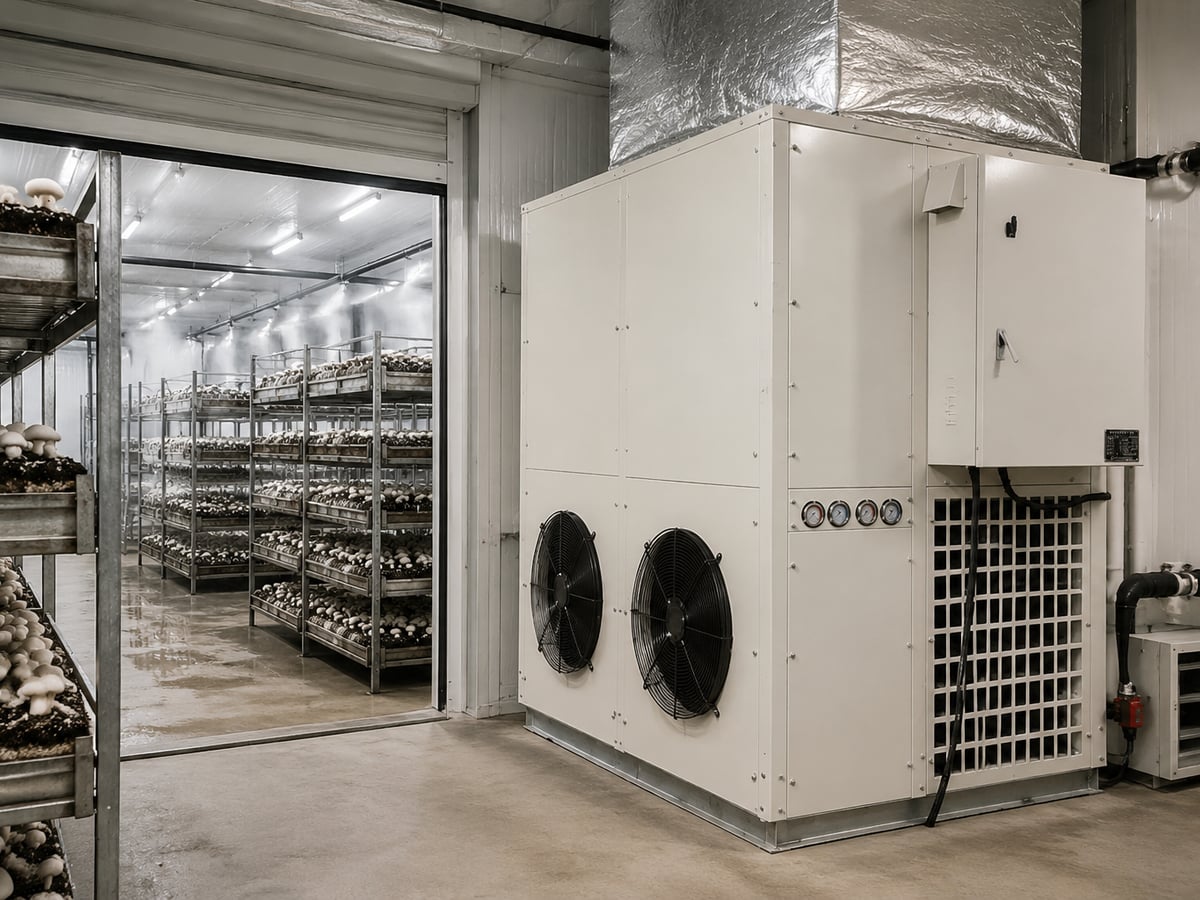
Quick Answer: How Mushroom Air Handling Units Work

Mushroom air handling units are engineered climate-control systems that condition, filter, mix, and distribute air through cultivation rooms. Their primary purpose is to maintain the temperature, relative humidity, carbon dioxide concentration, cleanliness, and air movement required at each stage of mushroom production. A well-designed unit normally combines fresh-air intake, return-air mixing, filtration, cooling, heating, humidification, fan pressure control, condensate drainage, and automation in one serviceable package.
The correct air path depends on the crop, room volume, growing method, local climate, and production schedule. A typical arrangement draws a controlled amount of outdoor air into a mixing section, combines it with recirculated room air, passes the mixture through filters and coils, adds humidity when necessary, and sends the conditioned air through supply ductwork or textile distribution. Return air then flows back to the unit for another cycle. In some phases, a higher percentage of outdoor air is required to remove carbon dioxide; in others, recirculation saves energy and stabilizes room conditions.
For global mushroom projects, the most important specification points are not only cooling capacity and fan airflow. Buyers should also check filter face velocity, coil selection, drain-pan slope, access-door dimensions, corrosion resistance, sensor locations, controls compatibility, electrical standards, sound levels, and the available maintenance space. These details directly influence crop uniformity, energy consumption, sanitation, and long-term reliability.
Lanhu supplies modular cultivation equipment and agricultural HVAC systems for commercial farms, engineering contractors, distributors, and cultivation projects in multiple regions. Its product range includes smart mushroom cultivation containers and climate-control equipment, supported by engineering assistance and factory-direct customization. Buyers planning a complete room can also review the smart mushroom climate controller to understand how temperature, humidity, carbon dioxide, and operating schedules can be coordinated.
Fresh-Air and Return-Air Sections in Mushroom Facilities

The air-mixing section determines how much outdoor air enters the cultivation room and how much conditioned room air is reused. Fresh air is essential when mushrooms generate carbon dioxide or when the crop requires a defined gas-exchange rate. Return air, however, already contains useful sensible and latent energy. Recirculating it can reduce the load on refrigeration, heating, and humidification equipment.
Fresh-air dampers should be sized for the required airflow at acceptable pressure drop. They need tight control, stable operation at low positions, and construction suitable for humid environments. Outdoor intake hoods should reduce rain entry and prevent leaves, insects, dust, and snow from entering the unit. In coastal locations such as Rotterdam, Singapore, or Santos, corrosion-resistant finishes and careful intake placement are especially important.
Return-air dampers should be positioned to create even mixing rather than short-circuiting directly toward the filter or coil. A mixing box with opposed-blade or parallel-blade dampers can be selected according to the desired control response. Differential pressure sensors help confirm actual airflow, while temperature and humidity sensors should be located downstream of the mixing point where the reading represents the blended air stream.
| Section | Main function | Important design point | Common risk |
|---|---|---|---|
| Outdoor-air hood | Admits and protects incoming air | Weather louver and insect protection | Rain or dust entering the unit |
| Fresh-air damper | Regulates ventilation volume | Stable low-flow control | Insufficient carbon dioxide removal |
| Return-air damper | Controls recirculation | Low leakage and balanced mixing | Uneven temperature distribution |
| Mixing chamber | Blends outdoor and return air | Enough length for uniform mixing | Sensor readings that do not represent room air |
| Relief or exhaust section | Discharges excess room air | Coordination with supply airflow | Room pressure instability |
| Access section | Allows inspection and cleaning | Large doors and safe lighting | Hidden contamination or difficult repairs |
The air balance should be reviewed together with room pressure. A slight positive pressure can help limit uncontrolled infiltration in clean cultivation areas, while a controlled negative pressure may be appropriate where odor or exhaust containment is important. In either case, the controls must coordinate supply fans, return fans, exhaust dampers, and door-opening events.
Filter Selection and Service Access for Mushroom Air

Filters protect coils, fans, ducts, and cultivation rooms from dust and airborne contamination. Mushroom farms often operate with high humidity and frequent organic material handling, so filter selection must consider both particle removal and moisture exposure. A common arrangement uses a washable or coarse pre-filter followed by a finer final filter. The exact grade should be determined by the hygiene target, local regulations, room classification, and pressure-drop budget.
Filters with excessive resistance can reduce airflow and force the fan to operate at a higher speed. This increases electricity use and may create uneven air distribution. Filters that are too open may allow dust to reach the coil and create a difficult-to-clean biological film. The specification should state the initial pressure drop, recommended replacement pressure drop, filter dimensions, frame material, gasket type, and expected service interval.
Service access is as important as filter efficiency. The operator should be able to remove each filter without dismantling ductwork, electrical panels, or humidifier piping. Access doors should include durable seals, positive latches, inspection windows where useful, and corrosion-resistant hinges. In large facilities, a front service corridor or removable filter rack can significantly reduce maintenance time.
| Filter arrangement | Suitable use | Advantage | Buying consideration |
|---|---|---|---|
| Washable pre-filter | Dusty agricultural environments | Reusable and economical | Requires cleaning and drying procedures |
| Coarse disposable filter | General intake protection | Simple replacement | Maintain a reliable spare inventory |
| Pleated medium filter | Commercial cultivation rooms | Improved particle capture | Check available fan pressure |
| High-efficiency final filter | Higher hygiene requirements | Reduced fine-particle carryover | Higher resistance and replacement cost |
| Moisture-resistant filter | High-humidity applications | Better dimensional stability | Confirm frame and media compatibility |
| Carbon or specialty filter | Odor-sensitive installations | Can reduce selected gaseous contaminants | Requires dedicated pressure-drop review |
Operators should record filter pressure differential, replacement date, room conditions, and visual cleanliness. A simple trend in the controller can reveal whether filters are loading unusually quickly, which may indicate poor intake protection, construction dust, an unsealed access door, or excessive outdoor-air operation.
Cooling and Heating Coil Functions in Cultivation Rooms
Cooling coils remove sensible heat from fans, lights, people, compressors, and the outdoor air stream. They also remove moisture when the coil surface temperature is below the air dew point. This makes the cooling coil a central part of humidity control, especially during warm and wet weather. Coil selection should account for entering-air temperature, entering-air humidity, leaving-air condition, airflow, chilled-water or refrigerant conditions, and allowable air pressure drop.
In a chilled-water system, the coil should be matched with the pump, control valve, water temperature, and available flow. In a direct-expansion system, the coil must be coordinated with the compressor, expansion device, refrigerant, defrost strategy where applicable, and oil-return requirements. Fin spacing should balance heat transfer with cleanability. Wider spacing can be useful in dusty agricultural conditions because it reduces blockage risk.
Heating coils protect the crop from cold outdoor conditions and compensate for heat loss during low-temperature phases. Hot-water, electric, steam, and refrigerant-based heating options are available. Hot-water coils can integrate with boilers or heat pumps, while electric coils offer straightforward installation but may require substantial electrical capacity. Air-source heat pumps can provide efficient heating in suitable climates; Lanhu also supplies air-source heat-pump solutions that may be evaluated for integrated projects.
Coil controls should prevent rapid cycling and should respond to both room demand and supply-air limits. A low-limit safety sensor can protect against freezing in water coils. A leaving-air temperature limit can prevent excessively cold supply air from stressing the crop or causing local condensation. Coil casings, headers, drain connections, and fasteners should be selected for humid, chemically active environments.
| Condition | Preferred focus | Control method | Protection measure |
|---|---|---|---|
| Hot and humid summer | Latent cooling capacity | Leaving-air humidity reset | Deep drain pan and droplet control |
| Cold winter | Heating capacity and freeze protection | Modulating valve or staged heat | Low-limit thermostat |
| High outdoor-air phase | Mixed-air load management | Coordinated damper and coil control | Supply-air temperature limit |
| Dusty farm environment | Cleanable coil face | Filter pressure monitoring | Accessible upstream filter |
| Coastal installation | Corrosion resistance | Stable valve modulation | Protective coating and suitable materials |
| Variable production schedule | Part-load efficiency | Variable-speed fan and reset logic | Anti-short-cycle timer |
Humidification Location and Carryover Control
Mushroom production often requires precise humidity rather than simply “more moisture.” Humidification can be provided by high-pressure atomization, ultrasonic equipment, evaporative media, steam, or spray systems. The correct choice depends on water quality, required humidity range, hygiene policy, energy costs, and available service skills.
Humidifiers are commonly installed downstream of the cooling coil and upstream of the supply fan, provided that sufficient straight length is available for evaporation. The humidifier must not spray directly into the fan, filter, sensor, or duct elbow. If droplets remain suspended when the air reaches the fan or ductwork, carryover can cause corrosion, microbial growth, wet insulation, and uneven room humidity.
Steam injection can provide clean and rapid moisture addition when a suitable steam source is available. It requires dispersion distance, condensate management, and careful control of the steam lance. High-pressure atomization can be efficient but requires filtration, pump maintenance, nozzle inspection, and water treatment. Ultrasonic humidifiers may offer fine control at smaller capacities, although mineral content and hygiene must be carefully managed.
Water quality is a major consideration in regions with hard water, including parts of northern China, southern Europe, the Middle East, and Australia. Treatment may be needed to control scaling and mineral aerosol. Humidifier sections should include access panels, drain provisions, washable surfaces, and isolation valves. Relative-humidity sensors should be protected from direct spray and located where air is fully mixed.
Fan Pressure and Duct Resistance in Mushroom HVAC
The fan must provide the required airflow at the total external static pressure of the system. This pressure includes filters, coils, dampers, humidifiers, sound attenuators, flexible connections, supply ducts, return ducts, diffusers, and any textile air-distribution system. Selecting a fan only by nominal cubic metres per hour can result in inadequate airflow once the system is installed.
A useful design process begins with the required room air-change rate and crop airflow pattern. The engineer then calculates resistance for every major component and adds an appropriate allowance for filter loading and future operating conditions. Variable-frequency drives are valuable because they allow the fan to respond to actual demand rather than operating continuously at full speed.
| Component | Why pressure is lost | Design response | Maintenance signal |
|---|---|---|---|
| Dirty filter | Blocked media restricts airflow | Use differential-pressure monitoring | Rising pressure difference |
| Cooling coil | Air passes through fins and headers | Balance face velocity and coil depth | Reduced airflow or wet coil face |
| Humidifier section | Dispersal grids or pads resist air | Provide manufacturer data | Unexpected fan-speed increase |
| Duct elbows | Changes in direction create turbulence | Use smooth-radius fittings | Noise or uneven room distribution |
| Flexible duct connection | Compression or sharp transition | Keep connection short and aligned | Whistling or vibration |
| Supply diffuser | Terminal device creates resistance | Coordinate with throw pattern | Hot or humid room zones |
Air distribution should avoid high-velocity jets directly onto growing blocks or beds. Textile ducts, perforated ducts, low-velocity diffusers, and carefully positioned grilles can produce a more uniform environment. The final selection depends on room geometry, rack arrangement, ceiling height, and the sensitivity of the mushroom variety to drying or localized condensation.
Drain Pans and Condensate Removal
Whenever humid air contacts a cooling coil below its dew point, condensate forms. The drain pan must collect all water without allowing it to pool, splash, or become entrained in the airstream. A pan with a positive slope toward the drain connection is essential. The pan should extend beyond the coil face and include sufficient depth for the expected condensate rate.
Drain connections require a correctly sized trap based on the negative or positive pressure at the pan. An incorrectly sized trap can draw air through the drain, prevent drainage, or discharge water onto the equipment-room floor. Long drain lines should maintain continuous fall wherever possible. Where freezing conditions exist, exposed condensate piping needs insulation, heat tracing, or a protected routing arrangement.
Drain pans and internal surfaces should be accessible for cleaning and inspection. Stainless steel or appropriately coated materials can improve durability in humid environments. The drainage system should be tested during commissioning by introducing clean water to the pan and confirming that it flows freely to the final discharge point.
Condensate may contain dust and biological material, so the discharge arrangement should comply with local plumbing and environmental requirements. In large projects near ports such as Hamburg, Dubai, Vancouver, or Shanghai, the equipment specification should also account for local building codes, water regulations, and the responsibilities of the installation contractor.
Specifying Controls and Maintenance Clearances
A mushroom air handling unit should be specified as part of a complete control sequence rather than as an isolated box. The sequence should define start-up, normal operation, fresh-air modulation, cooling, heating, humidification, fan-speed control, high-humidity response, high-carbon-dioxide response, filter alarms, freeze protection, condensate alarms, and emergency shutdown.
At minimum, sensors usually include supply-air temperature, return-air temperature, room temperature, room relative humidity, outdoor temperature, outdoor humidity, carbon dioxide, filter differential pressure, and fan status. Sensor placement matters. A room sensor near a door or humidifier outlet may produce misleading readings and cause unstable control. Redundant sensors may be justified in larger farms or projects where crop losses are costly.
Communication options may include hardwired signals, Modbus, BACnet, Ethernet, or a proprietary gateway. Before ordering, buyers should confirm voltage, frequency, motor type, control protocol, language requirements, data logging, remote access, cybersecurity expectations, and alarm forwarding. A controller designed for a single room may not be suitable for a multi-zone farm without expansion modules.
Maintenance clearance should be shown on the general arrangement drawing. Allow enough space to remove filters, pull coils, service motors, inspect belts, clean drain pans, replace humidifier nozzles, and open electrical panels. Rooftop installations need safe access, weather protection, lifting provisions, and drainage planning. Containerized systems should allow doors to open fully and should include a practical route for spare parts.
| Item | Recommended specification | Reason | Verification method |
|---|---|---|---|
| Room temperature sensor | Calibrated, protected, correctly located | Prevents false heating or cooling demand | Compare with reference instrument |
| Relative-humidity sensor | Suitable for condensation-prone spaces | Maintains crop humidity accurately | Field calibration check |
| Carbon-dioxide sensor | Range matched to crop and ventilation plan | Controls fresh-air demand | Calibration gas or approved test |
| Filter alarm | Differential-pressure transmitter | Provides timely service warning | Simulate high-pressure signal |
| Drain alarm | Float or level sensor where needed | Limits overflow and water damage | Raise test level during commissioning |
| Service clearance | Shown on approved layout drawing | Reduces downtime and safety risk | Site inspection before installation |
Market Requirements, Product Types, and Buying Advice
The global market includes small specialty farms, large automated facilities, converted warehouses, modular cultivation containers, and research installations. A unit for a compact container may need integrated controls, compact dimensions, and plug-and-play connections. A multi-room commercial farm may require separate air handlers, central refrigeration, heat recovery, redundant fans, and a building management system.
Product types include packaged air handling units, modular indoor units, rooftop systems, containerized climate modules, chilled-water air handlers, direct-expansion units, and dedicated outdoor-air systems. The best choice depends on whether the project prioritizes low initial cost, energy efficiency, redundancy, sanitation, expansion capability, or rapid deployment.
| Product type | Best-fit project | Main advantage | Potential limitation |
|---|---|---|---|
| Compact packaged unit | Small commercial room | Fast installation and simple integration | Limited expansion capacity |
| Modular indoor unit | Multi-room cultivation building | Flexible coil and fan configuration | Requires planned service space |
| Containerized climate module | Remote or modular farm | Factory integration and transportability | Transport dimensions must be checked |
| Chilled-water air handler | Large centralized facility | Central plant flexibility | Needs pumps, piping, and water treatment |
| Direct-expansion unit | Independent room or small site | Self-contained refrigeration package | Refrigerant servicing is specialized |
| Dedicated outdoor-air unit | High-ventilation production phase | Precise ventilation and dehumidification | Higher capital and energy requirements |
When comparing quotations, buyers should request a performance schedule rather than relying on a product name. The schedule should identify airflow, external static pressure, entering and leaving conditions, cooling and heating capacity, water or refrigerant conditions, fan motor power, sound data, filter grades, dimensions, operating weight, electrical requirements, and control interfaces.
Delivery planning is also important. Equipment manufactured in Dezhou can be coordinated for export through major logistics routes serving Qingdao, Tianjin, Shanghai, or other suitable trade hubs. International projects should confirm packaging, lifting points, customs documentation, spare parts, installation supervision, and after-sales communication before placing an order.
Industries and Applications for Mushroom Air Handling Units
These systems serve button mushroom, oyster mushroom, shiitake, lion’s mane, enoki, and other commercial cultivation operations. Different varieties and substrate processes impose different requirements. Fruiting rooms often need stable high humidity and carefully managed carbon dioxide, while incubation areas may need different temperature and ventilation profiles.
| Application | Primary climate priority | Air-handling emphasis | Useful feature |
|---|---|---|---|
| Incubation room | Stable temperature | Moderate ventilation and even circulation | Low-turndown fan control |
| Fruiting room | Humidity and carbon dioxide balance | Fresh-air modulation and gentle distribution | Integrated humidity control |
| Substrate preparation | Heat and moisture removal | Robust exhaust and corrosion resistance | Washable surfaces |
| Spawn laboratory | Clean air and pressure stability | Higher-efficiency filtration | Room pressure monitoring |
| Cold storage | Low temperature and moisture control | Dedicated refrigeration airflow | Condensation protection |
| Research facility | Repeatable experimental conditions | Precise sensors and data logging | Independent zone control |
Applications extend beyond a single cultivation room. A complete facility may include clean preparation rooms, inoculation areas, incubation chambers, fruiting rooms, packing spaces, cold rooms, corridors, and waste-handling zones. Each space should be reviewed for pressure relationship, filtration, temperature, humidity, odor, and cleaning procedure.
Case Examples and Practical Project Lessons
A modular cultivation project in a cold continental climate may require strong heating capacity, freeze protection, insulated panels, and reliable humidification during winter. The air handler should be commissioned at low outdoor temperatures and tested for stable operation when the fresh-air damper opens rapidly.
A coastal farm may face salt-laden air, high humidity, and frequent corrosion exposure. The specification should include suitable coatings, stainless or protected drain components, weather-resistant intake construction, and a maintenance schedule for filters and coils. Projects near Ningbo, Busan, Rotterdam, or Durban should not use inland material assumptions without review.
A high-throughput commercial facility may benefit from duty-standby fans, multiple cultivation zones, remote alarm access, and spare sensors. Dividing the system into zones can improve control and reduce the impact of maintenance. However, additional zones increase commissioning complexity, so the control narrative must be approved before fabrication.
Lanhu presents cultivation equipment and related project experience through its project case collection. Case information should be read as a starting point rather than a substitute for a site-specific load calculation. Climate data, room construction, substrate process, operating hours, and local utility prices all influence the final selection.
Local Suppliers, Factory Support, and Global Delivery
Local installation contractors are valuable for ductwork, electrical connections, refrigerant work, plumbing, lifting, and code compliance. The equipment manufacturer remains important for factory testing, control programming, coil selection, fan performance, documentation, and spare parts. The strongest projects define these responsibilities in the purchase contract.
For buyers working with a local distributor, ask whether the supplier can provide commissioning records, translated manuals, filter replacements, sensor calibration, warranty handling, and emergency service. For direct factory purchasing, confirm who will perform site installation and whether remote technical support is available during start-up.
Lanhu supports factory-direct supply, OEM and ODM development, engineering coordination, international logistics, installation guidance, spare parts, and after-sales service. Its manufacturing process includes design, engineering development, sheet-metal fabrication, CNC bending, insulation-panel production, electrical assembly, system integration, testing, and quality inspection. Buyers seeking a tailored configuration can review the OEM and ODM customization service.
2026 Trends in Mushroom Climate Control
By 2026, mushroom facilities are expected to place greater emphasis on energy measurement, heat recovery, variable-speed equipment, predictive maintenance, and data-based crop control. Sensors are becoming more affordable, while controllers can compare current conditions with historical production recipes. This allows operators to identify fan degradation, filter loading, abnormal humidity demand, and refrigeration inefficiency earlier.
Artificial-intelligence-assisted optimization is likely to support, rather than replace, experienced growers. A control system may recommend ventilation changes based on carbon dioxide trends, outdoor enthalpy, crop stage, and energy tariffs. Safe limits should remain defined by the operator, with alarms and manual override always available.
Sustainability requirements are also influencing procurement. Buyers may request low-global-warming-potential refrigerants, recyclable panels, efficient motors, heat recovery, water-saving humidification, and lifecycle documentation. Policies in Europe, North America, East Asia, and other markets are increasingly linked to refrigerant management, energy performance, worker safety, and waste reduction.
Future-ready equipment should therefore provide open communication options, replaceable sensors, accessible components, and room for additional control points. A slightly higher initial investment in serviceability and energy monitoring can reduce operating cost over the equipment’s useful life.
Our Company: Technology, Manufacturing, and Service
Technological capabilities
Shandong Lanhu Air Conditioning Equipment Co., Ltd. develops agricultural climate-control equipment, industrial HVAC systems, modular cultivation solutions, and smart mushroom cultivation containers. The company has more than 12 years of thermodynamic research and development experience and holds more than 45 registered patents. Its engineering work covers temperature regulation, humidity management, ventilation, heat-pump integration, electrical control, and modular system design.
Its smart cultivation systems can be coordinated with climate controllers for repeatable production recipes. Buyers can explore the smart mushroom cultivation container when evaluating compact, integrated, or scalable growing formats.
Manufacturing capabilities
Lanhu operates a modern manufacturing facility covering more than 30,000 square metres. Integrated production includes product design, sheet-metal fabrication, CNC bending, insulation-panel production, electrical assembly, system integration, equipment testing, and quality inspection. This integrated structure helps coordinate enclosure dimensions, air paths, controls, insulation, and final assembly under one production program.
Before shipment, systems undergo functional inspection, electrical verification, performance testing, and operational evaluation. The company maintains ISO 9001, ISO 14001, ISO 45001, and ISO 12100 certifications, together with patent certificates and enterprise credibility credentials. Certification does not remove the need for project-specific inspection, but it provides a useful framework for quality and process control.
Service capabilities
Lanhu works with agricultural contractors, equipment distributors, engineering companies, and commercial farming projects worldwide. Service support can include application review, configuration advice, OEM and ODM development, logistics coordination, installation guidance, spare-parts planning, remote assistance, and after-sales support.
For an accurate quotation, provide the room dimensions, crop variety, production phase, target temperature and humidity, carbon-dioxide limits, outdoor design conditions, fresh-air requirement, power supply, installation location, duct arrangement, and preferred control protocol. Complete information helps the engineering team avoid undersizing and unnecessary equipment cost.
FAQ About Mushroom Air Handling Units
What is the main purpose of a mushroom air handling unit?
It conditions and distributes air to maintain temperature, humidity, carbon dioxide, cleanliness, and airflow uniformity in cultivation rooms. It normally combines ventilation, filtration, cooling, heating, humidification, fan control, and drainage.
Should a mushroom room use fresh air or recirculated air?
Most rooms use both. Fresh air removes carbon dioxide and supplies oxygen, while recirculated air saves energy and stabilizes conditions. The correct ratio changes with crop stage, room load, outdoor weather, and control requirements.
Where should the humidifier be installed?
It is commonly installed downstream of the cooling coil and upstream of the supply fan, with enough dispersion distance to evaporate moisture. The exact location depends on the humidifier type and must prevent droplets from reaching the fan, sensors, filters, or ductwork.
How often should filters be replaced?
There is no universal interval. Replacement should be based on differential pressure, visual condition, operating hours, outdoor dust, and hygiene requirements. A pressure alarm and maintenance log provide a more reliable method than a fixed calendar date.
Why is drain-pan design important?
The pan collects condensate from the cooling coil. If it does not slope correctly or the trap is incorrectly sized, water can remain inside the unit, overflow, encourage microbial growth, or be carried into the air stream.
Can a unit operate with an air-source heat pump?
Yes, an air-source heat pump can provide heating and, in suitable configurations, cooling. The system must be matched to outdoor temperatures, defrost requirements, coil conditions, electrical supply, and the required room humidity control.
What information is needed for a quotation?
Provide room size, insulation details, crop type, target conditions, outdoor design climate, airflow, ventilation rate, power supply, control preferences, installation country, shipping destination, and service-access limitations.
Are containerized mushroom systems suitable for international projects?
They can be suitable where rapid deployment, modular expansion, or limited building infrastructure is important. Transport dimensions, local electrical standards, lifting arrangements, ventilation connections, and local permits should be confirmed before purchase.
Share this article

About the Author: Shandong Lanhu Air Conditioning Equipment
Lanhu is a professional climate control equipment manufacturer specializing in smart agricultural systems, commercial HVAC solutions, and customized temperature control technologies. With extensive engineering experience, Lanhu provides reliable solutions for plant factories, controlled environment agriculture, and industrial applications.
Need a Custom Climate Control Solution?
From smart agricultural systems to commercial HVAC solutions, Lanhu provides reliable temperature and humidity control solutions tailored to your project needs.
Contact Us