Mushroom Climate Control Systems for the Global Market
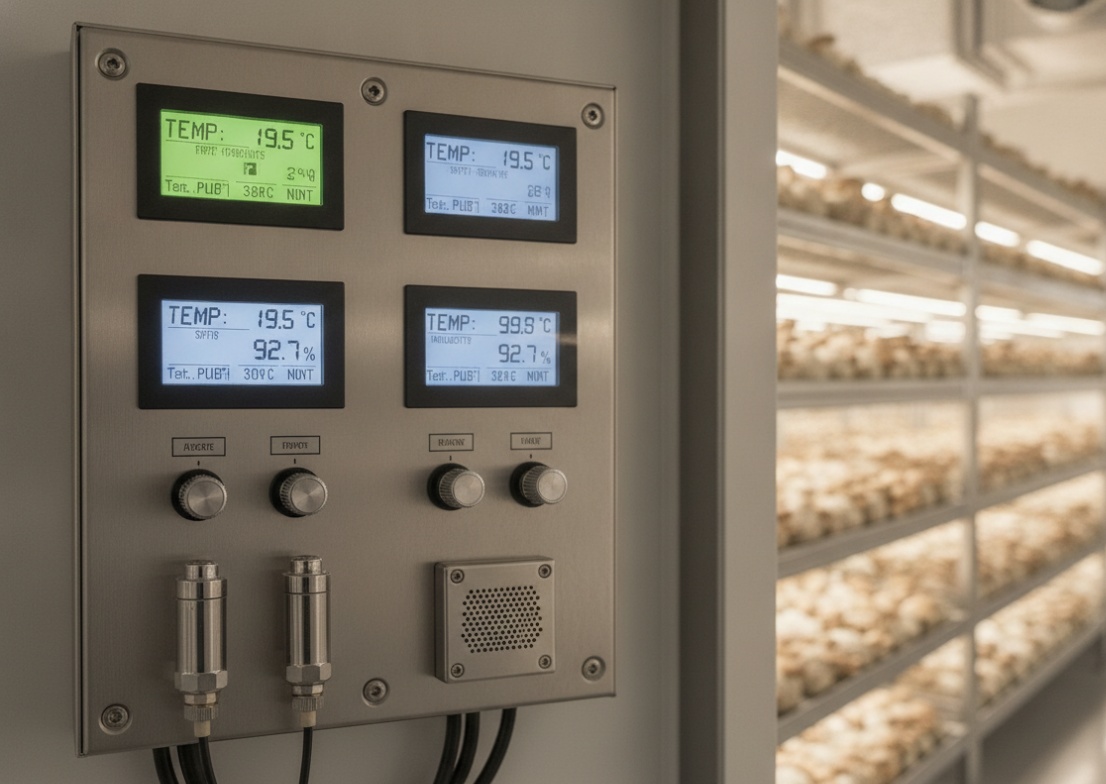
Practical Answer: How Mushroom Climate Control Works

A mushroom climate control system coordinates temperature, relative humidity, carbon dioxide, fresh air, recirculation, heating, cooling, humidification, and moisture removal inside a growing room. Instead of treating each device as an independent machine, the controller uses sensor readings and crop programs to maintain a stable environment as the crop develops.
The most reliable systems measure conditions at representative points rather than relying on a single sensor near an air outlet. They compare the measured values with programmed targets, calculate the required response, and adjust fans, dampers, compressors, heaters, humidifiers, and dehumidification functions. This closed-loop approach helps reduce environmental swings that can affect pinning, fruit body quality, biological efficiency, and harvest timing.
For growers in the Global Market, the right solution depends on mushroom species, room volume, substrate or casing method, local weather, energy prices, water quality, available utilities, and the required production schedule. A compact cultivation container may use an integrated controller and packaged air-handling equipment, while a large farm may require several climate zones connected to a central monitoring platform.
In simple terms, the system should:
- Measure air and crop-room conditions accurately.
- Distribute conditioned air evenly without excessive drying or condensation.
- Respond gradually enough to avoid stress but quickly enough to correct drift.
- Coordinate outside air with recirculated air according to CO2 and humidity demand.
- Apply crop-specific recipes while allowing authorized manual intervention.
- Record trends so operators can verify stability under real crop load.
Lanhu supplies integrated climate equipment for mushroom cultivation containers, agricultural facilities, and industrial HVAC applications. Its solutions can be reviewed through the smart mushroom climate controller product page and adapted for different facility sizes, climates, and operating requirements.
Temperature, Humidity, CO2, and Airflow Management

Four environmental variables form the core of mushroom room climate management: temperature, humidity, CO2 concentration, and airflow. They are closely connected. Increasing fresh-air exchange may reduce CO2 but also lower humidity. Cooling air can remove moisture, while heating may reduce relative humidity. Faster circulation can improve uniformity but may increase evaporation from the casing or fruiting surface.
For that reason, operators should not manage each parameter in isolation. The controller needs a coordinated strategy based on crop stage and room conditions.
| Stage | Primary objective | Temperature focus | Humidity focus | CO2 and airflow focus | Operator priority |
|---|---|---|---|---|---|
| Room preparation | Establish a clean, stable starting environment | Reach the programmed setpoint evenly | Prevent excessive dryness or condensation | Purge unwanted gases and verify circulation | Check sensors, alarms, and equipment response |
| Spawn run | Support controlled biological activity | Limit heat accumulation in the crop mass | Maintain sufficient moisture without wet surfaces | Use measured ventilation and gentle circulation | Watch for hot spots and sensor disagreement |
| Pinning | Promote uniform initiation | Make gradual changes according to the recipe | Maintain high but controlled room humidity | Adjust CO2 and airflow without surface drying | Prioritize uniformity across the room |
| Fruiting | Protect quality, shape, and harvest timing | Hold a stable crop-zone temperature | Balance transpiration and condensation risk | Provide adequate oxygen and CO2 control | Prevent drafts, wet caps, and stagnant pockets |
| Between flushes | Restore the room for the next production cycle | Remove accumulated biological heat | Correct excess moisture before the next flush | Increase air exchange when required | Use trends rather than one-time readings |
| Sanitation and reset | Prepare equipment and surfaces safely | Follow the sanitation procedure | Dry the room where appropriate | Ventilate odors and residual gases | Inspect filters, coils, drains, and sensors |
Temperature sensors should represent the actual crop environment, not simply the air leaving a cooling coil. Humidity should be interpreted alongside temperature because relative humidity changes when air temperature changes, even if the absolute moisture content remains similar. CO2 measurements should be located where the crop experiences the air, with additional attention to areas where gas may accumulate.
Airflow is often the least visible but one of the most important variables. A room may show acceptable average temperature and humidity while still having cold corners, warm shelves, high-velocity drafts, or stagnant zones. Air distribution should therefore be evaluated through multiple sensors, smoke testing, anemometer readings, or commissioning measurements.
Sensors and Representative Measuring Locations

Sensor selection and placement determine whether a climate controller receives useful information. A high-quality controller cannot compensate for a sensor installed beside a supply duct, in direct sunlight, above a heater, or in a location that does not represent the crop zone.
Temperature and humidity probes are commonly positioned at crop height or within the air path that reflects the growing environment. In multi-level systems, one measuring point may be insufficient. The number of sensors should reflect room size, shelf arrangement, airflow pattern, and the cost of crop variation.
CO2 sensors require particular care. Carbon dioxide can be higher near the crop, floor, corners, or poorly mixed areas. The probe should be protected from water droplets and placed where it can detect the room condition without being directly exposed to a fresh-air jet. Calibration and periodic comparison with a reference instrument are important for dependable ventilation control.
| Measuring point | Main sensors | Reason for use | Common risk | Commissioning check | Control decision supported |
|---|---|---|---|---|---|
| Crop-zone center | Temperature and humidity | Represents the average growing condition | Reading may miss corner variation | Compare with several temporary probes | Primary heating, cooling, and humidification |
| Upper room level | Temperature and humidity | Identifies stratification and heat accumulation | Warm air may create a false room average | Compare vertical temperature difference | Fan speed and circulation adjustment |
| Lower room level | Temperature, humidity, and optional CO2 | Detects heavy-gas accumulation and cold areas | Water or cleaning activity may damage probes | Protect the probe and verify drainage | Fresh-air and mixing strategy |
| Return-air path | Temperature, humidity, and CO2 | Shows the condition entering the air-handling unit | Reading may be distorted by poor mixing | Check return-air velocity and location | Capacity and equipment staging |
| Supply-air path | Temperature and humidity | Verifies the effect of the coil or heater | Direct jet can produce unstable readings | Allow adequate straight length or mixing | Valve, compressor, and heater control |
| Outside-air intake | Temperature, humidity, and optional CO2 | Provides weather data for ventilation decisions | Rain, dust, or solar gain can bias readings | Use a shielded, representative intake point | Economizer and fresh-air compensation |
Sensor redundancy is valuable in commercial mushroom production. A controller can use an average, median, or high-value strategy depending on the application. For example, average temperature may be suitable for general control, while a high-temperature alarm can protect the warmest crop area. If two sensors differ beyond an allowed tolerance, the system should generate an alarm rather than silently accepting unreliable data.
Operators should inspect probes during every production cycle. Look for condensation, substrate particles, dust, damaged cables, loose connectors, and calibration drift. A clean sensor with a documented calibration history is more useful than a sophisticated sensor that is neglected.
Heating and Cooling Equipment Response
Heating and cooling equipment must respond to changes in both room air and crop heat. Growing mushrooms generate biological heat, and the load can change significantly as the crop develops. Doors, loading activities, outdoor temperature, insulation quality, and fresh-air volume also affect the required capacity.
Cooling may be provided by chilled water coils, direct-expansion units, packaged air conditioners, or air source heat pump systems. Heating may use electric heaters, hot-water coils, heat pumps, or other local energy sources. The controller should stage or modulate equipment so that the room reaches the setpoint without repeated short cycling.
Capacity alone does not guarantee performance. An oversized unit may cool the air rapidly but create excessive dehumidification, temperature overshoot, and frequent starts. An undersized unit may run continuously while the crop zone remains outside the target. Equipment selection should consider sensible and latent loads separately.
| Equipment or function | Primary role | Useful control method | Potential problem | Recommended verification | Energy consideration |
|---|---|---|---|---|---|
| Cooling coil | Remove sensible heat and some moisture | Modulating valve or compressor staging | Overcooling and unwanted drying | Check leaving-air temperature and drain flow | Use variable capacity where practical |
| Electric heater | Raise room or supply-air temperature | Step control or proportional output | Rapid temperature overshoot | Test high-limit protection | Use only when required by the recipe |
| Heat pump | Provide efficient heating and cooling | Mode selection with anti-short-cycle timing | Reduced heating output in cold weather | Confirm defrost and low-temperature operation | Recover energy when conditions allow |
| Supply fan | Move conditioned air through the room | Variable-frequency or multi-speed control | Drafts, noise, or weak circulation | Measure airflow at representative outlets | Lower speed when full capacity is unnecessary |
| Return fan | Maintain balanced air movement | Pressure or airflow tracking | Uneven room pressure and leakage | Check door seals and room pressure | Coordinate with supply fan speed |
| Damper system | Regulate fresh and recirculated air | Position control linked to CO2 and humidity | Sticking dampers or incorrect feedback | Command and observe actual position | Use recirculation when outdoor air is costly |
A practical control sequence normally includes a deadband around the setpoint, minimum run times, compressor protection, fan delays, and alarm limits. These functions reduce wear and prevent the system from reacting to every small fluctuation. The control response should also consider the time lag between a command and a measurable change in the crop zone.
For facilities near hot and humid coastal regions such as Singapore, Ho Chi Minh City, Lagos, or Miami, latent cooling demand may be substantial. In dry continental locations such as Almaty, Ulaanbaatar, or inland northern China, humidification and winter heating may dominate. Equipment selection must therefore be adapted to the local design climate instead of copied from another region.
Humidification and Moisture Removal
Humidity management is a balance between preserving crop moisture and preventing free water. A high relative humidity target may support fruiting, but wet surfaces, condensation, and poor air exchange can encourage contamination or quality problems. The appropriate operating range varies by species, substrate, room temperature, crop stage, and production method.
Humidification may use high-pressure water mist, ultrasonic systems, evaporative devices, steam, or controlled spraying. The selected method should produce the required moisture without wetting fruit bodies, electrical components, insulation joints, or filters. Water treatment is also important because mineral deposits can block nozzles and create maintenance issues.
Moisture removal occurs through cooling coils, dedicated dehumidifiers, ventilation, heating followed by air exchange, or combinations of these methods. Ventilation alone may remove moisture efficiently in a cold, dry climate but can be expensive or ineffective when outdoor air is already humid.
The controller should avoid using humidity readings alone to start humidification. It should consider temperature, dew point, surface risk, equipment status, and whether fresh-air operation is already removing moisture. A dew-point calculation can provide a more useful indication of condensation risk than relative humidity by itself.
| Method | Best application | Strength | Limitation | Maintenance requirement | Control advice |
|---|---|---|---|---|---|
| High-pressure mist | Large rooms requiring rapid moisture addition | Good distribution with suitable nozzles | Can wet surfaces if poorly designed | Filter and nozzle inspection | Use short pulses and verify evaporation |
| Ultrasonic humidifier | Compact rooms and modular containers | Fine mist and quick response | Water minerals may become airborne | Water treatment and membrane cleaning | Use humidity and water-level interlocks |
| Steam humidifier | Applications needing hygienic, precise moisture | Accurate and low risk of liquid droplets | Higher energy consumption | Scale removal and cylinder replacement | Modulate output gradually |
| Cooling coil dehumidification | Rooms already requiring cooling | Combines sensible and latent control | May overcool the room | Coil, drain, and condensate pan cleaning | Coordinate with reheat where needed |
| Dedicated dehumidifier | High-moisture rooms needing independent control | Works without major room cooling | Creates heat that must be managed | Filter and coil service | Interlock with cooling and fan operation |
| Fresh-air drying | Cold or dry outdoor conditions | Can reduce moisture with low mechanical energy | Ineffective in humid weather | Filter and damper inspection | Use outdoor dew point for enable logic |
Drainage deserves the same attention as humidification. Condensate pans should slope correctly, drains should be trapped and accessible, and standing water should not remain inside the air-handling section. In a commercial room, a moisture-control failure can affect crop quality, building materials, electrical safety, and sanitation schedules.
Fresh-Air and Recirculation Coordination
Fresh air is essential for managing CO2 and replenishing oxygen, but all outside air carries a thermal and moisture load. A well-designed mushroom HVAC system therefore mixes fresh and recirculated air according to the actual demand. During some stages, the room may need strong recirculation for uniformity. During others, fresh-air exchange may become the primary method of CO2 reduction.
Fresh-air dampers, exhaust fans, return-air fans, filters, and supply fans should operate as one system. If the exhaust fan runs without enough replacement air, the room may develop excessive negative pressure. If the intake damper opens without adequate mixing, cold or dry outdoor air may reach the crop directly.
CO2 control is not simply a matter of opening a damper whenever a single reading rises. The controller should account for sensor location, outdoor conditions, crop respiration, fan capacity, and the time needed for room mixing. A staged ventilation sequence is often more stable than a sudden full opening.
| Condition | Preferred response | Reason | Risk if unmanaged | Useful sensor input | Operator check |
|---|---|---|---|---|---|
| CO2 above target | Increase controlled fresh-air exchange | Removes accumulated crop respiration gases | Long stems, poor morphology, or delayed development | CO2, airflow, and damper position | Confirm the reading reflects the crop zone |
| Outdoor air is hot and humid | Limit unnecessary intake and use mechanical drying | Prevents excess latent and sensible load | Wet surfaces and high energy use | Outdoor temperature, humidity, and dew point | Inspect coils and condensate drainage |
| Outdoor air is cold and dry | Preheat and humidify incoming air when needed | Protects the crop from drying and shock | Surface drying and temperature gradients | Outdoor temperature and room humidity | Check mixing before air reaches shelves |
| CO2 is acceptable but room is uneven | Increase recirculation or adjust distribution | Improves uniformity without unnecessary ventilation | Different crop performance by location | Multiple temperature and humidity probes | Measure supply and return airflow |
| Door opens frequently | Use a recovery sequence after the event | Restores room conditions without overreacting | Repeated equipment cycling | Door switch, temperature, and humidity | Review event logs and operator routines |
| Filter pressure increases | Service or replace the filter | Maintains airflow and protects equipment | Reduced capacity and fan energy waste | Differential pressure and fan speed | Keep a planned maintenance record |
In cities with strong seasonal changes, such as Rotterdam, Istanbul, Toronto, or Seoul, ventilation recipes may need seasonal adjustment. In tropical markets, the system may require more mechanical dehumidification and less direct outside-air exchange. Local design conditions, utility tariffs, building pressure, and water availability should be included in the engineering review.
Crop Programs and Manual Override Functions
A crop program translates production knowledge into a repeatable sequence. It may contain setpoints, ramp rates, alarm limits, equipment priorities, ventilation stages, and time-based or event-based changes. Programs are usually divided into phases such as room preparation, spawn run, pinning, fruiting, flush recovery, and sanitation.
A good recipe is not a fixed number copied from a supplier brochure. It is a starting framework that must be validated for the selected strain, substrate, room design, and market specification. Oyster mushrooms, shiitake, enoki, and button mushrooms can require different environmental strategies. Even the same species may respond differently in bags, shelves, blocks, or containers.
Manual override is necessary for maintenance, testing, emergency recovery, and experienced operator intervention. However, unrestricted manual control can create confusion and safety risks. Overrides should have user permissions, time limits, visible status indicators, and automatic return-to-program functions.
- Use automatic control for normal crop production.
- Use temporary manual commands for commissioning and troubleshooting.
- Record the person, time, reason, and duration of each override.
- Keep safety interlocks active during manual operation.
- Require confirmation before disabling high-temperature, low-water, or fan-failure protection.
Remote access can help supervisors review trends and alarms across several sites. It should be protected by appropriate account controls and a clear division between monitoring access and equipment-command authority. A useful interface shows current values, target values, alarm state, equipment status, and recent trends in a way that operators can understand quickly.
Verifying Stability Under Real Crop Load
Commissioning should not end when the fans start and the room reaches an empty-room setpoint. Mushroom rooms behave differently after substrate, shelving, containers, workers, packaging materials, and a developing crop are introduced. Biological heat and moisture can change the load substantially.
Verification should include empty-room testing, loaded-room testing, transition testing, alarm testing, and a complete production-cycle review. The goal is to confirm not only that the average values are correct, but also that the room recovers predictably after disturbances.
| Test | What to measure | Suggested timing | Acceptance focus | Evidence to record | Corrective action if unsuccessful |
|---|---|---|---|---|---|
| Sensor comparison | Controller readings against a reference instrument | Before the first crop cycle | Values remain within agreed tolerance | Calibration and comparison sheet | Calibrate, replace, or relocate the probe |
| Empty-room pull-down | Time to reach temperature and humidity targets | After installation and sanitation | Stable response without excessive cycling | Trend graph and equipment status | Adjust capacity, tuning, or airflow |
| Air-distribution survey | Supply velocity and room-zone conditions | Before loading and after modifications | No persistent drafts or stagnant zones | Airflow map and temporary sensor data | Balance outlets, dampers, and fan speeds |
| CO2 recovery test | Time required to reduce elevated CO2 | During a controlled production stage | Ventilation responds without damaging humidity | CO2 trend and damper position | Review intake, exhaust, mixing, and sensor location |
| Full crop-load test | Temperature, humidity, CO2, and equipment runtime | During active biological growth | Stable conditions under realistic load | Daily trend report and operator notes | Retune sequence or add capacity |
| Alarm and fail-safe test | Probe failure, fan failure, high temperature, and water faults | During commissioning and scheduled service | Alarm reaches the correct user and equipment enters safe state | Test record and alarm acknowledgement | Correct wiring, logic, or notification settings |
Trend review is more informative than looking at a single current value. Operators should examine minimum, maximum, average, rate of change, equipment runtime, and the relationship between variables. For example, a humidity alarm that occurs every time cooling starts may indicate coil dehumidification, poor control tuning, or an incorrectly located humidity probe.
Stability should be evaluated by zone. A room average can conceal a warm back corner or a dry area close to a supply grille. If crop results are inconsistent by shelf or row, compare the environmental trend at those locations before changing the entire recipe.
Market, Product Types, and Buying Guidance
The Global Market includes small specialty growers, supermarket suppliers, agricultural contractors, research facilities, modular farms, and large commercial mushroom producers. Their climate-control requirements differ in scale and complexity.
Smart mushroom cultivation containers are useful where rapid deployment, transportability, and integrated operation are priorities. They can combine insulated panels, air treatment, control hardware, lighting where required, and service access in a compact footprint. Larger farms may prefer separate air-handling units, multiple rooms, central monitoring, and expandable control architecture.
When comparing suppliers, buyers should assess more than nominal cooling capacity. Ask for design conditions, air volume, sensible and latent capacity, sensor locations, control sequence, electrical requirements, water quality assumptions, maintenance access, spare parts, and commissioning responsibilities.
- Room compatibility: Confirm dimensions, insulation, door arrangement, rack layout, and service clearances.
- Climate suitability: Review performance at the actual summer and winter design conditions.
- Control flexibility: Check crop recipes, alarm handling, data logging, and user permissions.
- Hygiene: Specify cleanable surfaces, drainage, filter access, and corrosion-resistant components.
- Energy performance: Compare fan power, compressor efficiency, heat recovery, and operating schedules.
- Support: Confirm installation guidance, remote assistance, spare parts, and response procedures.
For international projects, logistics can influence the equipment choice. Export routes through Qingdao, Tianjin, Shanghai, Rotterdam, Hamburg, Dubai, or Singapore may affect lead time and landed cost. Buyers should clarify packaging, container dimensions, electrical standards, refrigerant requirements, documentation, customs classification, and local installation capability at the quotation stage.
Industries and Applications
Mushroom climate systems serve several industries beyond conventional farm buildings. Food companies may use controlled rooms for year-round supply. Agricultural contractors may install modular facilities for clients in regions where traditional construction is slow or expensive. Universities and research centers may need precise, repeatable conditions for strain trials and substrate experiments.
Typical applications include:
- Commercial button, oyster, shiitake, and specialty mushroom farms.
- Containerized farms close to urban food markets.
- Food-processing sites with controlled indoor growing areas.
- Demonstration farms and agricultural training centers.
- Research facilities conducting crop and environmental trials.
- Remote projects requiring factory-tested modular equipment.
- Contract growing operations serving retailers, restaurants, and distributors.
Urban cultivation projects in London, Paris, New York, Tokyo, Johannesburg, and Sydney often value compact equipment, low noise, heat rejection planning, and reliable remote monitoring. Rural operations may focus more on service access, robust components, energy cost, and integration with existing boilers, generators, or renewable systems.
Case Examples and Local Supplier Considerations
A practical project in a warm coastal market may require a packaged cooling and dehumidification solution with carefully limited outside-air intake. The controller can use CO2 demand to open the fresh-air damper while monitoring room humidity and coil condensate. If outdoor dew point is high, mechanical moisture removal may remain active after the CO2 target is reached.
A project in a cold inland market may require preheating, humidification, frost protection, and heat-pump defrost management. The fresh-air sequence should prevent cold air from reaching the crop directly, while recirculation maintains uniformity. Outdoor-air sensors and supply-air limits become especially important.
A modular container installed near a city may face limited electrical capacity. In that case, the design should prioritize variable-speed fans, staged compressors, thermal insulation, and operating schedules that reduce peak demand. The supplier should also provide clear instructions for service technicians who may not have experience with the original manufacturer.
Local suppliers are valuable for electrical work, ducting, foundations, water treatment, refrigeration service, and regulatory compliance. However, local procurement should not remove the need for an integrated design authority. Sensors, control logic, dampers, coils, and equipment capacity must work together. A division of responsibility should be documented before installation.
Buyers can review installation references and international project information through Lanhu’s mushroom cultivation project cases. A useful case review should explain room size, crop type, climate, equipment arrangement, commissioning method, and measured operating results rather than showing only photographs.
Future Trends in Mushroom Climate Technology
Climate control is moving toward more data-driven, energy-aware, and modular operation. Artificial intelligence and advanced analytics may help identify unusual trends, estimate crop heat, predict equipment faults, and recommend recipe adjustments. These tools should support growers rather than replace agronomic judgment.
Digital twins and improved simulation can help engineers evaluate airflow, cooling loads, condensation risk, and equipment sizing before construction. Low-cost wireless sensors may make zone mapping easier, although wireless reliability, battery life, sanitation, and cybersecurity must be considered.
Energy efficiency will become increasingly important because cooling, ventilation, humidification, and heating can represent a large portion of production cost. Heat pumps, variable-speed drives, heat recovery, solar power, thermal storage, and demand-response operation may reduce emissions and peak electricity use.
Policy and market expectations are also changing. Food traceability, water efficiency, refrigerant management, worker safety, and greenhouse-gas reporting may influence equipment specifications. Systems that log environmental conditions can support internal quality programs and provide evidence for audits.
Future facilities are likely to combine modular construction with scalable controls. A grower may begin with one container or room, then add additional modules while keeping common monitoring and recipe management. Standardized communication interfaces and documented service procedures will make expansion easier across different countries and trade regions.
Our Company and Project Support
Shandong Lanhu Air Conditioning Equipment Co., Ltd. is based in Dezhou, Shandong, China, a manufacturing region with convenient connections to major domestic transport corridors and export logistics. The company develops agricultural climate equipment, industrial HVAC systems, modular cultivation solutions, smart mushroom cultivation containers, climate controllers, hydroponic plant containers, and air source heat pumps.
Technological capabilities
Lanhu combines more than 12 years of thermodynamic research and development experience with practical system integration. Its engineering work covers temperature and humidity control, airflow organization, refrigeration, heat-pump operation, electrical control, sensor integration, and modular cultivation design. The company has more than 45 registered patents and develops solutions that can be adapted to different crop programs, room sizes, and climate conditions.
The engineering process considers not only equipment selection but also control sequences, sensor locations, maintenance access, water management, and operational safety. This integrated approach is important when a mushroom room must remain stable under changing biological loads.
Manufacturing capabilities
The company operates a modern manufacturing facility covering more than 30,000 square meters. Its production capabilities include product design, engineering development, sheet-metal fabrication, CNC bending, insulation-panel production, electrical assembly, system integration, equipment testing, and quality inspection.
Factory integration helps coordinate enclosure construction, air-treatment equipment, wiring, control panels, insulation, and final assembly. Before shipment, systems undergo functional inspection, electrical verification, performance testing, and operational evaluation. Lanhu maintains ISO 9001, ISO 14001, ISO 45001, and ISO 12100 certifications, together with patent certificates and enterprise credibility credentials.
Service capabilities
Lanhu provides factory-direct supply, OEM and ODM customization, engineering assistance, international logistics support, spare parts support, installation guidance, and after-sales service. This model is suitable for agricultural contractors, equipment distributors, engineering companies, and commercial farming projects in the Global Market.
Customers can discuss room dimensions, crop type, local climate, voltage, installation conditions, monitoring requirements, and target production capacity before selecting a configuration. For customized development, the OEM and ODM mushroom climate service page provides a starting point for project coordination.
Buyers who need a dedicated control platform can also review the intelligent mushroom climate-control solution for information about monitoring, automation, and crop-program management.
Frequently Asked Questions
What does a mushroom climate control system control?
It usually controls temperature, relative humidity, CO2 concentration, airflow, fresh-air exchange, recirculation, heating, cooling, humidification, and moisture removal. More advanced systems also manage alarms, data logging, crop recipes, user permissions, and remote monitoring.
Why are multiple sensors better than one sensor?
Multiple sensors reveal differences between crop zones, shelves, corners, supply areas, and return-air paths. A single sensor may show an acceptable average while part of the crop experiences excessive heat, dryness, humidity, or CO2 accumulation.
Can one controller manage different mushroom species?
Yes, if the controller supports separate crop programs and the equipment has sufficient capacity. Each species and production stage should be validated through crop trials. Programs should include appropriate setpoints, ramp rates, ventilation logic, alarm limits, and recovery sequences.
How often should sensors be calibrated?
The interval depends on sensor type, environment, manufacturer guidance, and production risk. Many facilities perform a comparison before each major production cycle and schedule formal calibration at defined intervals. Sensors exposed to condensation, dust, chemicals, or frequent cleaning may require more frequent inspection.
What is the difference between fresh air and recirculated air?
Fresh air comes from outside the building and helps remove CO2 while supplying oxygen. Recirculated air remains within the room or air-handling loop and is conditioned repeatedly. A stable system blends both according to CO2, humidity, temperature, outdoor conditions, and crop requirements.
Does high humidity always improve mushroom production?
No. Humidity must be balanced with airflow, surface temperature, evaporation, and sanitation. Excess humidity can cause condensation and wet surfaces, while insufficient humidity can dry the casing or fruit bodies. The correct strategy depends on species, stage, room design, and crop observations.
How can a grower reduce energy consumption?
Use well-insulated rooms, variable-speed fans, efficient heat pumps, staged cooling, appropriate fresh-air control, clean filters, heat recovery where practical, and crop programs that avoid unnecessary equipment operation. Trend data can reveal equipment running longer than expected.
Should a mushroom container be customized for the local climate?
Yes. A container in a humid tropical city may need greater latent cooling and moisture removal, while one in a cold, dry region may require more heating, humidification, and frost protection. Electrical standards, water quality, logistics, and service availability should also be considered.
What should be included in a supplier quotation?
The quotation should identify room dimensions, cooling and heating capacity, airflow, sensor quantity and location, control functions, electrical requirements, humidity equipment, fresh-air and exhaust arrangements, insulation, drainage, testing, packaging, delivery terms, installation support, warranty, and spare-parts availability.
How can a buyer confirm that a system is ready for production?
Request commissioning records showing sensor checks, empty-room testing, airflow verification, CO2 response, equipment staging, alarm tests, drainage inspection, and loaded-room performance. The most useful evidence includes trend graphs and operator training records, not only a statement that the equipment has been tested.
Share this article

About the Author: Shandong Lanhu Air Conditioning Equipment
Lanhu is a professional climate control equipment manufacturer specializing in smart agricultural systems, commercial HVAC solutions, and customized temperature control technologies. With extensive engineering experience, Lanhu provides reliable solutions for plant factories, controlled environment agriculture, and industrial applications.
Need a Custom Climate Control Solution?
From smart agricultural systems to commercial HVAC solutions, Lanhu provides reliable temperature and humidity control solutions tailored to your project needs.
Contact Us