Global Market Mushroom Container Installation Guide 2026
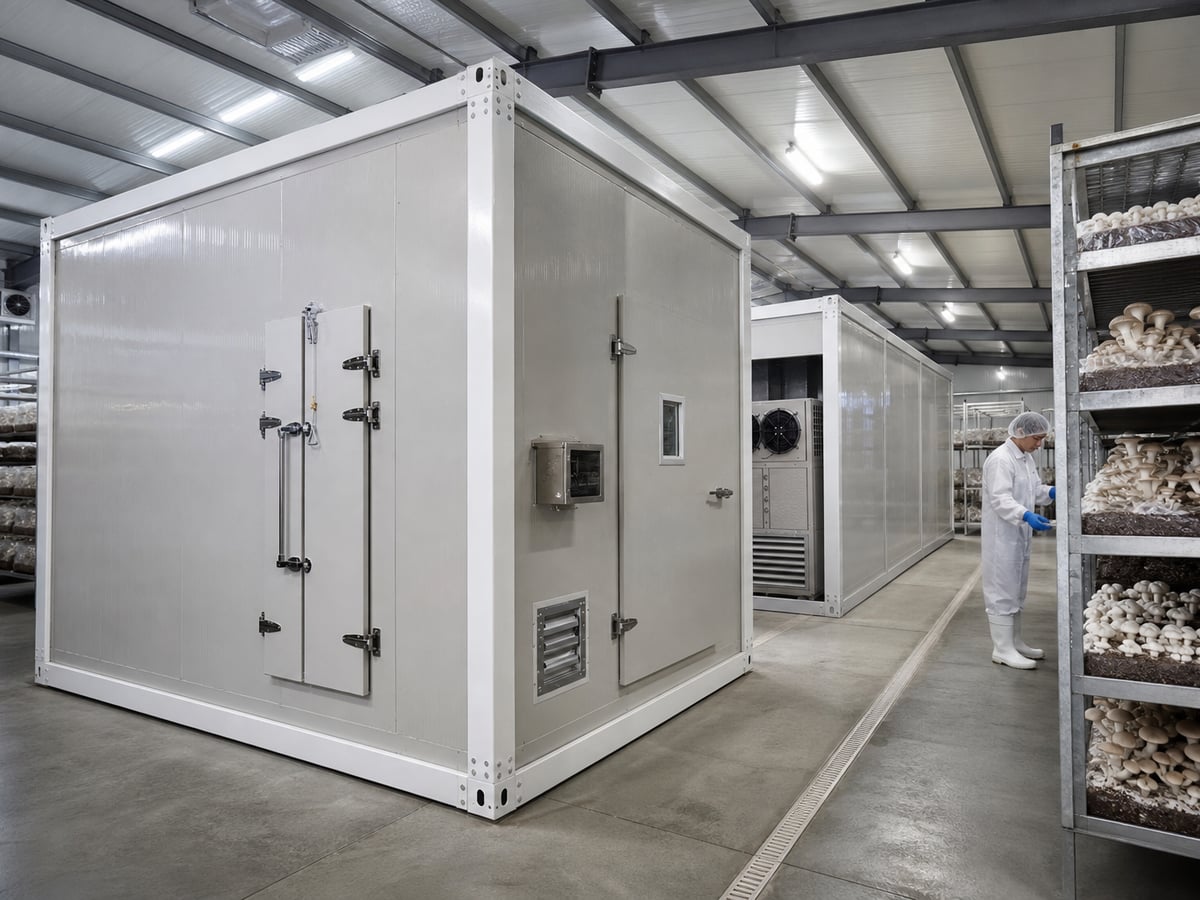
Immediate Installation Answer

A successful mushroom container installation starts long before the container arrives at the farm. For Global Market projects, the site must be surveyed for vehicle access, crane reach, foundation bearing capacity, electrical supply, water availability, drainage routing, outdoor-unit airflow, and operational safety. A smart mushroom cultivation container is a controlled agricultural production system, not simply a shipping container placed on level ground.
The recommended sequence is simple: verify access; prepare the foundation; confirm lifting points and final orientation; connect power, earthing, water, condensate, and drainage; preserve ventilation clearances; test the climate controller, alarms, and safety devices; then complete commissioning before substrate, shelves, or crop bags are loaded. Skipping any one of these stages can cause unstable temperature, excess humidity, poor drainage, electrical faults, reduced HVAC performance, or delayed production.
For commercial growers, contractors, distributors, and agricultural engineering companies, installation planning should be completed before equipment leaves the factory. This is especially important for projects shipped through major logistics hubs such as Shanghai, Qingdao, Rotterdam, Jebel Ali, Singapore, Los Angeles, Durban, Santos, and Melbourne. Port delivery is only one part of the project; local transport, lifting equipment, utility connections, and startup personnel must be ready at the destination.
| Installation Stage | Primary Objective | Responsible Party | Typical Risk if Missed |
|---|---|---|---|
| Site survey | Confirm access, levels, utilities, and local constraints | Buyer and installation contractor | Container cannot be positioned safely |
| Foundation preparation | Create stable, level, drained support | Civil contractor | Door misalignment, poor drainage, structural stress |
| Lifting plan | Match crane, forklift, spreader, and lifting path | Logistics and lifting team | Equipment damage or unsafe handling |
| Electrical connection | Provide correct voltage, protection, and earthing | Licensed electrician | Controller faults or electrical hazards |
| Water and drainage | Maintain hygiene and remove condensate reliably | Plumbing contractor | Standing water and contamination risk |
| Commissioning | Validate climate performance and alarms | Supplier technician or trained operator | Crop loading before stable operation |
The table above shows why installation should be treated as a coordinated project rather than a delivery task. The most effective approach is to appoint one site coordinator who can communicate with the supplier, local electrician, civil contractor, crane company, plumbing team, and farm manager.
Modern systems can be ordered as complete smart mushroom cultivation containers with insulated structure, climate equipment, fresh-air systems, lighting, racks, sensors, and automated control integrated before shipment. Even with a factory-assembled solution, however, the final site connections and startup checks remain essential.
Survey Access and Foundation Conditions

Before placing an order or releasing a shipment, assess the full route from the nearest port, warehouse, or road connection to the installation pad. Global Market projects often involve regional transport from commercial gateways to rural farms. A container unloaded at Qingdao Port, Rotterdam Port, Jebel Ali Port, or the Port of Los Angeles may still need to pass narrow gates, low bridges, soft agricultural roads, sharp turning areas, or overhead utility lines before reaching the farm.
Measure road width, turning radius, gate height, bridge limits, and ground conditions. Confirm whether a container truck can enter directly or whether a smaller vehicle, side-loader, crane, or temporary road improvement is required. Wet-season conditions must be considered: an access road that supports a truck in dry weather may become unsuitable after heavy rain.
The foundation should support the loaded operating weight of the container, including racks, substrate, water, workers, HVAC equipment, and possible snow or wind loads according to local conditions. Reinforced concrete pads, engineered strip foundations, steel beams on concrete footings, or properly designed compacted gravel bases may be used depending on the container size, soil bearing capacity, frost conditions, drainage needs, and local building requirements.
| Foundation Checkpoint | Recommended Site Condition | Why It Matters | Practical Verification |
|---|---|---|---|
| Levelness | Level across all support points | Protects door seals, drainage slopes, and structure | Check with laser level before delivery |
| Bearing capacity | Suitable for loaded container weight | Prevents settlement and frame distortion | Review soil report or civil engineer advice |
| Drainage fall | Surface water directed away from the unit | Reduces flooding and corrosion | Observe runoff after irrigation or rain |
| Clear perimeter | Working room around doors and service panels | Allows maintenance and emergency access | Mark footprint and access zones on site |
| Frost protection | Foundation designed for local freeze conditions | Limits seasonal movement in cold regions | Follow local civil construction practice |
| Surface finish | Durable, cleanable, and slip-resistant | Improves hygiene and worker safety | Inspect concrete curing and finish quality |
This foundation checklist is not a substitute for local structural or civil engineering approval. It explains the operating conditions that help a containerized mushroom farm remain stable and serviceable. In coastal areas such as Southeast Asia, the Gulf region, northern Europe, or island markets, special attention should be given to salt air, high rainfall, wind exposure, and local corrosion protection requirements.
A practical layout should also reserve room for loading carts, spent-substrate removal, cleaning activities, water treatment equipment, electrical cabinets, and future expansion. If the project will operate multiple units, establish vehicle lanes and utility corridors at the beginning. A poor initial layout can make later expansion more expensive than installing a larger utility network from the start.
For commercial buyers comparing suppliers, ask for the exact external dimensions, operating weight estimate, service-side requirements, utility entry locations, and recommended base arrangement during the quotation stage. This information lets the local contractor prepare accurately before the container arrives.
Plan Lifting and Placement Clearances

Lifting and placement are among the highest-risk activities in mushroom container installation. The lifting method must be selected according to the unit design, transport configuration, weight, center of gravity, local lifting regulations, and site access. Only trained lifting personnel should perform unloading and placement. Never assume that a standard container-handling method is suitable for a climate-controlled cultivation unit without confirming the supplier’s instructions.
Before arrival, determine whether the project requires a mobile crane, reach stacker, side-loader, forklift, container handler, spreader beam, or another approved lifting solution. The lifting team should inspect the final placement area, check outrigger space if a crane is used, identify underground services, assess wind conditions, and establish an exclusion zone around the lifting operation.
| Placement Clearance Area | Minimum Planning Consideration | Operational Reason | Common Mistake |
|---|---|---|---|
| Door side | Space for full door opening and trolley movement | Supports loading, harvesting, and sanitation | Placing doors against a wall or fence |
| Service side | Access to electrical and HVAC service panels | Enables inspections and repairs | Blocking panels with pallets or structures |
| Outdoor equipment | Free airflow around condensers or heat pumps | Maintains cooling and heating efficiency | Installing beside dense shrubs or walls |
| Roof zone | Clear from low cables, branches, and roof overhangs | Prevents lifting and maintenance hazards | Ignoring overhead obstructions |
| Drain outlet | Accessible route to approved drainage point | Protects sanitation and moisture control | Routing discharge beneath the container |
| Emergency path | Unobstructed worker exit and access route | Improves safety during faults or fire events | Using the access route for storage |
The clearance table should be converted into a marked site plan before delivery. Use painted lines, stakes, or temporary barriers to show the container footprint, crane working area, door swing, service zones, drain route, electrical route, and equipment access lane. This simple preparation reduces last-minute decisions when a truck and lifting crew are already on site.
Container orientation matters. In hot climates, direct afternoon sun can increase external heat gain. In windy areas, orient external equipment to avoid severe wind recirculation where practical. In locations with frequent dust, plan for service access that allows filters, coils, and intake screens to be cleaned efficiently. In high-rainfall regions, keep roof drainage and surrounding ground drainage clear of walkways and electrical connection points.
For farms using several units, leave enough spacing to avoid heat discharged from one outdoor unit being drawn into another. Rows should also permit a forklift, maintenance lift, or harvest vehicle to move safely. A compact layout may look efficient on paper but can reduce climate performance and increase service costs for years.
Connect Electrical Supply and Earthing
The electrical connection must match the container’s nameplate requirements and the local electrical code. Verify voltage, phase, frequency, maximum current, cable size, breaker rating, residual-current protection where required, isolator location, surge protection, and earthing arrangement before energizing the unit. Electrical work must be carried out by a qualified local electrician.
Global Market projects may operate on different supply standards, including single-phase or three-phase systems and regional frequency differences. Buyers should provide their local supply details during design confirmation so motors, climate equipment, controllers, pumps, lighting, and protection devices can be selected correctly. Do not rely on a temporary construction supply for commercial crop production unless it has been assessed for stable voltage and sufficient capacity.
Dedicated power supply is strongly recommended. Large loads such as compressors, heat pumps, heaters, humidifiers, circulation fans, and water pumps can create starting currents or voltage fluctuations. A shared supply with welding equipment, grain dryers, cold storage, or heavy machinery may cause nuisance trips and unstable climate control.
| Electrical Item | Pre-Startup Check | Purpose | Acceptance Result |
|---|---|---|---|
| Supply voltage | Measure at incoming isolator | Protect motors and electronic components | Within equipment tolerance |
| Phase sequence | Test three-phase rotation where applicable | Ensures correct motor direction | Fans and pumps rotate correctly |
| Earthing | Verify continuity and earth resistance | Reduces electric shock risk | Complies with local standard |
| Breaker capacity | Confirm protective device rating | Protects cables and equipment | Matches approved electrical design |
| Emergency isolator | Operate and label the disconnect point | Allows safe shutdown during service | Accessible and functional |
| Surge protection | Inspect protective devices where specified | Protects controller and sensors | Installed and correctly connected |
The electrical table provides a commissioning framework rather than a wiring design. The final installation must follow the equipment documentation and applicable national, regional, and municipal rules. In markets with unreliable grids, a properly sized generator, automatic transfer arrangement, voltage stabilizer, or uninterruptible power support for control equipment may be considered. Climate interruptions can affect mushroom quality, especially during sensitive fruiting stages.
Smart climate control adds operational value when the wiring and communication network are installed correctly. A mushroom climate controller can coordinate temperature, humidity, carbon dioxide, fresh-air exchange, fan operation, heating, cooling, alarms, and data records. Keep low-voltage sensor cables separated from high-power conductors where required, label every cable, and protect connections from washdown moisture.
Technological capability is especially important at this stage. Lanhu develops integrated agricultural climate systems using thermodynamic research, sensor-based control logic, equipment testing, electrical verification, and operational evaluation. The objective is not simply to install hardware, but to create a stable growing environment that responds to actual crop-room conditions.
Connect Water, Condensate, and Drainage
Water supply, condensate disposal, and floor drainage have direct effects on hygiene, humidity control, worker safety, and equipment reliability. The installation plan should identify potable or process-water source, pressure range, filtration need, shutoff valve location, pipe protection, backflow prevention where required, drain trap arrangement, and legal discharge route.
Water quality varies widely across the Global Market. Hard water can create mineral scale on humidification components; high sediment levels can block nozzles or filters; untreated water may introduce microbiological concerns. Where local water is unsuitable, use filtration, softening, UV treatment, or another appropriate solution based on water analysis and system requirements.
| Water or Drainage Component | Installation Requirement | Inspection Method | Operational Benefit |
|---|---|---|---|
| Incoming water valve | Accessible shutoff close to entry point | Open and close test | Fast isolation during maintenance |
| Water filter | Specified mesh or treatment level | Check housing, pressure, and service access | Protects humidification equipment |
| Condensate line | Continuous fall and protected route | Pour water through line | Prevents backup and leakage |
| Floor drain | Connected to approved drainage system | Flood test during cleaning simulation | Supports sanitation and safe floors |
| Drain trap | Correctly installed where needed | Inspect seal and water retention | Limits odors and pest entry |
| External discharge | Directed away from foundation and walkways | Observe flow at outlet | Reduces erosion and standing water |
The drainage table should be reviewed during both dry and wet conditions. A drain that appears adequate during a short test may fail when the room is washed down, humidification is running, and heavy rain affects the surrounding site. Avoid discharging water directly beneath the container because trapped moisture can encourage corrosion, insects, unstable soil, and difficult-to-detect leaks.
For farms growing oyster mushrooms, shiitake, lion’s mane, button mushrooms, or specialty varieties, cleaning procedures and humidity demand may differ. The plumbing arrangement should support the selected crop, substrate method, local hygiene requirements, and labor routine. Commercial operations often benefit from separate water points for humidification, cleaning, and staff sanitation rather than relying on one shared connection.
In water-limited regions, sustainability planning may include rainwater collection for non-critical cleaning use, efficient fogging technology, leak monitoring, and controlled washdown practices. Any reuse program must comply with local food-safety, agricultural, and wastewater requirements.
Verify Ventilation and Outdoor Unit Space
Mushroom production requires balanced management of temperature, humidity, carbon dioxide, oxygen exchange, air circulation, and fresh-air introduction. The container must not be installed in a location where intake air is contaminated by vehicle exhaust, compost dust, livestock buildings, chemical storage, waste handling, or discharge air from nearby equipment.
Outdoor condensers, heat pumps, and ventilation equipment need open space to reject heat and maintain rated performance. Obstructions such as walls, stacked pallets, vegetation, tarpaulins, or adjacent containers can cause hot-air recirculation. This increases energy consumption, reduces cooling capacity, and can lead to compressor protection trips during high ambient temperatures.
Climate conditions differ greatly between Dubai, Nairobi, Jakarta, Hamburg, Toronto, Santiago, and Auckland. In hot and humid regions, dehumidification capacity and outdoor airflow are particularly important. In cold climates, insulation quality, frost management, heat recovery, and winter drainage protection become more significant. The installation layout should match the local climate rather than applying one universal arrangement.
The chart illustrates a useful commissioning principle: no individual installation area should be treated as partially complete when crop loading begins. A container may appear operational while hidden deficiencies in earthing, drainage, airflow, or alarm configuration remain unresolved. Full readiness across all categories is the safer commercial target.
Inspect intake and discharge paths after the unit has operated for at least one stable cycle. Listen for unusual vibration, confirm that doors close without pressure problems, check for condensation around ducts or penetrations, and verify that fresh-air dampers respond correctly. Sensor placement should also be reviewed to ensure readings represent the crop zone rather than a direct air stream, wall surface, or humidifier plume.
Future-oriented facilities increasingly use variable-speed fans, high-efficiency heat pumps, heat recovery, remote monitoring, predictive maintenance alerts, and adaptive control algorithms. By 2026 and beyond, energy reporting, refrigerant compliance, water efficiency, carbon accounting, and worker-safety documentation are expected to become more important in agricultural supply chains. Providing adequate service clearance now helps a project adapt to these upgrades later.
Test Controls and Safety Alarms
Commissioning should prove that the system can maintain the intended operating environment and respond safely to abnormal conditions. Begin with a visual inspection of panels, sensors, ducts, pipework, drains, cable entries, access doors, emergency labels, and protective guards. Then energize the system under controlled conditions and test each operating mode.
Confirm setpoints for temperature, relative humidity, carbon dioxide, fresh-air cycles, fan schedules, lighting schedules, defrost functions where applicable, and alarm thresholds. Compare controller readings with calibrated portable instruments when possible. A sensor may be connected and visible on the display while still being installed in an unsuitable location or reading outside its intended accuracy range.
| Control or Alarm Test | Test Action | Expected Response | Record Required |
|---|---|---|---|
| Temperature control | Adjust setpoint within safe test range | Heating or cooling starts correctly | Actual and target temperatures |
| Humidity control | Call for humidification or dehumidification | Equipment operates without leaks | Humidity response time |
| CO₂ alarm | Use approved simulation or threshold check | Alarm activates and is acknowledged | Alarm setting and notification route |
| High-temperature alarm | Temporarily adjust alarm condition | Visible or remote warning occurs | Activation and reset result |
| Door or access alarm | Open monitored door if fitted | Status changes on controller | Door signal verification |
| Emergency stop or isolator | Operate according to safe procedure | Equipment enters safe state | Shutdown and restart sequence |
The test table should become part of the project handover file. Record dates, names, readings, corrective actions, and final acceptance signatures. This documentation helps the farm manager understand the system and gives service technicians a reliable baseline if performance changes later.
Automation should support experienced growers, not replace crop observation. Operators should inspect mushroom appearance, pinning, cap development, stem length, surface moisture, substrate condition, and harvest quality alongside controller data. If crop symptoms and displayed conditions do not match, investigate sensor calibration, air distribution, local microclimates, fresh-air balance, or crop-management practices.
Remote access can improve response times for distributed farms, franchises, and projects managed across borders. However, cybersecurity matters. Change default passwords, control user permissions, keep backups of controller parameters, and decide who receives alarm notifications outside working hours. For larger networks, create a clear escalation procedure covering power loss, high temperature, water leak, sensor failure, refrigeration fault, and ventilation alarm.
Complete Handover Before Crop Loading
Do not load substrate, shelves, trays, or mushroom blocks until installation defects have been corrected and the system has completed a stable pre-production run. The handover phase should include physical inspection, utility verification, operational tests, cleaning confirmation, operator training, documentation review, spare-parts discussion, and agreement on after-sales contacts.
A practical pre-crop run may include operating the container through representative temperature and humidity conditions, observing drainage, checking controller history, testing alarms, verifying fresh-air cycles, and confirming that all doors, seals, lighting, and safety labels are complete. The exact test duration depends on project complexity, local climate, and customer requirements, but the principle remains the same: prove the room before placing valuable crop material inside.
Service capability is most valuable when it begins before the first crop cycle. Lanhu supports international customers with engineering assistance, installation guidance, spare-parts coordination, factory-direct supply, OEM and ODM options, international logistics support, and after-sales communication. For projects requiring customized dimensions, climate capacity, internal racking, branding, voltage configuration, or control functions, early technical coordination reduces site changes later.
Buyers developing a private-label product line or regional distribution program can review available OEM and ODM mushroom cultivation solutions during the planning stage. Customization should include a documented review of intended crops, target climate, utility conditions, certification needs, shipping route, and maintenance capability in the destination market.
Crop loading should be gradual for a first cycle. Start with a manageable quantity, monitor the climate response, inspect shelves and airflow distribution, and adjust approved operating parameters based on crop requirements. This approach allows the farm team to learn the new system while minimizing risk to the first commercial production batch.
Our Company
Shandong Lanhu Air Conditioning Equipment Co., Ltd. is a China-based manufacturer serving agricultural climate-control, industrial HVAC, and modular cultivation projects for customers across the Global Market. The company supplies smart mushroom cultivation containers, mushroom climate controllers, hydroponic plant containers, air-source heat pumps, and customized climate-control equipment for commercial agricultural applications.
Its technological capabilities are built on more than 12 years of thermodynamic research and development experience, with more than 45 registered patents supporting product innovation. System design focuses on the interaction of insulation, refrigeration, heating, airflow, humidity, fresh-air management, sensors, electrical controls, and operating conditions. This integrated perspective helps buyers select equipment suitable for mushroom cultivation rather than adapting general-purpose HVAC equipment after installation.
Manufacturing capability is supported by a modern facility of more than 30,000 square meters in Dezhou, Shandong. Internal production resources include product design, engineering development, sheet-metal fabrication, CNC bending, insulation-panel production, electrical assembly, system integration, equipment testing, and quality inspection. Functional inspection, electrical verification, performance testing, and operational evaluation are conducted before shipment to help reduce startup uncertainty at the destination site.
The company’s quality and management credentials include ISO 9001, ISO 14001, ISO 45001, and ISO 12100 certifications, along with patent certificates and enterprise credibility credentials. These systems support consistent manufacturing, environmental management, occupational safety, and machine-safety-oriented development practices.
For buyers evaluating practical results, the company’s mushroom container project cases provide examples of how modular cultivation and climate control can be applied in commercial operations. Case review is useful for comparing layout decisions, crop types, regional climates, and operational objectives before finalizing a purchase.
Local suppliers may provide civil works, electrical installation, plumbing, crane services, agricultural consumables, and routine maintenance in each destination country. The equipment manufacturer and local contractor should coordinate responsibilities clearly. A strong project model combines factory engineering support with locally qualified installation professionals who understand municipal permits, power standards, drainage rules, weather conditions, and site safety requirements.
For distributors, engineering firms, and commercial farms, the best buying advice is to compare total operating suitability rather than only container price. Review insulation performance, climate capacity, control functions, service access, component quality, utility requirements, warranty terms, spare-parts strategy, delivery method, installation support, and projected energy consumption. The lowest initial quote can become costly if it lacks commissioning support, drainage planning, reliable controls, or sufficient environmental capacity.
Containerized mushroom systems serve many industries and applications: commercial mushroom farms, urban agriculture companies, agricultural training centers, food-security projects, research facilities, hotel and restaurant supply programs, specialty-food brands, rural development initiatives, controlled-environment agriculture contractors, and distributors building regional cultivation networks. The modular format can also support phased expansion where farmers begin with one unit and add capacity as sales demand grows.
Frequently Asked Questions
How long does mushroom container installation usually take?
The physical placement may take one day when the foundation, crane, utilities, and site access are prepared. Complete commissioning can take longer because electrical checks, water tests, drainage tests, climate stabilization, controller configuration, and operator training must be completed before crop loading.
Can a mushroom container be installed directly on soil?
Direct placement on untreated soil is generally not recommended for commercial operation. Soil can settle, retain water, create uneven support, and make drainage difficult. Use an engineered base suitable for local ground conditions and the loaded operating weight of the unit.
What electrical information should be provided before ordering?
Provide available voltage, phase, frequency, breaker capacity, local electrical standard, distance from the power source, and whether backup power is available. This allows the supplier to configure electrical components appropriately for the destination market.
Do outdoor heat-pump or condenser units need open space?
Yes. Outdoor equipment requires clear airflow and service access. Avoid locating it beside walls, stacked materials, dense vegetation, or other equipment that can recirculate hot discharge air or block maintenance access.
Is water treatment necessary for humidification?
It depends on the local water supply and the humidification design. Water containing sediment, high mineral content, or contaminants may require filtration, softening, or other treatment to protect equipment and maintain hygienic operation.
What should be included in the handover package?
The handover package should include equipment manuals, wiring information, utility connection details, commissioning records, alarm settings, maintenance guidance, spare-parts recommendations, warranty information, and operator-training records.
Can the container be customized for different mushroom varieties?
Yes. Configuration can be adapted for crop type, growing method, rack layout, temperature range, humidity requirements, fresh-air demand, lighting, power standard, branding, and local installation conditions. Confirm the crop plan before production begins.
What are the main 2026 trends for modular mushroom farming?
Key trends include higher-efficiency heat pumps, remote climate monitoring, predictive maintenance, energy-use reporting, improved insulation, water-saving humidification, low-impact refrigerant strategies, modular expansion, traceability, and increasing attention to sustainable food production. Buyers should choose systems that can be maintained, upgraded, and documented throughout their operating life.
Share this article

About the Author: Shandong Lanhu Air Conditioning Equipment
Lanhu is a professional climate control equipment manufacturer specializing in smart agricultural systems, commercial HVAC solutions, and customized temperature control technologies. With extensive engineering experience, Lanhu provides reliable solutions for plant factories, controlled environment agriculture, and industrial applications.
Need a Custom Climate Control Solution?
From smart agricultural systems to commercial HVAC solutions, Lanhu provides reliable temperature and humidity control solutions tailored to your project needs.
Contact Us