Mushroom Containers or Grow Tents: A Global Scaling Guide
Quick Answer: Which System Fits a Growing Mushroom Farm?

Grow tents are usually sufficient for trials, education, small direct-to-consumer farms, and operators producing limited batches of oyster, lion’s mane, or other specialty mushrooms. They have a low entry cost, require little building work, and can be installed in an existing room. Their limitations become more serious when production volume, hygiene requirements, labor movement, climate stability, and repeatability begin to increase.
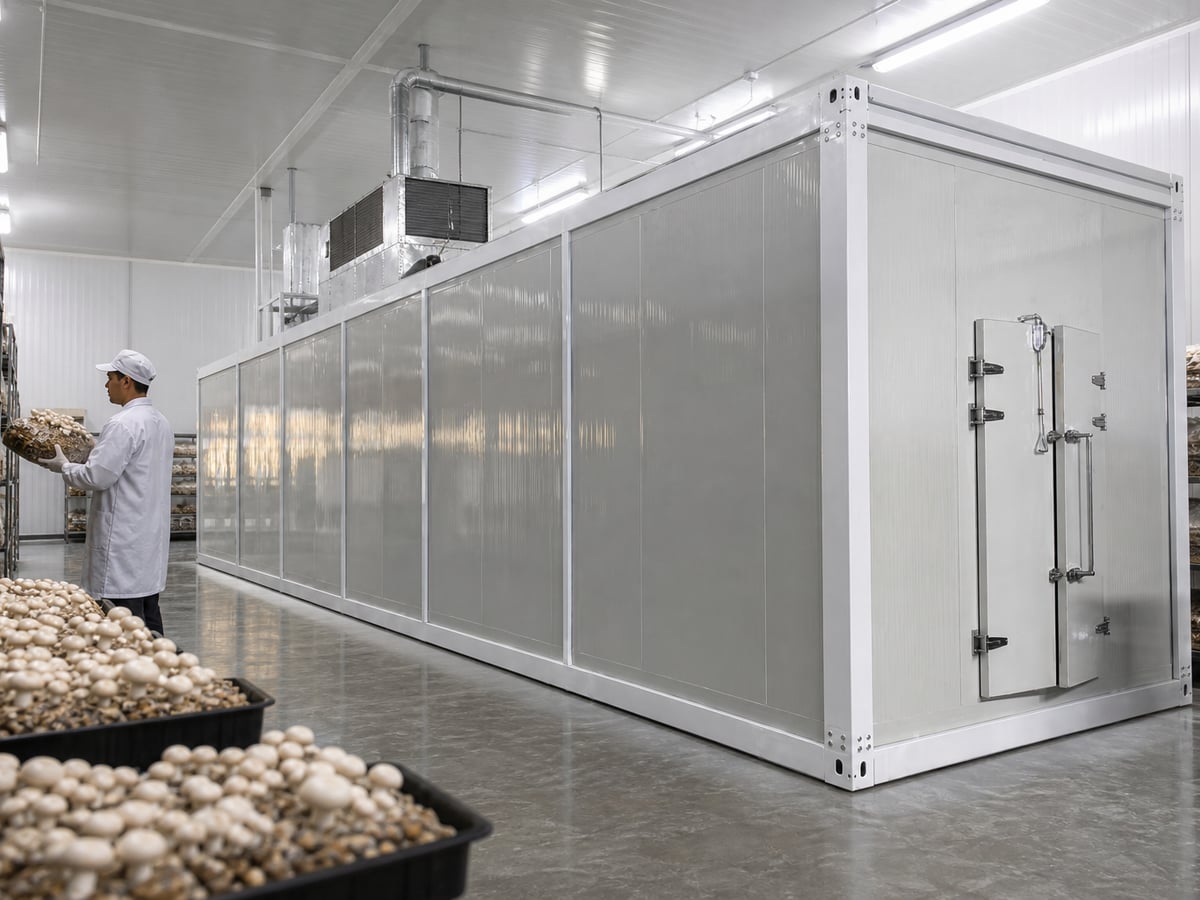
Smart mushroom cultivation containers are generally the stronger choice for commercial expansion. A purpose-built container integrates insulated structure, air treatment, cooling, heating, humidification, ventilation, controls, lighting, drainage, and service access in a coordinated cultivation environment. It can provide more predictable conditions across multiple crop cycles and can be installed as a modular production unit near a warehouse, farm, food-processing site, or distribution center.
The right decision is not based only on the purchase price. Compare both systems at the same usable production level. A tent may appear inexpensive, but several tents can require multiple climate devices, additional electrical circuits, more floor space, more cleaning time, and greater labor movement. A container may cost more at the beginning but reduce operational complexity as the farm scales.
For most businesses, the practical progression is simple: begin with a grow tent when the goal is learning and validation; move to a container when consistent weekly output, controlled contamination risk, and efficient workflow matter more than the lowest initial investment.
| Decision factor | Grow tent | Purpose-built container | Best fit |
|---|---|---|---|
| Initial investment | Low to moderate | Moderate to high | Grow tents for testing; containers for planned commercial output |
| Installation speed | Very fast in a prepared room | Fast after foundations and utilities are ready | Grow tents for temporary or indoor projects |
| Climate consistency | Depends heavily on room layout and equipment | Designed around controlled airflow and insulation | Containers for repeatable production |
| Sanitation and drainage | Often requires owner-built solutions | Can be designed with washable surfaces and planned drainage | Containers for intensive commercial use |
| Expansion model | Add more separate tents | Add modular cultivation units | Containers for organized scaling |
| Portability | Easy to relocate within a building | Transportable but requires lifting and logistics planning | Grow tents for short-term flexibility; containers for durable sites |
The table shows why a simple cost comparison can be misleading. A farm should evaluate the complete production environment, including air handling, humidity control, cleaning, labor access, power demand, and future capacity.
When a Grow Tent Is Sufficient

A grow tent can be an effective cultivation chamber when the operation is small enough for the owner to monitor conditions closely. It is particularly useful for a new farm validating local demand before making a larger capital commitment. Restaurants, farmers’ market vendors, culinary schools, research teams, and urban growers often benefit from this flexibility.
For a small indoor farm, a tent may be placed in a spare room, insulated garage, basement, or light-industrial unit. The owner can add shelving, a humidifier, an exhaust fan, a temperature controller, and basic filtration. This arrangement works best when the surrounding building already has stable temperatures and suitable electrical capacity.
Grow tents are also appropriate when production is seasonal or experimental. A producer may test several substrate formulas, compare strains, or learn the fruiting requirements of shiitake and lion’s mane without committing to a permanent cultivation building. Because the tent itself is relatively easy to dismantle, it can support a gradual startup process.
Conditions that favor a tent
- Weekly harvest volume is modest and demand is not yet predictable.
- One person can inspect all shelves without excessive walking or repeated door opening.
- The building already provides drainage, cooling, heating, and fresh-air access.
- Cleaning can be completed between batches without delaying the next cycle.
- The operator is comfortable adjusting humidity and air exchange manually.
- There is enough separation between incubation, fruiting, packing, and waste handling.
A tent is not automatically unsuitable for professional production. The decisive issue is whether the entire workflow remains controlled. A well-managed small tent can outperform a poorly planned large room. However, as more tents are added, the operator often recreates the complexity of a commercial facility without receiving the structural advantages of one.
Capacity and Workflow Constraints

Capacity should be measured by usable production, not simply by the number of shelves or bags that fit inside a chamber. Usable capacity accounts for aisle width, loading space, fan clearance, service access, crop separation, cleaning time, and the ability to remove finished blocks without disturbing younger crops.
Many first-time growers fill a tent as tightly as possible. This can increase the number of bags temporarily, but it may reduce airflow and make harvesting difficult. Crowded shelving also increases the risk that one contaminated block will affect nearby material. If a humidifier or fan fails, a densely loaded chamber can lose uniform conditions rapidly.
Containers support a more deliberate workflow. Doors, racks, air distribution, drain locations, control panels, and service areas can be planned together. Multiple containers can also be assigned to different crop stages. One unit may support fruiting while another is used for incubation or a different species. This separation reduces cross-contamination and makes production scheduling easier.
| Workflow area | Question to ask | Risk in a crowded tent | Container advantage |
|---|---|---|---|
| Loading | Can workers load racks without moving finished crops? | Repeated handling and crop disturbance | Planned door and rack arrangement |
| Harvesting | Can harvesters work safely during peak output? | Blocked aisles and slower collection | More predictable access and layout |
| Inspection | Can every block be checked daily? | Hidden contamination or uneven development | Organized rows and controlled circulation |
| Cleaning | Can all surfaces be washed and dried quickly? | Fabric, corners, and floor areas retain moisture | Washable panels and planned drainage options |
| Crop separation | Can incubation and fruiting be separated? | Different conditions compete in one room | Multiple units or dedicated zones |
| Dispatch | Can harvested product move to packing without crossing waste flows? | Congestion and hygiene conflicts | More orderly material movement |
For a farm supplying hotels, supermarkets, wholesalers, or processors, workflow usually becomes the limiting factor before the physical tent reaches its theoretical maximum. A commercial plan should therefore model labor minutes per kilogram, not just the number of cultivation bags per square meter.
Climate Uniformity Under Higher Loads
Mushrooms respond to a combination of temperature, relative humidity, carbon dioxide concentration, fresh-air exchange, air velocity, and light. A system that maintains the correct reading near the door may still produce poor results at the back of the room. Climate uniformity becomes more difficult as the number of blocks, shelves, and simultaneous crop stages increases.
In a grow tent, air movement often depends on portable fans and a separate humidifier. These devices can create strong local airflow while leaving stagnant areas behind racks. Humidifiers may also produce wet zones near the outlet and dry zones farther away. Manual adjustments can correct the problem temporarily, but they require regular measurement in several locations.
A smart mushroom cultivation container is engineered around air distribution. Insulated panels reduce heat transfer, while integrated cooling, heating, humidification, and ventilation equipment can be managed by a climate controller. Sensors can monitor key conditions and activate equipment according to programmed limits. This does not remove the need for crop knowledge, but it reduces the number of uncontrolled variables.
Uniformity is especially important for commercial species with tight quality requirements. Oyster mushrooms can tolerate some variation, but inconsistent fresh-air exchange may produce long stems, small caps, or uneven flushes. Lion’s mane can be sensitive to humidity and airflow balance. Shiitake requires careful management during fruiting and may require different scheduling from fast-growing oyster varieties.
| Parameter | Small tent approach | Higher-load challenge | Container-oriented solution |
|---|---|---|---|
| Temperature | Portable air conditioner or room HVAC | Heat from equipment and crop respiration accumulates | Integrated cooling and heating sized for the chamber |
| Humidity | Standalone humidifier | Uneven moisture and condensation | Controlled humidification with distributed airflow |
| Carbon dioxide | Fan timer or manual ventilation | Concentration varies between shelves | Programmed fresh-air exchange and sensor feedback |
| Air movement | One or more circulation fans | Dead zones and excessive drying near fans | Planned supply and return air paths |
| Monitoring | One or two handheld or wall sensors | Readings do not represent the full crop | Multiple sensors and centralized control |
| Recovery after door opening | Manual adjustment and waiting | Frequent disturbances during harvest | Automated recovery routines and stronger insulation |
When comparing systems, request actual design information rather than relying on general claims. Ask about cooling capacity, humidity range, fresh-air volume, sensor locations, filtration, drain design, operating temperature range, and control functions. A supplier should be able to explain how the equipment performs under the intended crop load.
Cleaning, Durability, and Drainage
Hygiene is one of the strongest arguments for moving from tents to purpose-built containers. A fabric tent can be cleaned, but seams, zippers, folds, floor coverings, and lower corners may be difficult to sanitize thoroughly. If the surrounding floor is not sloped or sealed, wash water can spread into adjacent areas and create a persistent source of moisture.
A durable cultivation container can use insulated sandwich panels, coated metal surfaces, sealed joints, washable flooring, and protected electrical components. The exact specification varies by supplier, so buyers should confirm the materials and cleaning procedure before ordering. Smooth surfaces are valuable, but they must also be installed correctly so that joints do not trap organic residue.
Drainage deserves special attention. Humidification, condensation, floor washing, and accidental spills all require a controlled path away from the crop. A drain should be accessible for inspection and designed to prevent standing water. Where local building rules require a floor drain, backflow protection, or a particular wastewater arrangement, the installation plan should be reviewed with a qualified local contractor.
Durability also includes doors, hinges, seals, lighting, fan motors, refrigeration components, control cabinets, and rack supports. A low-cost unit may not be economical if key parts are difficult to replace. Buyers should ask whether standard components are used, how spare parts are supplied, and whether technical support is available in their region.
| Item | What to inspect | Why it matters | Questions for the supplier |
|---|---|---|---|
| Interior panels | Smooth, sealed, washable surfaces | Reduces residue and microbial harborage | What panel material and surface finish are used? |
| Door seals | Continuous compression and easy replacement | Protects climate stability and hygiene | Are replacement gaskets available? |
| Floor | Slip resistance, slope, and cleanable finish | Supports safe washing and drainage | How is wastewater collected? |
| Electrical enclosure | Protection from humidity and washdown | Improves safety and component life | What protection rating and maintenance access are provided? |
| Fans and motors | Service access and corrosion resistance | Limits downtime in a humid environment | What is the replacement procedure? |
| Refrigeration system | Capacity, filters, controls, and service points | Maintains temperature during changing loads | Can local technicians service the system? |
Building Utilities and Indoor Installation
A cultivation container is modular, but it is not utility-free. Before delivery, the site should be checked for access, lifting, ventilation, electrical supply, water, drainage, fire safety, and local permits. A shipping container-style module may need a level foundation or concrete pads. Indoor placement may require structural verification, door clearance, floor loading review, and a plan for removing heat and moisture from the surrounding building.
Electrical requirements vary by climate system and country. A buyer in Rotterdam, Dubai, Nairobi, São Paulo, or Vancouver may need a different voltage, frequency, plug arrangement, protection system, and cooling strategy. These requirements should be agreed in writing before manufacturing. The supplier should receive accurate information about local power conditions and site limitations.
Water quality can also affect humidifiers, pumps, nozzles, and drains. Hard water may create mineral deposits, while untreated water can introduce maintenance or hygiene issues. Ask whether filtered, softened, or reverse-osmosis water is recommended. Local water treatment requirements should be incorporated into the operating budget.
For international projects, logistics planning is important. Equipment may move through Qingdao, Shanghai, Ningbo, or another export port before reaching a regional hub such as Rotterdam, Jebel Ali, Singapore, Durban, or Los Angeles. The route, container dimensions, lifting method, customs documents, insurance, and destination handling costs should be reviewed before signing a purchase order.
Indoor installation can be attractive in cold climates or dense urban areas because the building provides weather protection. However, the building still needs a way to reject heat and moisture. Installing a high-capacity cultivation module in a sealed warehouse without exhaust planning can raise ambient temperature and affect nearby operations.
Comparing Costs at Equal Production
The most useful financial comparison is based on equal saleable output over a defined period. For example, compare the total cost of producing a target number of kilograms per month using one container against the number of tents, humidifiers, cooling units, sensors, racks, electrical upgrades, and labor hours needed to reach the same output.
Capital cost should include the chamber, climate equipment, control system, racks, shipping, foundation, installation, local electrical work, water treatment, drainage, commissioning, and staff training. Operating cost should include electricity, water, filters, consumables, repairs, cleaning labor, crop losses, and downtime.
Grow tents may remain the more economical option for a small operation because their low purchase price and flexibility outweigh their disadvantages. Containers often become more competitive when a farm needs several tents operating at once or requires a higher degree of environmental consistency.
| Cost category | Grow tent system | Container system | How to compare |
|---|---|---|---|
| Chamber and structure | Individual tents and room preparation | Insulated modular cultivation unit | Calculate cost per usable growing area |
| Climate equipment | Separate fans, humidifiers, and cooling devices | Integrated equipment package | Include installation and replacement costs |
| Electrical work | May increase as more devices are added | Designed around a defined system load | Obtain a local electrical quotation |
| Labor | More manual checks and adjustments | More centralized monitoring and control | Measure labor hours per production cycle |
| Crop loss | Greater exposure to local climate variation | Potentially lower with stable conditions | Use actual farm records rather than assumptions |
| Maintenance | Many independent components | Fewer integrated interfaces but specialized parts | Review spare parts and service availability |
| Expansion | Additional tents and duplicate equipment | Additional modules with planned infrastructure | Model the next three years of capacity |
A simple payback calculation can help: divide the additional investment in the container solution by the expected annual savings and additional contribution margin. Contribution margin should reflect saleable mushrooms, not total biological output. If better climate control increases quality, reduces rejected product, or allows reliable contracts, those benefits belong in the calculation.
Energy efficiency is becoming more important in 2026 as electricity prices, carbon reporting, and customer sustainability requirements influence farm decisions. Insulated panels, efficient compressors, variable-speed fans, heat recovery, smart scheduling, and renewable-energy integration can improve long-term economics. Buyers should ask for expected energy consumption under their local climate rather than relying on a generic estimate.
Signals That Justify Moving to Containers
The decision to move from tents to containers is usually justified by operational signals rather than a specific number of shelves. Consider a purpose-built module when one or more of the following conditions appear consistently:
- Customers request weekly volumes that cannot be fulfilled reliably.
- Several tents require separate cooling, humidification, and ventilation systems.
- Workers spend too much time correcting temperature, humidity, or fresh-air problems.
- Harvest quality varies significantly between shelves or across different tents.
- Cleaning a tent delays production or leaves inaccessible wet areas.
- Contamination events are difficult to isolate.
- Energy use rises faster than saleable output.
- The farm needs traceable, repeatable production for wholesalers or retailers.
- There is a clear expansion plan for the next two to five years.
- The business needs to install production close to a city, restaurant district, or logistics hub.
Some farms adopt a hybrid model. Tents remain useful for strain trials, incubation, overflow, or seasonal production, while containers handle the main fruiting schedule. This arrangement can reduce risk and allow the business to build operating experience before replacing every temporary room.
Container selection should be based on the crop, rack arrangement, target output, local climate, and expected operating schedule. A unit designed for a warm, humid region may require different cooling capacity from one intended for northern Europe. Similarly, a project near a city center may prioritize noise control and heat rejection, while a rural farm may have more space for outdoor equipment.
Market, Product Types, and Commercial Applications
The global market for controlled mushroom production includes small urban farms, agricultural contractors, food companies, research institutions, hospitality suppliers, and regional distributors. Buyers are increasingly interested in modular systems because they can add production capacity without constructing a complete building from the ground up.
Product types range from basic insulated rooms and portable fruiting chambers to fully integrated smart mushroom cultivation containers. Some systems are designed only for fruiting, while others support broader environmental control and can be configured for different crop stages. Climate controllers may be sold separately for existing rooms or integrated into a complete cultivation module.
Common applications include:
- Fresh oyster mushroom production for urban retail and food-service customers.
- Lion’s mane cultivation for specialty food and wellness markets.
- Shiitake production for restaurants, wholesalers, and regional markets.
- Research and demonstration farms operated by universities or agricultural centers.
- Containerized farms located near supermarkets and distribution facilities.
- Contract cultivation projects delivered by agricultural engineering companies.
- Remote or climate-challenging sites where a conventional building is impractical.
In cities such as London, Paris, Toronto, Melbourne, Dubai, and Singapore, floor space and stable indoor climate can be expensive. Modular cultivation units allow operators to evaluate a site based on access to customers, utilities, and logistics rather than only on agricultural land availability.
Buying Advice for International Projects
Prepare a technical brief before contacting suppliers. Include the mushroom species, target production, block dimensions, number of shelves, desired temperature and humidity ranges, fresh-air needs, available voltage, local climate, installation location, and preferred control method. A clear brief allows suppliers to size the system more accurately.
Ask for a quotation that separates the equipment price from freight, insurance, destination charges, installation, commissioning, and taxes. Confirm whether the quoted price includes sensors, control cabinet, humidifier, refrigeration, heating, lights, racks, drainage fittings, filters, spare parts, and manuals.
Review the supplier’s quality process. A reliable manufacturer should be able to describe design review, panel production, electrical assembly, system integration, testing, and pre-shipment inspection. Request photographs or videos of comparable projects, but also ask for the operating conditions and production purpose of each reference.
After-sales support is particularly important for international buyers. Confirm response times, remote troubleshooting, warranty terms, replacement parts, software access, language support, and whether local technicians can be trained. A system that cannot be maintained after installation can become expensive regardless of its initial price.
Case Examples and Regional Planning
A small specialty farm near Amsterdam may begin with two tents in a converted warehouse. Once restaurant contracts require a fixed weekly supply, a container can provide a dedicated fruiting environment while the tents remain available for trials. Because the Netherlands has strong logistics links through Rotterdam, the farm may prioritize delivery scheduling, energy efficiency, and integration with existing warehouse utilities.
A project in Dubai or Riyadh faces a different challenge. High outdoor temperatures increase cooling demand, so insulation quality, refrigeration capacity, condensate management, and heat rejection must be evaluated carefully. The container may be installed indoors or under a shaded structure, but the surrounding space must still manage the heat produced by the cooling system.
An urban farm in Toronto or Vancouver may benefit from indoor installation during cold seasons. The buyer should evaluate snow access, winter delivery, building power, condensate drainage, and the effect of indoor heat recovery. A container can stabilize production, but the building must be able to accommodate the equipment during peak winter and summer conditions.
A regional agricultural contractor in São Paulo, Nairobi, or Johannesburg may use modular units for several customer sites. In this situation, standardization is valuable. Repeating the same control architecture, spare-parts package, training method, and commissioning checklist can reduce project risk across multiple locations.
These examples are planning illustrations rather than guarantees. Local energy prices, building codes, labor costs, water conditions, transport routes, and customer pricing should always be used in the final feasibility study.
Local Suppliers, Manufacturing, and Delivery Considerations
Local suppliers can provide faster site visits, easier installation support, and quicker access to common replacement parts. International manufacturers may offer broader customization, integrated production, and stronger specialization in modular cultivation systems. The best choice depends on the complexity of the project and the supplier’s ability to support the equipment after delivery.
For a global purchase, compare suppliers on more than price. Review manufacturing capacity, engineering resources, testing procedures, export experience, certifications, packaging, documentation, and project references. A factory with in-house sheet metal fabrication, insulated panel production, electrical assembly, and system testing may have better control over consistency than a trading company outsourcing every stage.
Delivery planning should include factory acceptance checks, loading photographs, serial-number records, spare-parts lists, wiring diagrams, installation drawings, and operating manuals. For containerized equipment, confirm lifting points, total weight, dimensions, center of gravity, and access restrictions at the destination site.
Our Company
Shandong Lanhu Air Conditioning Equipment Co., Ltd. is a manufacturer in Dezhou, Shandong, China, serving agricultural contractors, equipment distributors, engineering companies, and commercial farming projects in international markets. The company focuses on agricultural climate control, industrial HVAC, and modular cultivation equipment.
Technological capabilities
Lanhu combines more than 12 years of thermodynamic research and development experience with expertise in temperature regulation, humidity management, ventilation, air treatment, and automated control. Its product range includes smart mushroom cultivation containers, mushroom climate controllers, smart hydroponic plant containers, and air-source heat pumps. More than 45 registered patents support ongoing product development and system improvement.
For buyers comparing tents with containers, the company’s mushroom climate control technology can be relevant when the priority is stable monitoring and coordinated operation of cooling, heating, humidification, and ventilation equipment. System specifications should still be matched to the buyer’s crop, site, and local utilities.
Manufacturing capabilities
Lanhu operates a modern manufacturing facility covering more than 30,000 square meters. Its integrated production process includes product design, engineering development, sheet metal fabrication, CNC bending, insulation panel production, electrical assembly, system integration, equipment testing, and quality inspection. This structure allows the company to coordinate the physical chamber with the climate equipment and control system.
Each system undergoes functional inspection, electrical verification, performance testing, and operational evaluation before shipment. The company maintains ISO 9001, ISO 14001, ISO 45001, and ISO 12100 certifications, along with patent certificates and enterprise credibility credentials. These qualifications do not replace site-specific due diligence, but they provide useful evidence of an organized manufacturing and quality process.
Service capabilities
Lanhu provides factory-direct supply, OEM and ODM customization, engineering assistance, international logistics support, spare-parts support, installation guidance, and after-sales service. This is useful for distributors and contractors that need private-label products, different electrical configurations, modified dimensions, or coordinated delivery to several countries.
Customers can review the smart mushroom cultivation container range, discuss customized projects through the OEM and ODM service, and examine selected cultivation equipment project examples. A technical discussion should include target species, production volume, site climate, utilities, rack layout, control requirements, and installation responsibilities.
Future Trends for 2026 and Beyond
In 2026, controlled mushroom production is expected to place greater emphasis on automation, energy performance, traceability, and modular deployment. Sensors are becoming more affordable, while cloud-connected controllers can help operators compare cycles, identify abnormal conditions, and monitor multiple sites. Data is most useful when it supports practical decisions such as adjusting fresh-air exchange or scheduling maintenance.
Artificial intelligence may assist with crop image analysis, contamination detection, yield forecasting, and anomaly alerts. These tools should support experienced growers rather than replace biological judgment. A camera cannot compensate for poor sanitation, incorrectly sized refrigeration, or inadequate airflow design.
Energy and environmental policy will also influence equipment selection. More farms will evaluate refrigerant choice, insulation performance, heat recovery, renewable electricity, water consumption, and end-of-life recyclability. Efficient fans, variable-speed compressors, demand-based ventilation, and improved control logic can reduce operating costs as well as emissions.
Modular production may expand in regions where food security, urban agriculture, and short supply chains are policy priorities. Local production near consumers can reduce transport time for highly perishable mushrooms. However, sustainability claims should be based on measured energy, water, packaging, and logistics data rather than on the word “local” alone.
FAQ
Are mushroom containers better than grow tents?
Neither is universally better. Grow tents are economical and flexible for small farms, trials, and education. Containers are generally better for higher output, climate uniformity, hygiene, repeatability, and organized expansion.
Can a grow tent produce commercial mushrooms?
Yes. A well-managed tent can support commercial sales at a small scale. The operator must control temperature, humidity, fresh air, sanitation, drainage, and workflow. The main limitation is usually the difficulty of adding multiple tents without increasing labor and equipment complexity.
How many mushroom containers does a new farm need?
The answer depends on species, block size, cycle length, target sales, and whether incubation is separate from fruiting. Many projects begin with one unit for validation and add modules after confirming demand and operating data.
Can one container grow different mushroom species?
It may be possible when the species have compatible environmental requirements, but separate units provide better control. Oyster mushrooms, lion’s mane, and shiitake can require different temperature, humidity, airflow, and scheduling strategies.
Do mushroom containers need a foundation?
Most outdoor installations need a level, stable base suitable for the module’s weight and local weather conditions. The exact foundation depends on dimensions, soil, wind, snow, drainage, and local construction requirements. Indoor installations may require a floor-load and access review instead.
What utilities should be prepared before delivery?
Prepare suitable electrical power, water, drainage, ventilation or heat-rejection space, lifting access, and service clearance. Confirm voltage and frequency early, especially for international projects.
How should I compare container prices from different suppliers?
Compare the complete delivered and installed system, not only the factory quotation. Include equipment, racks, controls, shipping, customs, foundation, utilities, commissioning, training, spare parts, warranty, and expected energy use.
Is an integrated climate controller necessary?
It is not essential for every small tent, but it becomes increasingly valuable as output and equipment count rise. Centralized control can reduce manual adjustments, record operating data, and coordinate cooling, heating, humidification, and ventilation.
What is the first sign that a tent operation has outgrown its setup?
Common signs include inconsistent harvest quality, frequent climate corrections, rising energy use, difficult cleaning, blocked aisles, contamination that spreads between batches, and labor spent managing equipment rather than harvesting and selling mushrooms.
How can I request a suitable container specification?
Provide the supplier with your mushroom species, target monthly output, block dimensions, rack plan, local climate, power supply, water conditions, installation location, and preferred automation level. This information supports a more accurate engineering and commercial proposal.
Conclusion
Grow tents remain a practical starting point for small-scale mushroom production, product testing, and flexible indoor cultivation. Their low initial cost makes them attractive when demand is uncertain and the owner can manage the environment closely.
Purpose-built mushroom cultivation containers become more compelling when the business needs repeatable climate conditions, controlled hygiene, better drainage, efficient labor movement, and modular expansion. The most reliable decision compares equal saleable production and includes utilities, maintenance, energy, labor, crop loss, logistics, and future capacity.
For global projects, choose a supplier that can support engineering, manufacturing, testing, delivery, installation, spare parts, and after-sales service. With the right specification, a container can turn expansion from a collection of improvised rooms into a controlled and scalable production system.
Share this article

About the Author: Shandong Lanhu Air Conditioning Equipment
Lanhu is a professional climate control equipment manufacturer specializing in smart agricultural systems, commercial HVAC solutions, and customized temperature control technologies. With extensive engineering experience, Lanhu provides reliable solutions for plant factories, controlled environment agriculture, and industrial applications.
Need a Custom Climate Control Solution?
From smart agricultural systems to commercial HVAC solutions, Lanhu provides reliable temperature and humidity control solutions tailored to your project needs.
Contact Us