Wood Ear Mushroom Containers for the Global Market
Quick Answer: How to Arrange Wood Ear Mushroom Containers

Wood ear mushroom containers should create a stable, clean, and serviceable fruiting environment rather than simply maximize the number of cultivation bags inside a room. The most reliable layout combines suitable Auricularia strains, breathable and correctly perforated bags, controlled humidity, regular fresh-air exchange, and enough access for harvesting and sanitation.
For most commercial projects, shelving is easier to scale and clean than dense hanging arrangements. Hanging can be useful when floor space is limited or when the production method is designed around suspended bags, but it requires secure supports, even air distribution, and careful control of condensation. A practical starting point is to leave service aisles between rack rows, avoid direct water spray onto bags, and use sensors at several heights rather than relying on one room reading.
Humidity should be high enough to prevent thin, dry fruit bodies, but surfaces should not remain continuously wet. Clean water, filtered air, gentle circulation, and staged temperature changes help reduce bacterial problems. Before purchasing a full container system, run a pilot batch using the same bags, substrate formula, strain, rack height, humidification equipment, and operating schedule planned for the commercial room.
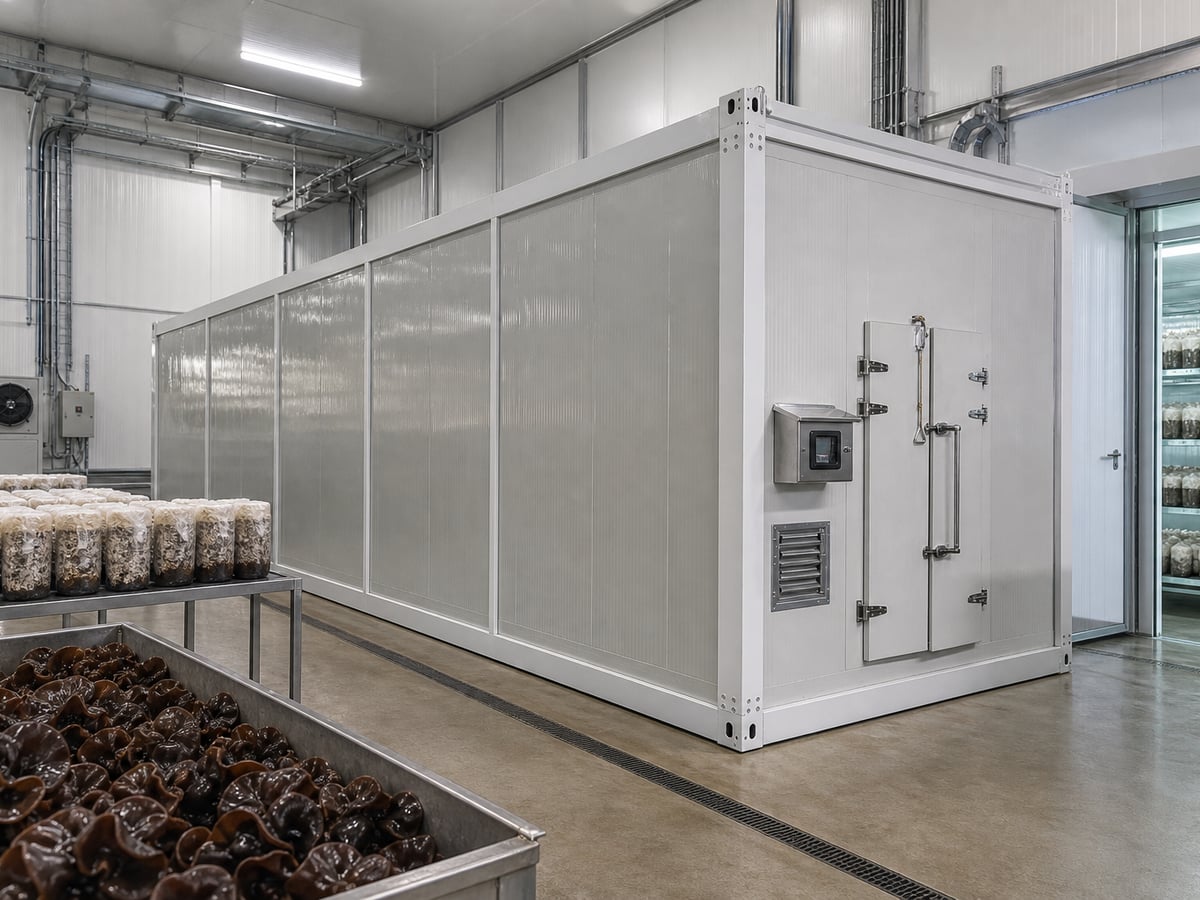
For international buyers, a smart mushroom cultivation container can be valuable because it integrates insulation, climate control, humidification, ventilation, monitoring, and electrical protection in one modular unit. However, container performance still depends on local climate, water quality, power supply, operator training, logistics, and the biological characteristics of the chosen wood ear strain.
Choosing Wood Ear Strains and Suitable Cultivation Bags

Strain selection is the first major decision because wood ear varieties differ in fruiting temperature, moisture tolerance, fruit-body thickness, growth speed, color, texture, and market preference. A strain that performs well in a cool northern production area may require different environmental settings in Southeast Asia, the Middle East, or coastal South America. Buyers should request documented cultivation parameters and test them locally rather than selecting a strain only by appearance.
Commercial growers commonly evaluate dark wood ear, light wood ear, and locally adapted Auricularia strains. Product specifications may emphasize fresh texture, dried yield, broad ear shape, crispness after rehydration, or resistance to handling. Restaurants, dried-food processors, wholesalers, and retail brands may prefer different characteristics. A food-service customer in Singapore or Dubai may value uniform size and fast delivery, while a dried mushroom processor near Hamburg or Rotterdam may focus on dry matter and stable color.
Bags must match the substrate, sterilization process, incubation duration, and fruiting method. Filter-patch polypropylene bags are widely used because they tolerate sterilization and allow gas exchange. Some farms use thicker bags for long incubation or rough handling, while others prefer lighter material to reduce packaging cost. The selected film should remain sealed during sterilization and should not become brittle under the expected temperature cycle.
| Selection factor | What to evaluate | Why it matters | Useful buying question |
|---|---|---|---|
| Strain temperature range | Incubation and fruiting limits | Determines cooling and heating demand | What temperature range gives consistent primordia? |
| Fruit-body form | Thickness, color, size, and texture | Influences fresh and dried market value | Is the strain intended for fresh retail or drying? |
| Bag film | Thickness, clarity, strength, and heat resistance | Reduces leakage, tearing, and contamination | What sterilization cycle is the bag rated for? |
| Filter patch | Filter type, area, and placement | Balances gas exchange with contamination protection | Does the filter suit the planned substrate moisture? |
| Bag dimensions | Diameter, height, and fill weight | Affects rack spacing and heat transfer | What bag size gives even colonization? |
| Fruit-induction openings | Cut size, number, and position | Controls where fruit bodies develop | Can openings be standardized for automated work? |
The table shows why a bag should be treated as part of the complete cultivation system. A tall bag may increase substrate volume per position, but it can also create slower heat release, uneven colonization, and difficult harvesting. Conversely, a small bag may improve handling while increasing packaging, labor, and rack-space costs. The best choice is the one that produces consistent biological performance at an acceptable total cost.
During purchasing, ask suppliers for sample bags and run a small sterilization and handling test. Check seal strength, filter adhesion, puncture resistance, and stability after cooling. Also confirm whether replacement bags and compatible filters can be sourced locally in cities such as Bangkok, Jakarta, Nairobi, São Paulo, or Istanbul. Local availability can be more important than a small initial price difference.
Hanging or Shelving: Selecting the Better Layout

Hanging and shelving are both workable for wood ear production, but they create different airflow, labor, and sanitation requirements. Hanging bags can expose more surfaces to moving air and may make use of vertical volume. Shelving provides predictable positions, easier sensor placement, and safer access for routine inspection. The appropriate choice depends on bag weight, rack strength, container height, labor practices, and whether the room is designed for manual or semi-automated work.
Hanging systems need corrosion-resistant hooks, cables, rails, or frames. Each support point should tolerate the fully hydrated bag weight with a safety margin. Bags should not touch walls, evaporator coils, lights, ducts, or one another so closely that air becomes stagnant. Swinging bags can also create abrasion and accidental tearing. In regions with frequent earthquakes, high winds, or uneven floors, the support system should be engineered and secured according to local requirements.
Shelving usually simplifies stock rotation and harvest access. Slotted or mesh shelves can improve air movement, while solid shelves are easier to wipe but may restrict circulation around the lower side of bags. Rack levels should leave enough vertical clearance for fruit bodies to expand and for workers to remove mature clusters without damaging adjacent bags.
| Layout type | Main advantage | Main limitation | Best suited to | Control priority | Sanitation note |
|---|---|---|---|---|---|
| Single-sided wall shelving | Simple inspection and cleaning | Lower space utilization | Small pilot rooms | Wall clearance | Keep the rear gap accessible |
| Double-sided central racks | Good production density | Requires a service aisle | Commercial container rooms | Even supply and return airflow | Clean both sides routinely |
| Suspended single bags | Flexible use of vertical space | More movement and support hardware | Lightweight bag systems | Secure hooks and spacing | Inspect contact points for damage |
| Suspended bag chains | High density and rapid loading | Harder harvesting and isolation | Experienced high-volume farms | Load balance and access | Remove contaminated chains quickly |
| Mobile racks | Flexible aisle configuration | Higher equipment cost | Multi-room facilities | Wheel locks and floor level | Move only after checking clearance |
| Tiered stepped racks | Improved visibility of upper bags | Complex fabrication | Manual harvesting operations | Light and airflow uniformity | Design for pressure washing avoidance |
When comparing layouts, calculate productive volume rather than counting only bag positions. A dense arrangement may reduce construction cost per bag but increase labor time, crop loss, and the risk of condensation. Include the area needed for loading, inspection, harvest carts, waste removal, filter replacement, and emergency access. In a modular container, a well-planned aisle can improve output per labor hour even if it slightly reduces the number of bags.
For overseas projects, confirm container internal dimensions after insulation, ductwork, humidification pipes, lighting, sensors, and electrical cabinets are installed. A nominal shipping-container length does not equal usable cultivation length. Buyers should request layout drawings that show rack footprints, door swing, service clearances, drain locations, and the position of evaporators or air-handling equipment.
Water Quality and Humidification Choices
Water quality has a direct effect on humidifier cleanliness, sensor reliability, surface deposits, odor, and crop hygiene. Municipal water may be suitable in one location and problematic in another. Hard water can leave mineral scale on nozzles, coils, walls, and sensors. Untreated surface water may introduce microorganisms or organic matter. Before finalizing equipment, test hardness, total dissolved solids, pH, iron, manganese, and microbiological indicators according to local food-production requirements.
Common humidification options include high-pressure fogging, ultrasonic humidifiers, evaporative media, and atomizing nozzles. High-pressure fogging can distribute fine moisture efficiently when filtration and nozzle maintenance are well managed. Ultrasonic systems are compact but may aerosolize minerals if feedwater is not treated. Evaporative systems can be gentle and hygienic, although they need regular cleaning and may add sensible heat depending on the design. Simple spray systems can create oversized droplets and wet bags if pressure, nozzle angle, or run time is poorly controlled.
| Humidification method | Strength | Risk | Water requirement | Maintenance action | Suitable project profile |
|---|---|---|---|---|---|
| High-pressure fog | Fine distribution and fast response | Blocked nozzles or wet spots | Filtered, low-sediment water | Inspect filters and nozzles | Commercial controlled rooms |
| Ultrasonic mist | Compact and quiet | Mineral aerosol and white dust | Low-mineral or treated water | Clean tanks and transducers | Small rooms and pilot batches |
| Evaporative media | Gentle moisture addition | Microbial growth in wet media | Clean water with drainage | Wash and replace media | Stable, moderate-load facilities |
| Air-atomizing nozzle | Adjustable droplet size | Needs compressed air | Filtered water and dry air | Check air and water lines | Precision installations |
| Low-pressure spray | Low equipment cost | Large droplets and wet surfaces | Clean water | Adjust spray timing | Basic systems with close supervision |
| Steam humidification | Very clean vapor output | High energy consumption | Treated boiler feedwater | Descale and inspect boiler | Specialized hygienic facilities |
The table should be read together with the room’s ventilation strategy. A humidifier that works well in a sealed room may be too slow when fresh-air exchange is high. Conversely, continuous misting in a poorly ventilated room can leave condensation on ceilings and bags. Use short control cycles, allow the room to stabilize, and place humidity sensors away from direct fog discharge.
Drainage is equally important. Floors should slope toward cleanable drains, and humidifier reservoirs should be accessible for emptying and disinfection. Do not allow standing water beneath racks. In export projects, check local regulations concerning wastewater, electrical safety near water, and the use of disinfectants in food-related production areas.
Balancing Fresh Air and Surface Moisture
Fresh air and humidity must be controlled together. Wood ear mushrooms need moisture for expansion, but fruit bodies and bags also need an environment that prevents excessive carbon dioxide, heat accumulation, and persistent free water. A room can show a high relative-humidity reading while still producing dry edges if air movement is uneven. It can also show an acceptable reading while the crop suffers from wet surfaces because the sensor is positioned in a drier return-air zone.
Fresh-air exchange removes carbon dioxide and excess heat and supplies oxygen. The correct rate depends on crop stage, bag density, temperature, room volume, and strain. Start with the equipment supplier’s control range, then adjust based on crop appearance, CO₂ readings, surface condition, and harvest quality. Avoid directing a strong air jet at newly opened bags. Excessive velocity can dry exposed tissue, while almost no movement encourages localized condensation and uneven fruiting.
Use supply and return grilles that distribute air across all rack levels. In a container, short airflow paths can cause one end to receive too much conditioned air while the other end remains stagnant. Baffles, perforated ducts, variable-speed fans, and carefully placed return openings can improve uniformity. Sensors should be installed near the lower, middle, and upper rack zones during commissioning so that stratification is visible.
| Observation | Likely cause | First adjustment | What to monitor | Do not do | Expected result |
|---|---|---|---|---|---|
| Dry, curled fruit edges | Low humidity or excessive air speed | Reduce direct velocity and review humidification | Surface moisture and RH trend | Do not flood the room | More even expansion |
| Water droplets on bags | Over-humidification or cold surfaces | Shorten mist cycles and improve circulation | Condensation duration | Do not spray bags directly | Drier, cleaner surfaces |
| Long, thin fruit bodies | Insufficient fresh air or excess CO₂ | Increase measured air exchange gradually | CO₂ and morphology | Do not change several variables at once | Stronger, broader growth |
| Uneven growth by rack level | Air stratification or blocked grilles | Balance supply and return airflow | Temperature and RH by height | Do not rely on one sensor | More uniform crop timing |
| Frequent contamination | Dirty water, poor cleaning, or wet openings | Review hygiene and moisture exposure | Contamination location and timing | Do not mask the issue with chemicals | Lower recurring losses |
| Condensation on ceiling | Cold surface, high vapor load, or poor insulation | Correct thermal bridges and air distribution | Surface temperature | Do not ignore dripping water | Safer, cleaner room |
Operational records are more valuable than isolated readings. Log room temperature, relative humidity, CO₂, humidifier runtime, fan speed, water consumption, and crop observations at least once per shift during the pilot phase. Compare readings with fruit-body thickness, color, contamination, and shelf life. This creates a site-specific operating profile that can later be transferred to additional containers.
Managing Temperature Changes Through Fruiting
Temperature should be treated as a planned sequence rather than a single fixed number. Incubation, fruit initiation, expansion, and pre-harvest stages may require different conditions. The exact values depend on the strain and substrate, so operating ranges should come from the culture supplier and be verified in a local trial. Stable transitions are usually safer than sudden changes that stress the substrate or create condensation.
During incubation, the main goals are consistent substrate colonization and prevention of overheating inside dense bags. Bag centers can be warmer than room air, especially when shelves are packed tightly. Use representative bag-temperature checks during the first cycles. After colonization, the fruiting transition may involve increased fresh air, adjusted humidity, altered lighting, or carefully controlled temperature reduction. The transition should be gradual enough to avoid excessive moisture release on cold surfaces.
During fruit expansion, monitor daily high and low temperatures, not only the set point. In hot climates such as Lagos, Manila, Ho Chi Minh City, or parts of southern India, the cooling load may rise sharply during the afternoon. In cold climates near Warsaw, Vancouver, or northern Japan, heating and humidification may interact to create dry air or condensation. A well-insulated cultivation container reduces these swings but does not remove the need for correctly sized equipment.
| Fruiting stage | Primary objective | Temperature focus | Humidity focus | Airflow focus | Operator check |
|---|---|---|---|---|---|
| Post-incubation transition | Begin uniform fruit initiation | Change gradually within strain limits | Prevent sudden surface wetting | Increase exchange carefully | Inspect first openings |
| Primordia formation | Protect small developing tissues | Avoid peaks and cold shocks | Maintain stable moisture | Use gentle circulation | Check all rack levels |
| Early expansion | Build healthy fruit-body structure | Keep daily variation controlled | High but not continuously wet | Balance supply and return air | Record morphology |
| Late expansion | Reach target size and texture | Avoid overheating in dense zones | Prevent edge drying | Remove excess heat and CO₂ | Assess harvest maturity |
| Pre-harvest | Improve handling quality | Follow strain-specific finishing plan | Reduce free moisture if required | Keep air clean and steady | Confirm access and tools |
| Between batches | Prepare a clean room | Dry equipment safely | Remove residual moisture | Ventilate during cleaning | Release room only after inspection |
Climate control should include alarms for high temperature, low temperature, high CO₂, water shortage, fan failure, and abnormal humidity. Remote notifications can help international operators supervise several rooms, but alarms should not replace local inspections. A blocked drain, damaged bag, or contaminated humidifier can require immediate physical action.
Harvest Access and Sanitation Routines
Harvest access should be designed before racks and equipment are ordered. Workers need a clear path to each bag, enough room to hold a clean harvest container, and a way to remove mature clusters without touching neighboring fruit bodies. Narrow aisles may appear efficient during installation but can slow harvesting, increase bruising, and make cleaning difficult.
Use dedicated tools for each room or production zone where possible. Knives, scissors, carts, baskets, gloves, and protective clothing should be cleaned according to a written schedule. Harvest containers should be washable and resistant to cracking. Remove waste substrate, cut stems, fallen tissue, and visibly contaminated bags promptly. Do not place harvested mushrooms on floors, evaporator housings, or unclean work surfaces.
Sanitation begins before loading. Clean racks, walls, floors, drains, fans, humidifier tanks, sensors, door seals, and lighting fixtures. Follow the disinfectant manufacturer’s instructions for concentration, contact time, ventilation, and worker protection. Never combine cleaning chemicals unless the product instructions explicitly permit it. After cleaning, allow surfaces to dry as appropriate before the next batch.
A practical sanitation program distinguishes between cleaning and disinfection. Cleaning removes organic matter; disinfection is less reliable when dirt remains. Record who performed each task, which area was treated, the product used, and any maintenance issue found. This documentation supports quality management and helps identify recurring contamination patterns.
Checking Suitability with a Pilot Batch
A pilot batch is the fastest way to reduce risk before a full commercial purchase. It should reproduce the intended production method as closely as possible. Use the proposed strain, substrate, bag film, openings, rack style, humidification system, sensor package, and operating schedule. If the pilot uses different materials or a different room, its results may not predict commercial performance.
For a useful test, define measurable targets before starting. These may include colonization time, contamination percentage, days to first harvest, fresh yield per bag, dried yield, average fruit-body size, water consumption, energy consumption, labor minutes per bag, and harvest loss. Include at least one comparison group when testing a new bag type, rack spacing, or humidification method.
| Pilot measurement | How to collect it | Why it is useful | Decision supported | Minimum review timing | Warning sign |
|---|---|---|---|---|---|
| Colonization duration | Record inoculation and full-colonization dates | Shows biological consistency | Choose strain and bag size | Every batch | Large variation among bags |
| Contamination rate | Count rejected bags by cause | Reveals hygiene or substrate problems | Approve process or investigate | At opening and harvest | Clusters of failures by rack |
| Fresh yield | Weigh each harvest by batch | Measures production output | Estimate revenue and capacity | Each harvest | Declining yield without explanation |
| Energy use | Track HVAC, humidifier, and lighting meters | Supports operating-cost estimates | Size power supply and equipment | Daily or weekly | High use during stable weather |
| Water use | Measure tank refill or flow meter | Shows local water and drainage demand | Select treatment and storage | Daily | Rapid unexplained consumption |
| Labor time | Time loading, inspection, harvest, and cleaning | Reveals layout efficiency | Compare hanging and shelving | Each work cycle | Unsafe or congested movement |
Evaluate the pilot over more than one harvest cycle when the strain allows it. A layout that performs well during the first flush may become difficult to clean or harvest later. Ask workers for practical feedback about reach, visibility, bag handling, and fatigue. Their experience often identifies design improvements that cannot be seen in a technical drawing.
When the pilot is successful, freeze the main parameters in a written operating procedure. If results are poor, change one factor at a time where possible. This may include reducing rack density, improving water filtration, adjusting fan speed, changing opening size, or selecting a more suitable strain. A controlled pilot prevents expensive full-scale changes after delivery.
Market, Product Types, and Buying Advice
The global market for controlled mushroom cultivation is expanding as growers seek year-round supply, better labor productivity, and consistent quality despite climate variation. Wood ear mushrooms are used in fresh produce, dried-food processing, restaurants, meal kits, Asian grocery distribution, functional-food products, and international ingredient trade. Demand can be influenced by cuisine, diaspora communities, retail packaging, import rules, and seasonal supply gaps.
Product options range from insulated cultivation rooms and modular containers to stand-alone climate controllers, humidifiers, air-handling units, racks, sensors, and complete turnkey systems. A containerized solution is attractive for farms that need a compact production unit, rapid installation, relocation flexibility, or a controlled expansion plan. A fixed room may be more economical when a building, cold-water system, drainage network, and electrical infrastructure already exist.
Buyers should compare total delivered cost rather than factory price alone. Consider international freight, port handling, import duties, local installation, commissioning, water treatment, spare parts, staff training, replacement filters, software access, and warranty response. Common trade hubs such as Shanghai, Ningbo-Zhoushan, Qingdao, Rotterdam, Hamburg, Jebel Ali, Singapore, and Long Beach may involve different transit times, documentation requirements, and inland delivery costs.
| Buyer priority | Specification to request | Commercial benefit | Risk if overlooked | Verification method | Recommended document |
|---|---|---|---|---|---|
| Stable climate | Cooling, heating, humidity, and airflow capacity | More consistent crop quality | Seasonal production failure | Review design calculations | Equipment schedule |
| Low operating cost | Insulation, fan efficiency, controls, and heat recovery | Lower energy per kilogram | High recurring expense | Compare load assumptions | Performance statement |
| Easy cleaning | Washable surfaces, drains, access panels | Faster turnover and hygiene | Contamination and downtime | Inspect drawings and sample finish | Cleaning procedure |
| Reliable delivery | Factory test, packing, and shipping plan | Fewer commissioning delays | Damage or missing components | Request inspection records | Packing list and test report |
| Local support | Remote assistance, spare parts, and manuals | Shorter recovery time | Extended outage | Confirm response process | Service agreement |
| Future expansion | Modular controls and repeatable layouts | Lower cost for additional rooms | Incompatible upgrades | Review communication protocols | Expansion plan |
Industries that may benefit include commercial mushroom farms, agricultural contractors, food-processing groups, greenhouse operators adding fungi production, research facilities, hospitality suppliers, supermarket growers, and distributors serving urban markets. Applications include fresh wood ear production, dried mushroom supply, demonstration farms, climate-controlled pilot facilities, and modular production near ports or population centers.
Local suppliers can contribute racks, plumbing, electrical installation, water treatment, insulation repairs, and routine maintenance. However, local fabrication should follow the equipment manufacturer’s airflow and hygiene requirements. Unplanned changes to duct size, sensor position, drain height, or electrical protection can reduce system performance. Coordinate the international equipment supplier and the local contractor through one approved drawing set.
2026 Trends in Mushroom Container Technology
In 2026, buyers are increasingly assessing cultivation equipment through the combined lens of productivity, energy use, traceability, and resilience. Smart controllers are moving beyond simple on-and-off switching toward data logging, alarm management, variable-speed fans, predictive maintenance, and recipe-based crop programs. Sensors for temperature, humidity, CO₂, water level, pressure, and power consumption can help operators compare batches across different locations.
Artificial intelligence may assist with image-based crop monitoring, but reliable decisions still require clean data and experienced supervision. Camera systems can identify uneven growth, blocked airflow, or changes in fruit-body shape. They should support, not replace, manual inspection and food-safety procedures. Interoperability is also becoming more important: buyers should ask whether controllers can exchange data with farm-management platforms and whether data remains accessible if software subscriptions change.
Sustainability requirements are also shaping purchasing decisions. Efficient compressors, high-performance insulation, heat recovery, water filtration, recyclable packaging, durable racks, and repairable control panels can reduce lifetime environmental impact. Some projects are evaluating solar power, thermal storage, rainwater treatment, and the use of waste heat from adjacent food-processing operations. Any water-reuse plan must be validated against crop hygiene and local regulations.
Policy and trade conditions may affect equipment selection. Energy-efficiency standards, refrigerant rules, electrical certifications, cybersecurity expectations, worker-safety requirements, and import documentation differ by destination. A buyer shipping equipment to the European Union, the United States, Australia, the Gulf region, or Africa should confirm the applicable local compliance pathway before production begins. Planning compliance early is usually less expensive than modifying equipment after arrival.
Our Company: Engineering, Manufacturing, and Service
Shandong Lanhu Air Conditioning Equipment Co., Ltd. is based in Dezhou, Shandong, China, a region with strong manufacturing and logistics connections to major domestic and international trade routes. The company develops agricultural climate-control equipment, industrial HVAC systems, and modular cultivation solutions for customers in the global market.
Technological capabilities
Lanhu combines thermodynamic research and development with practical cultivation-environment engineering. Its product range includes smart mushroom cultivation containers, mushroom climate controllers, smart hydroponic plant containers, and air-source heat pumps. For a wood ear project, this capability supports the integration of temperature control, humidity management, fresh-air exchange, sensors, alarms, and operating logic rather than treating each item as an isolated component.
More than 12 years of thermodynamic research and development experience and over 45 registered patents support the company’s approach to modular climate systems. Buyers can review the smart mushroom climate controller to understand how centralized monitoring and control can be incorporated into a cultivation project.
Manufacturing capabilities
Lanhu operates a modern manufacturing facility covering more than 30,000 square meters. Its integrated production processes include product design, engineering development, sheet-metal fabrication, CNC bending, insulation-panel production, electrical assembly, system integration, equipment testing, and quality inspection. This in-house structure can improve coordination between the enclosure, insulation, HVAC components, electrical cabinet, and control system.
Each system undergoes functional inspection, electrical verification, performance testing, and operational evaluation before shipment. The company maintains ISO 9001, ISO 14001, ISO 45001, and ISO 12100 certifications, along with patent certificates and enterprise credibility credentials. For an international buyer, these systems provide a framework for consistent production, documented inspection, and safer project handover.
Service capabilities
Lanhu provides factory-direct supply, OEM and ODM customization, engineering assistance, international logistics support, spare-parts support, installation guidance, and after-sales service. These services are relevant when a customer needs a special container dimension, a region-specific power configuration, a customized rack plan, a different control language, or integration with local water and drainage systems.
Customers can review the company’s OEM and ODM customization service when planning a branded or project-specific cultivation unit. Existing installations and application examples can also be explored through the cultivation equipment case portfolio. Before ordering, ask for a project questionnaire, technical drawing, utility list, acceptance criteria, spare-parts recommendation, and commissioning plan.
For buyers comparing modular options, the smart mushroom cultivation container provides a reference point for evaluating integrated room construction, climate equipment, controls, and installation requirements. The final configuration should still be adapted to the chosen wood ear strain, bag arrangement, local climate, water chemistry, electrical standard, and production target.
Frequently Asked Questions
Should wood ear mushroom bags be hung or placed on shelves?
Both methods can work. Shelving is generally easier to inspect, harvest, clean, and scale. Hanging may improve vertical space use but requires secure supports, careful spacing, and stronger procedures for bag movement and sanitation. A pilot comparison is recommended before selecting a full commercial layout.
What humidity should a wood ear container maintain?
The correct humidity depends on strain, bag openings, airflow, temperature, and fruiting stage. The target should be high enough to prevent drying but not so high that bags, ceilings, and fruit bodies remain continuously wet. Use crop appearance, surface condition, CO₂, and sensor trends together rather than following one number blindly.
Can ordinary tap water be used in a mushroom humidifier?
Sometimes, but it should be tested first. Hardness, dissolved solids, iron, organic matter, and microbial quality can affect nozzles and room hygiene. Depending on the results, filtration, softening, reverse osmosis, ultraviolet treatment, or another approved method may be appropriate. Confirm that the treatment system can supply the required flow.
How much fresh air does wood ear cultivation need?
Fresh-air demand changes with strain, room density, temperature, and growth stage. Use CO₂, fruit-body shape, room temperature, and surface moisture to guide adjustments. Supply and return air should reach all rack levels without creating a strong drying jet. A commissioning test with multiple sensors is more reliable than using a general rule alone.
What should be included in a pilot batch?
Use the intended strain, substrate, bags, openings, rack system, humidifier, controller, and operating schedule. Record colonization time, contamination, fresh and dry yield, energy, water, labor, temperature, humidity, CO₂, and harvest quality. Continue long enough to observe the planned harvest cycles and cleaning process.
What information should be sent to an equipment manufacturer?
Provide destination country and city, climate data, power standard, room or container dimensions, target bag count, bag size and weight, strain parameters, water test results, expected production schedule, local installation conditions, and desired automation level. Clear information allows the supplier to size refrigeration, heating, humidification, airflow, electrical protection, and drainage more accurately.
Can a cultivation container be expanded later?
Many modular systems can be expanded by adding containers or repeating a standard room design. Confirm that the control architecture, spare parts, communication system, electrical capacity, and service plan support future units. Expansion should also consider water supply, wastewater, loading access, cold-room capacity, labor, and market demand.
How can contamination be reduced?
Start with clean substrate preparation and reliable sterilization, then maintain sound bag seals, controlled openings, clean water, effective drainage, and disciplined worker movement. Remove failed bags promptly, clean organic residues before disinfection, and keep records that identify whether contamination begins during incubation, opening, fruiting, or harvesting.
Share this article

About the Author: Shandong Lanhu Air Conditioning Equipment
Lanhu is a professional climate control equipment manufacturer specializing in smart agricultural systems, commercial HVAC solutions, and customized temperature control technologies. With extensive engineering experience, Lanhu provides reliable solutions for plant factories, controlled environment agriculture, and industrial applications.
Need a Custom Climate Control Solution?
From smart agricultural systems to commercial HVAC solutions, Lanhu provides reliable temperature and humidity control solutions tailored to your project needs.
Contact Us