Global Market Mushroom Container Layout Planning Guide
Fast Layout Guidance

A mushroom cultivation container should be designed around the crop target before racks, beds, or climate equipment are selected. The most productive layout is not always the one with the most shelves. It is the layout that balances growing area, airflow, worker access, loading space, harvest movement, cleaning access, and reliable climate distribution.
For growers in the Global Market, a practical container plan normally starts with four questions: How many kilograms of mushrooms are expected per crop cycle? What bag, block, bottle, tray, or bed system will be used? How many people must harvest inside the container at one time? How will air return to the climate unit after passing through fully loaded racks?
In most commercial projects, leave a central aisle for carts and harvesting, reserve clearance from shelves to walls for air circulation and sanitation, and maintain a dedicated loading or discharge zone near the entrance. A container packed too tightly may appear efficient on a drawing, but uneven temperature, high carbon dioxide zones, wet corners, and difficult cleaning can reduce usable yield.
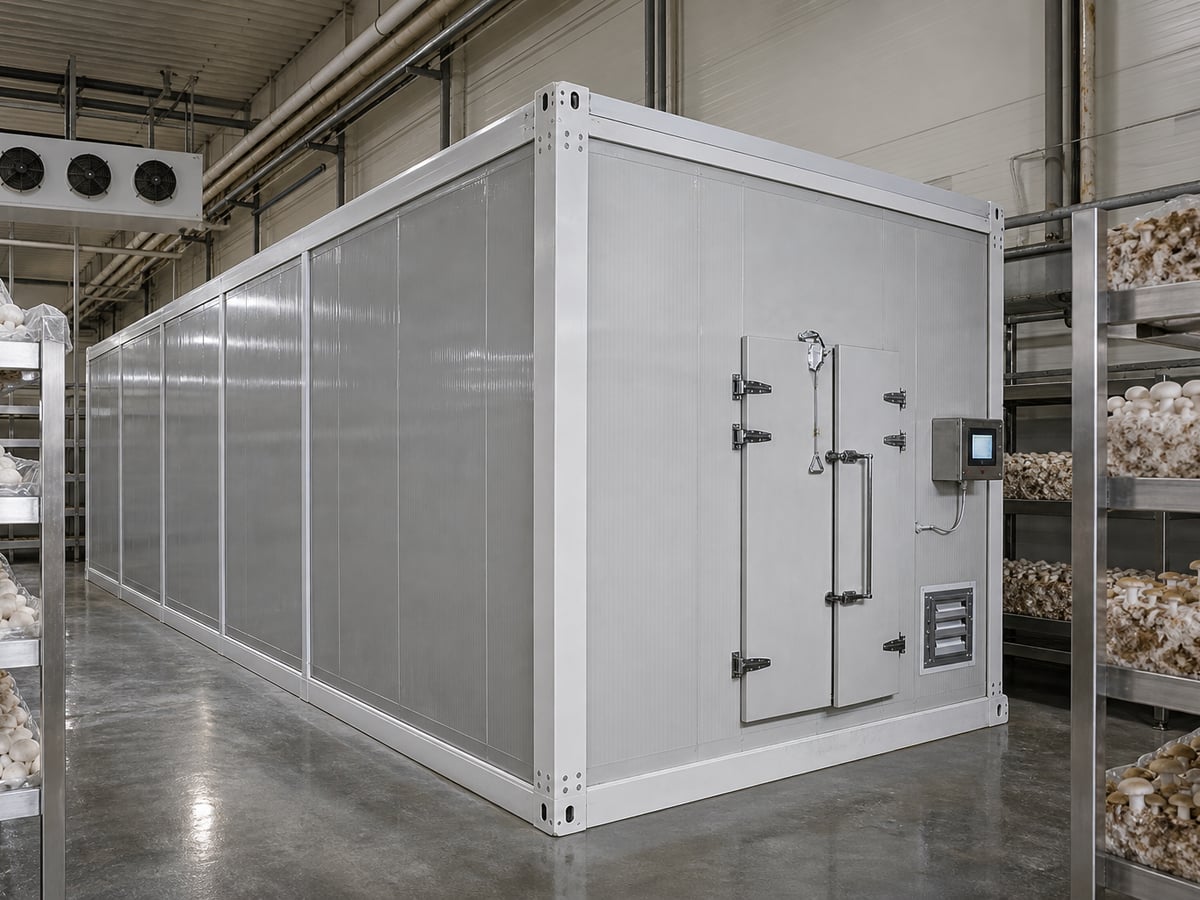
A well-designed smart mushroom cultivation container combines insulated structure, climate control, shelving configuration, humidification, fresh-air exchange, lighting where required, and operational access. The layout should be reviewed as a complete production system rather than as a rack-count calculation.
| Planning Factor | Recommended Question | Layout Impact |
|---|---|---|
| Crop species | Oyster, shiitake, button, lion’s mane, or another crop? | Determines humidity, CO₂ tolerance, shelf format, and harvesting clearance. |
| Production target | What weekly harvest volume is required? | Sets the number of containers, rack levels, and loading schedule. |
| Growing unit | Bag, block, tray, bottle, or bulk bed? | Determines shelf depth, vertical spacing, and handling method. |
| Labor model | Will workers harvest manually or with carts? | Defines aisle width, door arrangement, and turning space. |
| Climate design | Where will supply and return air travel? | Prevents stagnant zones behind dense crop loads. |
| Hygiene routine | How will the container be washed and disinfected? | Requires drain paths, washable surfaces, and access behind racks. |
The table above shows why layout decisions should be made together. A narrow aisle can increase nominal capacity, for example, but it can also slow harvesting and prevent carts from moving safely. The resulting labor cost may exceed the value of the additional growing bags.
Aligning Layouts with Production Goals

Start with a production calendar rather than a container footprint. A farm supplying supermarkets in Dubai, Singapore, Rotterdam, Toronto, or Sydney may need steady weekly delivery. A farm serving restaurants or local wholesale markets may prefer concentrated harvests. These different sales models require different container layouts and crop-loading patterns.
For continuous harvest, divide the available growing space into batches. Load one section or one container each week, then move it through incubation, fruiting, harvest, emptying, and sanitation in a predictable rotation. If all shelves are loaded on the same day, harvest peaks may overwhelm labor and cold storage capacity.
Growers should calculate usable crop positions instead of simply counting shelf levels. Usable positions exclude door clearance, humidifier service access, climate equipment space, drain areas, turning zones, and the air gaps required around packed substrate. A supplier drawing that claims maximum capacity without showing these exclusions should be reviewed carefully.
| Production Objective | Suitable Layout Direction | Operational Priority |
|---|---|---|
| Small local farm | Two rack banks with a central aisle | Simple access and low capital investment. |
| Weekly retail supply | Multiple containers with staggered loading | Stable harvest volumes and predictable delivery. |
| Export-oriented project | Standardized modules with documented capacity | Repeatability, traceability, and scalable logistics. |
| High-value specialty mushrooms | Lower rack density with wider harvest access | Protect fruit body quality and reduce handling damage. |
| Labor-constrained facility | Cart-compatible aisles and ergonomic shelf levels | Faster harvesting and reduced worker fatigue. |
| Training or demonstration farm | Open viewing routes and separated work zones | Safety, visitor flow, and easier instruction. |
This comparison helps buyers match the mushroom container layout to their commercial model. For projects near major trade hubs such as Jebel Ali, Hamburg, Los Angeles, Durban, or Santos, standardized modular units can also simplify shipping, installation planning, spare-parts stocking, and future expansion.
Before ordering, request a capacity estimate based on your actual substrate size, crop species, expected flush pattern, and acceptable labor time per kilogram harvested. A meaningful capacity estimate should state whether it means bag count, substrate weight, first-flush yield, total cycle yield, or annual production.
Bag Size and Shelf Clearance

Bag dimensions directly affect the practical shelf layout. A 2.5 kg oyster mushroom bag, a larger 5 kg block, and a long substrate log may require completely different shelf depths and vertical gaps. Shelf spacing must allow the crop to develop without touching the shelf above, while also leaving room for inspection, harvesting, and air movement.
Do not use empty-bag measurements alone. Measure the fully expanded bag or block after substrate filling, colonization, and fruiting. During peak fruiting, mushroom clusters may extend far beyond the substrate surface. If the vertical gap is too small, fruit bodies deform, caps are damaged during harvest, and moisture accumulates in tight spaces.
Shelf construction should resist moisture, cleaning chemicals, and repeated loading. Smooth galvanized, coated steel, stainless steel, food-grade polymer, or properly finished aluminum components may be suitable depending on the project environment. Avoid sharp edges that can puncture cultivation bags or damage workers’ gloves.
| Growing Format | Typical Layout Need | Spacing Consideration |
|---|---|---|
| Small substrate bags | High-density multi-level shelves | Allow space for clusters and hand harvesting. |
| Large fruiting blocks | Deep shelves or single-side placement | Maintain adequate rear airflow behind blocks. |
| Long hanging bags | Rail or hanging frame system | Keep bags from contacting floor or adjacent rows. |
| Trays | Level support racks with consistent depth | Provide access for tray removal and cleaning. |
| Bottle cultivation | Automated or semi-automated rows | Match spacing to conveyors and handling equipment. | Bulk substrate beds | Low-level bed arrangement | Reserve walking paths on both working sides. |
The table provides a starting point, not a universal specification. Climate conditions, crop genetics, harvesting style, and local labor practices can change the final dimensions. A trial layout with several fully loaded shelves is often useful before a large production order is confirmed.
For container farms in humid coastal areas such as Manila, Mombasa, Jakarta, or Guayaquil, corrosion resistance and easy washdown access deserve additional attention. High ambient humidity can increase condensation risk around poorly insulated joints or hidden rack-to-wall areas.
Bed, Wall, and Hanging Configurations
Mushroom growing systems are commonly arranged as bed systems, wall-mounted shelves, free-standing rack banks, or hanging structures. Each method can work well when it matches the crop and operating routine. The wrong choice may create inaccessible corners, uneven air distribution, or excessive labor during loading and harvest.
Bed systems are usually suitable for compost-based crops or projects where workers need direct access to broad growing surfaces. They require clear walkways and effective drainage. Wall-mounted shelf arrangements can keep the central aisle open, but they must leave a service gap behind or below the rack where air and cleaning water can move. Free-standing double-sided racks increase density and are common in containerized oyster mushroom production. Hanging systems can maximize vertical space, although they demand secure structural anchoring and careful separation between bags.
For a standard freight-container-sized mushroom room, two long rack banks with one central aisle are often easier to manage than many narrow rows. This format helps workers harvest from both sides, allows a cart to travel through the center, and leaves predictable airflow routes along walls and above the rack tops.
| System Type | Best Use | Main Advantage | Key Caution |
|---|---|---|---|
| Floor bed | Compost or bulk substrate crops | Simple loading of large substrate volumes. | Requires strong drainage and broad access paths. |
| Wall shelf | Small bags and blocks | Preserves a clear center aisle. | Do not block wall airflow or cleaning access. |
| Double-sided rack | Commercial bag cultivation | High density with two working faces. | Maintain an air channel through loaded shelves. |
| Single-sided rack | Premium crops or narrow containers | Excellent visibility and easy picking. | Lower capacity per container footprint. |
| Hanging rail | Long bags or logs | Uses vertical volume efficiently. | Verify load capacity and worker head clearance. |
| Mobile rack | Specialized high-density projects | Can increase space utilization. | Needs robust mechanics and controlled hygiene. |
The comparison above should be considered alongside local building rules, electrical requirements, and worker safety practices. In some markets, clients may require non-slip floors, emergency lighting, fire-resistant panels, specific electrical enclosures, or documented load ratings for shelving systems.
Harvest Access and Cart Movement
Harvesting is one of the most labor-intensive stages of mushroom production. A layout that makes picking awkward can reduce quality even when climate performance is excellent. Workers need room to reach crop surfaces, carry collection crates, inspect developing mushrooms, and remove spent substrate without damaging nearby bags.
A central aisle should be sized according to the actual equipment used. A person carrying small crates can work in a narrower passage than a worker pushing a harvest trolley, substrate cart, or pallet jack. Where carts are used, plan for door threshold clearance, turning space at the entry, and enough width to pass a worker safely.
Place the first loading and harvest zone near the entrance when possible. This limits travel distance and reduces the chance that dirty spent substrate must pass through a clean fruiting area. If the project uses separate clean and dirty workflows, a dedicated discharge route can improve biosecurity.
Ask operators to simulate a harvest day before finalizing the drawing. Mark the route from the door to every shelf level, including where crates are stacked, where mushrooms are weighed, and how spent blocks are removed. This simple exercise often reveals bottlenecks that are not obvious in a two-dimensional plan.
Air Movement Around Full Racks
Airflow should be evaluated with racks fully loaded, not empty. Empty shelving may appear to have excellent circulation, while dense bags and developing fruit bodies can create resistance that changes the air path completely. The goal is not high air speed everywhere; it is even delivery of properly conditioned air without stagnant zones, direct drying drafts, or uncontrolled condensation.
Supply air, return air, humidification, fresh-air intake, and exhaust points must be coordinated with rack placement. If return air is blocked by substrate bags, the climate unit may short-cycle or pull air mostly from the nearest aisle. The far end of the container can then become warmer, wetter, and higher in carbon dioxide.
Lanhu integrates climate engineering into container planning rather than treating ventilation as an afterthought. Its technical team can combine rack geometry with sensors, fresh-air control, cooling, heating, humidity management, and circulation logic. A smart mushroom climate controller can help growers monitor key conditions and adjust operating parameters according to crop stage.
For consistent performance, include inspection points near supply and return zones. During commissioning, measure temperature, relative humidity, and carbon dioxide at multiple shelf levels and at both ends of the loaded room. Adjust baffles, fan settings, duct orientation, or rack clearance where measurements show persistent variation.
Sanitation Routes Between Crop Cycles
Cleaning routes are a production feature, not an optional detail. Between crop batches, workers need to remove spent substrate, wash surfaces, apply approved sanitation procedures, dry the room as needed, and inspect equipment before the next loading cycle. If racks are too close to walls or each other, these tasks become incomplete and contamination pressure can increase.
Plan the container so that water, debris, and cleaning tools have a logical route. Floors should direct wash water toward suitable drainage where applicable. Electrical components must be protected from washdown conditions. Rack legs, wall intersections, and floor joints should be accessible enough for inspection. Smooth internal surfaces and sealed panel joints simplify daily hygiene.
Separate clean incoming materials from spent substrate whenever the site allows. In larger projects, use one area for receiving colonized bags, another for fruiting, and another for waste handling or composting. This is particularly important where farms supply food-service customers, retailers, or export distribution networks that expect documented hygiene procedures.
Future sustainability requirements are also influencing layout decisions. By 2026, more commercial mushroom projects are expected to prioritize water-efficient cleaning, low-energy ventilation, reusable crates, recyclable insulation materials, and data-based maintenance. Buyers should ask how panel materials, drainage design, energy recovery options, and control systems support their environmental objectives.
How to Review a Supplier Layout Drawing
A supplier layout drawing should show more than exterior dimensions and rack count. It should identify the internal clear width, insulated wall thickness, door location, rack footprint, shelf levels, climate equipment position, lighting, drain route, fresh-air and exhaust openings, electrical panel location, and service clearances.
When reviewing a drawing, check whether the stated crop capacity is physically possible using your bag dimensions. Count the number of positions per shelf, multiply by shelf levels and rack sections, then subtract areas affected by doors, equipment, and required clearances. Request confirmation of the assumed bag diameter, bag length, substrate weight, and crop orientation.
Buyers should also review shipping and installation conditions. A unit moving through Qingdao Port, the Port of Rotterdam, Port Klang, or Long Beach may face different transport restrictions, local electrical standards, foundation conditions, and site-access limits. Confirm container lifting points, power requirements, water supply needs, drainage arrangements, and final placement access before dispatch.
Lanhu’s manufacturing process covers product design, engineering development, sheet-metal fabrication, CNC bending, insulation-panel production, electrical assembly, system integration, equipment testing, and quality inspection. This integrated approach helps maintain consistency between the approved layout drawing and the finished container system.
| Drawing Item | What to Verify | Why It Matters |
|---|---|---|
| Internal dimensions | Net usable width, length, and height after insulation. | Prevents overestimating rack capacity. |
| Rack dimensions | Depth, shelf count, load rating, and access gap. | Confirms compatibility with bags or blocks. |
| Door opening | Clear width, threshold, and opening direction. | Ensures carts and substrate can enter safely. | Air distribution | Supply, return, intake, exhaust, and fan positions. | Reduces uneven climate zones. |
| Drainage route | Floor slope, outlet location, and cleaning-water path. | Supports sanitation between batches. |
| Electrical layout | Voltage, control panel, lighting, and protected outlets. | Supports local compliance and safe maintenance. |
The table gives buyers a practical drawing-review checklist. Request revised drawings when important features are shown only verbally. A documented layout is especially valuable for OEM, ODM, and engineering projects where local contractors must prepare foundations, utility connections, and site workflow before equipment arrives.
Our Capabilities and Global Support
Shandong Lanhu Air Conditioning Equipment Co., Ltd. supports mushroom growers, agricultural contractors, distributors, and engineering companies with modular cultivation and climate-control solutions. Based in Dezhou, Shandong, China, the company serves customers across the Global Market with containerized mushroom rooms, climate-control equipment, hydroponic container solutions, and air-source heat-pump systems.
Technologically, Lanhu draws on more than 12 years of thermodynamic research and development experience and holds more than 45 registered patents. Its solutions are designed to coordinate temperature, humidity, fresh-air exchange, carbon dioxide management, and operational monitoring for controlled-environment agriculture. This is valuable when a layout must perform reliably across different seasonal conditions, from hot dry regions to humid tropical zones.
From a manufacturing perspective, the company operates a modern production facility exceeding 30,000 square meters. Integrated fabrication and assembly support quality control across insulation panels, sheet metal, electrical systems, structural components, and final equipment integration. Functional inspection, electrical verification, performance testing, and operational evaluation are completed before shipment. The company holds ISO 9001, ISO 14001, ISO 45001, and ISO 12100 certifications.
In service, Lanhu offers factory-direct supply, customization, engineering assistance, international logistics coordination, installation guidance, spare-parts support, and after-sales service. Customers requiring branded systems, specialized dimensions, alternate power configurations, or project-specific interiors can explore the company’s OEM and ODM customization services. For project examples and application ideas, growers can also review mushroom container case studies.
For buyers comparing local suppliers with overseas manufacturers, the key issue is not location alone. Compare drawing accuracy, component traceability, response time, certifications, technical support, spare-parts availability, and the supplier’s ability to adapt the layout to local codes and operating conditions. A reliable global supplier should make the design process transparent before production begins.
Frequently Asked Questions
- How many shelves should a mushroom cultivation container have?
- The right number depends on crop type, bag size, worker reach, airflow requirements, and harvest method. More shelves increase nominal capacity, but excessive density can reduce crop quality and make harvesting difficult.
- What aisle width is suitable for mushroom harvesting?
- The aisle should match the way your team works. Manual harvesting with hand crates needs less space than cart-based harvesting. Confirm the actual trolley width, turning radius, and door clearance before finalizing the layout.
- Can a container layout be customized for different mushroom species?
- Yes. Oyster mushrooms, shiitake, lion’s mane, button mushrooms, and other crops may require different shelf gaps, humidity strategies, fresh-air volumes, lighting conditions, and access arrangements.
- Why is airflow behind racks important?
- Without a return-air path and adequate clearance, loaded bags can create stagnant areas. These zones may develop uneven temperature, elevated carbon dioxide, excess moisture, and inconsistent fruiting.
- Should I choose hanging bags or shelf racks?
- Choose based on substrate format, labor availability, container height, structural requirements, and cleaning routines. Shelves often provide easy organization, while hanging systems can use vertical space efficiently for suitable bag formats.
- What should I ask before buying a mushroom container from an overseas supplier?
- Ask for a detailed layout drawing, crop capacity assumptions, electrical specifications, climate-control configuration, shipping dimensions, installation requirements, warranty terms, spare-parts plan, and support for your local operating conditions.
- How can a layout support sustainable mushroom production in 2026?
- Prioritize efficient insulation, variable-speed ventilation, precise climate sensors, water-conscious cleaning routes, durable reusable racks, energy-efficient cooling and heating, and modular expansion that avoids unnecessary construction waste.
Share this article

About the Author: Shandong Lanhu Air Conditioning Equipment
Lanhu is a professional climate control equipment manufacturer specializing in smart agricultural systems, commercial HVAC solutions, and customized temperature control technologies. With extensive engineering experience, Lanhu provides reliable solutions for plant factories, controlled environment agriculture, and industrial applications.
Need a Custom Climate Control Solution?
From smart agricultural systems to commercial HVAC solutions, Lanhu provides reliable temperature and humidity control solutions tailored to your project needs.
Contact Us