Global Market Guide to Container Mushroom Farm Conversion
Quick Answer

Converting a shipping container into a mushroom production room can be practical when the shell is structurally sound, correctly insulated, fully washable, and designed around controlled airflow rather than simply fitted with shelves. For Global Market buyers, the most reliable approach is to start with a dry cargo container or purpose-built modular shell, then integrate insulated panels, a continuous vapor barrier, sloped drainage, corrosion-resistant racks, and a mushroom-specific climate control system.
A successful container mushroom farm must manage four connected conditions: temperature, humidity, fresh-air exchange, and hygiene. Oyster mushrooms, shiitake, lion’s mane, enoki, button mushrooms, and specialty fungi each require different climate recipes, but all benefit from a sealed and washable production envelope. A poorly converted container often develops condensation behind wall panels, corrosion around floor edges, uneven air distribution, or standing water beneath racks. These issues can reduce yield, increase contamination risk, and shorten the usable life of the facility.
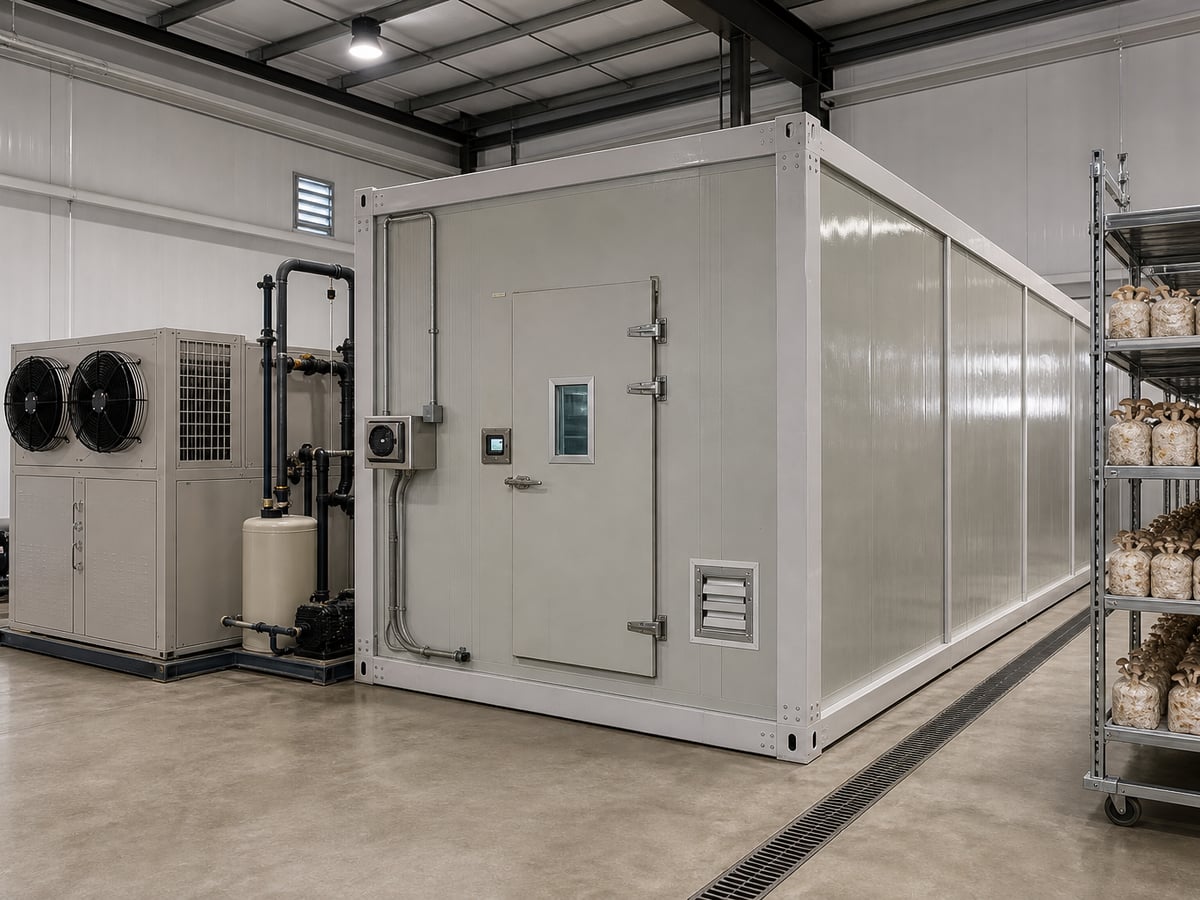
For commercial projects in the Global Market, buyers should compare three options before placing an order: self-conversion, local workshop conversion, and factory-assembled smart cultivation containers. A factory-built unit usually provides better insulation continuity, documented electrical integration, tested drainage, coordinated HVAC placement, and faster commissioning at the farm site. Businesses that need a turnkey starting point can review a smart mushroom cultivation container designed around controlled production workflows.
| Conversion Element | Minimum Practical Requirement | Why It Matters | Common Failure if Ignored |
|---|---|---|---|
| Container shell | Dry, square, low-corrosion structure | Provides a stable base for panels and doors | Leaks, rust and difficult sealing |
| Insulation | Continuous insulated envelope | Reduces heat gain and condensation | High energy use and wet wall cavities |
| Vapor barrier | Sealed warm-side moisture barrier | Protects steel and insulation from moisture migration | Hidden corrosion and mold growth |
| Floor drainage | Sloped floor with accessible drain route | Supports wash-down sanitation | Standing water and bacterial buildup |
| Racking | Corrosion-resistant, load-rated shelves | Supports substrate safely and efficiently | Rack deformation or restricted airflow |
| HVAC system | Dedicated cooling, heating, humidity and fresh air control | Maintains crop-specific climate stability | Uneven pinning and inconsistent harvests |
The table shows why container farming is an engineering project rather than a simple refurbishment task. The shell, insulation, drainage, racks, and climate system should be designed as one coordinated production environment.
Choosing a Shell for Mushroom Production

The shell selection stage determines how much repair work, insulation detail, and corrosion protection will be required. Most conversion projects begin with either a new one-trip container, a carefully inspected used dry container, a refrigerated container body, or a factory-built insulated modular cabin. Each option has advantages, but the choice should match the crop, local climate, expected operating life, and delivery route.
For projects in humid coastal regions, including Rotterdam, Singapore, Busan, Dubai, Mombasa, Santos, and Los Angeles, salt exposure and long-distance freight handling can accelerate exterior corrosion. A one-trip container generally offers cleaner steel, more reliable door seals, and fewer unknown repairs than an older unit. Used containers can reduce initial purchase cost, but they require detailed inspection for roof dents, floor contamination, rust at lower side rails, twisted frames, damaged locking bars, and chemical odors from previous cargoes.
Recommended shell inspection points
- Check roof panels for pinholes, impact dents, and evidence of previous patching.
- Inspect corner posts, lower rails, cross members, and forklift pockets for structural corrosion.
- Confirm the container sits square and doors close without excessive force.
- Examine the original floor for absorbed oils, pesticides, cargo residues, or delamination.
- Measure internal dimensions before designing rack layout, cooling units, ducts, and service corridors.
- Verify local road, crane, port, and site-access limits before selecting 20-foot, 40-foot, or high-cube formats.
| Shell Type | Best Use | Advantages | Limitations |
|---|---|---|---|
| New one-trip dry container | Commercial conversion projects | Clean structure, fewer repairs, predictable dimensions | Higher purchase cost |
| Used dry cargo container | Budget pilot farms | Lower entry cost and wide availability | Requires strict inspection and refurbishment |
| High-cube container | Multi-level racks and taller ducting | Extra headroom for cultivation layout | May face transport restrictions in some areas |
| Refrigerated container shell | Specialized retrofit projects | Existing insulation can be useful | Repairs and cleaning can be complex |
| Factory modular insulated cabin | Turnkey mushroom production | Purpose-built panels, drainage and service openings | Usually requires a higher initial investment |
| Multiple connected modules | Large commercial farms | Separates incubation, fruiting and packing zones | Needs more site planning and utilities |
This comparison helps buyers avoid selecting a shell only by purchase price. A cheaper container with damaged steel or contaminated flooring may cost more after blasting, repair, coating, panel installation, and labor. For growers seeking consistent production across several sites, standardized factory modules make it easier to duplicate climate settings and operating procedures.
Shell selection should also reflect product type. Small gourmet mushroom farms may use a 20-foot unit for trials, spawn run support, or low-volume fruiting. A 40-foot high-cube container is more appropriate for commercial fruiting racks, especially where workers need room for harvest carts and sanitation. Larger businesses may deploy separate modules for substrate handling, incubation, fruiting, cold storage, and packing to reduce cross-contamination.
Insulation and Vapor Barrier Design

Mushroom rooms operate at high relative humidity, often between 80% and 95%, which makes insulation and vapor control essential. Steel containers quickly transfer outdoor heat and cold into the cultivation room. Without a continuous insulated envelope, interior surfaces can fall below the dew point and create condensation. Over time, water can collect behind panels, corrode the shell, saturate insulation, and create hygiene problems that are difficult to see until major repairs are required.
Closed-cell polyurethane, polyisocyanurate, and insulated sandwich panels are commonly used in container mushroom farm conversion. The correct thickness depends on the local climate, target temperature, electricity price, and HVAC capacity. A project in tropical Southeast Asia, the Gulf region, or equatorial Africa usually needs stronger protection against heat gain than a project in northern Europe or Canada. However, cold-climate projects still need careful vapor control because warm humid room air can migrate toward colder steel surfaces.
Principles for a durable envelope
Insulation should be continuous over walls, roof, doors, corners, and service penetrations. Thermal bridges around steel ribs, framing screws, window openings, and ducts should be minimized. The vapor barrier must be sealed with compatible tape, sealant, or welded panel joints. Door frames require insulated thresholds and compression gaskets. Electrical conduits, condensate drains, sensor cables, and refrigerant lines should be routed through sealed penetrations instead of improvised holes.
| Design Area | Recommended Practice | Production Benefit | Inspection Method |
|---|---|---|---|
| Wall panels | Use washable insulated panels with sealed joints | Stable temperature and easier sanitation | Check seams for gaps and water ingress |
| Ceiling insulation | Provide continuous roof insulation | Reduces solar heat gain and ceiling condensation | Inspect after hot-weather operation |
| Steel ribs | Cover or isolate thermal bridges | Limits cold spots behind finishes | Use thermal imaging where available |
| Door system | Install insulated hygienic doors with gaskets | Reduces air leakage and pest entry | Perform light and smoke leakage tests |
| Utility penetrations | Seal around pipes, cables and ducts | Protects vapor barrier continuity | Visually inspect sealant condition |
| Exterior coating | Apply corrosion-resistant coating system | Extends shell life in wet or coastal locations | Review coating thickness and adhesion |
The table highlights a key point: insulation is not only an energy-saving layer. It is a moisture-management system. A container that feels cool enough during a short test may still fail after months of humid operation if the vapor barrier is interrupted or the outer steel begins to corrode.
In 2026 and beyond, energy efficiency will become more important as electricity tariffs, carbon reporting requirements, and sustainability expectations increase across international food supply chains. Many commercial farms are combining high-performance insulation with variable-speed compressors, heat recovery, solar-assisted electricity, and remote climate monitoring. These measures can reduce operating cost while helping growers document resource efficiency for retailers, investors, and certification programs.
Floor Loads and Drainage Routes
The floor must safely support substrate blocks, shelving, workers, harvest carts, wash-down water, and equipment. Original container floors were designed for cargo transport, not repeated high-humidity sanitation cycles. Timber floors may retain moisture, odors, or residues. For food-adjacent mushroom production, the preferred approach is usually a sealed, washable floor with a durable top layer, coved wall junctions, and a drainage route that can be cleaned and inspected.
Floor loading should be calculated before racks are installed. A four-tier or five-tier rack filled with hydrated substrate can create concentrated loads at its feet. The design must consider rack weight, block weight, water uptake, worker movement, and any rolling harvest trolley. Heavy rack legs should sit on load-spreading bases where required, especially if the finished floor includes insulation boards, panels, or a raised drainage layer.
Drainage planning for wash-down operations
Drainage should move water away from walking paths and rack bases. A modest floor slope toward a channel drain or point drain makes cleaning easier and prevents puddles. Drain traps, removable grates, smooth pipe runs, and accessible clean-out points help prevent clogging from substrate fragments. Wastewater discharge must follow local regulations, particularly near dense urban areas, industrial parks, or protected water zones.
| Floor and Drainage Item | Preferred Design | Reason | Operational Check |
|---|---|---|---|
| Floor finish | Sealed resin, welded vinyl or hygienic composite surface | Resists water and supports cleaning | Check for cracks and lifting edges |
| Floor slope | Consistent fall toward designated drains | Prevents standing water | Test with controlled wash-down water |
| Drain cover | Removable corrosion-resistant grate | Allows routine cleaning | Inspect weekly for substrate debris |
| Rack footings | Load-spreading feet or base plates | Reduces point-load damage | Inspect for indentation and movement |
| Wall-floor junction | Coved, sealed transition | Eliminates dirt-trapping corners | Verify sealant remains intact |
| Drain outlet | Accessible pipe route with trap and clean-out | Improves hygiene and maintenance | Flush and inspect regularly |
This table demonstrates why drainage should be designed before interior finishes are installed. Retrofitting drains after racks and wall panels are in place can be disruptive, expensive, and difficult to seal correctly.
Production facilities serving restaurants, wholesalers, supermarkets, meal-kit businesses, and food processors benefit from documented cleaning procedures. A hygienic drainage design supports daily sanitation, reduces odor buildup, and makes it easier to maintain a professional standard during buyer audits. In major trade hubs such as Hamburg, Jebel Ali, Shanghai, and Antwerp, suppliers increasingly expect modular agricultural equipment to arrive with clear utility connection points and sanitation-ready interiors.
Rack Clearances and Working Aisles
Rack design determines production capacity, air movement, harvest efficiency, and worker safety. The goal is not to install as many shelves as possible. Overcrowded racks create stagnant air zones, shade fruiting bodies, obstruct cleaning, and make it difficult for workers to inspect bags or blocks. The most productive layout balances substrate density with adequate aisle width, headroom, air delivery, and access to every shelf.
Rack materials should tolerate high humidity and regular wash-down. Hot-dip galvanized steel, coated steel, aluminum, and suitable food-grade polymer components may be used depending on the budget and crop. Stainless steel is highly durable but can increase project cost. Shelves should allow air movement around bags or blocks and avoid sharp edges that damage packaging.
Layout considerations by application
- Oyster mushroom fruiting rooms need even fresh-air distribution and enough space for cluster development.
- Shiitake blocks require access for inspection, soaking, and harvest handling.
- Lion’s mane production benefits from stable humidity without direct high-speed airflow across fruits.
- Incubation rooms may use denser layouts but still require heat removal and monitoring access.
- Training farms and research centers should reserve wider aisles for demonstrations and data collection.
- Commercial packing operations may require a separate clean area instead of placing packaging tables inside fruiting rooms.
| Layout Factor | Planning Guidance | Impact on Operations | Typical Risk |
|---|---|---|---|
| Main aisle | Allow safe worker and cart movement | Improves harvest speed and cleaning access | Congestion and damaged crops |
| Side clearance | Keep space between racks and walls | Supports airflow and inspection | Condensation and inaccessible surfaces |
| Top clearance | Leave room below ducts and ceiling units | Prevents airflow blockage | Uneven climate at upper shelves |
| Rack spacing | Match spacing to crop shape and bag size | Improves fruit quality and light access | Deformed mushrooms and poor airflow |
| Service access | Keep valves, sensors and drains reachable | Speeds maintenance and troubleshooting | Long downtime for simple repairs | Harvest zone | Provide a clean temporary collection area | Improves workflow and product handling | Cross-contamination during harvest |
The table confirms that aisle space is productive space. It enables faster harvests, safer movement, sanitation, inspection, and maintenance. For a buyer comparing quotations, rack quantity alone is not a useful measure of capacity; usable growing area, climate uniformity, and workflow efficiency are more meaningful indicators.
HVAC Openings and Air Distribution
Mushroom production depends on precise air management. The climate system must cool or heat the room, add or remove moisture, control carbon dioxide, circulate air evenly, and introduce filtered fresh air when needed. HVAC openings should be planned before insulation panels and racks are fixed in place. Improvised penetrations can create leaks, thermal bridges, condensation, and difficult-to-clean gaps.
Air distribution should be designed according to container length, rack height, crop load, outdoor climate, and target air velocity. A single cooling unit at one end of the container may create a cold zone near the evaporator and warmer conditions at the far end. Ducted supply, perforated air tubes, properly positioned return openings, and variable-speed fans can improve uniformity. Sensors should be placed at more than one position and at different rack levels rather than beside the main air outlet.
A mushroom climate controller can integrate temperature, humidity, carbon dioxide, fresh-air exchange, lighting schedules, alarms, and remote monitoring. This is especially valuable for distributed farms where operators manage units in different cities or countries. Remote alarms can notify staff about high temperature, low humidity, door-open events, sensor faults, or power interruptions before crop losses become severe.
Technology capabilities for controlled cultivation
Modern container systems increasingly use sensor-driven climate recipes rather than manual switching of fans and humidifiers. Lanhu applies more than 12 years of thermodynamic research and development experience to agricultural climate control equipment, with control logic designed for cultivation environments. Integrated systems can coordinate cooling, heating, humidification, ventilation, circulation, and protection functions to improve repeatability from one growing cycle to the next.
For Global Market projects, climate design should also consider local electrical supply. Farms in Europe may operate on different voltage and frequency standards than projects in North America, the Middle East, Latin America, Africa, or Southeast Asia. Buyers should confirm power supply, phase configuration, backup power needs, cable routing, control language, and remote-access requirements before manufacturing begins.
Washable Finishes and Corrosion Protection
Mushroom rooms are wet, biologically active environments. Interior finishes must be smooth, non-absorbent, easy to wash, and resistant to repeated exposure to humidity, cleaning chemicals, and organic material. Unsealed plywood, rough paint, exposed mineral wool, untreated timber, and unprotected carbon steel are poor choices for fruiting rooms because they trap moisture and become difficult to sanitize.
Washable wall panels with sealed joints are widely used because they create a bright, cleanable interior surface. Light-colored finishes also improve visibility during crop inspection and cleaning. Floor-wall coving, sealed ceiling joints, waterproof lighting, corrosion-resistant fasteners, and protected electrical enclosures support a more complete hygiene system.
Exterior protection is equally important. Containers placed in tropical rain, coastal salt air, snowy industrial zones, or desert heat cycles should receive suitable preparation and coating. Rust treatment, primer selection, topcoat durability, and regular inspections are all important. The underside of the container deserves particular attention because it can be exposed to standing water, uneven foundations, and pests.
Industries and applications served by container farms
Container mushroom farms are used by commercial mushroom growers, agricultural contractors, food distributors, hospitality groups, universities, vocational schools, community agriculture programs, mining camps, island food-security projects, and controlled-environment agriculture investors. They can operate near urban demand centers where land is expensive, such as London, Tokyo, New York, Dubai, Sydney, Johannesburg, and Mexico City. They are also useful in remote areas where conventional mushroom buildings are difficult to construct.
Typical applications include trial production, premium gourmet mushroom cultivation, decentralized farm networks, supermarket supply programs, training centers, substrate-to-harvest demonstration sites, and supplemental production beside existing greenhouses. Units can be configured for incubation, fruiting, or specialized crop research. Growers should avoid mixing incompatible hygiene zones in a single container when production volume grows; separating dirty substrate handling from clean fruiting areas is usually the safer long-term strategy.
Comparing Conversion and Factory Assembly
Self-conversion can work for experienced growers with access to qualified refrigeration technicians, electricians, fabricators, and food-facility contractors. It offers flexibility and may suit experimental projects. However, it requires detailed coordination. The buyer becomes responsible for shell sourcing, design drawings, structural changes, insulation, waterproofing, panel installation, drainage, electrical work, refrigeration, controls, testing, and warranty management.
Factory assembly reduces coordination risk by integrating these components before shipment. This can be particularly valuable for export projects where the destination site has limited specialist labor or where the installation schedule is tight. A factory-built unit can be tested before dispatch, then delivered by road, rail, or sea freight through international logistics routes such as Qingdao, Shanghai, Ningbo, Rotterdam, Jebel Ali, or Durban.
| Purchase Approach | Best For | Main Strength | Main Consideration |
|---|---|---|---|
| DIY conversion | Experienced technical growers | Maximum local customization | High coordination and quality-control burden |
| Local workshop conversion | Projects with trusted local contractors | Potentially lower transport cost | Quality varies by contractor capability |
| Factory-assembled container | Commercial buyers and distributors | Integrated production and pre-shipment testing | Requires clear specification before order |
| OEM-branded unit | Equipment distributors | Supports private-label market programs | Needs brand, documentation and support planning |
| Multi-container farm package | Expanding commercial farms | Separates workflow zones and increases capacity | Needs site utilities and logistics planning |
| Hybrid project | Regional engineering companies | Factory core equipment plus local installation | Responsibilities must be clearly defined |
The comparison shows that the best option depends on technical resources, project scale, local labor quality, and risk tolerance. Buyers should request drawings, equipment lists, electrical diagrams, load information, climate parameters, acceptance testing details, and warranty terms before comparing quotations.
Buying advice for Global Market projects
Ask suppliers whether the quoted capacity is based on actual usable rack area, crop type, substrate block size, and climate conditions. Confirm whether cooling, heating, humidification, fresh air, racks, lights, floor drainage, electrical panels, and control systems are included. Clarify whether the unit is tested under load, how spare parts are supplied, and what remote support is available after delivery.
Case experience across modular agriculture projects shows that early planning prevents expensive changes later. For example, a grower adding more racks after installation may discover that airflow no longer reaches lower shelves. Another project may install a powerful humidifier without providing drainage or sufficient circulation, creating wet floors and uneven crop conditions. Reviewing practical container cultivation project cases can help buyers identify layout, logistics, and climate-control questions before procurement.
Future trends include connected farm management, predictive maintenance, lower-GWP refrigerants, solar-linked power systems, water-saving humidification strategies, energy dashboards, and standardized modular farm clusters. Governments and food buyers are also placing greater emphasis on traceability, energy efficiency, worker safety, and reduced food-mileage. A well-designed container farm can support these trends when it includes efficient equipment, documented cleaning procedures, reliable data collection, and scalable production planning.
Our Company
Shandong Lanhu Air Conditioning Equipment Co., Ltd. supports Global Market customers with smart mushroom cultivation containers, climate controllers, hydroponic plant containers, air source heat pumps, and modular agricultural climate solutions. The company serves agricultural contractors, commercial growers, engineering companies, distributors, and controlled-environment agriculture projects that require reliable equipment integration.
Manufacturing capabilities
Lanhu operates a modern manufacturing base of more than 30,000 square meters in Dezhou, Shandong, China. Its integrated production process includes product design, engineering development, sheet metal fabrication, CNC bending, insulation panel production, electrical assembly, system integration, equipment testing, and quality inspection. This in-house coordination helps maintain compatibility between the shell, panels, climate equipment, control system, racks, drainage, and electrical components.
Technological capabilities
With more than 45 registered patents and long-term thermodynamic research experience, Lanhu develops climate-control solutions for demanding agricultural environments. Systems undergo functional inspection, electrical verification, performance testing, and operational evaluation before shipment. The company’s management and product credentials include ISO 9001, ISO 14001, ISO 45001, and ISO 12100 certifications, supporting quality, environmental management, occupational safety, and risk-oriented equipment design.
Service capabilities
Lanhu provides factory-direct supply, OEM and ODM customization, engineering assistance, international logistics support, spare-parts coordination, installation guidance, and after-sales service. Customers seeking private-label systems or customized layouts can explore the company’s OEM and ODM customization services. For overseas buyers, early communication about destination port, local voltage, delivery access, customs documentation, site foundation, and installation resources helps ensure a smoother project launch.
FAQ
Can any used shipping container be converted into a mushroom farm?
No. A used unit should be dry, structurally square, free from serious corrosion, and free from hazardous cargo contamination. Older containers can be converted, but inspection and refurbishment costs must be included in the budget.
Is insulation necessary in mild climates?
Yes. Even mild climates can create daily temperature swings, solar heat gain, and condensation on steel surfaces. Insulation and vapor sealing reduce energy consumption and help maintain stable growing conditions.
Should incubation and fruiting happen in the same container?
They can for small pilot projects, but separate zones are usually better for commercial production. Incubation and fruiting have different climate requirements, and separation improves workflow and contamination control.
What is the most important HVAC feature for mushroom production?
Uniform air distribution is as important as cooling or humidification capacity. The system must maintain suitable temperature, humidity, carbon dioxide concentration, and fresh-air exchange across all rack levels.
How often should a container mushroom room be cleaned?
Routine cleaning should occur throughout production, with more thorough sanitation between crop cycles. Floors, drains, door seals, rack surfaces, humidification equipment, and air openings should be included in the maintenance plan.
Can container mushroom farms be exported internationally?
Yes. Factory-assembled units can be shipped through major international ports, but buyers should confirm dimensions, container loading method, destination regulations, electrical requirements, customs documents, and local installation arrangements before ordering.
Share this article

About the Author: Shandong Lanhu Air Conditioning Equipment
Lanhu is a professional climate control equipment manufacturer specializing in smart agricultural systems, commercial HVAC solutions, and customized temperature control technologies. With extensive engineering experience, Lanhu provides reliable solutions for plant factories, controlled environment agriculture, and industrial applications.
Need a Custom Climate Control Solution?
From smart agricultural systems to commercial HVAC solutions, Lanhu provides reliable temperature and humidity control solutions tailored to your project needs.
Contact Us