Global Market Mushroom Ventilation Systems: Buyer Guide
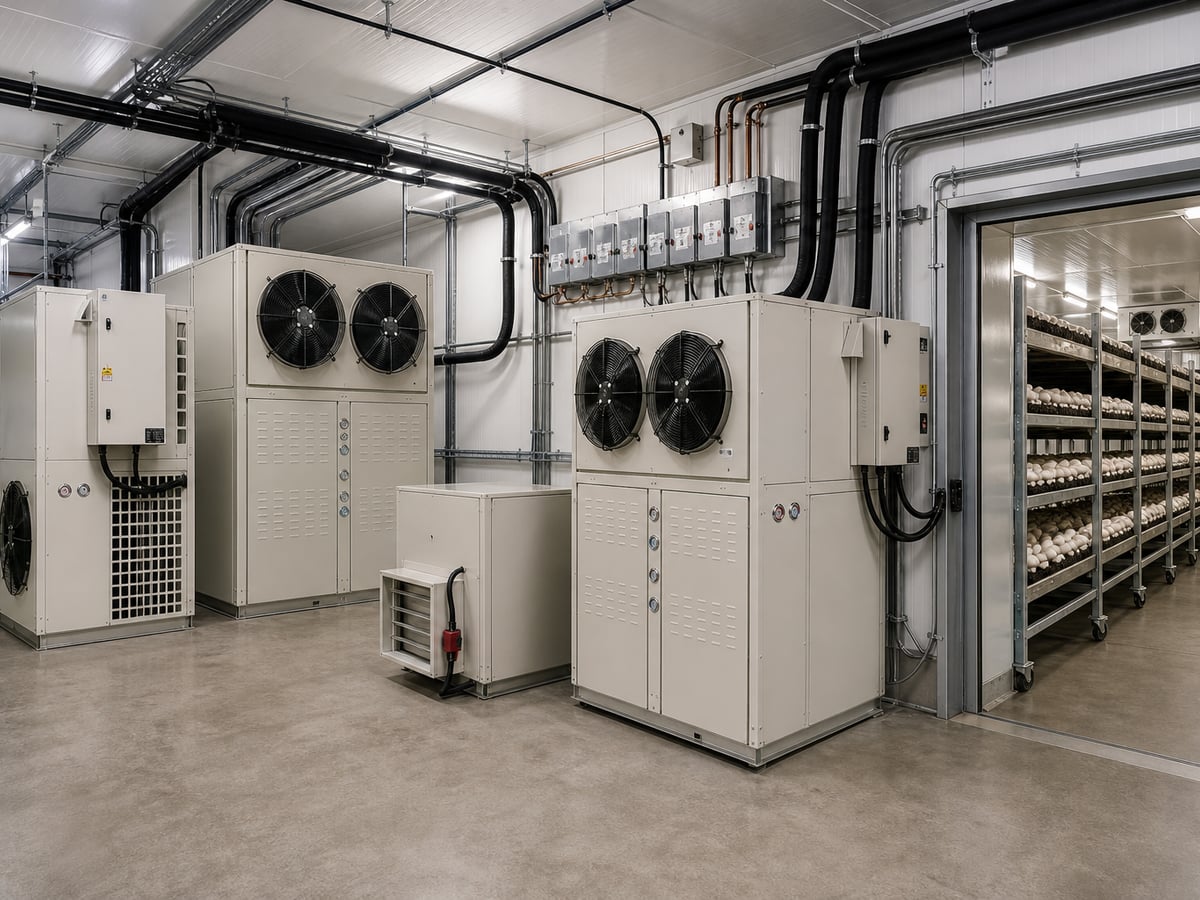
Quick Answer

A mushroom ventilation system is a purpose-built climate management solution that supplies fresh air, removes excess carbon dioxide, balances humidity, distributes conditioned air, and helps maintain stable growing-room conditions. It is used in commercial mushroom farms, container farms, growing tunnels, indoor cultivation rooms, spawn-run facilities, and modular production sites producing oyster mushrooms, shiitake, button mushrooms, enoki, lion’s mane, king oyster mushrooms, and other specialty varieties.
For the Global Market, a reliable mushroom air handling system must do more than move air. It should coordinate intake, exhaust, cooling, heating, humidification, filtration, sensors, and automated controls to protect crop quality during every cultivation stage. Proper ventilation can reduce CO2 accumulation, prevent uneven pinning, lower condensation risk, improve fruiting-body consistency, and support higher utilization of vertical growing space.
Buyers should evaluate ventilation capacity, room volume, crop density, outdoor climate, humidity load, local power supply, insulation level, and required automation before selecting equipment. A farm near Rotterdam, Dubai, Singapore, Los Angeles, Sydney, or São Paulo may need different cooling, dehumidification, filtration, corrosion protection, and electrical configurations because weather conditions, utility standards, and logistics routes vary significantly.
| Decision Factor | Why It Matters | Recommended Buyer Check |
|---|---|---|
| Room volume | Determines baseline airflow and circulation needs. | Provide length, width, height, and rack layout. |
| Mushroom species | Different strains require different temperature and CO2 levels. | Confirm incubation and fruiting recipes. |
| Outdoor climate | Controls cooling, heating, and moisture-load requirements. | Share seasonal temperature and humidity data. |
| Production scale | Affects equipment redundancy and control architecture. | State daily substrate and harvest targets. |
| Power standard | Ensures motors, controllers, and protection devices match site utilities. | Confirm voltage, phase, frequency, and backup power. |
| Automation target | Influences sensor selection, remote access, and data reporting. | Define manual, semi-automatic, or fully automated operation. |
The table above shows why mushroom ventilation equipment should be designed around the farm rather than selected solely by fan size. A correctly sized system considers biological demand and building performance together. For turnkey projects, ventilation can also be integrated with a smart mushroom cultivation container to create a compact, factory-built growing environment.
What Is a Mushroom Ventilation System and Where Is It Used?

A mushroom ventilation system is an engineered combination of fans, ducts, dampers, cooling and heating devices, humidification units, sensors, filters, controls, and electrical protection components. Its purpose is to regulate the cultivation climate while introducing outside air or treated air at a controlled rate. In fruiting rooms, fresh-air exchange is particularly important because mushrooms release CO2 as they grow. Excess CO2 may lead to elongated stems, small caps, slow development, poor shape, and inconsistent yield.
Commercial growers use mushroom air circulation and ventilation systems in insulated grow rooms, converted warehouses, agricultural sheds, refrigerated rooms, mobile farm units, and containerized farms. They are suitable for new projects and for upgrades where basic exhaust fans cannot maintain stable climate conditions. Larger operations may install separate ventilation zones for incubation, primordia formation, fruiting, packing, and post-harvest handling.
Typical Markets and Applications
- Commercial oyster mushroom farms supplying supermarkets, restaurants, and wholesale distributors.
- Shiitake farms operating in humid subtropical, temperate, or cold-climate regions.
- Urban indoor farms in cities such as London, Toronto, Seoul, Dubai, Jakarta, and Mexico City.
- Food-security and controlled-environment agriculture projects in remote areas.
- Research farms, agricultural colleges, demonstration centers, and training facilities.
- Container cultivation projects near logistics hubs including Shanghai, Hamburg, Jebel Ali, Santos, and Long Beach.
- Farm expansion projects requiring independent climate zones and traceable operating records.
In the Global Market, local supplier availability should be assessed alongside technical quality. Buyers may source fans locally but procure integrated controls, climate cabinets, insulated panels, and complete systems from specialized manufacturers. This approach can shorten service response time while preserving a consistent control strategy. Import planning should include shipping routes, destination port clearance, inland transport dimensions, local electrical compliance, and availability of installation technicians.
| Application Site | Primary Ventilation Need | Common System Arrangement |
|---|---|---|
| Small grow room | Basic fresh-air exchange and humidity stability | Wall-mounted supply and exhaust fans with controller |
| Multi-room mushroom farm | Independent climate settings by room | Zoned air handlers, dampers, sensors, central controls |
| Container farm | Compact integrated climate management | Roof or side-mounted ventilation and modular controls |
| Warehouse conversion | Long air-throw distance and room uniformity | Ducted supply, return-air system, circulation fans |
| Hot and humid region | Cooling and dehumidification under high latent load | Cooling coil, fresh air unit, dehumidification logic |
| Cold-climate facility | Freeze protection and energy-efficient heating | Heat pump, insulated ducts, frost-safe dampers |
This comparison explains why “ventilation” should not be understood as ventilation fans alone. A project in tropical Southeast Asia may emphasize cooling and moisture removal, while a farm in northern Europe may require heat recovery, winter heating, and freeze-resistant intake protection.
Standard Product Configuration and System Boundaries

A standard commercial mushroom ventilation package can include supply fans, exhaust fans, circulation fans, fresh-air dampers, air filters, ducts, diffusers, flexible connections, temperature and humidity sensors, CO2 sensors, electrical cabinet, programmable controller, touchscreen interface, alarm functions, and communication modules. Depending on the project, the system may also include cooling coils, heating elements, humidifiers, dehumidification equipment, air source heat pumps, ultraviolet treatment, heat recovery, and backup ventilation.
System boundaries should be clearly defined before purchase. A supplier’s scope may cover climate equipment only, or it may include room panels, racks, drainage, electrical cables, piping, installation, commissioning, operator training, and remote monitoring. Clear boundaries prevent disputes between the equipment supplier, civil contractor, electrical contractor, and farm owner.
| System Item | Usually Included | May Be Optional |
|---|---|---|
| Supply and exhaust fans | Yes | Variable-frequency drives or redundancy |
| Climate controller | Yes | Advanced recipe library and cloud platform |
| Temperature and humidity sensors | Yes | Additional sensor calibration kits |
| CO2 monitoring | Often included | Multi-point CO2 mapping |
| Ductwork and diffusers | Project dependent | Food-grade or insulated duct specification |
| Cooling and heating source | Project dependent | Air source heat pump or heat recovery unit |
| Installation service | Guidance commonly available | On-site installation team and local contractor management |
The table clarifies that standard configuration is not identical for every project. Buyers should request a bill of materials, equipment layout, electrical load list, airflow diagram, control sequence, and exclusions list. For projects requiring tailored dimensions, control logic, branding, or functional integration, OEM and ODM customization services can help align the equipment with a specific farm model.
Capacity, Dimensions, and Utility Requirements
Ventilation capacity is usually expressed in cubic meters per hour or cubic feet per minute. The appropriate airflow depends on cultivation-room volume, crop respiration, number of shelves, bag or block density, target CO2 concentration, outdoor conditions, and the amount of conditioned air required to maintain uniform temperature and humidity. Higher airflow is not automatically better; excessive air velocity can dry substrate surfaces and create uneven humidity around the crop.
For preliminary planning, suppliers typically calculate room air volume, expected CO2 generation, sensible and latent heat load, fresh-air requirement, and pressure losses through filters, ducts, dampers, and coils. Final selection should include a site-specific engineering review rather than relying on a generic air-change figure.
| Project Size | Typical Growing Area | Indicative Airflow Range | Suggested Electrical Supply |
|---|---|---|---|
| Micro farm | 20–50 m² | 2,000–6,000 m³/h | Single or three phase, depending on cooling load |
| Small commercial room | 50–150 m² | 6,000–15,000 m³/h | Three phase preferred |
| Medium production room | 150–300 m² | 15,000–30,000 m³/h | Three phase with protected control cabinet |
| Large fruiting hall | 300–600 m² | 30,000–60,000 m³/h | Three phase with VFD and backup planning |
| Container cultivation unit | 15–30 m² internal area | 1,500–5,000 m³/h | Customized by container climate package |
| Multi-zone facility | 600 m² and above | 60,000 m³/h and above | Central distribution board and zone controls |
These figures are indicative planning ranges, not final engineering values. Room dimensions influence duct length, fan static pressure, access-door position, maintenance space, and the placement of diffusers. Utility requirements may include three-phase electrical power, clean water for humidification, drainage for condensate, internet access for remote monitoring, and standby power for critical ventilation functions.
International buyers should provide local utility information early. Common standards include 380–415V/50Hz in many regions, 220–240V/50Hz in others, and 208V, 230V, 460V, or 480V/60Hz in North American and selected Latin American projects. Equipment can be configured for the destination market, but voltage, phase, frequency, plug standards, and local certification requirements should be confirmed before fabrication.
Temperature, Humidity, CO2, Airflow, and Control Performance
Climate targets vary by mushroom species, substrate, strain, production stage, and desired product form. During incubation, growers may require warmer and more stable conditions with limited fresh-air exchange. During pinning and fruiting, ventilation demand generally rises because CO2 must be reduced while temperature and humidity remain controlled. The ventilation system should react gradually, using sensor feedback and programmed logic instead of frequent full-speed fan cycling.
| Control Parameter | Typical Operating Purpose | System Response |
|---|---|---|
| Temperature | Supports strain-specific growth and fruiting timing | Cooling, heating, fresh-air modulation, circulation |
| Relative humidity | Protects surface moisture and crop quality | Humidification, dehumidification, airflow adjustment |
| CO2 concentration | Controls morphology and fresh-air requirement | Supply/exhaust fan speed and damper position |
| Air velocity | Prevents stagnant zones without drying crops | Fan balancing, diffuser selection, VFD control |
| Static pressure | Maintains designed airflow through filters and ducts | Fan control and filter maintenance alarms |
| Room pressure | Helps manage infiltration and contamination pathways | Balanced supply and exhaust operation |
The table demonstrates that climate performance is interconnected. For example, opening a fresh-air damper may reduce CO2 but can also raise cooling demand in a hot climate or reduce humidity during dry weather. A capable controller manages these interactions by prioritizing crop safety, using staged actions and adjustable deadbands.
Commercial buyers should ask for sensor accuracy, calibration intervals, control response options, alarm thresholds, historical data capability, and airflow balancing procedures. CO2 sensors should be installed where they represent the crop zone rather than directly beside an air outlet. Temperature and humidity sensors should avoid direct spray, solar heat, or local hot spots. Multiple sensors may be appropriate in long rooms or high-density rack systems.
The chart illustrates the principle of stable control: temperature, humidity, and CO2 should remain within the grower’s defined range rather than swing sharply during daily operation. Actual setpoints must be selected according to mushroom variety and production stage.
Core Components, Materials, and Protection Features
A commercial mushroom ventilation system typically uses corrosion-resistant, moisture-tolerant components because mushroom rooms operate in humid conditions and may be cleaned frequently. Key components include high-efficiency centrifugal or axial fans, galvanized or coated steel housings, stainless steel fasteners where required, insulated panels, aluminum or PVC air diffusers, washable filters, sealed electrical enclosures, and industrial-grade sensor assemblies.
Protection features are especially important for farms in coastal environments, high-humidity regions, and locations with unstable power. Projects near ports such as Manila, Durban, Ho Chi Minh City, Antwerp, or Jeddah may require enhanced anti-corrosion specifications because salt-laden air and logistics storage conditions can affect exposed equipment.
- Fan motors with thermal overload protection and suitable ingress protection ratings.
- Variable-frequency drives for energy-saving speed control and reduced startup current.
- Phase-loss, phase-sequence, overvoltage, undervoltage, and leakage protection.
- Corrosion-resistant coatings for fan casings, supports, and outdoor units.
- Insulated ducts or panels to reduce condensation and thermal loss.
- Filter monitoring and maintenance alerts to protect airflow performance.
- Emergency ventilation mode for sensor faults or high CO2 conditions.
- Door switches, alarms, and manual override functions for operational safety.
Material selection should match the cleaning regime and local environment. Galvanized sheet metal is suitable for many indoor structures, while aluminum, coated steel, fiberglass, PVC, or stainless steel may be selected for more aggressive humidity or washdown conditions. Buyers should request material grades and finish specifications when durability is critical.
Automation, Remote Monitoring, and Customization Options
Automation transforms mushroom ventilation from a manual task into a repeatable production process. A modern controller can collect signals from temperature, humidity, CO2, pressure, water level, door status, and fan feedback devices. It can then operate fans, dampers, humidifiers, cooling units, heaters, and alarms according to the selected crop recipe.
Remote monitoring supports farm managers who oversee several rooms or locations. Through a computer, tablet, or mobile device, authorized users may review real-time climate conditions, change approved setpoints, receive alarm notifications, and compare historical trends. This is valuable for operators managing farms across regions or contractors supporting projects from major trade centers such as Frankfurt, Dubai, Singapore, Chicago, and Johannesburg.
| Automation Feature | Operational Benefit | Customization Option |
|---|---|---|
| Recipe-based control | Applies repeatable climate stages by mushroom variety | Custom strain and substrate programs |
| Variable fan speed | Improves stability and reduces energy consumption | Different day/night speed limits |
| Remote dashboard | Enables off-site supervision and reporting | Multi-farm user permissions |
| Alarm notification | Provides early warning of climate deviations | SMS, email, app, or local beacon alerts |
| Data logging | Supports traceability and crop analysis | Export format and retention period | Language interface | Improves local operator usability | Multilingual screen and documentation |
The table shows how automation can be scaled from a simple touchscreen controller to a networked farm-management platform. Buyers should specify whether they need cloud access, local network access, offline operation, PLC integration, Modbus communication, third-party sensor compatibility, or connection to an existing building management system.
For mushroom growers seeking an integrated control platform, a smart mushroom climate controller can centralize climate settings, alarms, and operational data. Customization may also include cabinet size, fan arrangement, duct outlet positions, panel thickness, electrical standards, branding, and shipping configuration.
Installation, Commissioning, Maintenance, and Warranty
Correct installation is essential to achieve designed airflow and climate uniformity. Before delivery, the project team should confirm equipment access routes, foundation or wall structure, drainage position, cable paths, fresh-air intake location, exhaust discharge direction, and service clearances. Air intakes should be positioned away from exhaust outlets, dust sources, vehicle traffic, chemical storage, and standing water.
Commissioning normally includes electrical verification, fan rotation checks, sensor checks, damper operation, airflow balancing, humidification testing, cooling and heating confirmation, alarm testing, setpoint programming, and operator training. A baseline performance record should be created at handover so future maintenance teams can compare fan current, airflow, pressure, and sensor readings.
Routine Maintenance Plan
- Inspect filters weekly or according to dust conditions; clean or replace as required.
- Check fan noise, vibration, belt condition where applicable, and mounting bolts monthly.
- Verify temperature, humidity, and CO2 sensor readings at scheduled intervals.
- Clean humidification components and water lines to control scale and biological buildup.
- Inspect drainage and condensate lines to prevent overflow and microbial growth.
- Review electrical terminals, protective devices, and controller alarms periodically.
- Perform seasonal checks before peak summer cooling or winter heating demand.
Warranty terms vary by component, project scope, operating environment, and maintenance compliance. Buyers should confirm warranty duration, spare-parts coverage, remote diagnosis availability, response procedures, exclusions, and the process for submitting service records. Keeping recommended spare parts on site—such as sensors, contactors, fuses, fan belts, filters, and humidifier nozzles—can reduce operational downtime.
For international projects, installation guidance can be delivered through drawings, manuals, commissioning checklists, video support, remote sessions, or on-site technical assistance where agreed. Case evidence is useful during vendor selection; growers can review relevant mushroom cultivation project cases to compare room formats, container applications, and climate-control solutions.
Our Company
Shandong Lanhu Air Conditioning Equipment Co., Ltd. supplies agricultural climate-control equipment and modular cultivation solutions for commercial growers, engineering contractors, distributors, and farm investors in the Global Market. The company is located in Dezhou, Shandong, China, an established manufacturing area with practical access to domestic supply chains and export logistics through major Chinese ports.
Technological Capabilities
Lanhu has more than 12 years of thermodynamic research and development experience and more than 45 registered patents. Its engineering focus includes mushroom climate control, smart cultivation containers, hydroponic plant containers, air source heat pumps, and integrated agricultural HVAC applications. Product design considers heat load, humidity balance, fresh-air demand, sensor feedback, energy use, and the operational needs of commercial cultivation teams.
The company can support technical discussions from concept stage through equipment selection, helping customers translate crop requirements into practical ventilation, cooling, heating, humidification, and control specifications. This is particularly valuable for farms entering new markets, expanding production capacity, or converting conventional agricultural buildings into controlled-environment mushroom facilities.
Manufacturing Capabilities
Lanhu operates a modern manufacturing facility exceeding 30,000 square meters. Its integrated capabilities include product design, engineering development, sheet-metal fabrication, CNC bending, insulation-panel production, electrical assembly, system integration, equipment testing, and quality inspection. Managing these processes within one production system improves consistency between mechanical parts, panels, controls, and final equipment assembly.
Before shipment, systems undergo functional inspection, electrical verification, performance testing, and operational evaluation. The company holds ISO 9001, ISO 14001, ISO 45001, and ISO 12100 certifications, alongside patent certificates and enterprise credibility credentials. These systems support quality control, workplace safety, environmental management, and structured product development.
Service Capabilities
Lanhu provides factory-direct supply, OEM and ODM customization, engineering assistance, spare-parts support, installation guidance, international logistics coordination, and after-sales service. Support can be tailored for equipment distributors, agricultural contractors, commercial farms, and project developers requiring phased deliveries or containerized transportation.
Whether a buyer needs a standalone mushroom ventilation unit, a multi-room climate-control package, or a complete modular solution, the project team can discuss technical requirements and commercial details through the contact channel for mushroom climate projects. Early consultation helps identify site risks, clarify system boundaries, and create a more accurate equipment proposal.
Future Trends for 2026 and Beyond
By 2026, mushroom ventilation systems are expected to become more data-driven, energy-conscious, and traceable. Demand is increasing for variable-speed fans, high-efficiency heat pumps, heat recovery, low-water humidification, predictive maintenance, and cloud-based production records. Farms will increasingly use sensor data to compare crop batches, identify climate deviations, and optimize fresh-air use without compromising morphology or food safety.
Policy and sustainability pressures are also shaping purchasing decisions. Energy efficiency, refrigerant selection, worker safety, electrical protection, water management, and carbon reporting are becoming more relevant in public procurement, supermarket supply programs, export-oriented farms, and large agricultural developments. Modular systems that reduce on-site construction waste, use insulated structures, and support controlled energy consumption can offer long-term operational advantages.
FAQ
How do I choose the correct mushroom ventilation capacity?
Start with room dimensions, number of cultivation racks, mushroom species, substrate quantity, target CO2 level, outdoor climate, and cooling or heating requirements. A supplier should calculate airflow, pressure loss, and climate load rather than select equipment only by floor area.
Can one system serve incubation and fruiting rooms?
It can, but separate climate zones are usually better for commercial production because incubation and fruiting often require different temperatures, humidity levels, and fresh-air rates. Independent controls reduce cross-stage compromise.
Is a CO2 sensor necessary for mushroom cultivation?
For consistent commercial fruiting, a CO2 sensor is strongly recommended. It allows the system to adjust fresh-air exchange according to actual room conditions instead of operating fans only on a timer.
What information should I provide for a quotation?
Provide room drawings, dimensions, insulation details, location, outdoor climate data, mushroom variety, production stage, rack layout, power supply, water availability, desired automation level, and any local compliance requirements.
Can the system be used in hot or cold climates?
Yes. The configuration must be adapted to local conditions. Hot climates may need stronger cooling and dehumidification, while cold climates may need heating, insulated ductwork, frost protection, and energy-recovery considerations.
How often should filters and sensors be maintained?
Filter inspection frequency depends on local dust levels and intake-air quality, but regular weekly checks are common. Sensors should be checked and calibrated according to the manufacturer’s guidance and the farm’s quality-control program.
Can the ventilation system be integrated into a container farm?
Yes. Container farms commonly use compact integrated ventilation, cooling, heating, humidification, insulation, and automation systems. This arrangement is suitable for urban farms, demonstration projects, remote locations, and modular expansion plans.
What is the main advantage of automated mushroom climate control?
Automation improves repeatability. It can maintain climate settings continuously, respond to CO2 or humidity changes, provide alarms, record operating data, reduce manual workload, and help growers create more consistent crop conditions across multiple rooms.
Share this article

About the Author: Shandong Lanhu Air Conditioning Equipment
Lanhu is a professional climate control equipment manufacturer specializing in smart agricultural systems, commercial HVAC solutions, and customized temperature control technologies. With extensive engineering experience, Lanhu provides reliable solutions for plant factories, controlled environment agriculture, and industrial applications.
Need a Custom Climate Control Solution?
From smart agricultural systems to commercial HVAC solutions, Lanhu provides reliable temperature and humidity control solutions tailored to your project needs.
Contact Us