Global Market Guide to Relocating Mushroom Farm Units
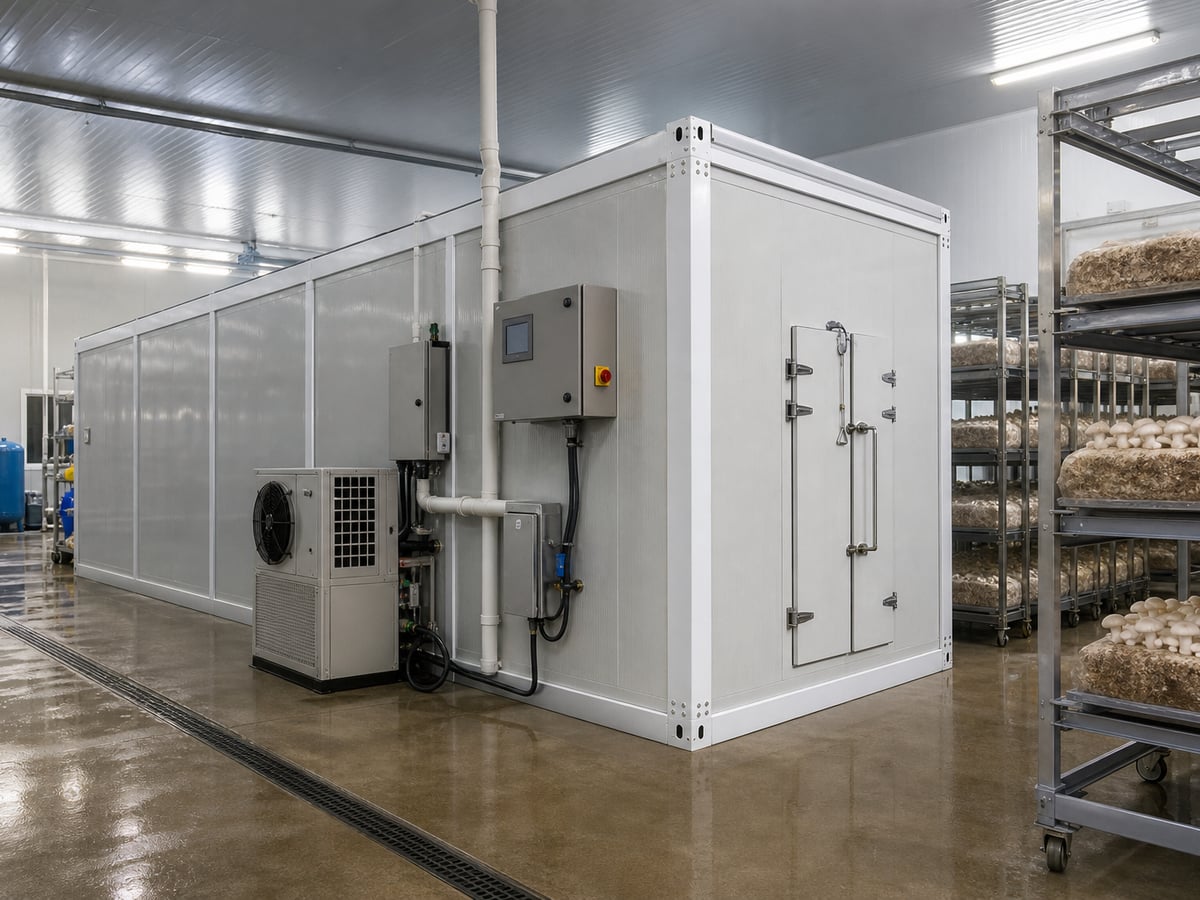
Immediate Guidance for Moving a Mushroom Farm

A relocatable mushroom farm can be moved successfully when the production unit was designed as a modular system, the destination has reliable utilities, and the complete relocation plan is priced before transport is booked. For Global Market growers, a portable mushroom cultivation container can reduce the time required to establish production in new regions, near new customers, or on leased agricultural land.
The key principle is simple: move the growing room as an integrated controlled-environment asset, not as an empty shipping box. Before relocation, document the existing climate settings, crop stage, shelving layout, electrical connections, water quality, drain configuration, controller parameters, and equipment condition. This creates a reliable baseline for commissioning after installation.
For most projects, the safest sequence is: inspect the farm, confirm transport dimensions, harvest or stabilize the crop, isolate utilities, secure internal equipment, lift the unit using approved points, transport it, reconnect services, test all safety systems, and then verify climate performance before loading new substrate or mushroom blocks.
| Relocation Decision Factor | Move the Existing Unit | Build a New Site | Recommended Action |
|---|---|---|---|
| Lease ending soon | Usually practical if utility access is available at the new site | May cause production interruption | Plan transport before the lease expiry date |
| Strong local demand | Allows production to follow customers or distributors | Requires new construction lead time | Move near urban food markets or wholesale hubs |
| Container is structurally sound | Good value when insulation panels and chassis remain intact | New construction may be unnecessary | Complete a structural inspection first |
| Old utilities are unreliable | Moving may improve operational stability | New fixed building may also be considered | Compare utility capacity at both sites |
| Crop is near harvest | Possible with careful scheduling, but risk is higher | Production delay can be expensive | Harvest before movement whenever possible |
| International relocation | Feasible with customs, port, and freight coordination | Can involve different import requirements | Confirm import rules and documentation early |
The table above shows that mobility is most valuable when speed, land flexibility, or market proximity outweighs the cost of lifting and reconnecting utilities. A modular system is particularly attractive for growers serving hotels, supermarkets, food-service distributors, research farms, and regional fresh-produce markets where short delivery times support premium mushroom quality.
When a Relocatable Growing Farm Is the Right Choice

A movable farm makes sense when the business needs flexibility without sacrificing environmental control. Mushroom growers often relocate because of changing rental agreements, expansion into new cities, seasonal market opportunities, industrial redevelopment, agricultural project funding, or a need to position production closer to buyers.
In the Global Market, containerized mushroom farms are used in metropolitan regions such as Dubai, Singapore, Rotterdam, Los Angeles, Sydney, Johannesburg, São Paulo, and Nairobi. In these locations, land availability and logistics costs can change quickly. A self-contained farm can be deployed on agricultural land, industrial estates, food distribution zones, university campuses, resort properties, or controlled-environment demonstration sites.
Movable mushroom units are suitable for oyster mushrooms, shiitake, lion’s mane, enoki, king oyster mushrooms, and other varieties where stable temperature, humidity, fresh-air exchange, carbon dioxide control, and lighting schedules are necessary. The exact crop determines the acceptable transport downtime and the required recommissioning procedure.
Best business situations for relocation
- Short-term land leases, pilot farms, and temporary production contracts.
- Expansion into a new customer region before building a permanent facility.
- Projects where mushroom production must be located close to restaurants, retailers, or fresh-food logistics centers.
- Disaster recovery, site redevelopment, or utility failure at the existing location.
- Government-supported agricultural demonstrations, vocational training centers, and research applications.
- Contract growing operations serving multiple regions throughout the year.
Buyers should avoid relocation if the container frame has corrosion damage, the floor is compromised, insulation panels are severely deteriorated, or local permits prohibit temporary agricultural structures. A fixed building may also be preferable where output is very large and transport access is limited.
Before buying, compare a standard container farm with a customized solution. A smart mushroom cultivation container is designed to integrate insulation, climate equipment, shelving, lighting, sensors, and controls into a compact production environment. Buyers planning repeated relocation should request reinforced lifting provisions, service access panels, transport locks, and clearly labeled utility interfaces.
| Farm Type | Mobility Level | Typical Use | Relocation Advantage |
|---|---|---|---|
| 20-foot mushroom container | High | Small commercial farms, trials, training | Easy to place where access is limited |
| 40-foot mushroom container | High | Commercial production and distribution pilots | Strong balance of capacity and transport efficiency |
| Multiple-container farm | Medium | Regional mushroom hubs | Can move in phases instead of all at once |
| Container with packing room | Medium | Fresh mushroom processing and direct sales | Protects cold-chain workflow during expansion |
| Hybrid container and greenhouse project | Medium | Integrated agricultural operations | Core climate room remains movable |
| Permanent insulated growing building | Low | Large-scale industrial farms | Limited relocation value but higher long-term scale |
This comparison highlights why container farms are increasingly used as modular agricultural infrastructure. The right product type depends on daily output targets, substrate supply, labor availability, access roads, local energy pricing, climate conditions, and whether the unit will move once or several times during its service life.
Transport Size Limits and Approved Lifting Locations

Transport planning begins with accurate measurements. Record the external length, width, height, gross weight, center of gravity, chassis condition, roof-mounted equipment, external pipework, and door clearance requirements. Do not assume that a containerized farm has the same transport profile as an empty ISO shipping container. Air handling units, condensers, electrical boxes, roof curbs, pipe guards, and external platforms can alter dimensions.
For road transport, local regulations vary. A standard 20-foot or 40-foot format can generally be handled through major freight corridors, but oversized width or height may require permits, route studies, escorts, or special low-bed trailers. This is especially important when travelling through city areas with low bridges, tunnels, overhead cables, narrow industrial entrances, or strict daytime vehicle restrictions.
Global shipping routes often involve ports such as Shanghai, Qingdao, Ningbo, Rotterdam, Jebel Ali, Antwerp, Long Beach, Singapore, Durban, Santos, and Melbourne. When a mushroom farm is shipped internationally, the transport plan must include inland trucking, port handling, export documentation, ocean freight, destination customs clearance, local delivery, lifting, and final positioning.
Lifting and rigging requirements
Use only the lifting points specified by the manufacturer. Certified corner castings, reinforced base lifting points, or engineered lifting lugs may be used depending on the unit design. Never lift a mushroom container by roof rails, refrigeration brackets, ventilation ducts, cable trays, water pipes, or shelving supports.
A qualified lifting contractor should inspect the crane, spreader beam, slings, shackles, forklift capacity, ground bearing conditions, and exclusion zone. The lifting team should also check whether the container is level before loading and after placement. A container that twists during lifting can damage door alignment, insulated panel joints, drain slopes, refrigerant lines, and electrical components.
| Transport Check | What to Verify | Risk if Ignored | Practical Control |
|---|---|---|---|
| Overall dimensions | Length, width, height, external accessories | Route blockage or permit rejection | Measure before booking the carrier |
| Operating weight | Empty unit, equipment, racks, water, crop load | Unsafe lifting or overloaded trailer | Use documented gross weight calculations |
| Lifting points | Approved corner castings or engineered lugs | Structural deformation or dropped load | Follow manufacturer lifting instructions |
| Center of gravity | Location of heavy machinery and tanks | Tilting during crane handling | Use a spreader beam and balanced rigging |
| Route clearance | Bridges, trees, wires, gates, turns | Damage, delays, or traffic penalties | Complete a route survey |
| Foundation level | Concrete pads, steel beams, drainage gradient | Door problems and water pooling | Check level before final placement |
The transport checklist above should be completed by the farm owner, freight company, lifting contractor, and site manager together. A written handover record protects all parties and makes it easier to identify pre-existing damage versus movement-related issues.
For high-value systems, take timestamped photographs of the exterior, ceiling, floor drains, climate equipment, controller screen, door seals, shelves, and electrical panels before loading. Record refrigerant system pressures where applicable and retain copies of the controller configuration.
Restoring Electrical, Water, and Drain Connections
Utility reconnection determines whether a relocated farm can return to production quickly. Before delivery, verify that the destination has adequate electrical voltage, frequency, phase configuration, grounding, breaker capacity, water pressure, water quality, drainage capacity, and reliable internet or mobile connectivity if remote monitoring is used.
Electrical compatibility is essential in the Global Market because site supply standards differ. A unit built for one voltage or frequency may need a transformer, revised protection devices, or selected equipment changes at another destination. Never connect power until a qualified electrician confirms cable size, earth continuity, phase rotation, overload protection, residual-current protection where required, and the integrity of weatherproof connections.
Water supply should be tested for pressure, hardness, sediment, microbial quality, and chlorine level where crop management requires control. For farms using humidification equipment, poor water quality can create scale, blocked nozzles, sanitation issues, and inaccurate humidity performance. Install appropriate filtration or treatment equipment when the incoming water source does not meet the operating requirement.
Drain systems should slope correctly and discharge in accordance with local regulations. Standing water inside or below the container can raise humidity, attract pests, damage the foundation, and create sanitary concerns. In cold regions, protect external water and drain lines from freezing with insulation, heat tracing, or seasonal draining procedures.
| Utility System | Pre-Connection Test | Commissioning Requirement | Common Relocation Issue |
|---|---|---|---|
| Main electrical supply | Voltage, frequency, phase, grounding | Verify protection and phase rotation | Incorrect supply specification |
| Climate controller | Sensor wiring and network connection | Restore saved setpoints and alarms | Loose terminals after vibration |
| Water inlet | Pressure, flow rate, filtration condition | Flush lines before operation | Sediment blocking humidification devices |
| Drain outlet | Slope, trap, discharge capacity | Run water test at full flow | Backflow or pooling below the unit |
| Internet connection | Signal strength and router stability | Confirm remote access and alerts | Controller cannot send notifications | Backup power | Generator capacity or UPS condition | Simulate outage and restart sequence | Climate interruption during grid failure |
For precise environmental management, growers can use a smart mushroom climate controller to coordinate temperature, humidity, fresh-air exchange, carbon dioxide management, lighting, and alarm functions. After moving, it is good practice to compare live sensor readings with portable calibrated instruments before relying on automated control.
Safeguarding Farm Equipment While in Transit
Transport vibration, sudden braking, lifting shock, road dust, moisture, and temperature changes can harm sensitive agricultural equipment. Preparing the farm correctly protects both the production asset and the next crop cycle. The most important goal is to eliminate movement inside the container and isolate components that could be damaged by vibration or impact.
Remove fresh mushrooms, substrate blocks, spawn, loose trays, chemicals, packaging, and standing water before transport unless a specialist crop continuity plan has been approved. In most cases, harvesting before relocation provides the lowest operational risk. Growing blocks may shift, release moisture, block air pathways, or create contamination risks during an extended move.
Secure racks to the floor and wall structure, lock wheels on movable equipment, brace fans and ductwork, protect controller screens, isolate power, and cap water lines. Refrigeration or heat-pump systems should be handled by trained technicians. Refrigerant circuits must not be opened casually, and all equipment should be protected from physical impact.
Recommended protection practices
- Use corrosion-resistant fasteners, transport straps, and padded restraints for internal components.
- Lock all doors, service panels, and access hatches; keep keys under controlled handover procedures.
- Cover electronic controllers and sensors against dust and moisture without trapping condensation.
- Drain humidification tanks, water lines, condensate trays, and external hoses where appropriate.
- Protect floor drains from debris during road transport and construction work at the new site.
- Use shock indicators or transport data loggers for long-distance and international movements.
Modern modular systems benefit from integrated engineering because mechanical, electrical, insulation, and controls are designed to work together. Lanhu’s technological capabilities include thermodynamic research, climate-control integration, equipment testing, sensor-based environmental management, and modular cultivation system development. This engineering approach supports growers who need stable growing conditions after installation, not merely a transportable enclosure.
When evaluating suppliers, ask whether the equipment is tested as a complete system before shipment. Functional inspection, electrical verification, performance checks, and operational evaluation are valuable because they create a known baseline before the farm reaches its destination.
Climate Verification After the Farm Is Reinstalled
After placement and utility reconnection, do not immediately load the farm with a full crop. Complete a climate commissioning period first. The purpose is to confirm that the unit can hold the required environmental conditions under realistic operating loads and local weather conditions.
Start by inspecting the container shell, door seals, insulated panels, floor joints, vents, drains, and external service penetrations. Then test each major system: cooling, heating, humidification, dehumidification if fitted, fresh-air fans, exhaust fans, carbon dioxide sensors, lighting, circulation fans, alarms, and remote communications.
Run the farm empty for at least one complete operating cycle relevant to the target mushroom variety. Measure temperature and humidity at several rack levels, not only at the controller sensor location. High and low points can reveal airflow restrictions, poorly balanced fan settings, blocked ducts, open panel joints, or improperly positioned shelving.
| Climate Commissioning Test | Target Observation | Why It Matters | Corrective Response |
|---|---|---|---|
| Temperature stability | Setpoint is maintained across rack levels | Supports uniform crop development | Adjust airflow, cooling, or sensor position |
| Humidity performance | Humidity reaches target without condensation | Prevents dry caps and disease pressure | Check water flow, foggers, and insulation |
| Carbon dioxide control | Fresh-air cycle responds to demand | Influences stem length and fruiting quality | Inspect fans, dampers, and sensor calibration |
| Air distribution | No dead zones behind racks or near doors | Improves yield consistency | Reposition racks or balance circulation fans |
| Drainage test | Water exits without pooling or odors | Protects hygiene and structure | Correct slope or clear drain obstruction | Alarm response | Alert is received for simulated fault | Reduces loss during unattended operation | Repair network, sensors, or alarm settings |
The table above should be completed as a signed commissioning record. It gives the owner a practical reference for future troubleshooting and supports training of farm operators. It is also useful for insurers, investors, engineering contractors, and distributors managing several container farms.
Climate validation should account for seasonal conditions. A unit relocated from a mild coastal climate to a hot inland region, a humid tropical area, a cold high-altitude site, or a desert environment may need revised control strategies. Solar exposure, prevailing winds, dust load, external humidity, and local grid reliability all influence equipment performance.
Permissions, Delivery Access, and Site Readiness
Site approval should begin before a farm is purchased or moved. Requirements vary by country, municipality, industrial park, agricultural zone, port area, and private landowner. A modular farm may be classified as a temporary structure, agricultural equipment, a container installation, a food-production facility, or a small industrial unit depending on local rules.
Check land-use permission, zoning, building approvals, food production regulations, wastewater requirements, electrical inspection rules, fire access, worker safety obligations, noise restrictions, and signage requirements. For projects supplying supermarkets, hotels, export buyers, or food processors, additional hygiene documentation and traceability procedures may be required.
Delivery access is equally important. The final road may be more difficult than the international freight journey. Inspect turning radii, gate width, bridge loading, overhead clearance, road surface, slope, crane standing area, forklift access, and foundation location. In dense cities such as London, Tokyo, New York, Paris, and Mumbai, delivery windows and road restrictions can significantly affect the final cost.
Site readiness checklist
- Level concrete pad, steel support frame, or engineered foundation completed before arrival.
- Clear crane or forklift work zone with adequate ground bearing capacity.
- Electrical, water, drain, and data connection points positioned according to the equipment layout.
- Safe access for operators, substrate delivery, harvest collection, waste removal, and maintenance.
- Stormwater management around the unit to prevent standing water and foundation erosion.
- Local approvals, landlord consent, and utility agreements confirmed in writing.
Local suppliers can support civil works, electrical connection, plumbing, transport, and routine maintenance, while the equipment manufacturer provides product-specific guidance. For international buyers, the best procurement model is often a coordinated network: factory engineering support, regional freight partners, certified local contractors, and trained farm operators.
Reviewing completed mushroom farming project examples can help buyers compare site layouts, container configurations, climate strategies, and deployment conditions before selecting a local contractor.
How to Calculate the Complete Relocation Budget
The full relocation cost is broader than freight. A realistic budget includes crop scheduling, cleaning, disconnection, packing, crane work, trucking, permits, insurance, customs procedures where applicable, foundation preparation, utility works, commissioning, labor, spare parts, and production downtime.
For Global Market projects, international moves may also require export packing, port charges, terminal handling, container booking, marine cargo insurance, customs brokerage, duties, destination inspections, and inland delivery. Buyers should request itemized quotations instead of relying only on a freight rate.
| Cost Category | Typical Scope | Budgeting Advice | Hidden Cost Risk |
|---|---|---|---|
| Pre-move inspection | Structural, electrical, climate, and crop review | Budget professional assessment | Undetected damage before transport |
| Crop and cleaning work | Harvesting, disposal, sanitation, drying | Plan around crop cycle | Lost yield and contamination risk |
| Lifting and loading | Crane, forklift, rigging, labor, traffic control | Get site-specific lifting quotes | Extra time due to poor access |
| Freight and insurance | Road, rail, ocean, inland transport | Confirm total door-to-door pricing | Uninsured transit damage |
| Destination preparation | Pad, drainage, utilities, gates, access road | Complete before delivery day | Storage charges while waiting |
| Commissioning and downtime | Testing, calibration, labor, delayed production | Include contingency funds | Revenue loss from delayed restart |
This cost table demonstrates why the lowest transport quote is not always the lowest relocation cost. A carrier may offer inexpensive trucking but exclude crane waiting time, route permits, final positioning, or special handling. Conversely, a coordinated turnkey quotation may cost more initially but reduce delays and damage risk.
As a buying guideline, compare the total cost of relocation against the cost of purchasing a new modular unit, building a fixed facility, or continuing to operate at the current site. Include expected revenue at the new location, reduced delivery distance, new customer access, local energy prices, and anticipated farm life after the move.
Future trends through 2026 favor more mobile, data-driven food production. Smart controllers, remote alarm systems, energy-efficient heat pumps, improved insulation, water-saving humidification, and predictive maintenance will make relocatable farms easier to operate across different climates. Sustainability policies are also encouraging shorter food supply chains, lower transport emissions for fresh produce, water efficiency, and controlled environmental agriculture near urban populations.
Buyers should also expect stronger requirements for electrical safety, energy performance, refrigerant management, food hygiene, worker protection, and waste handling. Selecting a system with documented quality control and adaptable engineering can reduce compliance risk when the farm is deployed in new regions.
About Our Modular Cultivation Solutions
Shandong Lanhu Air Conditioning Equipment Co., Ltd. supplies modular cultivation and agricultural climate-control solutions for commercial growers, contractors, distributors, engineering firms, and international farming projects. The company supports mushroom farms that require consistent environmental control, practical installation, and adaptable deployment across the Global Market.
Its manufacturing capabilities are supported by a modern production facility of more than 30,000 square meters in Dezhou, Shandong, China. Integrated processes include product design, engineering development, sheet-metal fabrication, CNC bending, insulation panel production, electrical assembly, system integration, equipment testing, and quality inspection. This integrated approach helps maintain control over the quality of the container structure, climate equipment, electrical systems, and finished modular farm.
Lanhu’s service capabilities include factory-direct supply, OEM and ODM customization, engineering assistance, international logistics coordination, spare-parts support, installation guidance, and after-sales service. Buyers requiring different dimensions, climate specifications, crop types, control languages, electrical standards, or site layouts can discuss a customized program through the company’s OEM and ODM customization service.
With more than 12 years of thermodynamic research and development experience and over 45 registered patents, the company focuses on climate performance, reliable system integration, and practical agricultural deployment. Its quality management and operational practices are supported by ISO 9001, ISO 14001, ISO 45001, and ISO 12100 certifications.
For buyers planning a relocation, early communication with the equipment supplier is valuable. Sharing the existing unit model, destination country, site drawings, utility specifications, expected crop, transport route, and installation schedule enables more accurate technical recommendations before the project begins.
Frequently Asked Questions
Can a mushroom cultivation container be moved while it contains growing mushrooms?
It is technically possible in limited situations, but it is generally not recommended. Transport vibration, climate interruption, delayed unloading, and changes in airflow can reduce yield and increase crop risk. Harvesting before relocation is usually the safest commercial option.
How long does it take to restart production after relocation?
The physical move may take one day or several weeks depending on distance and customs procedures. Utility reconnection and climate commissioning can take from a few days to longer for complex sites. Production should resume only after climate, drainage, alarms, and equipment performance have been verified.
Does a relocated container farm need a new foundation?
Usually yes, or at minimum a new level support arrangement. The foundation must support the loaded weight, maintain level alignment, allow drainage, and provide safe access for operators and maintenance personnel.
Can the same mushroom climate settings be used at the new site?
They are a useful starting point, but local weather, water quality, altitude, ambient humidity, solar exposure, and electrical reliability may require adjustments. Recalibrate sensors and confirm conditions at multiple rack levels after installation.
What documents should be kept during relocation?
Keep equipment drawings, serial numbers, electrical diagrams, controller backups, inspection photographs, freight documents, lifting plans, utility test records, commissioning reports, maintenance logs, and any relevant local permits.
Is a portable mushroom farm suitable for international shipment?
Yes, provided the unit dimensions, weight, export packaging, customs requirements, port handling, inland delivery route, and destination utility standards are confirmed in advance. International logistics planning is especially important for moves through major ports and remote agricultural destinations.
What should buyers ask a supplier before ordering a movable mushroom farm?
Ask about transport dimensions, gross weight, lifting points, electrical standard, climate capacity, insulation level, equipment access, water and drain requirements, spare parts, commissioning support, customization options, and documentation for installation and operation.
Share this article

About the Author: Shandong Lanhu Air Conditioning Equipment
Lanhu is a professional climate control equipment manufacturer specializing in smart agricultural systems, commercial HVAC solutions, and customized temperature control technologies. With extensive engineering experience, Lanhu provides reliable solutions for plant factories, controlled environment agriculture, and industrial applications.
Need a Custom Climate Control Solution?
From smart agricultural systems to commercial HVAC solutions, Lanhu provides reliable temperature and humidity control solutions tailored to your project needs.
Contact Us