Global Hydroponic Container Farming Guide for Buyers
Quick Answer

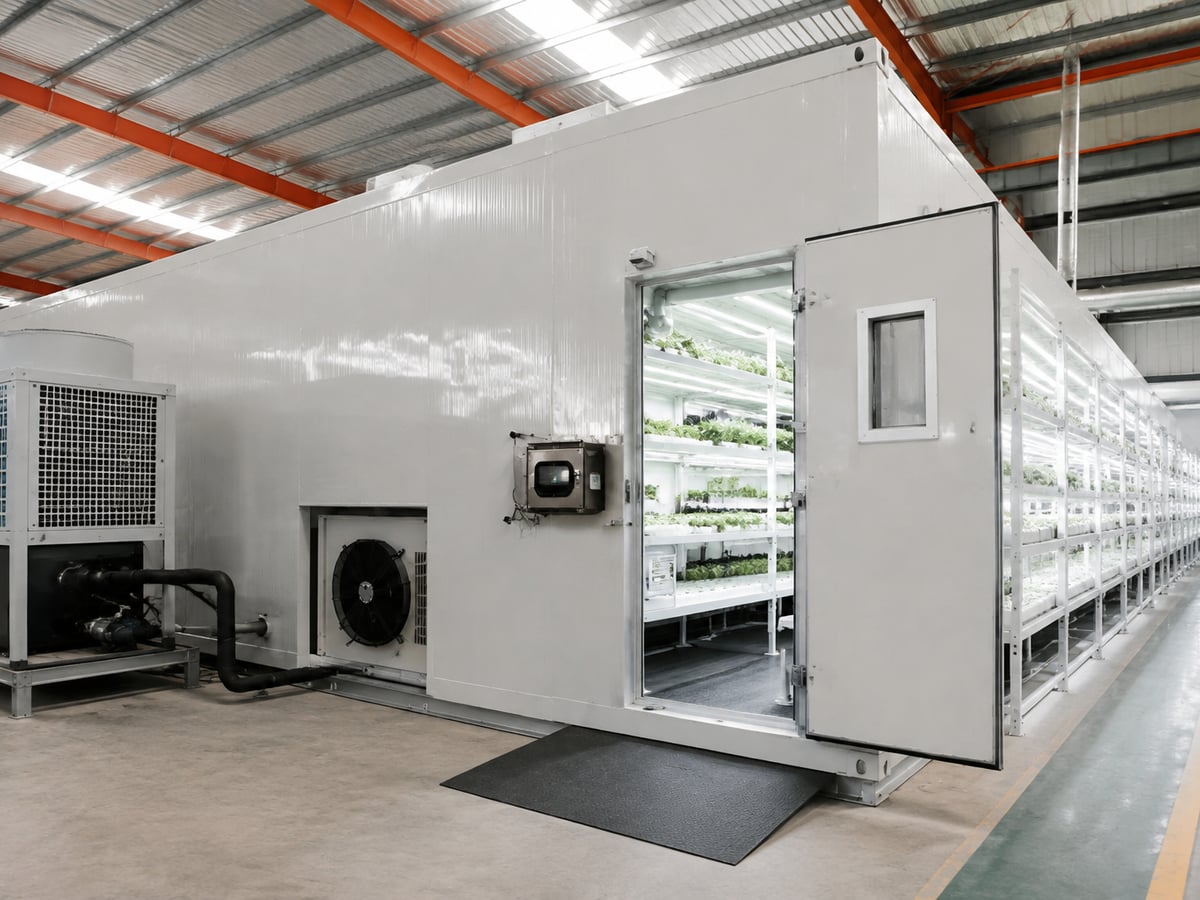
A hydroponic shipping container is a factory-built, insulated growing facility installed inside a modified shipping container. It combines vertical racks, LED grow lights, nutrient dosing, irrigation, HVAC, humidity control, sensors, and automation into one controlled-environment farming unit. Instead of relying on outdoor weather or soil quality, growers produce crops in a closed, managed environment throughout the year.
For the global market, containerized hydroponic farms are commonly used by commercial growers, food distributors, hotels, restaurants, universities, military bases, mining camps, island communities, agricultural contractors, and urban farming projects. They are especially valuable where farmland is limited, weather is extreme, water availability must be carefully managed, or fresh produce must travel long distances.
A well-designed hydroponic shipping container can produce leafy greens, herbs, microgreens, seedlings, and selected compact fruiting crops with predictable quality. Buyers should evaluate more than the container price. Crop plans, electrical supply, water treatment, local climate, operating labor, spare parts, service access, and food-safety procedures all influence the final business result.
Shandong Lanhu Air Conditioning Equipment Co., Ltd. supplies modular growing systems for international projects, including smart hydroponic plant containers designed around practical climate control, crop production, and remote management requirements.
What Is a Hydroponic Shipping Container and Who Uses It?

A hydroponic container farm is usually built from a 20-foot or 40-foot high-cube shipping container. The structure is fitted with thermal insulation, washable interior panels, food-grade water components, multi-layer cultivation racks, growing channels or trays, LED fixtures, ventilation equipment, air conditioning, and digital controls. The result is a compact indoor farm that can be transported by road, rail, or sea freight.
Unlike a conventional greenhouse, a container farm has limited exposure to outdoor sunlight, insects, dust, rainfall, and temperature swings. The grower controls photoperiod, nutrient concentration, water temperature, airflow, humidity, and carbon dioxide strategy. This makes production more consistent, although the facility requires reliable energy and disciplined operation.
Demand is increasing in global trade hubs and densely populated regions. In Singapore, Dubai, Doha, Tokyo, London, Rotterdam, Los Angeles, and Sydney, fresh greens can have high transport costs or short shelf-life challenges. Remote communities in Australia, Canada, the Middle East, Africa, and island markets can also use modular farms to reduce dependence on long supply chains.
| User Group | Typical Need | Container Farm Benefit |
|---|---|---|
| Commercial growers | Year-round harvest planning | Controlled climate and repeatable crop cycles |
| Hotels and resorts | Premium herbs and visible food production | Fresh harvest close to kitchens |
| Restaurants | Consistent specialty greens | Reduced spoilage and differentiated menus |
| Distributors | Local supply near urban customers | Shorter transport routes and faster replenishment |
| Remote sites | Reliable fresh vegetables | Production in harsh or isolated locations |
| Schools and research centers | Education and crop trials | Controlled, measurable growing conditions |
| Agricultural contractors | Modular farm deployment | Scalable projects for clients and communities |
The table shows that hydroponic containers are not limited to one farming model. A restaurant may prioritize basil and microgreens, while a distributor may focus on high-volume lettuce. A remote mining camp may value resilience and low water use more than premium branding. The correct configuration should follow the customer’s market, crop mix, and operating resources.
Container farms are also used as pilot units before larger vertical farming or greenhouse investments. A buyer can validate crop recipes, test local demand, train staff, and develop sales channels before expanding to multiple containers or a larger controlled-environment agriculture facility.
Container Layout, Growing Method, and Suitable Crops

The internal layout normally includes a personnel entrance, technical zone, nutrient tank area, cultivation room, vertical racks, drainage paths, electrical control cabinet, air handling equipment, and service access panels. A 40-foot high-cube container provides more usable growing area than a standard-height model and is frequently selected for commercial leafy-green production.
Most hydroponic container systems use nutrient film technique, deep water culture, drip irrigation, ebb-and-flow trays, or hybrid methods. Nutrient film technique is common for lettuce and herbs because a thin nutrient stream passes through channels, delivering water and dissolved minerals directly to plant roots. Deep water culture supports leafy greens using rafts or channel systems with aerated nutrient solution. Drip systems are more appropriate for some fruiting crops, though these crops need more space and stronger environmental control.
| Growing Method | Best Crop Types | Main Strength | Buyer Consideration |
|---|---|---|---|
| Nutrient film technique | Lettuce, pak choi, basil | Efficient water circulation | Channels require regular cleaning |
| Deep water culture | Leaf lettuce, kale, herbs | Stable root-zone moisture | Water aeration is essential |
| Drip hydroponics | Strawberries, peppers, tomatoes | Individual plant dosing | Higher crop-management complexity |
| Ebb-and-flow trays | Seedlings, microgreens | Flexible tray production | Drainage sanitation is important |
| Aeroponics | Specialty crops and research | High oxygen exposure | Requires dependable nozzles and filtration |
| Hybrid systems | Mixed commercial crop plans | Different zones for different crops | More controls and operator training needed |
This comparison helps buyers select an agricultural process before selecting equipment. A container intended for daily lettuce supply should not be configured in the same way as a premium herb unit or a nursery seedling facility. Crop density, seedling area, harvest access, packaging workflow, and sanitation procedures should be included in the layout discussion.
Suitable crops include butterhead lettuce, romaine lettuce, oakleaf lettuce, spinach, arugula, kale, bok choy, coriander, basil, mint, parsley, dill, chives, mustard greens, edible flowers, and microgreens. These crops generally have short cycles, compact root systems, and a favorable value-to-space ratio. Seedlings for greenhouses and outdoor farms can also be profitable where local nurseries need consistent young plants.
Tomatoes, cucumbers, peppers, and strawberries are possible but require careful evaluation. Their longer crop cycles, larger canopy, pollination needs, trellising requirements, and greater lighting load may reduce production efficiency inside a shipping container. For most first-time buyers, leafy greens and culinary herbs are the most practical commercial starting point.
Production Capacity, Rack Density, and Utility Requirements
Production capacity depends on container length, internal width, rack levels, crop spacing, crop cycle, germination area, and harvest losses. Capacity claims should always be reviewed as crop-specific estimates rather than universal promises. A dense microgreen operation and a butterhead lettuce operation cannot be measured by the same plant count.
In many 40-foot hydroponic containers, racks may have four to eight growing levels. More levels can increase planted area, but excessive rack density can make airflow, light uniformity, cleaning, and crop access more difficult. Buyers should request a layout drawing that shows aisle width, rack height, channel dimensions, tank locations, electrical panels, drainage, and service clearances.
| Specification Area | Typical Commercial Range | Why It Matters |
|---|---|---|
| Container size | 20-foot or 40-foot high-cube | Determines growing area and transport format |
| Rack levels | 4 to 8 levels | Influences planting density and access |
| Crop cycle | 10 to 45 days for greens | Determines harvest frequency |
| Electrical supply | Three-phase supply preferred | Supports lighting, HVAC, pumps, and controls |
| Water connection | Clean municipal or treated source | Protects crops and dosing equipment |
| Drain connection | Local wastewater-compliant outlet | Supports sanitation and maintenance |
| Internet connection | Wired, Wi-Fi, or cellular service | Enables remote monitoring and alarms |
The values above are planning ranges, not final engineering specifications. The actual electrical load depends heavily on local climate. A farm operating in Dubai or Riyadh may need greater cooling capacity than one operating in Rotterdam or Vancouver. Projects near tropical ports such as Jakarta, Manila, Mombasa, and Santos may need stronger dehumidification and corrosion protection because of high ambient humidity and coastal conditions.
Buyers should verify voltage, frequency, plug standards, cable sizing, circuit protection, grounding requirements, and local electrical codes before shipment. In many projects, the site should be ready with a concrete pad, electrical cabinet, water source, drain arrangement, outdoor condenser location, and safe equipment access. A backup power strategy is also recommended where electricity interruptions are common.
LED Lighting, Nutrient Dosing, Irrigation, and Water Treatment
LED lighting is one of the largest operating loads in container farming. Professional fixtures should provide appropriate photosynthetic light, consistent distribution across rack levels, efficient heat management, and a programmable daily lighting schedule. Crop recipes may adjust intensity and photoperiod depending on whether the grower is producing lettuce, basil, microgreens, or seedlings.
White-spectrum LEDs with supplemental red and blue wavelengths are widely used because they support plant growth while allowing workers to inspect leaf color, nutrient issues, and crop cleanliness. Dimmable fixtures can help growers adjust light output during early propagation, normal vegetative growth, or periods when energy costs are high.
Nutrient dosing systems blend concentrated fertilizer stock solutions with water to achieve target electrical conductivity and pH. Automatic dosing can improve consistency, but it does not eliminate the need for routine manual verification. Operators should calibrate sensors, inspect dosing lines, monitor tank levels, and maintain accurate records of crop recipes.
| System Component | Primary Function | Routine Check |
|---|---|---|
| LED fixtures | Provide crop lighting | Inspect output, timers, and heat condition |
| Nutrient tanks | Store fertilizer concentrates | Confirm levels, labels, and cleanliness |
| Dosing pumps | Add nutrients and acid/base solution | Calibrate flow and check tubing |
| Circulation pump | Move nutrient solution through the system | Check noise, pressure, and filters |
| Filtration unit | Remove particles from water | Replace or clean filters on schedule |
| UV or disinfection unit | Reduce waterborne contamination risk | Verify lamp, flow, and maintenance status |
| pH and EC sensors | Measure nutrient balance | Calibrate using approved standards |
This equipment works as a connected process. If source water has high hardness, sodium, chlorine, iron, or microbial contamination, nutrient management becomes less predictable. Depending on the location, a project may require sediment filtration, activated carbon filtration, reverse osmosis, ultraviolet treatment, or a combination of water-treatment methods.
Water recirculation is one of the key sustainability advantages of hydroponics. Compared with conventional field agriculture, a recirculating system can use substantially less water for many leafy crops. However, water savings depend on leak prevention, proper drainage design, regular tank sanitation, and careful nutrient-solution replacement. Used nutrient water should be handled according to local environmental regulations rather than discharged without planning.
HVAC, Humidity, CO2, Airflow, and Condensation Control
Climate control is the most important engineering element in a hydroponic shipping container. Plants release moisture through transpiration, LEDs add heat, and the metal container shell is exposed to outdoor temperature changes. Without correctly sized HVAC and dehumidification, crop quality can decline rapidly.
Temperature targets vary by crop, but many leafy greens grow well in moderately cool conditions. Relative humidity must be managed to reduce disease risk while preventing excessive plant stress. Rather than looking only at temperature and humidity separately, experienced operators monitor vapor pressure deficit, which describes the moisture relationship between air and leaves. This helps create a more stable transpiration environment.
Airflow should move evenly through every rack level. Weak airflow can create stagnant humid zones, edge-to-center crop variation, tip burn, powdery mildew risk, and condensation on walls or ceilings. Properly positioned fans, supply air paths, return air paths, insulated panels, and sealed penetrations all help maintain uniform conditions.
| Climate Factor | Operational Goal | Risk If Poorly Controlled |
|---|---|---|
| Air temperature | Maintain crop-specific growth conditions | Slow growth, bolting, or heat stress |
| Relative humidity | Balance transpiration and disease control | Condensation and fungal pressure |
| Airflow | Distribute heat and moisture evenly | Uneven crop size and leaf disorders |
| Carbon dioxide | Support photosynthesis where appropriate | Limited growth or unnecessary gas use |
| Dehumidification | Remove plant-generated moisture | Wet surfaces and equipment corrosion |
| Insulation | Reduce heat transfer and condensation | High energy consumption and water droplets |
| Fresh-air exchange | Maintain safe, healthy air conditions | Stale air and unstable climate conditions |
The table highlights why a shipping container is not simply a rack of lights placed inside steel walls. It is a compact mechanical system. Sizing should account for summer peak temperatures, winter low temperatures, solar exposure, crop transpiration, lighting heat, door opening frequency, and site elevation.
Carbon dioxide enrichment can increase growth under the right conditions, particularly when light, temperature, water, and nutrition are already well controlled. Yet it must be designed with worker safety, ventilation requirements, gas monitoring, and local regulations in mind. For new operators, stable temperature, humidity, airflow, sanitation, and crop scheduling should be mastered before implementing aggressive CO2 enrichment programs.
Sensors, App Control, Automation, and Remote Alarms
Modern hydroponic shipping containers can include sensors for air temperature, humidity, water temperature, pH, electrical conductivity, tank level, flow rate, leak detection, door status, carbon dioxide, lighting status, and equipment faults. These measurements allow the operator to make decisions based on data rather than visual inspection alone.
A cloud-connected controller or mobile app can display real-time conditions, historical trends, alarm status, and operational setpoints. Remote access is useful for growers managing multiple sites across different cities or countries. For example, a project operator may monitor a container near the Port of Rotterdam while working from another European office, or supervise units in Nairobi, Dubai, and Kuala Lumpur through a centralized dashboard.
Automation can control lights, pumps, dosing, irrigation intervals, fans, HVAC equipment, alarm thresholds, and scheduled cleaning reminders. The best automation design still allows manual override. Operators must be able to respond safely if a sensor fails, internet service is interrupted, or a component requires maintenance.
The chart illustrates the type of data a controller can record during a typical production day. Stable trends are usually more valuable than constantly changing setpoints. When a temperature or humidity spike occurs, remote alarms can notify the operator by app message, email, or other configured communication methods.
Before purchase, ask whether the controller supports multilingual interfaces, data export, remote firmware updates, user-permission levels, alarm history, manual control, and compatibility with local network conditions. For commercial projects, the control system should simplify operations rather than create dependence on a proprietary interface that cannot be serviced locally.
Installation, Training, Maintenance, and Warranty
Installation starts before the container arrives. The project site should have stable ground, adequate drainage, vehicle access, lifting clearance, electrical infrastructure, a water connection, a wastewater plan, and a safe area for outdoor equipment. In ports and industrial zones such as Hamburg, Jebel Ali, Antwerp, Busan, and Houston, logistics planning should also consider crane scheduling, customs documentation, container delivery timing, and local site safety rules.
After placement, technicians connect utilities, test equipment, check water circulation, verify lighting schedules, calibrate sensors, inspect drainage, confirm climate-control operation, and run the system before planting. A commissioning process should include no-load and loaded testing, with the latter reflecting actual light and moisture loads created by growing plants.
Training should cover seed handling, germination, transplanting, nutrient management, pH and EC verification, harvesting, cleaning, pest prevention, food hygiene, alarm response, and basic maintenance. Good crop results depend on staff discipline as much as on technology.
| Maintenance Task | Suggested Frequency | Purpose |
|---|---|---|
| Check pH and EC readings | Daily | Maintain nutrient accuracy |
| Inspect pumps and water flow | Daily | Prevent crop dehydration |
| Review temperature and humidity logs | Daily | Identify climate instability early |
| Clean filters and drain points | Weekly | Maintain flow and sanitation |
| Inspect lighting and electrical connections | Monthly | Reduce operational failures |
| Calibrate sensors | Monthly or as required | Protect automated dosing decisions |
| Deep-clean growing channels and tanks | Between crop cycles | Lower biofilm and disease risk |
The maintenance schedule above should be adjusted to crop load, water quality, operating hours, and manufacturer guidance. Buyers should confirm warranty coverage for major components, response procedures for faults, recommended spare-parts lists, and whether remote technical support is available in their time zone.
A practical spare-parts package often includes sensors, dosing tubes, filters, pump seals, fuses, relays, LED drivers, valves, and controller accessories. Keeping critical parts on site can prevent a minor issue from becoming a crop-loss event, especially in remote locations.
Our Company
Shandong Lanhu Air Conditioning Equipment Co., Ltd. serves agricultural contractors, equipment distributors, engineering companies, and commercial growers seeking modular climate-controlled cultivation solutions. The company combines hydroponic container design with expertise in agricultural climate management, industrial HVAC, mushroom cultivation systems, and air source heat pump applications.
From a technological perspective, Lanhu applies more than 12 years of thermodynamic research and development experience to controlled-environment agriculture. Its engineering work focuses on the relationship between cooling, heating, dehumidification, airflow, insulation, water circulation, and digital control. This capability is important because successful container farming depends on coordinated systems rather than individual components.
From a manufacturing perspective, the company operates a modern production facility of more than 30,000 square meters in Dezhou, Shandong, China. Integrated operations include engineering development, sheet-metal fabrication, CNC bending, insulation-panel production, electrical assembly, equipment integration, testing, and quality inspection. Functional inspection, electrical verification, performance testing, and operational evaluation are completed before shipment. Lanhu also holds ISO 9001, ISO 14001, ISO 45001, and ISO 12100 certifications, supported by more than 45 registered patents.
From a service perspective, Lanhu provides factory-direct supply, customized OEM and ODM development, project engineering support, international logistics coordination, installation guidance, operator training assistance, spare-parts support, and after-sales service. Buyers needing custom branding, revised layouts, local voltage adaptation, or specialized climate requirements can explore the company’s OEM and ODM customization service.
For projects that combine container agriculture with broader energy planning, buyers may also consider Lanhu’s air source heat pump solutions. Application examples and project references are available through the company’s container farming case studies. For quotation requests, technical drawings, and project consultation, contact the team through the international inquiry page.
Looking toward 2026, global hydroponic container farming is expected to place greater emphasis on energy efficiency, low-global-warming-potential refrigerants, renewable-energy integration, water recirculation, traceability, remote diagnostics, and data-driven crop recipes. Policy trends in many markets increasingly favor resilient local food systems, reduced water consumption, and shorter supply chains. Buyers should select equipment that can be maintained, upgraded, and adapted as these requirements develop.
FAQ
How much does a hydroponic shipping container cost?
Cost varies according to container size, insulation level, rack density, LED specification, HVAC capacity, automation, water treatment, shipping route, and customization. Buyers should compare complete delivered-system scope instead of evaluating only the base container price.
Can a container farm operate in hot or cold climates?
Yes, if HVAC, insulation, dehumidification, and electrical design are sized for the local climate. A container operating in desert heat, tropical humidity, or northern winter requires site-specific engineering.
What crops are most profitable in a hydroponic container?
Profitability depends on local selling price, energy cost, labor, packaging, and customer demand. Lettuce, basil, specialty herbs, microgreens, and seedlings are common starting crops because they have relatively short cycles and fit vertical systems well.
How much water does a hydroponic container use?
Recirculating systems can use far less water than open-field production for many leafy crops. Actual consumption depends on crop type, ambient climate, sanitation practices, leaks, and whether water treatment rejects a portion of the incoming supply.
Does the container need three-phase electricity?
Three-phase power is often preferred for commercial systems because it supports HVAC, lighting, pumps, and controls more efficiently. The required voltage and frequency should be confirmed before manufacturing.
How many people are needed to operate one unit?
A small container farm can often be managed by one trained operator for daily checks, seeding, transplanting, harvesting, cleaning, and recordkeeping. Labor needs increase when packing, delivery, retail sales, or multiple containers are added.
Can the system be monitored remotely?
Many smart hydroponic container designs support remote monitoring of temperature, humidity, pH, EC, water level, lighting, and alarms. Reliable internet access and clear alarm-response procedures are still necessary.
What should buyers request before ordering?
Request layout drawings, utility requirements, crop capacity assumptions, electrical load information, component lists, warranty terms, training scope, spare-parts recommendations, shipping details, and after-sales service procedures. A clear technical proposal reduces installation risks and improves long-term operating confidence.
Share this article

About the Author: Shandong Lanhu Air Conditioning Equipment
Lanhu is a professional climate control equipment manufacturer specializing in smart agricultural systems, commercial HVAC solutions, and customized temperature control technologies. With extensive engineering experience, Lanhu provides reliable solutions for plant factories, controlled environment agriculture, and industrial applications.
Need a Custom Climate Control Solution?
From smart agricultural systems to commercial HVAC solutions, Lanhu provides reliable temperature and humidity control solutions tailored to your project needs.
Contact Us