Global Market Commercial Mushroom Farm Cost Guide 2026
Quick Answer: Commercial Mushroom Farm Cost

The cost of a commercial mushroom farm in the Global Market can range from approximately US$80,000 for a small controlled-environment operation to more than US$2 million for a highly automated, multi-room production facility. A practical budget depends on species, capacity, site conditions, local construction prices, labor availability, energy tariffs, cooling requirements, production method, and food-safety expectations.
For many buyers, the core investment is not simply a growing room. A profitable mushroom project requires an integrated system: insulated cultivation rooms or containers, climate control, humidification, fresh-air exchange, cooling or heating, racks, lighting, electrical distribution, water treatment, sanitation zones, packing space, monitoring hardware, and a reliable supply of substrate or compost. The lowest purchase price may not deliver the lowest long-term farming cost.
As a general planning benchmark, a containerized oyster mushroom or specialty mushroom unit may require US$35,000 to US$120,000 per production module, depending on dimensions, automation, climate zone, and included equipment. A conventional indoor farm using insulated panels may range from US$300 to US$1,100 per square meter of production area before land acquisition, depending on regional building requirements and level of environmental control.
Commercial farms near logistics centers such as Rotterdam, Dubai, Singapore, Los Angeles, Hamburg, Durban, São Paulo, Mumbai, and Melbourne may benefit from stronger buyer access but can face higher land, labor, utility, and compliance costs. Projects in lower-cost industrial areas can reduce initial investment, yet operators must still ensure dependable cold-chain access and routes to wholesale markets.
For a customized estimate, buyers should define the target species, weekly output, fresh or dried sales format, climate conditions, available utilities, local regulatory requirements, and preferred level of automation before comparing quotations.
| Farm Scale | Typical Output Range | Indicative Investment | Suitable Model | Main Buyer Type |
|---|---|---|---|---|
| Pilot farm | 100–300 kg/week | US$80,000–US$180,000 | One to two controlled rooms or containers | Restaurants, local retailers, farm shops |
| Small commercial farm | 300–1,000 kg/week | US$180,000–US$600,000 | Multiple fruiting rooms with packing area | Distributors, supermarkets, food service |
| Regional producer | 1–5 tonnes/week | US$600,000–US$2 million | Multi-room facility with cold storage | Wholesale markets and chain stores |
| Industrial operation | 5–20 tonnes/week | US$2–8 million+ | Automated rooms and high-volume logistics | National retailers and processors |
| Specialty medicinal farm | Variable by product format | US$150,000–US$1.5 million+ | Controlled grow, drying, extraction support | Nutraceutical and wellness brands |
| Compost-to-harvest farm | Large-scale volume | US$3 million+ | Full substrate, growing, packing operation | Integrated distributors and retailers |
This table is a planning guide rather than a fixed quotation. The estimate changes substantially when a project includes composting, sterilization, substrate bagging, cold storage, grading, processing, solar power, backup generation, or automated harvesting systems.
Typical Commercial Cost Structure

A commercial mushroom farm budget should separate capital expenditure from operating expenditure. CAPEX covers durable assets purchased before production starts, while OPEX covers recurring expenses needed to grow, harvest, pack, sell, and maintain the crop. This distinction is important because a low initial equipment budget can create higher recurring costs through inefficient cooling, poor humidity control, labor-intensive workflows, or increased crop loss.
In a typical controlled-environment mushroom project, building and room preparation account for 20% to 40% of investment, climate equipment and controls represent 20% to 35%, racking and cultivation infrastructure represent 10% to 20%, and electrical, plumbing, commissioning, freight, and contingency make up the balance. In regions with strict construction standards, fire systems, drainage requirements, food-grade finishes, or high connection fees, the site-related portion may be substantially higher.
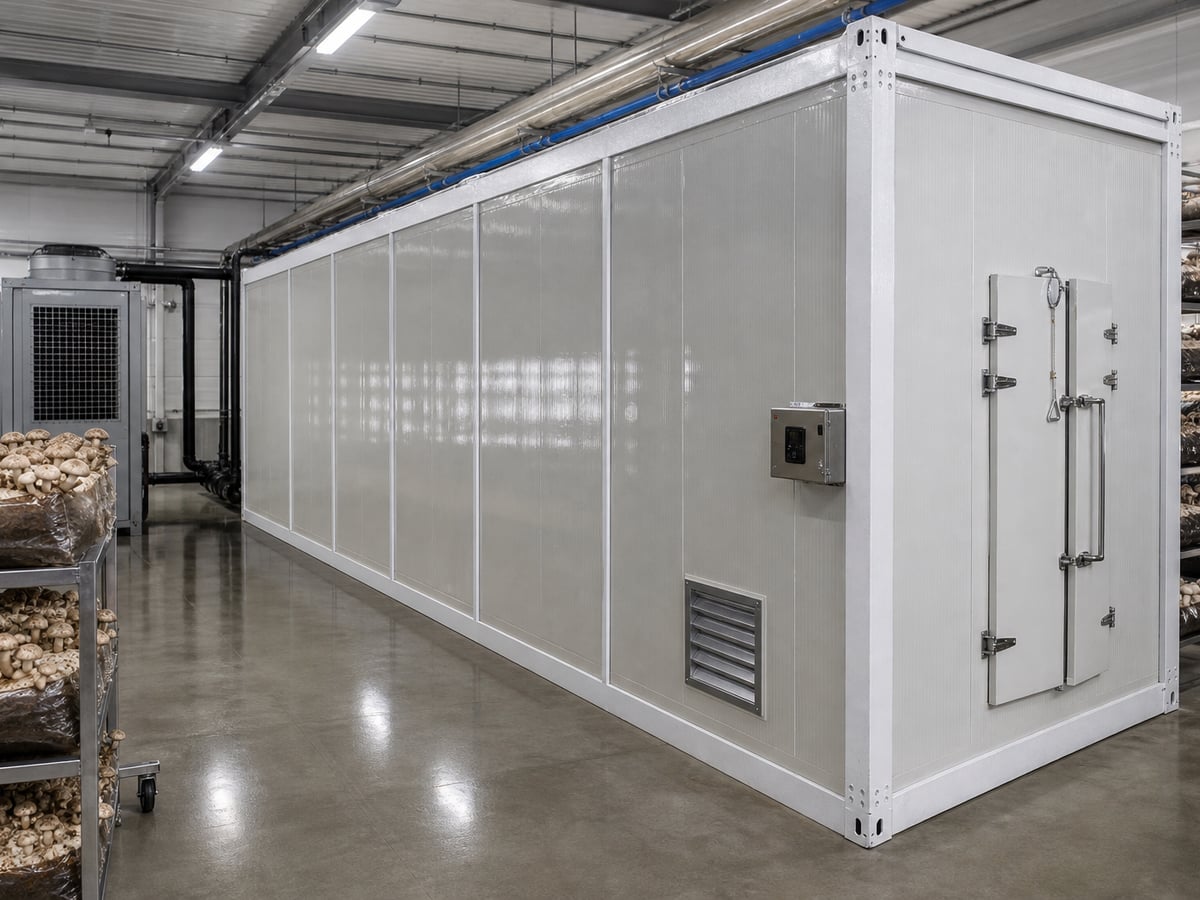
For container-based farms, the allocation differs. The insulated container shell, refrigeration or heat pump equipment, ventilation system, humidification, climate controller, racks, electrical cabinet, sensors, and factory testing form the main equipment package. This approach can shorten installation time, reduce on-site construction work, and make capacity expansion more modular.
| Cost Category | Typical Share of CAPEX | Examples | Cost Control Approach |
|---|---|---|---|
| Site and civil works | 10%–30% | Concrete, drainage, access roads, foundations | Use existing industrial buildings where appropriate |
| Building envelope | 15%–30% | Insulated panels, doors, hygiene finishes | Specify insulation for local climate conditions |
| Climate control equipment | 20%–35% | Cooling, heating, air handling, humidification | Select energy-efficient integrated systems |
| Cultivation equipment | 10%–20% | Racks, trays, hanging systems, carts | Match layout to crop handling method |
| Utilities and controls | 8%–18% | Electrical panels, sensors, piping, controllers | Allow spare electrical and control capacity |
| Logistics and contingency | 5%–15% | Freight, import duty, installation, training | Include a realistic risk allowance early |
Buyers should request an itemized proposal that clearly identifies what is included and excluded. For example, a quoted price may cover climate equipment but exclude shipping, local taxes, civil work, power connection upgrades, cranes, installation labor, substrate equipment, and post-harvest refrigeration. Transparent scope definition helps prevent budget gaps.
CAPEX: Equipment, Building, Utilities, and Controls

CAPEX is the investment required to create a farm capable of consistent production. The largest technical decisions are usually the type of growing structure, cooling and heating strategy, air distribution design, humidity generation method, room zoning, racking density, and level of automation. These decisions should be based on local weather data, not only on average annual temperature.
In hot and humid climates, farms often need stronger dehumidification, insulation, airflow management, and cooling capacity. In cold regions, heating and heat recovery may have greater importance. In dry climates, humidification water demand can increase. Coastal sites near ports such as Jebel Ali, Rotterdam, Santos, Long Beach, or Singapore should also consider corrosion resistance, electrical protection, and reliable service access.
A well-designed mushroom growing environment typically manages temperature, relative humidity, fresh-air intake, carbon dioxide concentration, airflow velocity, and lighting cycles. Oyster mushrooms, shiitake, lion’s mane, enoki, button mushrooms, and medicinal varieties have different environmental requirements. A controller must support programmable recipes and alarm logic rather than operate only as a basic thermostat.
For modular projects, a smart mushroom cultivation container can combine insulation, cultivation racks, climate management, electrical systems, and operational monitoring in one factory-built unit. This is especially useful for new market entrants, remote agricultural projects, urban farms, research centers, and distributors seeking repeatable deployment.
| CAPEX Item | Why It Matters | Typical Specification Choice | Potential Risk if Undersized |
|---|---|---|---|
| Insulated structure | Limits heat gain, heat loss, and condensation | Food-grade insulated sandwich panels | High energy use and unstable climate |
| Cooling and heating system | Maintains crop temperature year-round | Heat pump or refrigeration-based system | Seasonal production losses |
| Fresh-air ventilation | Controls CO2 and removes excess heat | Variable-speed fans with filtered intake | Long stems, poor caps, low yield |
| Humidification system | Supports pinning and crop quality | High-pressure mist or ultrasonic humidification | Drying, cracking, or bacterial risk |
| Climate controller | Coordinates all environmental equipment | Recipe-based smart controller with alarms | Manual errors and inconsistent batches |
| Racks and handling tools | Determines usable growing area and labor flow | Galvanized or stainless cultivation racks | Low room utilization and difficult cleaning |
| Cold room and packing zone | Protects shelf life after harvest | Pre-cooling and refrigerated storage | High shrinkage and rejected deliveries |
Utilities deserve detailed attention. A farm may require three-phase electricity, stable water pressure, drainage, internet connectivity, ventilation discharge routes, and emergency power arrangements. In regions with unreliable grids, a generator, battery storage, or hybrid solar system may be financially justified because several hours of climate failure during a heat event can damage an entire crop cycle.
Controls are increasingly central to farm value. A smart mushroom climate controller can collect sensor readings, automate equipment responses, maintain crop recipes, provide remote access, and trigger alarms for temperature, humidity, CO2, fan faults, or water shortages. Better data supports more disciplined crop management and more accurate future capacity planning.
OPEX: Energy, Labor, Water, Consumables, and Maintenance
Operating expenses determine whether a farm can remain profitable after the initial investment. For most commercial mushroom businesses, substrate or compost, labor, energy, packaging, logistics, and crop losses are the most important recurring cost drivers. The exact ranking varies by mushroom species and country.
Energy can be particularly significant for farms in tropical, desert, continental, or high-humidity regions. Cooling demand rises during hot periods, while ventilation and humidity control can run continuously. High-efficiency fans, insulated panels, inverter-driven compressors, heat pumps, variable-speed equipment, properly sized ducts, and intelligent control sequences can reduce avoidable consumption.
Labor includes receiving substrate, loading rooms, harvesting, trimming, weighing, packing, cleaning, monitoring crops, maintaining equipment, and managing sales. The farm layout should minimize walking distances and repeated handling. High-density racks may increase output per square meter, but only if safe access, airflow, cleaning procedures, and harvesting ergonomics are maintained.
| OPEX Category | Typical Cost Influence | What Drives It | Management Method |
|---|---|---|---|
| Substrate or compost | Very high | Species, supplier distance, contamination rate | Use qualified suppliers and incoming checks |
| Electricity and fuel | High | Climate, insulation, tariff structure, equipment efficiency | Monitor kWh per kg harvested |
| Labor | High | Harvest frequency, packing format, wage level | Improve workflow and standard operating procedures |
| Water and treatment | Low to medium | Humidification method and water quality | Filter water and prevent nozzle blockage |
| Packaging | Medium | Retail format, labeling, food safety requirements | Standardize pack sizes and reduce waste |
| Maintenance and spare parts | Medium | Operating hours, dust, corrosion, service access | Schedule preventive maintenance |
| Sales and distribution | Medium to high | Delivery radius, cold chain, customer terms | Consolidate routes and plan harvest to orders |
Water is often underestimated. Although mushrooms do not consume water in the same way as hydroponic crops, farms still need water for humidification, cleaning, sanitation, cooling systems, and staff welfare. Water with high mineral content can block misting nozzles and reduce humidification efficiency. Testing the water supply before final equipment selection is advisable.
Preventive maintenance should include filter replacement, drain inspection, sensor calibration, fan checks, humidifier cleaning, electrical tightening, refrigeration service, door seal inspection, rack repairs, and cleaning of evaporator and condenser coils. A maintenance budget is far lower than the cost of unexpected production downtime.
Capacity and Production Assumptions Behind the Estimate
Cost estimates are only useful when the production assumptions are realistic. Buyers should avoid calculating revenue from the maximum theoretical rack capacity. Actual output depends on substrate quality, biological efficiency, crop recipe, growing density, flush count, contamination level, labor quality, harvest timing, and post-harvest rejection rates.
A production model should define the number of rooms, usable rack area, loading frequency, incubation period, fruiting duration, crop turnover days, expected yield per bag or block, harvest grade, and loss allowance. For example, a farm targeting 1 tonne per week should normally plan more than 1 tonne of gross biological capacity because some product will be lower grade, delayed, contaminated, or unsold.
Modular farms can scale in stages. A producer may start with one or two units to validate local demand, establish substrate supply, train staff, and build a customer base. Once sales and operating data are stable, additional units can be installed. This phased approach can reduce financial risk compared with building a large facility before market demand is confirmed.
| Production Assumption | Example Planning Range | Effect on Financial Model | Verification Method |
|---|---|---|---|
| Room utilization | 70%–90% of design capacity | Changes annual output directly | Review loading and empty-room time |
| Yield per substrate unit | Species and substrate dependent | Determines crop revenue per cycle | Run pilot batches and keep records |
| Crop cycle duration | Several weeks to several months | Sets turnover and cash conversion timing | Use supplier and farm trial data |
| First-grade packout | 75%–95% | Influences average selling price | Track grading and customer returns |
| Contamination loss | 2%–15% or more during poor control | Can eliminate projected margin | Monitor hygiene and substrate quality |
| Weekly sales capacity | Based on contracted demand | Prevents oversupply and waste | Secure buyer commitments early |
The best planning method combines biological data with commercial data. A high-yield crop has limited value if the local market only accepts low prices. Conversely, premium restaurants and specialty retailers may pay more for consistent freshness, traceability, unique varieties, or pesticide-free production, but they usually require reliable delivery and attractive packaging.
Specifications and Customization That Change Price
Commercial mushroom farm pricing changes when buyers request customized dimensions, higher insulation values, different electrical standards, special corrosion protection, remote monitoring, additional racks, stainless steel components, multi-zone controls, cold storage, automated doors, solar integration, or specialized equipment for a particular mushroom species.
Customization is often valuable when it solves a real operational problem. For example, a farm in Riyadh may prioritize high cooling capacity and solar-load protection. A project in Northern Europe may need stronger heating performance and heat recovery. A coastal farm in Southeast Asia may need anti-corrosion materials. A remote African project may require generator-ready electrical design and simplified service access.
Buyers should distinguish between essential customization and decorative complexity. Essential customization improves yield, efficiency, compliance, durability, or safety. Nonessential additions may increase CAPEX without generating measurable commercial value. Ask suppliers to explain how each option affects production, maintenance, power consumption, and replacement-part availability.
Lanhu supports project-specific configurations through its OEM and ODM customization service. The company can adapt modular cultivation solutions, controllers, air handling components, electrical configurations, and internal layouts for contractors, distributors, engineering companies, and commercial growers.
Yield, Revenue, Margin, and Break-Even Scenarios
A farm’s financial performance should be evaluated using contribution margin, not sales revenue alone. Revenue equals saleable kilograms multiplied by the average realized selling price. From this amount, operators deduct substrate, packaging, direct labor, utilities, freight, sales commissions, and crop waste. The remaining contribution must cover administration, repairs, financing, depreciation, rent, taxes, and profit.
Break-even analysis should include conservative scenarios. A robust project can continue operating if yield falls by 10%, energy costs rise by 20%, or selling price declines due to seasonal supply. Projects that only work under perfect assumptions may struggle when market conditions change.
| Scenario | Yield Performance | Average Selling Price | OPEX Condition | Likely Financial Result |
|---|---|---|---|---|
| Conservative | Below target by 10%–15% | Lower wholesale price | Energy and labor above budget | Slow payback; focus on cost correction |
| Base case | Near validated target | Mixed wholesale and retail sales | Budgeted cost level | Stable operating margin |
| Optimized case | Consistent high-grade output | Premium customer mix | Efficient labor and energy use | Faster payback and expansion potential |
| High-energy-risk case | Target yield maintained | Stable price | Electricity rises 25% | Margin pressure; efficiency becomes critical |
| Oversupply case | Target yield maintained | Price declines 15%–25% | Normal operating cost | Need product differentiation or processing |
| Crop-loss case | Contamination or climate failures | Normal price | Higher waste and rework | Potential loss without contingency reserve |
Potential revenue enhancement strategies include selling several mushroom varieties, supplying chefs with specialty products, offering ready-to-cook retail packs, selling dried mushrooms, using lower-grade mushrooms in powders or sauces, and converting spent substrate into compost or soil-amendment partnerships where regulations allow.
However, processing adds complexity. Drying, milling, extraction, labeling, and food-safety compliance require additional equipment, quality control, and market expertise. A fresh mushroom business should first establish reliable crop quality and customer relationships before investing heavily in downstream processing.
Hidden Costs, Risk Allowances, and Sensitivity Analysis
Hidden costs can disrupt a farm budget even when the main cultivation equipment is correctly priced. Common omissions include land preparation, foundations, drainage, fire protection, permits, environmental assessments, import duty, customs clearance, local electrical work, cranes, insulation repairs, backup power, staff training, initial spare parts, packaging design, food testing, certification, product insurance, and working capital.
Working capital is especially important because expenses begin before sales become regular. The farm may need to purchase substrate, pay staff, run climate systems, and fund packaging for several production cycles before customer payments are received. Wholesale buyers may also have payment terms of 30 to 60 days.
A sensible risk allowance is often 10% to 15% of project CAPEX for smaller farms and may be tailored after a detailed engineering review. Projects involving international shipment, challenging sites, uncertain utility infrastructure, or specialized compliance requirements may need a larger contingency.
Sensitivity analysis should test at least five variables: yield, selling price, electricity price, labor cost, and substrate cost. The management team should identify the break-even point for each variable and establish actions to take if performance falls below target. For example, if electricity costs increase, the response may include changing cooling schedules, improving insulation, adjusting fresh-air timing, adding solar capacity, or renegotiating utility tariffs.
Future trends in 2026 and beyond include smart sensor networks, remote crop management, predictive maintenance, heat recovery, low-GWP refrigerants, renewable-energy integration, water-saving humidification, traceability systems, and modular production close to urban consumers. Sustainability policies are also influencing packaging choices, energy reporting, food traceability, and waste management in many Global Market regions.
Producers that measure kWh per kilogram, water per kilogram, labor hours per kilogram, substrate conversion, and customer rejection rates will be better positioned to respond to new sustainability reporting requirements and buyer expectations.
Our Company
Shandong Lanhu Air Conditioning Equipment Co., Ltd. provides agricultural climate control equipment and modular cultivation solutions for commercial farming projects worldwide. Its approach combines cultivation environment engineering with industrial HVAC knowledge, helping customers evaluate equipment selection according to crop type, climate, capacity, and operating goals.
Technological capabilities: Lanhu has more than 12 years of thermodynamic research and development experience and more than 45 registered patents. Its systems are designed to manage the critical growing parameters of mushroom production, including temperature, humidity, ventilation, CO2 control, and automated operational logic. Smart controls can help growers use standardized crop recipes, monitor conditions remotely, and receive alerts when operating values deviate from set points.
Manufacturing capabilities: The company operates a manufacturing facility of more than 30,000 square meters in Dezhou, Shandong, China. Internal capabilities include product design, engineering development, sheet metal fabrication, CNC bending, insulation panel production, electrical assembly, equipment integration, testing, and quality inspection. Systems undergo functional, electrical, performance, and operational checks before shipment. Management systems include ISO 9001, ISO 14001, ISO 45001, and ISO 12100 certifications.
Service capabilities: Lanhu offers factory-direct supply, OEM and ODM support, engineering assistance, international logistics coordination, spare-parts support, installation guidance, and after-sales service. The company works with agricultural contractors, equipment distributors, engineering firms, and commercial farm investors. Buyers can review practical deployment examples through the mushroom cultivation project cases and discuss site-specific requirements through the project inquiry team.
For Global Market customers, the recommended starting point is a technical consultation that defines the mushroom species, target output, local climate, electricity standard, available space, water conditions, logistics route, and desired level of automation. This produces a more accurate commercial mushroom farm cost estimate than selecting equipment solely from a standard price list.
FAQ
How much does it cost to start a commercial mushroom farm?
Small controlled-environment farms may begin around US$80,000 to US$180,000, while larger commercial operations can require US$600,000 to several million dollars. The final budget depends on farm capacity, construction method, climate equipment, automation, and local site costs.
Is a mushroom container cheaper than building a farm?
A container can reduce on-site construction time and provide a pre-engineered climate-controlled environment. It is often attractive for phased expansion, urban farms, remote sites, and pilot projects. A larger fixed facility may offer a lower cost per kilogram at high production volume, but it usually requires more site work and longer construction planning.
What is the biggest operating cost in mushroom farming?
Substrate or compost, labor, and energy are usually the leading expenses. Their importance differs by species, local utility tariffs, climate, wage rates, and degree of automation.
How long does commercial mushroom farm payback take?
Payback varies widely. A well-operated farm with validated demand, stable yield, and good pricing may target several years, while a poorly matched project can take much longer or fail to reach break-even. Conservative yield and price assumptions should always be used before financing.
Which mushrooms are suitable for controlled-environment farms?
Oyster mushrooms, shiitake, lion’s mane, enoki, button mushrooms, king oyster mushrooms, and several medicinal varieties can be produced in controlled environments. The best selection depends on local demand, substrate availability, grower expertise, and target selling price.
What information is needed for a detailed quotation?
Suppliers normally need the target mushroom species, desired weekly output, project location, outside climate, available building or land dimensions, electrical supply, water quality, preferred room or container format, automation requirements, and shipping destination.
Share this article

About the Author: Shandong Lanhu Air Conditioning Equipment
Lanhu is a professional climate control equipment manufacturer specializing in smart agricultural systems, commercial HVAC solutions, and customized temperature control technologies. With extensive engineering experience, Lanhu provides reliable solutions for plant factories, controlled environment agriculture, and industrial applications.
Need a Custom Climate Control Solution?
From smart agricultural systems to commercial HVAC solutions, Lanhu provides reliable temperature and humidity control solutions tailored to your project needs.
Contact Us