Mushroom Rack Selection Guide for the Global Market 2026
Quick Answer: Choose Racks Around the Crop, Not the Other Way Around

For commercial mushroom production in the Global Market, the right rack is determined by the growing method, substrate package, room dimensions, climate-control strategy, cleaning routine, and total operating load. A rack that appears strong in an empty room may become unstable after it is filled with wet blocks, harvest tools, trays, humidifiers, and workers moving between levels.
As a practical starting point, select a modular galvanized steel or stainless-steel rack with adjustable shelves, corrosion-resistant fasteners, braced frames, and a documented load rating for every shelf. Leave enough vertical clearance for the largest fruiting bodies, enough horizontal space for air circulation, and enough aisle width for harvesting and sanitation. Rack height should also match the safe reach of workers and the available ceiling height.
For oyster mushrooms grown in hanging bags or blocks, open racks with generous airflow paths are often suitable. For shiitake blocks, denser shelf arrangements may be possible, but the rack must still allow even humidity distribution and inspection. For button mushrooms in trays, shelf spacing, tray depth, trolley access, and harvesting posture require a different layout. The most reliable purchasing process begins with a scaled room drawing rather than a catalogue photograph.
- Confirm the wet weight of bags, blocks, trays, and accessories before choosing a load rating.
- Use shelf spacing that protects mushroom clearance and permits inspection from the aisle.
- Specify coatings and fasteners for continuous exposure to high humidity, condensation, and cleaning chemicals.
- Keep airflow channels open between shelf levels and avoid solid panels that block supply air.
- Review rack drawings, anchoring details, aisle dimensions, and cleaning access before fabrication.
In rooms supplied by a climate controller, rack geometry directly affects temperature, carbon dioxide removal, humidity uniformity, and fan energy use. A well-designed rack layout can therefore improve both yield consistency and the useful capacity of the room.
Matching Rack Designs to Bags, Blocks, Trays, and Containers

The first buying decision is the relationship between the rack and the growing unit. Mushroom bags and blocks differ in weight, shape, support requirements, and preferred airflow. A rack designed for shallow trays should not automatically be used for heavy rectangular blocks. Likewise, a structure designed for hand loading may not be suitable for carts or automated handling.
Oyster mushroom bags are often tall, flexible, and loaded with wet substrate. They may be placed upright on shelves, laid horizontally, or supported in rows. Upright bags require sufficient vertical clearance for fruiting clusters and stable shelf edges to prevent rolling. If the bags hang from rails, the upper frame must resist point loads and repeated movement during loading.
Shiitake blocks are usually denser and more stable than loose bags, but their high moisture content creates substantial shelf loads. Blocks may be arranged in rows with a small gap between units. The rack should prevent direct contact between blocks and the wall so workers can inspect contamination, remove spent substrate, and clean behind the crop.
For button mushrooms, tray racks or mobile shelves are common. These systems need accurate shelf alignment because trays are repeatedly inserted and removed. A small frame deformation can make the upper levels difficult to operate. Tray edges should be supported continuously or at clearly engineered points, and the rack should accommodate the weight of compost, casing soil, and water.
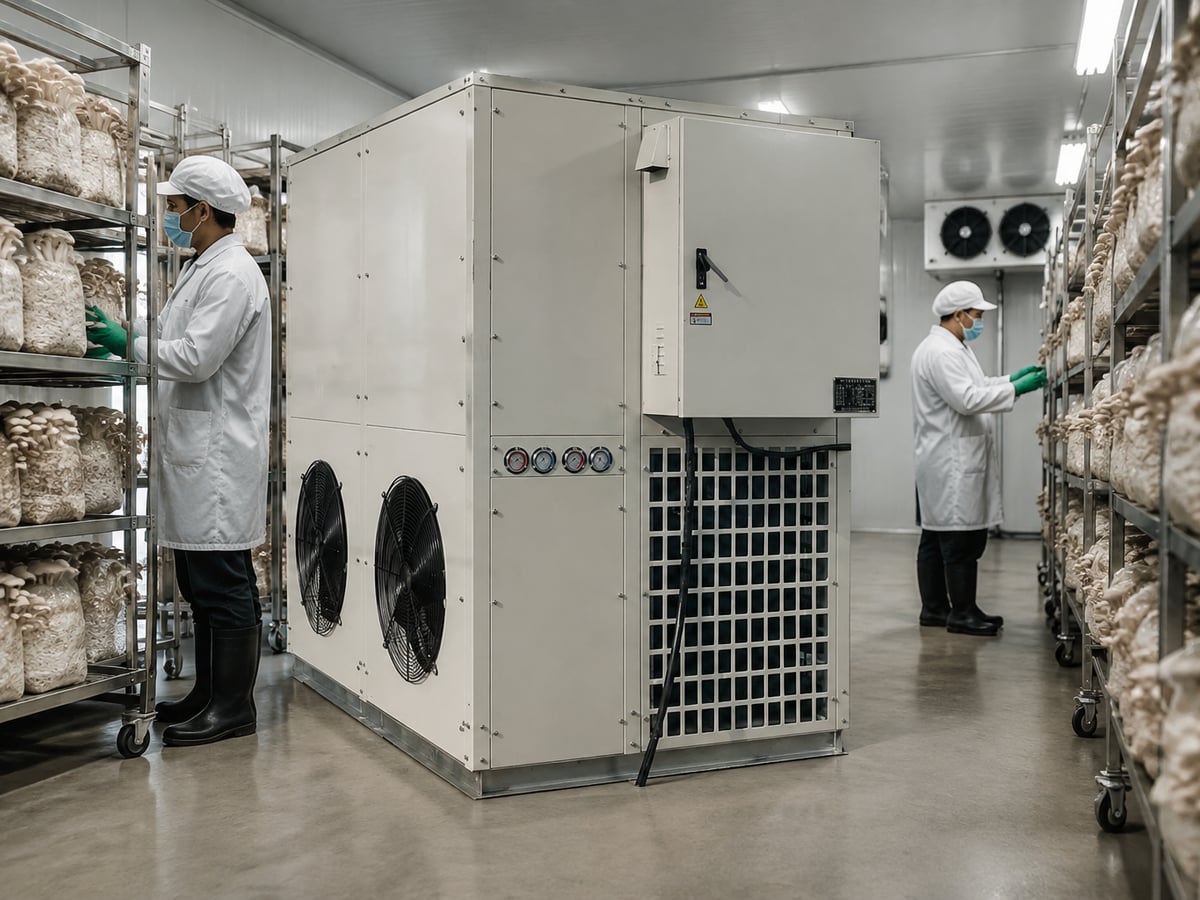
Containerized farms often use racks inside insulated cultivation rooms or smart mushroom cultivation containers. In these applications, the rack must be coordinated with evaporators, duct outlets, return-air openings, lighting, sensors, drains, and access doors. A high-density layout can be productive, but only when the climate system is designed around the real obstruction created by the shelves and crop.
| Rack format | Suitable crop unit | Main advantage | Primary risk | Recommended design feature | Typical operating setting |
|---|---|---|---|---|---|
| Fixed multi-tier shelf | Shiitake blocks and upright bags | Stable and economical | Limited access to rear areas | Adjustable shelf levels and rear clearance | Permanent fruiting rooms |
| Open wire shelf rack | Oyster bags and small blocks | Good air passage and visibility | Small bags may shift through openings | Suitable mesh size and raised shelf lips | High-humidity fruiting rooms |
| Tray rack | Button mushroom trays | Efficient use of vertical space | Heavy, uneven tray loads | Continuous tray support and diagonal bracing | Compost and casing production |
| Mobile rack | Trays, blocks, and test batches | Flexible aisle and cleaning access | Wheel failure or movement under load | Industrial casters with locking systems | Large commercial facilities |
| Hanging rail frame | Hanging oyster bags | Maximizes floor clearance | Point loading at suspension locations | Engineered rails and overhead bracing | Specialized bag-growing rooms |
| Container rack module | Standardized bags and blocks | Fast installation and repeatability | Restricted maintenance space | Compact dimensions coordinated with HVAC | Modular cultivation containers |
Before selecting a format, weigh a fully hydrated sample bag, block, or tray. Multiply that weight by the number of units per shelf and add a safety allowance for uneven loading. This simple measurement is more reliable than estimating from dry substrate weight.
Shelf Spacing and Mushroom Clearance for Consistent Growth

Shelf spacing must provide more than enough room to place a bag or block. It must also allow the mushroom cap, stem, cluster, or tray surface to develop without touching the shelf above. Contact can deform fruiting bodies, restrict airflow, create wet spots, and make harvesting difficult.
Measure the crop at its expected maximum size, not at the first flush. Oyster clusters can expand laterally and may extend beyond the original bag diameter. Shiitake caps can spread unevenly, while button mushrooms require enough clearance for the hands and harvesting knife. When a room is used for multiple varieties, design around the largest expected crop or use adjustable shelf levels.
Vertical clearance also affects air distribution. If shelves are packed too closely, supply air may pass over the top of the crop while the lower levels remain warm and carbon-dioxide-rich. A useful layout normally includes a deliberate path for air to move from the supply side through the crop zone and back to the return opening. The exact gap depends on fan capacity, crop density, room dimensions, and the position of ducts.
Horizontal clearance should protect the fruiting bodies from wall condensation and allow workers to remove individual units. A narrow gap between a rack and an insulated panel may become a hidden zone for mold, insects, and standing water. Leave a service gap that can be inspected and washed, or design the rack for complete removal during deep cleaning.
| Application | Vertical clearance approach | Side clearance approach | Airflow priority | Worker access priority | Adjustment recommendation |
|---|---|---|---|---|---|
| Small oyster bags | Allow space above the largest cluster | Prevent bag contact with neighbors | Open movement around clusters | Easy bag rotation and removal | Use perforated adjustable shelves |
| Large oyster blocks | Design for broad cluster expansion | Keep blocks separated from walls | Prevent stagnant pockets | Support two-handed lifting | Use deeper shelves and front lips |
| Shiitake blocks | Allow cap growth and inspection | Leave rear cleaning access | Balanced room circulation | Inspect block surfaces and pins | Use several shelf height positions |
| Button mushroom trays | Allow hand and tool movement | Maintain tray alignment | Uniform air over compost surface | Safe tray insertion and removal | Coordinate rack with trolley height |
| Research or trial batches | Allow different crop sizes | Separate lots for traceability | Prevent cross-flow between tests | Frequent observation | Choose tool-free adjustment |
| High-density container room | Use the full safe room height | Protect ducts and sensors | Maintain supply and return routes | Keep a defined service aisle | Approve layout through airflow review |
Do not measure only the distance between shelf boards. Include the thickness of the shelf frame, the depth of the crop unit, protective lips, lighting, irrigation lines, and any sensor brackets. In compact rooms, a few centimeters lost at every level can remove an entire usable tier or make the lowest shelf impossible to clean.
Load Ratings and Structural Stability for Wet Production Rooms
Rack capacity must be calculated using the heaviest operating condition. Water absorbed by substrate, residual water after misting, wet trays, tools, and temporary harvest containers all contribute to the load. If a shelf holds ten blocks weighing 12 kilograms each when wet, the crop alone creates 120 kilograms of load before the shelf, frame, and safety margin are considered.
Ask the supplier to identify whether the stated rating is a uniformly distributed load or a point load. A shelf rated for a distributed load may perform poorly if several heavy blocks are concentrated near the center or if bags are stacked at one end. The design should also account for repeated loading cycles, vibration from fans, accidental impact from carts, and uneven floors.
Structural stability depends on more than the vertical posts. Cross-bracing, shelf connectors, adjustable feet, anchors, and the connection between adjacent rack bays all matter. Tall racks with narrow bases can sway when workers load upper shelves. In seismic regions or facilities exposed to strong vibration, anchoring and lateral bracing deserve specific engineering review.
Mobile racks require an additional calculation for wheel capacity. Each caster should have a rating that exceeds the total weight divided by the number of wheels, because floor irregularities may temporarily transfer more load to some wheels than others. Brakes should resist both rolling and swiveling. Operators should not move a heavily loaded rack unless the floor, doorway, and turning radius have been checked.
For export projects, request drawings that show section sizes, steel grade, coating specification, shelf spacing, connection details, allowable loads, and anchoring requirements. These documents help contractors in cities such as Dubai, Rotterdam, Vancouver, Singapore, and Melbourne adapt the installation to local floor conditions and building codes.
| Check item | What to calculate | Why it matters | Warning sign | Preferred evidence | Action if uncertain |
|---|---|---|---|---|---|
| Wet crop weight | Total mass at maximum moisture | Defines the real shelf demand | Supplier uses only dry substrate weight | Measured sample weights | Recalculate with a moisture allowance |
| Uniform shelf load | Weight spread over the shelf area | Prevents excessive deflection | Long shelf with few support points | Load table and span details | Add intermediate supports |
| Point loading | Weight at block or tray contact points | Protects shelf boards and welds | Heavy units placed in a narrow row | Point-load specification | Use load-distribution plates |
| Lateral stability | Sway under loading and impact | Protects workers and crops | Tall frame with no bracing | Assembly drawing and anchor plan | Add cross-bracing or wall anchors |
| Floor and anchor capacity | Rack reactions at each foot | Prevents floor damage and movement | Unknown slab condition | Site survey and structural review | Consult the building engineer |
| Mobile rack capacity | Wheel load, brake force, and turning load | Prevents caster failure | Small domestic casters | Industrial caster rating | Specify heavy-duty locking casters |
Visible deflection is a useful warning but not a complete safety test. A rack may remain standing while connectors loosen, welds fatigue, or corrosion reduces the effective section. Establish a routine inspection schedule and remove damaged components from service immediately.
Corrosion Resistance in Humid Rooms and Washdown Areas
Mushroom rooms are demanding environments for metal. Relative humidity may remain high for long periods, condensation can form during temperature changes, and cleaning agents may attack exposed surfaces. Organic residues trapped in joints can also accelerate corrosion. The rack finish should therefore be selected according to the cleaning method, room temperature, humidity, and expected service life.
Hot-dip galvanized steel is often a practical choice for general cultivation rooms because the zinc coating provides broad protection at a reasonable cost. Galvanized surfaces should be free from sharp drips, exposed cut edges, and poorly protected weld areas. If the rack is cut or drilled after coating, the exposed area should be repaired using an approved zinc-rich treatment.
Stainless steel is preferred where frequent washdown, aggressive detergents, salt exposure, or very long service life justify the additional cost. Grades should be matched to the environment. In coastal locations such as Qingdao, Busan, Rotterdam, or Los Angeles, airborne salt may increase corrosion pressure. Stainless fasteners should also be compatible with the frame to reduce galvanic corrosion.
Powder coating can provide a clean appearance and color coding, but it should not be treated as a substitute for proper material selection. Scratches, impacts, and damaged edges expose the substrate. If powder-coated steel is used, request a coating system designed for humid industrial interiors and inspect all welded joints, corners, and cutouts.
Hygienic design is as important as the coating. Open profiles, rounded corners, smooth welds, removable shelf panels, and accessible feet reduce places where water and substrate residue can remain. Hollow sections should be sealed or designed with drainage provisions. Avoid unnecessary horizontal ledges above the crop, because they collect dust and condensation that may later fall onto mushroom surfaces.
| Material or finish | Humidity performance | Cleaning compatibility | Cost position | Best use | Maintenance requirement |
|---|---|---|---|---|---|
| Hot-dip galvanized steel | Good for normal humid rooms | Suitable for controlled detergents | Moderate | General commercial cultivation | Inspect cuts, welds, and scratches |
| Stainless steel 304 | Very good in most indoor rooms | Good for regular washdown | Higher | Hygienic rooms and food operations | Remove deposits and avoid chlorine misuse |
| Stainless steel 316 | Excellent in saltier environments | Very good with approved chemicals | High | Coastal or chemically demanding sites | Control chemical concentration |
| Powder-coated carbon steel | Good while the coating is intact | Depends on coating specification | Moderate | Dryer service areas and controlled rooms | Repair chips and impact damage quickly |
| Aluminum components | Good, but alloy dependent | Generally easy to clean | Moderate to high | Lightweight mobile or modular parts | Check joints and load deflection |
| Uncoated carbon steel | Poor in persistent humidity | Limited | Low initially | Temporary dry storage only | Frequent painting and replacement |
Cleaning procedures should be tested on a sample finish before full deployment. Record the detergent, concentration, temperature, contact time, and rinsing method. A finish that performs well under occasional wiping may fail under daily foaming and high-pressure washing.
Airflow Paths Between Shelf Levels and Across the Crop
Racks influence the climate system by creating resistance, turbulence, shaded zones, and dead spaces. The most powerful fan cannot correct every poor layout. Shelf depth, crop density, perforation pattern, aisle width, and rack orientation should be considered together with supply-air and return-air positions.
Open shelves generally allow more air movement than solid boards, but completely open shelves are not always ideal. Small bags may sag through large mesh openings, and concentrated air jets may dry exposed surfaces. A suitable shelf surface supports the crop while allowing air to pass around the sides and between levels.
Do not place racks directly in front of supply outlets unless the airflow design intentionally uses the rack as a distribution zone. A strong jet aimed at the nearest bags may cause uneven pinning, surface drying, or excessive evaporation. At the opposite extreme, a rack positioned in a return-air corner may experience excessive carbon dioxide accumulation and slow fruiting.
Airflow should be verified after installation with temperature and humidity measurements at the top, center, and bottom levels. Carbon dioxide readings are especially valuable in densely loaded rooms. If readings differ substantially between levels, review rack spacing, fan direction, blocked returns, and crop density before simply increasing fan speed.
Climate control equipment should be selected with the actual rack plan. Lanhu’s mushroom climate control solutions can be considered when temperature, humidity, ventilation, and carbon dioxide management need coordinated operation. A rack layout should be shared with the climate-control supplier so sensors and air outlets are not installed behind an inaccessible shelf.
In modular rooms and containers, ceiling height is limited, making airflow paths especially important. Compact racks may provide more cultivation area, but overfilling every level can reduce air exchange and increase condensation. A slightly lower stocking density may produce better uniformity, fewer quality losses, and easier sanitation.
Harvest Ergonomics and Cleaning Access for Daily Operations
A rack is used by people every day, not only by the crop. Poor ergonomics increase harvest time, product damage, worker fatigue, and accident risk. The design should allow workers to see the crop, reach the back of each shelf, lift wet units safely, and move harvested mushrooms to containers without twisting or stretching excessively.
Place the most frequently harvested levels within the comfortable working zone for the intended operators. Lower shelves may require bending or kneeling, while high shelves may require steps. If a step platform is necessary, include a stable, washable platform with hand protection and sufficient aisle clearance. Never assume workers will safely climb on shelf frames.
Aisle width should reflect the equipment used. A person carrying a harvest basket needs more room than a person carrying a clipboard. A trolley or pallet jack requires turning clearance and a level floor. Door swings, evaporator access panels, electrical cabinets, drains, and emergency routes must remain unobstructed.
Cleaning access should be demonstrated before the rack is approved. Ask whether a worker can wash the floor beneath the lowest shelf, reach the rear corners, remove a shelf panel, inspect a drain, and clean the rack without dismantling the entire room. If not, the rack may create a permanent hygiene weakness.
Separate clean and dirty movement where possible. Harvest containers should not pass through areas used for waste substrate or chemical storage. In larger facilities, rack bays can be numbered for crop tracking, batch separation, and targeted sanitation. Clear labels help operators identify a contaminated block before it affects an entire level.
Check Rack Drawings Before Fabrication and Installation
Fabrication should begin only after the rack design has been checked against the actual room. A drawing review prevents common errors such as shelves blocking evaporator access, posts covering floor drains, aisle widths that do not fit carts, or top levels colliding with lighting and ductwork.
The drawing package should include plan views, elevations, sections, shelf dimensions, frame sizes, material grades, coating details, fasteners, bracing, feet, anchors, allowable loads, and assembly instructions. It should also identify tolerances and the required floor flatness. For a modular container, include door openings, lifting points, service panels, cable routes, and refrigeration components.
Ask for a three-dimensional model or rendered layout when the room is dense. A visual model can reveal blocked sightlines and maintenance conflicts that are easy to miss in a two-dimensional plan. If the project involves several rooms, standardize bay dimensions and spare parts to simplify future expansion.
| Drawing element | Question to verify | Responsible reviewer | Common error | Required approval | Record to retain |
|---|---|---|---|---|---|
| Room plan | Do racks fit doors, drains, and aisles? | Site engineer | Door swing conflict | Signed layout | Approved floor plan |
| Rack elevation | Are all levels reachable and clear? | Operations manager | Top shelf too high | Ergonomic approval | Reach assessment |
| Load schedule | Does each level support the wet crop? | Structural reviewer | Dry weight used incorrectly | Load confirmation | Calculated load table |
| Airflow layout | Are supply and return paths open? | HVAC engineer | Rack blocks return air | Climate review | Airflow sketch or test |
| Material schedule | Are finishes suitable for humidity and cleaning? | Quality manager | Unprotected cut edges | Material approval | Coating and grade records |
| Assembly details | Can workers install and anchor safely? | Installation contractor | Missing fasteners or anchors | Method statement | Installation checklist |
During installation, inspect the first completed bay before assembling the entire room. Confirm shelf levels, frame alignment, anchor positions, coating condition, and access around equipment. Load-test representative shelves under controlled conditions and document any deflection or movement.
Market Options, Product Types, and Buying Advice
The Global Market includes local fabricators, specialized agricultural equipment suppliers, food-processing equipment companies, and complete cultivation-system integrators. Local rack manufacturers may offer fast delivery and easy site modification, while an experienced international supplier may provide standardized drawings, corrosion specifications, climate integration, and replacement parts.
Buyers in Europe may source through hubs such as Rotterdam, Hamburg, Antwerp, or Gdansk. Projects in the Middle East often use logistics routes through Jebel Ali and regional engineering contractors in Dubai or Riyadh. Asian projects may coordinate through Qingdao, Shanghai, Singapore, or Port Klang. North American buyers may use suppliers serving Vancouver, Los Angeles, Houston, or Toronto. The best supplier is not necessarily the closest; compare engineering documentation, after-sales support, warranty terms, and the ability to meet local compliance requirements.
Basic wire shelving can be suitable for small farms, laboratories, and pilot rooms, but commercial operations generally need a more controlled specification. Ask whether the quoted system includes transport protection, spare connectors, leveling feet, anchors, labels, and installation instructions. Request packaging details when importing, especially for long frames and fragile coated parts.
For a complete cultivation project, racks should be purchased as part of a coordinated room design. Lanhu’s smart mushroom cultivation container systems illustrate how rack capacity, insulated panels, climate equipment, electrical controls, and operating access can be planned as one modular solution rather than as separate purchases.
Compare the total cost of ownership instead of the initial price. A cheaper rack may require more frequent replacement, manual repairs, difficult cleaning, and reduced crop density. A well-engineered rack can support consistent production across multiple cycles and reduce the risk of contamination caused by inaccessible surfaces.
Industries and Applications for Mushroom Rack Systems
Mushroom racks are used in commercial farms, agricultural cooperatives, food-processing campuses, research institutes, urban farms, educational facilities, and contract-growing operations. Each sector has different priorities.
- Commercial mushroom farms: prioritize load capacity, rapid harvesting, sanitation, and repeatable room layouts.
- Urban and vertical farms: prioritize compact footprints, low noise, service access, and efficient use of ceiling height.
- Research facilities: need adjustable shelves, batch separation, observation access, and precise environmental control.
- Food-processing companies: require hygienic finishes, traceability, and integration with existing washdown procedures.
- Agricultural contractors: value standardized modules, installation documentation, and support across multiple sites.
- Container farms: need lightweight but strong structures coordinated with insulation, ventilation, electrical systems, and shipping dimensions.
Applications include incubation rooms, fruiting rooms, cold rooms, quarantine areas, post-harvest holding areas, and demonstration units. Incubation racks may support dense bags with limited fruiting clearance, while fruiting racks need more space around clusters and better airflow access. Quarantine racks should be easy to isolate and sanitize without interrupting the main production area.
Case Studies and Layout Lessons from Different Climates
In a humid coastal facility, corrosion protection and drainage may be more important than maximizing the number of shelves. A galvanized or stainless system with open profiles, protected fasteners, and generous cleaning access can outperform a denser low-cost rack that develops rust around welds and feet.
In a cold continental location, such as northern Europe or parts of Canada, the rack layout should prevent cold supply air from striking wet crop surfaces directly. The climate-control system may need careful air mixing, while the rack should maintain enough open area for warm return air to circulate through all levels.
In hot regions such as the Gulf states, rooms often depend heavily on mechanical cooling and dehumidification. Rack depth and crop density must be coordinated with cooling capacity. Blocking the return-air path can raise energy consumption and create high-temperature pockets even when the room controller displays an acceptable average value.
In a compact urban project in Singapore, London, or Tokyo, vertical capacity may be valuable, but the design must preserve maintenance and emergency access. Mobile racks, standardized bays, and modular climate equipment can make the room more flexible, provided the floor can support concentrated wheel loads.
Project references should be evaluated for similarity rather than appearance. A supplier’s case in a dry warehouse may not prove performance in a continuously humid fruiting room. Ask about crop type, shelf loading, room volume, operating temperature, cleaning chemicals, local labor practices, and the length of service before accepting a reference as relevant. Additional project examples can be reviewed through the company’s mushroom cultivation project portfolio.
Our Company: Technology, Manufacturing, and Project Support
Technological capabilities
Shandong Lanhu Air Conditioning Equipment Co., Ltd. develops agricultural climate-control equipment, industrial HVAC systems, and modular cultivation solutions for international projects. Its engineering work combines thermodynamic research with practical room integration, allowing rack layouts to be considered alongside temperature control, humidity management, ventilation, air-source heating, sensors, and electrical control.
The company has more than 12 years of thermodynamic research and development experience and has registered more than 45 patents. Its product range includes smart mushroom cultivation containers, mushroom climate controllers, smart hydroponic plant containers, and air source heat pumps. For rack projects, this technical background is useful when shelf density must be evaluated against airflow, cooling load, condensation control, and operating conditions.
Manufacturing capabilities
Lanhu operates a manufacturing facility of more than 30,000 square meters in Dezhou, Shandong, China. Its integrated production capabilities include product design, engineering development, sheet-metal fabrication, CNC bending, insulation-panel production, electrical assembly, system integration, equipment testing, and quality inspection.
This integrated structure can help reduce coordination problems between the cultivation room, rack layout, climate equipment, control cabinet, and insulated enclosure. Before shipment, systems undergo functional inspection, electrical verification, performance testing, and operational evaluation. The company also maintains ISO 9001, ISO 14001, ISO 45001, and ISO 12100 certifications, together with patent and enterprise credibility credentials.
Service capabilities
Lanhu supplies equipment directly from the factory and supports OEM and ODM projects for agricultural contractors, distributors, engineering companies, and commercial farming operators. Services can include engineering assistance, international logistics coordination, spare parts support, installation guidance, commissioning cooperation, and after-sales service.
For buyers who require a customized rack and climate package, the project discussion should include room drawings, crop details, wet load calculations, local voltage, climate data, access limitations, cleaning procedures, and target production capacity. The company’s OEM and ODM project service can be used when standard dimensions do not match a container, building, or multi-room production plan.
Future Trends in Mushroom Rack Design for 2026 and Beyond
Future mushroom facilities are likely to use more data-driven rack layouts. Sensors placed at several shelf levels can identify temperature, humidity, carbon dioxide, and airflow differences that are hidden by a single room sensor. This information can support dynamic fan control, targeted ventilation, and early detection of blocked airflow or overloaded areas.
Automation will also influence rack selection. Mobile racks, guided carts, machine-vision inspection, and robotic harvesting require consistent bay dimensions and accurate floor alignment. Even when a farm begins with manual labor, choosing standardized rack modules can make later automation more practical.
Sustainability requirements are becoming more important in procurement. Buyers may request recyclable steel, longer service life, repairable components, reduced packaging, low-leakage refrigeration, heat recovery, and energy-efficient air-source heat pumps. A durable rack that survives many production cycles can have a lower environmental impact than a cheaper system that requires frequent replacement.
Policy and food-safety expectations may also increase documentation requirements. Export-oriented farms may need stronger traceability, sanitation records, worker-safety procedures, and evidence that equipment materials are suitable for food-related environments. Suppliers that can provide drawings, material records, inspection data, and maintenance instructions will be better prepared for these requirements.
Modular expansion is another significant trend. Instead of constructing one very large room, operators may add standardized cultivation containers or rack bays as demand develops. This approach can reduce initial risk, simplify project phasing, and allow different mushroom varieties to be managed under separate climate conditions.
FAQ: Practical Questions Before Ordering Mushroom Racks
How much weight should each mushroom rack shelf support?
Calculate the maximum wet weight of all bags, blocks, trays, and accessories on the shelf. Add the shelf and any temporary working load, then apply an appropriate engineering safety margin. Confirm whether the supplier’s rating refers to distributed or point loading.
Is stainless steel always better than galvanized steel?
Not always. Galvanized steel may provide an excellent balance of cost and durability in many humid indoor rooms. Stainless steel is more appropriate when washdown is frequent, chemicals are aggressive, salt exposure is high, or a longer service life justifies the investment. Material selection should consider the complete cleaning and operating environment.
What shelf spacing is suitable for oyster mushrooms?
There is no single universal dimension. Measure the maximum expected cluster size, include worker hand clearance, and leave room for airflow above and around the bags. Adjustable shelves are preferable when varieties or bag sizes may change.
Can ordinary warehouse shelving be used in a mushroom room?
It may work for a small trial only if its load rating, coating, dimensions, hygiene, and stability are suitable. Many warehouse shelves are not designed for continuous condensation, frequent washing, or direct food-production conditions. Inspect joints, feet, shelf edges, and corrosion resistance carefully.
Should racks be anchored to the floor or wall?
Tall or heavily loaded racks often require anchoring or bracing, especially in seismic areas, high-traffic aisles, or rooms where carts may make contact. The correct method depends on the floor slab, wall construction, rack height, and local building requirements. Obtain an anchor plan rather than improvising during installation.
How can I check whether racks are blocking airflow?
Measure temperature, humidity, and carbon dioxide at the top, middle, and bottom of representative bays. Compare readings during a stable production period. Also inspect supply outlets, return openings, fan direction, and areas behind deep racks. A climate-control technician can perform a more detailed airflow assessment.
What cleaning features should a rack include?
Choose smooth surfaces, rounded corners, accessible feet, removable shelf panels, minimal ledges, sealed or drainable hollow sections, and corrosion-resistant fasteners. The rack should allow workers to clean the floor, rear surfaces, and underside of every level without unsafe climbing.
Are mobile racks suitable for heavy mushroom blocks?
They can be suitable when the casters, brakes, frame, floor, and aisle are engineered for the full wet load. Industrial casters should be rated for uneven load distribution. Operators should avoid moving heavily loaded racks across thresholds, slopes, or damaged floors.
What information should be sent to a rack supplier?
Provide room length, width, and height; door and equipment locations; crop type; bag, block, or tray dimensions; wet unit weight; desired capacity; shelf access requirements; cleaning chemicals; local voltage; climate conditions; floor details; and delivery location. Photos and a scaled drawing are also helpful.
How long should a commercial mushroom rack last?
Service life depends on material, coating, humidity, cleaning chemicals, loading cycles, impact, and maintenance. A well-specified rack can provide many years of service, but operators should inspect it regularly for rust, bent members, loose connectors, damaged coatings, and unstable feet.
What is the most common rack purchasing mistake?
The most common mistake is maximizing the number of shelves before confirming airflow, load capacity, worker access, and cleaning routes. A slightly less dense layout often delivers better crop uniformity, safer harvesting, lower contamination risk, and easier long-term maintenance.
Share this article

About the Author: Shandong Lanhu Air Conditioning Equipment
Lanhu is a professional climate control equipment manufacturer specializing in smart agricultural systems, commercial HVAC solutions, and customized temperature control technologies. With extensive engineering experience, Lanhu provides reliable solutions for plant factories, controlled environment agriculture, and industrial applications.
Need a Custom Climate Control Solution?
From smart agricultural systems to commercial HVAC solutions, Lanhu provides reliable temperature and humidity control solutions tailored to your project needs.
Contact Us