Global Market Mushroom Humidity Control Systems Guide
Quick Answer

Mushroom humidity control is an integrated environmental management system that maintains relative humidity, temperature, fresh-air exchange, carbon dioxide concentration, and air circulation within mushroom growing rooms. It is used to create stable fruiting conditions for commercial farms producing oyster mushrooms, shiitake, button mushrooms, lion’s mane, enoki, king oyster mushrooms, and other specialty varieties.
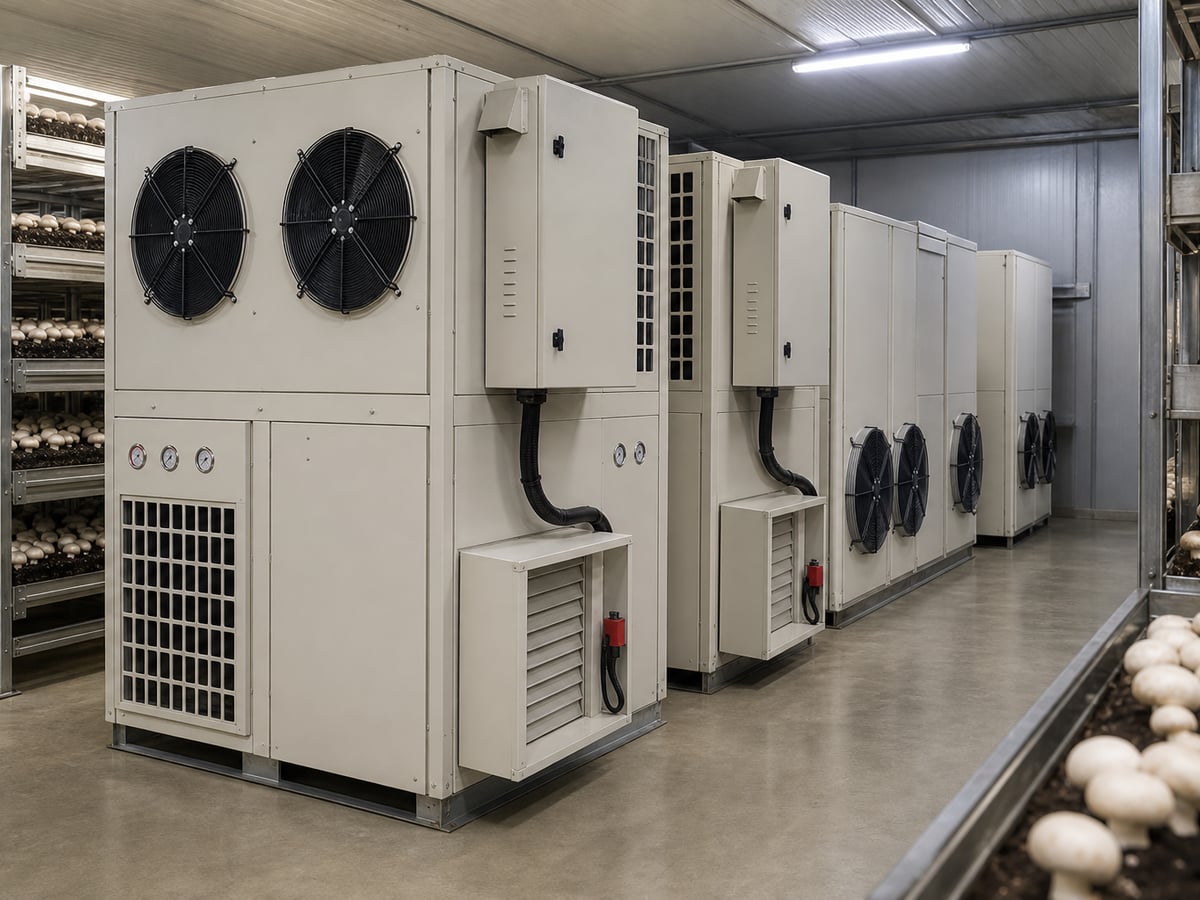
For Global Market buyers, a professional mushroom humidity control system normally combines ultrasonic or high-pressure mist humidification, cooling or heating equipment, ventilation fans, air ducts, sensors, and a programmable controller. Rather than simply adding moisture to the room, the system balances the whole cultivation climate. This reduces drying, condensation, uneven pinning, long stems, cracked caps, bacterial risk, and unnecessary energy use.
The most suitable solution depends on mushroom species, room volume, shelving layout, substrate load, local climate, electrical supply, water quality, and operating model. Small farms may use a compact climate controller with a humidifier and exhaust fan. Larger operations typically require zoned air handling, fresh-air units, dehumidification capability, automated dampers, and remote monitoring.
Lanhu supplies integrated climate solutions for growers, contractors, distributors, and agricultural engineering projects worldwide. Buyers seeking a complete controlled-environment solution can also review the smart mushroom cultivation container range for modular production projects.
What Is Mushroom Humidity Control and Where Is It Used
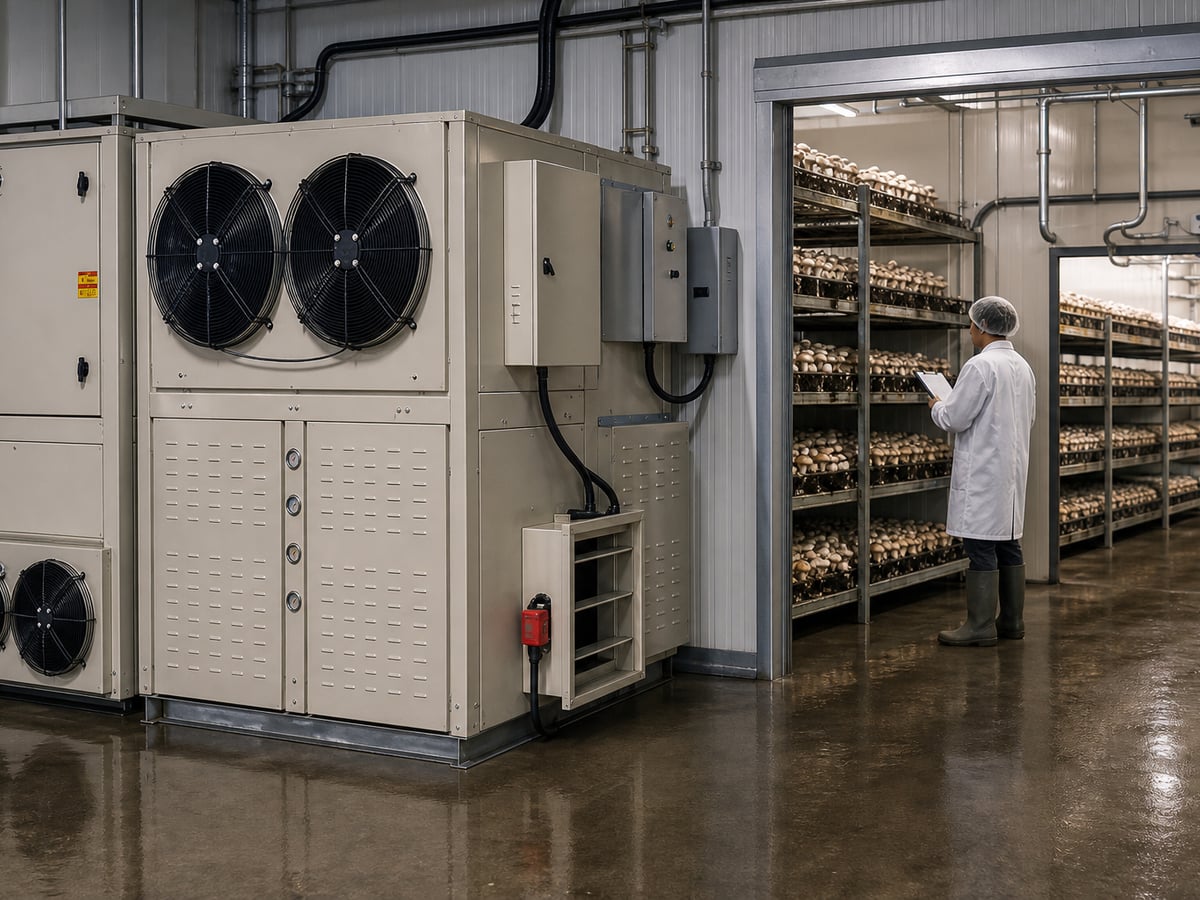
Mushroom humidity control refers to the equipment and operating strategy used to manage water vapor in a cultivation environment. Mushrooms have no protective skin like many field crops, so they respond quickly to moisture loss, excess condensation, poor ventilation, and unstable temperature. Relative humidity is therefore a production variable, not merely a comfort setting.
During incubation, growers may prioritize stable temperatures and lower fresh-air rates. During pinning and fruiting, humidity, carbon dioxide, temperature, and airflow must be coordinated much more carefully. A humidifier without ventilation can produce saturated stagnant air. Strong ventilation without adequate humidification can dehydrate substrate blocks and developing fruit bodies. Effective systems measure conditions continuously and respond in a controlled sequence.
Commercial systems are used in insulated growing rooms, converted warehouses, container farms, prefabricated cultivation cabins, tunnel rooms, mushroom houses, and multi-room farm facilities. They are increasingly installed near major food distribution and logistics hubs, including Rotterdam, Hamburg, Dubai, Singapore, Los Angeles, Melbourne, São Paulo, Johannesburg, and ports serving regional produce markets.
| Application Environment | Typical Use | Climate Control Priority | Recommended System Approach |
|---|---|---|---|
| Small mushroom room | Trial production or local farm sales | Stable humidity and simple ventilation | Compact controller, humidifier, exhaust fan, sensors |
| Commercial fruiting room | Daily harvest production | Uniform air distribution and CO2 management | Integrated HVAC, misting, fresh air, ducts, PLC control |
| Container mushroom farm | Modular urban or remote farming | Insulation, automation, compact installation | Pre-engineered climate unit with remote monitoring |
| Warehouse conversion | Expanded regional production | Zoning and energy efficiency | Multiple air handling zones and central controls |
| Research facility | Variety trials and process development | Precise repeatability and data logging | High-accuracy sensors and programmable recipes |
| Spawn or substrate facility | Preparation and incubation support | Temperature stability and contamination reduction | Filtered ventilation and controlled cooling/heating |
The table shows why system selection should begin with the production environment rather than a single humidity target. The room’s function, crop stage, and operational scale determine the correct equipment combination.
Standard Product Configuration and System Boundaries
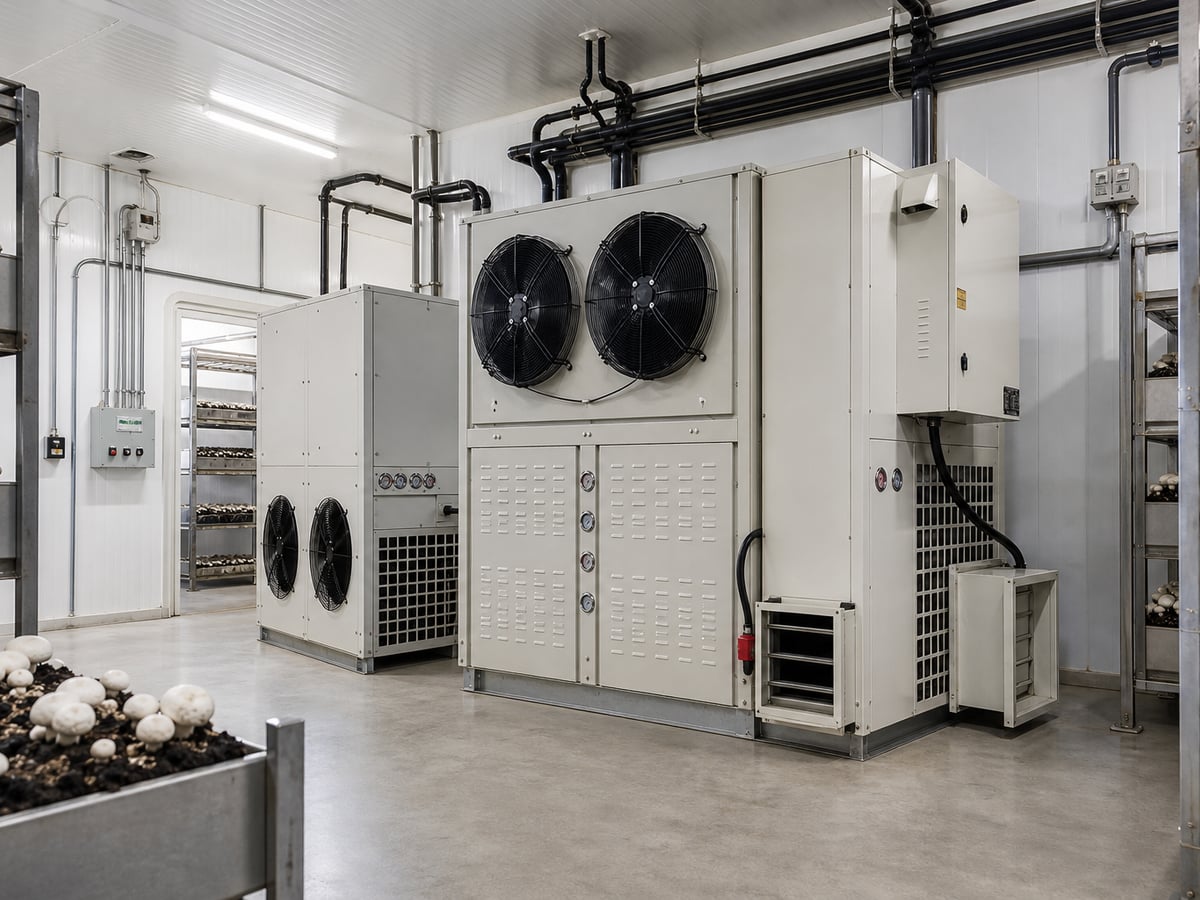
A standard mushroom humidity control package is designed to regulate the growing-room environment, but its exact boundary should be confirmed before ordering. A typical package includes a climate controller, temperature and humidity sensors, carbon dioxide sensor, ventilation fan control, humidification control, cooling or heating output, electrical cabinet, and basic alarms. Depending on project requirements, the system may also include air ducts, circulation fans, air filtration, damper actuators, refrigeration components, heat pump equipment, water treatment, and cloud access.
For a complete cultivation project, the system boundary usually starts at the electrical supply, water inlet, fresh-air intake, and room interface. Civil works, drainage construction, building insulation, external power transformers, water storage, and local permits may be outside the standard equipment scope unless included in the contract. Clear boundaries reduce installation delays and help international buyers compare quotations accurately.
Humidity control can be provided through ultrasonic atomization, high-pressure atomization, wet-pad systems, or specially configured air-handling equipment. The choice depends on room size, water quality, droplet requirements, hygiene expectations, and ambient climate. In hot and humid coastal areas, dehumidification and fresh-air strategy can be as important as humidification. In dry inland regions, larger water supply capacity and insulated ducting may be required.
| Standard Component | Primary Function | Common Inclusion | Buyer Checkpoint |
|---|---|---|---|
| Climate controller | Coordinates all operating equipment | Standard | Confirm language, recipes, and output capacity |
| Temperature/RH sensor | Measures air conditions | Standard | Check placement and calibration access |
| CO2 sensor | Controls fresh-air exchange | Usually included | Confirm measurement range and maintenance plan |
| Humidification unit | Adds controlled moisture | Project dependent | Match output to room volume and climate |
| Ventilation fans | Removes stale air and heat | Standard or optional | Verify static pressure and noise limits |
| Cooling/heating module | Maintains temperature setpoint | Optional or integrated | Confirm ambient design conditions |
| Air ducts and diffusers | Distribute conditioned air | Project dependent | Review layout for rack-level uniformity |
This configuration list is a practical comparison tool. A low initial quotation may exclude components that are essential for stable production, such as ductwork, water filtration, remote access, or commissioning support.
Capacity, Dimensions, and Utility Requirements
Capacity is normally determined by growing-room volume, insulation quality, number of cultivation racks, substrate mass, outside temperature, crop heat load, and target air-change rate. A humidity control system for a 30 m² room cannot be selected only by floor area; room height, shelving density, fresh-air demand, and local seasonal conditions significantly influence sizing.
For example, a compact cultivation room may require modest humidification output but frequent air exchange during heavy fruiting. A larger room may need several distribution zones so that the first and last racks receive similar humidity and temperature. In high-temperature regions, cooling capacity should account for solar gain, lighting, worker access, fresh-air load, and heat released by substrate metabolism.
Common electrical options include 220–240 V single phase and 380–415 V three phase, with 50 Hz or 60 Hz configurations available for export projects. Water quality should be evaluated before finalizing atomization equipment. Hard water, high mineral content, or untreated well water can block nozzles, damage ultrasonic components, and leave residue on surfaces. A filtration, softening, or reverse-osmosis recommendation may be appropriate.
| Planning Item | Typical Range or Requirement | Why It Matters | Information Needed From Buyer |
|---|---|---|---|
| Room volume | Calculated in cubic meters | Determines airflow and humidification sizing | Length, width, height, rack arrangement |
| Humidification output | Selected according to load and ventilation | Prevents dry substrate and unstable RH | Species, room temperature, local dryness |
| Cooling capacity | Based on total thermal load | Protects fruiting quality in warm weather | Outdoor design temperature and insulation data |
| Fresh-air volume | Adjusted by crop stage and CO2 target | Controls morphology and air quality | Production cycle and expected biomass |
| Electrical supply | Single or three phase, 50/60 Hz | Ensures compatible motors and controls | Voltage, phase, breaker capacity |
| Water supply | Filtered water with adequate pressure | Protects humidification components | Water analysis and inlet pressure |
| Drainage | Floor slope and condensate discharge | Reduces standing water and hygiene risks | Drain location and local construction plan |
The figures in this table are planning variables rather than fixed product ratings. A supplier should calculate equipment capacity after reviewing site data, crop requirements, and the buyer’s preferred operating method.
Temperature, Humidity, CO2, Airflow, and Control Performance
Humidity performance should always be evaluated together with temperature, carbon dioxide, and air velocity. Relative humidity changes when air temperature changes, so a controller must coordinate cooling, heating, humidification, and ventilation instead of switching them independently without logic.
Many fruiting programs operate within approximately 80% to 95% relative humidity, but the optimum range varies by mushroom species and growth stage. Oyster mushrooms often need high humidity during pinning and fruit development, while excessive surface wetness can still cause quality problems. Shiitake, lion’s mane, button mushrooms, and enoki each require crop-specific environmental recipes. Growers should treat published ranges as starting points and validate them through crop observation.
CO2 control is equally important. High CO2 may be desirable during some stages, while fruiting often requires more fresh air. Inadequate fresh-air exchange can lead to long stems, small caps, distorted shape, or slow development. Excessive air speed can dry mushrooms or substrate surfaces. Well-designed ducting uses low-velocity, distributed airflow to minimize dead zones and direct drafts.
| Control Variable | Typical Fruiting Objective | Risk When Too Low | Risk When Too High |
|---|---|---|---|
| Temperature | Species-specific stable setpoint | Slow growth or poor pin formation | Heat stress, weak quality, contamination pressure |
| Relative humidity | Moist air without persistent condensation | Cracking, drying, reduced yield | Bacterial issues, wet caps, surface condensation |
| CO2 concentration | Controlled according to crop stage | Over-ventilation and moisture loss | Long stems, deformed fruit bodies, slow development |
| Air velocity | Gentle and even rack-level movement | Stagnant zones and uneven climate | Direct drying and edge effects |
| Fresh-air rate | Enough oxygen and CO2 removal | Stale air and morphology defects | Higher cooling and humidification demand |
| Sensor accuracy | Reliable feedback for automation | Delayed corrective action | Incorrect equipment cycling and crop inconsistency |
This table highlights that there is no single “best” humidity number for all farms. Stable, evenly distributed conditions and crop-specific control logic are more valuable than chasing an isolated setpoint.
Core Components, Materials, and Protection Features
Commercial mushroom growing rooms are high-moisture environments, so material selection directly affects reliability. Electrical enclosures should be suitable for humid operating conditions, cable entries should be sealed, and metal components should be selected or coated for corrosion resistance. Stainless steel, galvanized steel with protective coatings, aluminum components, insulated panels, food-oriented plastics, and moisture-resistant wiring practices are commonly used according to the system area and budget.
Key climate equipment may include EC or centrifugal fans, axial exhaust fans, refrigeration coils, heat exchangers, humidification nozzles, ultrasonic humidifier modules, water pumps, solenoid valves, dampers, filters, PLCs, touch-screen interfaces, and sensor probes. The equipment should be accessible for cleaning and replacement because mushroom operations require regular hygiene management.
Protection features may include overload protection, phase-loss protection, circuit breakers, leakage protection, high-pressure and low-pressure refrigeration alarms, water-shortage protection, anti-freeze logic, fan delay, sensor fault alarms, emergency stop functions, and data backup. For export systems, buyers should confirm electrical component brands, certification needs, spare-parts availability, and compatibility with local maintenance practices.
Automation, Remote Monitoring, and Customization Options
Automation allows growers to run repeatable climate recipes across multiple rooms, shifts, or sites. A modern mushroom climate controller can receive signals from temperature, humidity, and CO2 sensors, then automatically manage cooling, heating, humidification, fresh-air fans, circulation fans, dampers, and alarm outputs. Timed ventilation and staged control are useful, but sensor-based control is usually more responsive to crop and weather changes.
Remote monitoring gives farm managers access to live operating data, historical trends, alarms, and parameter changes through a computer or mobile device when network conditions permit. This is particularly valuable for farms serving distant markets or operating multiple production sites. For example, an operator near Dubai can monitor a container farm placed at a desert logistics hub, while a technical team can review alarms before a climate deviation affects a full harvest cycle.
Customization options can include controller language, enclosure size, power configuration, climate recipes, sensor count, remote communication method, duct layout, humidification method, refrigeration capacity, heat-pump integration, filtration level, container installation, branding, and OEM or ODM design. Buyers who need a private-label system or special engineering layout can explore Lanhu’s OEM and ODM customization services.
| Automation Option | Operational Value | Suitable User | Customization Example |
|---|---|---|---|
| Preset climate recipes | Reduces manual adjustment errors | Multi-species growers | Separate programs for oyster and shiitake |
| Touch-screen HMI | Provides simple local operation | Commercial farms | Custom menu language and permissions |
| Remote cloud monitoring | Supports off-site supervision | Multi-site operators | Mobile alarms and trend reports |
| CO2-linked ventilation | Improves fresh-air efficiency | High-density fruiting rooms | Stage-based CO2 thresholds |
| Variable-speed fan control | Improves airflow precision and energy use | Premium facilities | Rack-zone airflow scheduling |
| Data logging | Supports troubleshooting and quality records | Export-oriented farms | Downloadable production reports |
| Alarm notifications | Shortens response time to failures | Unattended or remote farms | High temperature and water shortage alerts |
The automation choices above can be phased in according to budget. A reliable basic controller is often the right starting point, while data logging, cloud connectivity, and variable-speed equipment add value as operational scale increases.
Installation, Commissioning, Maintenance, and Warranty
Proper installation begins with a reviewed layout. Equipment locations should support service access, drainage, airflow distribution, electrical safety, and stable sensor readings. Sensors should not be installed directly in mist streams, beside cold coils, at door openings, or in concentrated exhaust paths. Duct outlets should avoid direct airflow onto fruiting bodies, while return-air paths should prevent stagnant corners.
Commissioning should include electrical verification, rotation checks for fans, water-line inspection, drainage testing, sensor validation, humidification output checks, refrigeration or heating function checks, alarm testing, and trial operation under expected load. The control parameters should then be adjusted according to the mushroom species and actual room behavior. A well-commissioned system is more likely to achieve consistent shelf-to-shelf conditions.
Routine maintenance typically includes cleaning filters, inspecting nozzles or ultrasonic modules, checking water treatment equipment, cleaning drain lines, verifying fan condition, reviewing sensor readings, inspecting electrical terminals, and monitoring refrigeration performance. The maintenance interval depends on water quality, operating hours, dust conditions, and local climate.
Warranty terms should be confirmed in the purchase agreement. Buyers should clarify coverage duration, excluded consumables, remote troubleshooting procedures, spare-parts lead times, freight responsibility, and required documentation. For international projects, photos, videos, wiring diagrams, controller manuals, and remote video support can substantially simplify after-sales service.
Lanhu provides factory-direct technical support, engineering communication, spare-parts assistance, installation guidance, and international logistics coordination. For project discussions, drawings, or quotation requests, buyers can contact the team through the mushroom climate control inquiry page.
Our Company
Shandong Lanhu Air Conditioning Equipment Co., Ltd. is a China-based manufacturer serving the Global Market with agricultural climate control equipment, industrial HVAC solutions, and modular cultivation systems. Its work is focused on helping farms build controlled environments that are practical to operate, maintain, and scale.
Technological capabilities: Lanhu has more than 12 years of thermodynamic research and development experience and more than 45 registered patents. Its engineering team develops climate control solutions for mushroom growing rooms, smart cultivation containers, hydroponic plant containers, and air source heat pump applications. Equipment parameters can be adapted to crop type, regional climate, room dimensions, electrical standards, and automation needs. Buyers can review the smart mushroom climate controller for an overview of integrated environmental management options.
Manufacturing capabilities: The company operates a modern manufacturing facility of more than 30,000 square meters in Dezhou, Shandong. Internal capabilities include product design, engineering development, sheet metal fabrication, CNC bending, insulation-panel production, electrical assembly, system integration, equipment testing, and quality inspection. Functional inspection, electrical verification, performance testing, and operational evaluation are completed before shipment. The company holds ISO 9001, ISO 14001, ISO 45001, and ISO 12100 certifications.
Service capabilities: Lanhu supports agricultural contractors, distributors, engineering companies, and commercial farms with factory-direct supply, OEM and ODM services, project engineering assistance, export logistics support, installation guidance, spare-parts planning, and after-sales coordination. For buyers comparing practical applications, the company’s mushroom cultivation project cases provide examples of controlled-environment farming configurations.
For Global Market projects, Lanhu can help evaluate shipping routes through major Chinese export gateways such as Qingdao Port, Tianjin Port, Shanghai Port, and Ningbo-Zhoushan Port, while aligning packaging and documentation with destination requirements.
FAQ
What humidity is normally required for mushroom fruiting?
Many species fruit within roughly 80% to 95% relative humidity, but the correct target depends on species, strain, crop stage, temperature, airflow, and room design. Use crop-specific recipes and adjust based on observed mushroom quality.
Can a normal household humidifier control a commercial mushroom room?
Usually not. Household units generally lack sufficient output, durable construction, sensor integration, airflow coordination, drainage design, and control logic for commercial production. They may be useful only for very small trials.
Why does humidity remain low even when the humidifier is running?
Common causes include excessive fresh-air volume, high room temperature, insufficient humidifier capacity, air leaks, poor insulation, blocked nozzles, incorrect sensor placement, or dry outdoor conditions. The full climate balance should be checked.
Why is condensation forming on walls or mushroom caps?
Condensation can occur when humid air contacts cold surfaces, when cooling is too aggressive, when airflow is uneven, or when humidity is set too high. Improve insulation, air mixing, dew-point management, and control sequencing.
Does a mushroom farm need CO2 control?
Yes. CO2 strongly affects mushroom morphology and fresh-air demand. A CO2 sensor and ventilation logic help maintain more consistent fruiting quality and reduce unnecessary ventilation.
What information is needed to request a quotation?
Provide mushroom type, room dimensions, rack layout, location, outdoor temperature range, insulation details, power supply, water source, target capacity, preferred automation level, and whether cooling, heating, ducts, or container installation are required.
What are the key trends for 2026?
In 2026, mushroom climate control is expected to move further toward sensor-driven automation, cloud-based production records, energy-efficient EC fans, heat pump integration, water-saving humidification, modular farms, predictive maintenance, and lower-carbon refrigeration choices. Sustainability policies, water-use requirements, energy reporting, and food-traceability expectations are also encouraging growers to use more measurable and efficient environmental control systems.
Share this article

About the Author: Shandong Lanhu Air Conditioning Equipment
Lanhu is a professional climate control equipment manufacturer specializing in smart agricultural systems, commercial HVAC solutions, and customized temperature control technologies. With extensive engineering experience, Lanhu provides reliable solutions for plant factories, controlled environment agriculture, and industrial applications.
Need a Custom Climate Control Solution?
From smart agricultural systems to commercial HVAC solutions, Lanhu provides reliable temperature and humidity control solutions tailored to your project needs.
Contact Us